Turning Inward, Opening Outward
I’ve been caught in a strange oscillation lately. Some days I want to fix the world, build something new, lay one more brick onto what has…
Photo by Randy Jacob on Unsplash — The Quiet Corner —
Turning Inward, Opening Outward
I’ve been caught in a strange oscillation lately. Some days I want to fix the world, build something new, lay one more brick onto what has been collectively built and leave a bit of myself in it. Other days it’s the reverse: the noisier and more tangled things get outside, the further I pull inward — toward reading, toward thinking, toward a kind of silence.
For a long while I put this down to my own moodiness. But I’m no longer sure that’s it. In Peter Watson’s enormous book (Ideas: A History of Thought from Fire to Freud — a book I’d kept on the shelf for years and somehow never reached for unitl now) I came across the idea that this swing might have nothing to do with my changeable temper, and everything to do with what our species has been doing for three million years. A radical thought maybe, but one worth examining.
Watson calls these the “inward turn” and the “outward turn.” His huge book (eleven hundred and fifty-two pages, a thing you struggle even to carry) is an unusual history narrative: it moves through the ideas that have shaped civilizations rather than the kings and battles.
Reading the whole of it, let alone summarizing it, is nearly impossible — but it left me with one simple suspicion: what if humanity isn’t progressing so much as swinging back and forth? Today, starting from my own private oscillation, I want to think out loud about that larger one. And I’ll be honest: underneath it all there is a Marxist reading here — alienation (a person’s loss of control over their environment or the order they’ve built), collective labor, mode of production, and the rest of that vocabulary. Anyone who reads and thinks drifts toward Marx now and then, I suspect, and then drifts away again.
Not progress, but a pendulum
The story we’re used to goes like this: we left the cave, found fire, invented the wheel, built the laboratory — a straight climb from darkness into light. Watson’s doubt is aimed precisely at that arc. To him, history isn’t a straight line. It behaves more like a pendulum, swinging between two directions: outward and inward.
The outward turn is the move to take the world in hand. Inventing tools, farming, engineering the landscape, channeling water, turning swamp into field, and finally industrializing the planet. Our hardware develops on these swings: security, surplus, physical infrastructure. The material side of staying alive.
The inward turn looks the other way. When the outside becomes chaotic, hierarchical, or suffocating, a person withdraws into themselves — into the soul, the conscience. This line, running from the Paleolithic shaman’s ritual to the individual conscience of the Reformation (the social rupture that came with the breaking of the Catholic Church in the late Middle Ages), is really a kind of defense. Against what? Against alienation — that deep helplessness we feel when our grip on our own world begins to slip. When the material world slides out of our hands, we go looking inside for an order, an escape, a space of freedom.
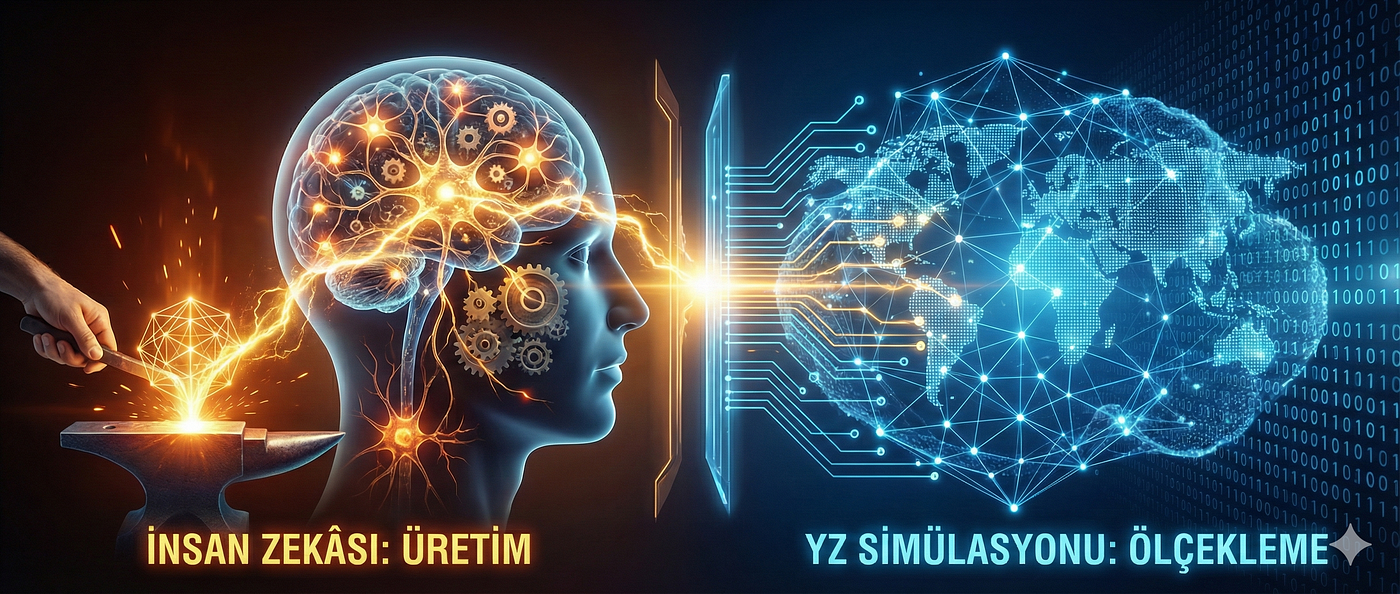
The lovely part is that neither one is enough on its own. The outward turn produces the hardware of existence; the inward turn produces the software that makes living with that hardware possible — culture, meaning, conscience. Hardware won’t run without software, and software has nothing to run on without hardware. Civilization, for Watson, is born of the tension between these two poles.
Lucy’s first step
If you’re wondering where this oscillation comes from, the answer isn’t in theory but in the red earth of the Afar Depression in Ethiopia. Roughly 3.2 million years ago, an archaic ape called Australopithecus afarensis began walking the savannah. Lucy — about 1.1 meters tall, a female whose skeleton survives some forty percent intact — is the biological spark of this story. Her brain is still small, her arms still long; but she carries a revolution: she walks on two legs.
The shift to upright walking seems to have been a response to the climate change of her day; as forests retreated and grasslands spread, those who could cover more ground survived. But the consequences of that shift didn’t stop at walking. Once the hands were freed from the work of locomotion, the body became the stage for a kind of conflict: the dialectic between hand and brain. The hand became the surface that touched the material world — the outside. The brain, forced to manage all this new complexity, had to grow into a high-capacity processor — the inside.
Forgive the analogy, but let’s look at the brain as a kind of processor. It’s an expensive one. The modern human brain is only about 2% of body weight, yet it devours 20% of the body’s energy. And that large skull created a separate crisis in a body built for upright walking: childbirth grew harder, infant mortality rose. Even so, the gamble counts as a success. The large brain let cultural evolution outrun biological evolution. While other species stay trapped in their ecological niches, we became the one species adapted to adapt.
The first great outward push
The first great outward turn arrives with the burst we call the Upper Paleolithic. For a million and a half years Homo erectus (upright man) carried the same stagnant toolkit — basically a single hand-axe, a general-purpose cutter. But with Homo sapiens, coming out of Africa some 85,000 years ago, the pace turns into a cultural arms race. The environment is no longer a mysterious force to be feared but a series of problems to be solved by technical wit.
Sites like Boxgrove in Sussex (500,000 years old) or Lynford in Norfolk (a 60,000-year-old mammoth butchery site) show this growing mastery. At Boxgrove, some 300 hand-axes were used to butcher horse, deer, and rhinoceros. By the Upper Paleolithic, things had evolved into the production of blades — stone tools far longer than they are wide, struck in near-serial fashion from a prepared core, so that the same lump of stone yields many times more cutting edge.
Let me give an example from Anatolia, since I’m Turkish and the record here is richer than most readers expect. Take Kaletepe Deresi 3 (Niğde, on the slopes of Göllü Dağ): the only site in Turkey with hand-axes found in situ, holding the country’s longest open-air Paleolithic sequence — more than seven meters deep — and the first Acheulean (hand-axe) industry documented in Anatolia. Its richest layer yielded bifacial and unifacial hand-axes of obsidian, along with obsidian flake cleavers. If you want a concrete image to set beside Boxgrove’s 300 axes, those obsidian blades will do the job. Or take Üçağızlı Cave (Hatay), which holds an early Upper Paleolithic sequence dated to roughly 41,000–29,000 years ago: the 1999–2002 excavations turned up more than 30,000 stone artifacts, and right around the boundary of layers E and F you can watch blade production shift from hard-hammer to soft-hammer percussion. A whole technological transition, readable in a single cave.
This swing had three layers to it.
First, the experimentalization of toolmaking: from the dozens of points and scrapers in the Neanderthal kit, to the Aurignacian blades of sapiens; to the harpoon, the spear-thrower, and finally the bow and arrow.
Second, adaptation to environment: the Neanderthal was biologically tuned to the cold — short, stout body, broad nose — whereas the same species that we are invented the needle and thread to sew clothing, and used fire to cook and to keep safe.
Third, collective labor and global spread: the descendants of a single band of hunter-gatherers that left Africa 85,000 years ago covered the planet within three thousand generations, from Arctic tundra to tropical forest. What made it possible were the forty-meter timber long-houses that demanded the joint labor of an entire lineage.
This first outward turn made Homo sapiens the dominant species not through brute strength but through the ability to organize planned collective labor. And yet this masterful seizing of the outside led to a crisis no invention could solve: the crisis of success.
The birth of the inward turn: alienation
The Neolithic Revolution (roughly 10,000 BCE) changed the mode of production at the root. As the earth warmed and the herds of mammoth and wild horse vanished, humanity was all but pushed into farming. Don’t underestimate it: farming is hard work. Clearing the soil, weeding, sowing, and then living with the constant dread of exhausted land and drought.
The shift from a primitive communism — where resources were shared and there were no “social parasites” (in Marxist terms, a layer that lives without producing, off the labor of others: the ones who don’t hunt or plow but live on the surplus others make — chiefs, priests, warlords, then landlords, and later the owners of capital) — to organized agriculture produced the first systemic problems. Population thickened, resources grew scarce, and the very idea of organized war was born. History keeps bloody snapshots of this transition: the Talheim death pit in southwestern Germany, for one. Thirty-four people killed by blows to the head or arrow wounds — seventeen of them children — dumped into a three-meter pit. This massacre, around 5000 BCE, marks the end of peaceful hunter-gatherer life and the rise of warlords — a figure that, in a different guise, is still with us today.
The inward turn is a psychological answer to this new reality — to violence, hierarchy, the lost grip on nature. When technical solutions run dry and social crisis becomes permanent, the human animal turns toward religion and alienation.
Here the difference between Paleolithic “magic” and Neolithic “religion” is crucial. Magic is really the beginning of the outward turn. For the hunter, drawing a mammoth on the cave wall was an attempt to “summon” the future symbolically — scientifically wrong, but effective in its way. An attempt, in a sense, to control reality. Religion, by contrast, is a deep withdrawal inward. Once humans understood they couldn’t command the Sun, the Moon, the Earth Mother with simple rituals, they began to pray and to sacrifice. Religion became the social glue holding the tribe together in a world splitting into classes.
The period we call the Axial Age — Karl Jaspers’s term for the window around 800–200 BCE when, across China, India, Persia, Israel, and Greece, thought turned almost at once toward ethics, conscience, and abstraction — is the peak of this inward turn. In a world of exhausted soil and roving warlords, it was an effort to build, on the inside, the order that had collapsed outside.
The pendulum doesn’t stop
The rest is the same rhythm repeating. In the Middle Ages the inward turn becomes the dominant cultural force. We moved from appeasing the gods outside to wrestling with the inner state of the soul. The Reformation is the extreme of this: it shifted the seat of truth from the external hierarchy of the Church to the individual conscience. Instead of taller cathedrals (the outward monumentalism of the Middle Ages), it explored the interior landscape of faith. It may well have laid the conceptual ground for the modern idea of individual liberty.
Then the pendulum swings back. Pure introspection can’t solve everything: it won’t cure the plague, won’t feed a swelling population. So came the Renaissance, the voyages, and the great outward opening of industry. Metallurgy is the key here — stone is shaped only by chipping away, and once it breaks it’s refuse; metal is melted, mixed, poured into endless forms. In Sumerian city-states like Lagash, canals and dams replaced “yelling at the gods” with “engineering the environment.” The wheel, the sail, and at last the steam engine, mass production, the factory. The peak of the logic of specialization. An age of materialism, where success was measured by dominion over nature.
But no outward turn, however successful, satisfies the soul forever. The cold, mechanical world of industry inevitably triggers a fresh inward turn: Romanticism. And that line reaches its summit with Freud, who moved the field of exploration from the African savannah to the inner landscape of the self. There’s a startling rhyme here: for the Paleolithic mind, symbolic shapes were reality itself. Freud took us right back there — our dreams, our repressed desires, the real ground from which we interpret the world. The horse-hunters of Gough’s Cave shaped their hopes with ritual before the hunt; modern psychoanalysis works the alienation of our high-speed, high-pressure society with symbols of its own.
Where are we now?
The human story is the story of this restless oscillation. The outward turns always handed us material and physical success: the Sumerian fields, the efficiency of stone tools, the global infrastructure of the modern age. Without them we’d have stayed a small, fragile population in the Afar Depression. But the freedoms that make survival meaningful — conscience, individual rights, psychological depth — those came from the inward turns. The inward turn is how we cope with the alienation our own material success produces.
We are, strangely, inside a systemic crisis that resembles the late Neolithic: the exhaustion of the soil (the ecological crisis) and the return of organized war (the return of the warlords). The pendulum looks tensed for its next great swing.
Our future, I think, depends on whether we can synthesize these two turns — whether our material mastery over the planet (the outside) can be balanced by a deep inner understanding of our own humanity (the inside). For that, we have to remain the species that keeps “talking, thinking, arguing” — endlessly questioning, interpreting, making mistakes and then learning from them and carrying on. Only that way can we continue the strange journey that began with Lucy’s first upright step.
Trying to read my own small oscillations, this perspective brought me a measure of relief. And not being entirely relieved may be the only way forward.
Yalçın Arsan — June 2026
메타데이터
- post_id
- 93203721c14a
- slug
- turning-inward-opening-outward-93203721c14a
- url
- https://medium.com/the-quiet-corner/turning-inward-opening-outward-93203721c14a
- canonical_url
- https://medium.com/the-quiet-corner/turning-inward-opening-outward-93203721c14a
- author_url
- https://medium.com/@yalcinarsan
- status
- ok
- fetched_at
- 2026-06-20 20:29:01