How are Predictive Analytics and Prediction Markets Connected?
In this Article about How are Predictive Analytics and Prediction Markets Connected? read it out.
How are Predictive Analytics and Prediction Markets Connected?
In this Article about How are Predictive Analytics and Prediction Markets Connected? read it out.
How are Predictive Analytics and Prediction Markets Connected?
Introduction
In today’s data-driven world, businesses, investors, and organizations are constantly searching for better ways to predict future outcomes. Whether it’s forecasting election results, market trends, sports events, or consumer behavior, accurate predictions can provide a significant competitive advantage. This is where Predictive Analytics and Prediction Markets come into play.
While these concepts may seem different at first glance, they share a common goal: helping people make informed decisions about future events. Predictive analytics relies on historical data and advanced algorithms, while prediction markets leverage the collective intelligence of participants. Together, they create a powerful forecasting ecosystem capable of generating more accurate and actionable insights.
What Is Predictive Analytics?
Predictive analytics is the process of using historical data, statistical techniques, artificial intelligence (AI), and machine learning algorithms to forecast future outcomes. Instead of simply analyzing what happened in the past, predictive analytics helps organizations estimate what is likely to happen next.
Businesses use predictive analytics for a wide range of purposes, including:
- Forecasting sales and customer demand
- Identifying market trends
- Assessing business risks
- Detecting fraud and unusual activities
- Improving operational efficiency
For example, an e-commerce company may analyze previous purchasing patterns to predict which products will be in high demand during an upcoming season. Similarly, financial institutions use predictive analytics to assess market movements and investment risks.
The effectiveness of predictive analytics largely depends on the quality of data and the accuracy of the models being used.
What Are Prediction Markets?
Prediction markets are platforms where participants trade contracts based on the outcome of future events. The market price reflects the collective belief about the probability of a particular event occurring.
For example, if a prediction market estimates a 75% chance that a sports team will win a championship, the market price will generally reflect that probability.
Unlike traditional forecasting methods that depend on a small group of experts, prediction markets gather insights from a large number of participants. Every trader contributes information, opinions, and analysis through their buying and selling decisions.
As new information becomes available, market prices adjust in real time, creating a dynamic forecasting mechanism that continuously evolves with changing circumstances.
The Connection Between Predictive Analytics and Prediction Markets
Predictive analytics and prediction markets approach forecasting from different directions, but they complement each other exceptionally well.
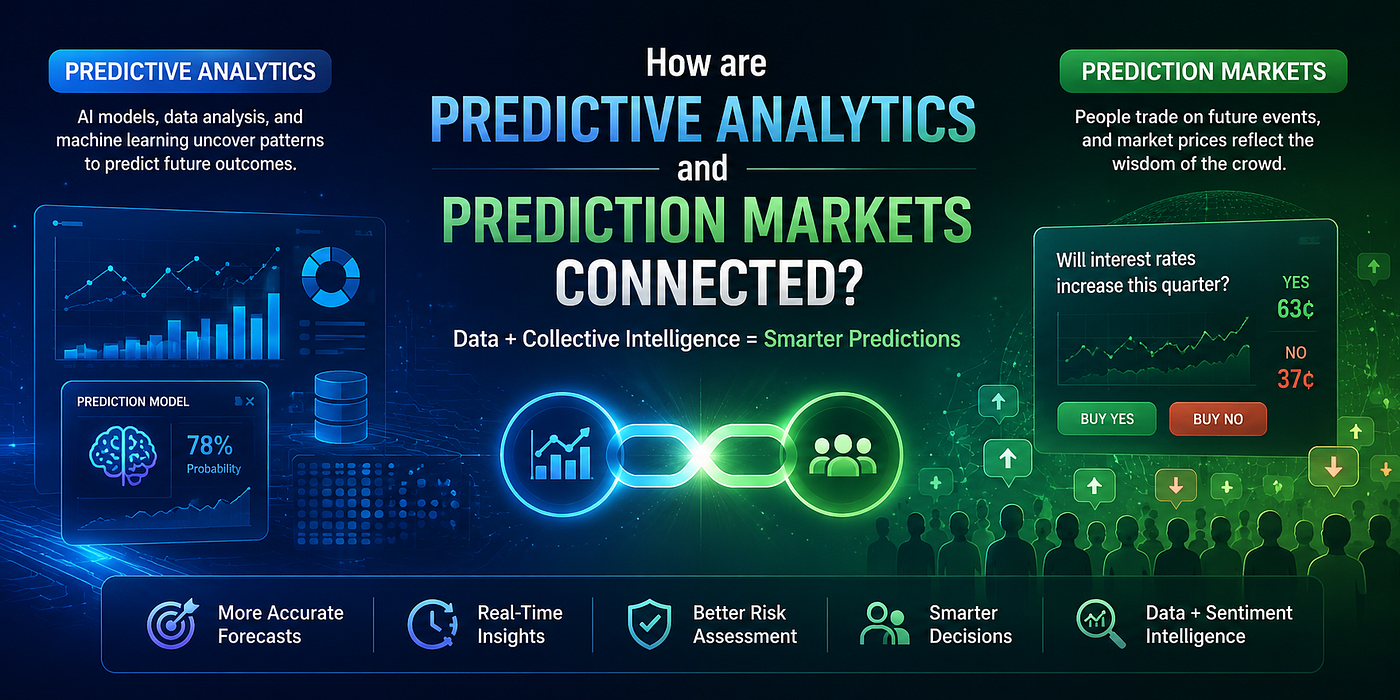
Predictive analytics focuses on data-driven forecasting, while prediction markets focus on crowd-driven forecasting.
Key Benefits of Combining Predictive Analytics and Prediction Markets
- Improved Forecast Accuracy
- Real-Time Adaptability
- Better Decision-Making
- Enhanced Risk Assessment
- Greater Transparency
- Reduced Bias
How Does Predictive Analytics Work in Prediction Markets?
Predictive analytics plays an increasingly important role in modern prediction market platforms.
Data Collection: The system gathers information from various sources, including historical events, financial data, news reports, social media activity, and market behavior.
Pattern Recognition: Machine learning algorithms analyze historical patterns to identify factors that may influence future outcomes.
Probability Estimation: Predictive models generate probability scores based on available data, helping users understand the likelihood of specific events occurring.
Market Intelligence: AI-powered tools monitor ongoing market activity and identify emerging trends that may impact predictions.
Sentiment Analysis: Natural language processing (NLP) technology evaluates public sentiment from news articles, forums, and social media discussions.
Continuous Learning: As events unfold and outcomes become known, predictive models learn from previous forecasts and improve future performance.
This integration allows prediction markets to become more intelligent, responsive, and efficient over time.
Real-World Applications Across Industries
- Financial Markets: Helps investors forecast stock prices, economic trends, and interest rate movements.
- Sports Forecasting: Combines historical data and market sentiment to predict match and tournament outcomes.
- Business Strategy: Enables companies to forecast demand, assess risks, and make smarter business decisions.
- Political Forecasting: Provides probability-based insights into elections, policy changes, and geopolitical events.
- Healthcare: Supports forecasting of disease outbreaks, patient demand, and public health trends.
- Technology and Innovation: Helps businesses identify emerging technologies and predict future market adoption trends.
Conclusion
Predictive analytics development and prediction markets development help people to make better predictions about the future. While predictive analytics relies on data, algorithms, and AI-driven insights, prediction markets harness the power of collective intelligence and real-time market sentiment.
When these two approaches work together, they create a powerful forecasting system that combines machine precision with human judgment.
As AI, blockchain technology, and decentralized Prediction platforms continue to evolve, the connection between predictive analytics and prediction markets will become even stronger, helping businesses, investors, and organizations make smarter decisions in an increasingly uncertain world.
메타데이터
- post_id
- 933692c70f0d
- slug
- how-are-predictive-analytics-and-prediction-markets-connected-933692c70f0d
- url
- https://medium.com/@blockchainxmarketing/how-are-predictive-analytics-and-prediction-markets-connected-933692c70f0d
- canonical_url
- https://medium.com/@blockchainxmarketing/how-are-predictive-analytics-and-prediction-markets-connected-933692c70f0d
- author_url
- https://medium.com/@blockchainxmarketing
- status
- ok
- fetched_at
- 2026-07-13 06:23:13