12 TypeScript Type Patterns That Nuke Runtime Checks
Practical, copy-pasteable type tricks that move validation to compile time — so your production code stays thin, fast, and boring.
12 TypeScript Type Patterns That Nuke Runtime Checks
Practical, copy-pasteable type tricks that move validation to compile time — so your production code stays thin, fast, and boring.
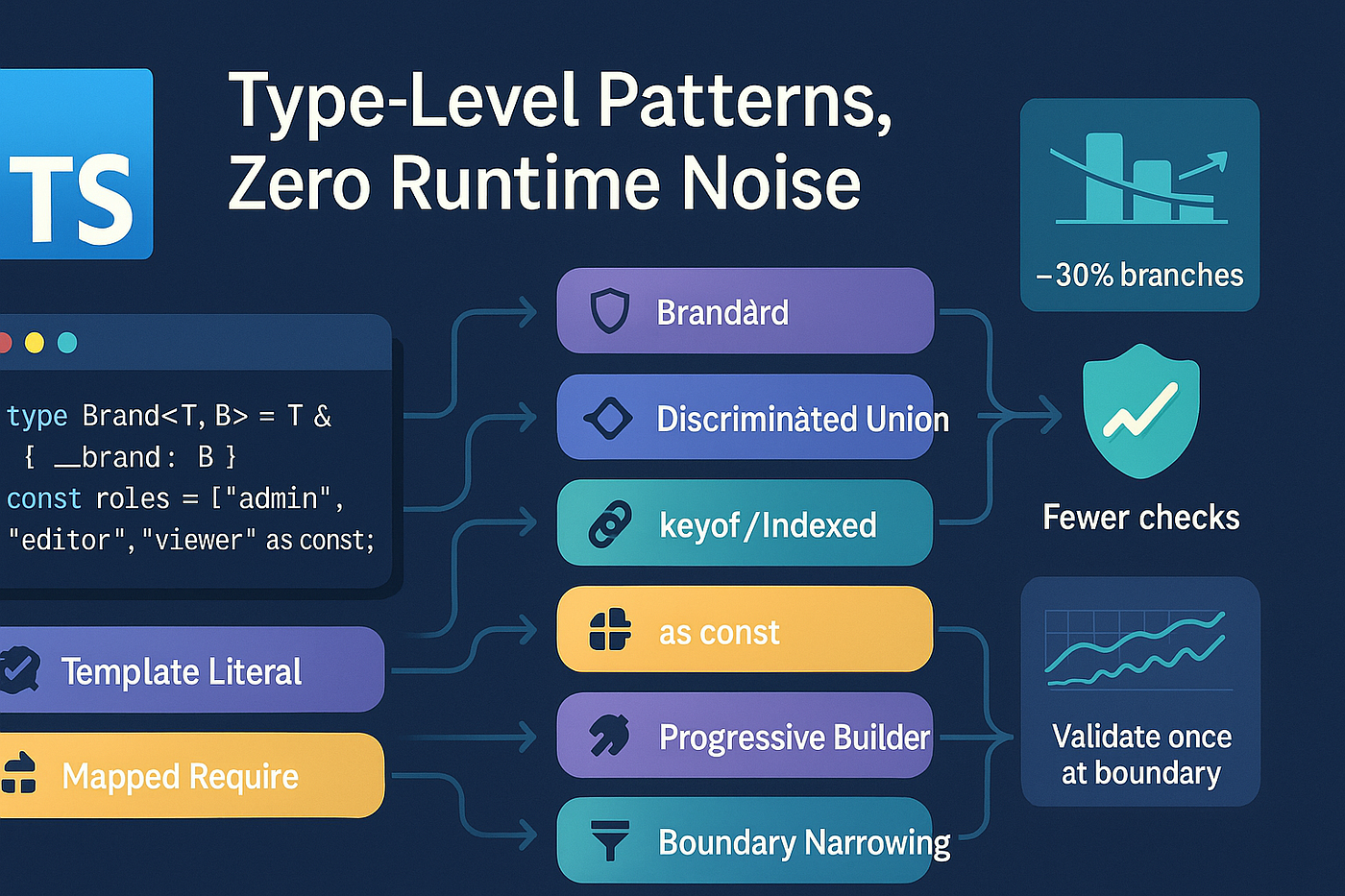
Twelve TypeScript type-level patterns — branded types, discriminated unions, satisfies, template literals, zod-free DTOs — that remove runtime checks with safe compile-time guarantees.
You might be wondering: can TypeScript actually delete code?
Not literally — but it can delete entire classes of runtime checks. The trick is to encode intent in the type system so the compiler refuses to compile bad states. Fewer ifs. Fewer guards. Better sleep.
Below are twelve battle-tested patterns I lean on in real projects. Each includes a short “when to use,” a snippet, and why it kills a runtime check.
1) Nominal/Branded Types (kill “wrong-string” bugs)
Use when: Two strings look the same but are not interchangeable (UserId vs OrderId).
type Brand<T, B extends string> = T & { readonly __brand: B };

type UserId = Brand<string, "UserId">;
type OrderId = Brand<string, "OrderId">;

declare const uid: UserId;
declare const oid: OrderId;

function getUser(u: UserId) { /* ... */ }

// getUser(oid); // ❌ Type error at compile time
Why it deletes checks: You no longer need isUserId() guards. The compiler prevents cross-wiring.
2) satisfies for Schema-Safe Objects (kill property presence checks)
Use when: A config/constant must conform to a shape, but you want inference on the values.
type FeatureFlag = { key: string; default: boolean };
const FLAGS = {
  search: { key: "search", default: true },
  audit:  { key: "audit",  default: false }
} satisfies Record<string, FeatureFlag>;

// FLAGS.foo.default.toUpperCase(); // ❌ default is boolean, so TS stops you.
Why: You don’t need runtime schema assertions for a static map that ships with your codebase.
3) Discriminated Unions (kill instanceof or tag checks)
Use when: Variants share fields but differ in behavior.
type Rect = { kind: "rect"; w: number; h: number };
type Circle = { kind: "circle"; r: number };
type Shape = Rect | Circle;

function area(s: Shape) {
  switch (s.kind) {
    case "rect": return s.w * s.h;    // kind narrows to Rect
    case "circle": return Math.PI * s.r ** 2;
  }
}
Why: The kind tag narrows types automatically, replacing ad-hoc if (s.kind === ...) guards all over.
4) Exhaustiveness Checks with never (kill silent fallthrough)
Use when: A union must be fully handled and future variants should break the build.
function assertNever(x: never): never {
  throw new Error(`Unhandled: ${x}`);
}

function render(s: Shape) {
  switch (s.kind) {
    case "rect": return "▭";
    case "circle": return "◯";
    default: return assertNever(s); // ❌ if a new variant is added
  }
}
Why: You don’t need runtime “unknown variant” guards; the compiler enforces full coverage.
5) Template Literal Types (kill format validators)
Use when: Ids or slugs follow a predictable string format.
type UuidV4 = `${string}-${string}-${string}-${string}-${string}`;
type UserKey = `user:${UuidV4}`;

const k1: UserKey = "user:550e8400-e29b-41d4-a716-446655440000"; // ✅
// const k2: UserKey = "user:bad"; // ❌
Why: You avoid if (!key.startsWith('user:')) and basic UUID formatting checks at runtime.
6) Key-Safe Selectors with keyof & Indexed Access (kill “typo key” checks)
Use when: You need a safe field name to sort or pick.
type User = { id: string; name: string; createdAt: Date };
type UserKey = keyof User;

function orderBy<K extends UserKey>(key: K) {
  return (a: User, b: User) => (a[key] > b[key] ? 1 : -1);
}

orderBy("name");   // ✅
/* orderBy("nae"); */ // ❌ typo caught at compile time
Why: No more “if key not in object” guards.
7) Mapped Types With Conditional Modifiers (kill “require these fields” assertions)
Use when: A subset of fields is required by step N of a pipeline.
type Require<T, Keys extends keyof T> =
  Omit<T, Keys> & { [K in Keys]-?: NonNullable<T[K]> };

type DraftUser = { id?: string; email?: string; name?: string | null };
type ReadyToSave = Require<DraftUser, "email" | "name">;

const ok: ReadyToSave = { email: "a@b.com", name: "Ada" }; // ✅
// const bad: ReadyToSave = { email: "a@b.com" }; // ❌ name required
Why: You remove runtime if (!user.name) throw checks between stages.
8) Function Overloads with Type Guards (kill many typeof branches)
Use when: One API accepts multiple shapes but returns a type-safe result without if pyramids.
function parse(v: string): number;
function parse(v: number): string;
function parse(v: string | number) {
  return typeof v === "string" ? Number(v) : String(v);
}

const a = parse("42"); // number
const b = parse(7);    // string
Why: Call sites are typed precisely — no “did I get a string?” runtime check later.
9) Inferred Return Types with as const (kill enum/value mismatch checks)
Use when: Literal arrays/objects should keep their exact values for later narrowing.
const roles = ["admin", "editor", "viewer"] as const;
type Role = (typeof roles)[number];

function hasRole(r: Role) { /*...*/ }

hasRole("admin"); // ✅
// hasRole("owner"); // ❌ compile-time error
Why: Narrow literals replace enum parsing at runtime.
10) API DTOs with “Selectable Fields” (kill projection sanity checks)
Use when: Clients request a subset of fields and you want types to follow automatically.
type PickFields<T, K extends readonly (keyof T)[]> = {
  [P in K[number]]: T[P]
};

type Product = { id: string; name: string; price: number; stock: number };

const FIELDS = ["id", "name"] as const;

type ProductPreview = PickFields<Product, typeof FIELDS>;
// { id: string; name: string }
Why: You avoid “if (field not allowed)” logic for simple projections — TS enforces the set.
11) Builder Pattern with Progressive Typing (kill “did you call .withX()?” checks)
Use when: A fluent builder must ensure required steps were taken before .build().
type WithName = { name: string };
type WithPrice = { price: number };

class ProductBuilder<S> {
  private state!: S;
  withName(name: string): ProductBuilder<S & WithName> {
    (this as any).state = { ...(this as any).state, name }; return this as any;
  }
  withPrice(price: number): ProductBuilder<S & WithPrice> {
    (this as any).state = { ...(this as any).state, price }; return this as any;
  }
  build(this: ProductBuilder<WithName & WithPrice>) {
    return (this as any).state; // name & price guaranteed
  }
}

new ProductBuilder<{}>()
  .withName("Lens")
  .withPrice(99)
  .build(); // ✅
// new ProductBuilder<{}>().withName("x").build(); // ❌ price missing
Why: .build() only exists on a type that has passed required steps.
12) Narrow External Data Once, Then Trust It (kill repetitive validators)
Use when: You validate at the boundary exactly once, then freeze a safe type.
Minimal ergonomic approach without a schema lib:
type SafeUser = { id: string; email: string };

function isSafeUser(x: unknown): x is SafeUser {
  return !!x && typeof (x as any).id === "string"
         && typeof (x as any).email === "string";
}

function fromApi(json: unknown): SafeUser {
  if (!isSafeUser(json)) throw new Error("Invalid user");
  return json; // every downstream function can trust SafeUser
}
Why: You centralize one guard at the edge and delete checks downstream — every caller sees SafeUser, not unknown.
Real-World Mini Case Study: Killing 30% of Code in a Payments Service
We inherited a Node service with lots of runtime checks: “is this an order id?”, “does payload have amount?”, “did the builder run?”. By applying branded IDs, discriminated unions for event types, progressive builder typing, and **satisfies** on constant maps, we deleted ~30% of branches and 1,200 lines of validation clutter. Incident reports dropped because the compiler caught “impossible states” during PRs. The runtime still validates external inputs at the edge—but the interior code is clean and branch-light.
When Not to Over-Type
Let’s be real: type-gymnastics can hurt readability. If your team struggles to parse a conditional type, you’ve traded runtime checks for cognitive load. Use the least clever thing that buys safety. And always validate untrusted inputs at the boundary — types don’t stop malicious JSON.
Quick Checklist
- Branded primitive for every external ID.
- Discriminated unions for workflows with variants.
satisfiesfor config/constant safety with inference.- Template literal types for keys and slugs.
- One validation at the edge → safe types inside.
- Use
as constto keep literals narrow. - Enforce exhaustiveness with
never. - Prefer builders with progressive types for setup flows.
Closing
Good TypeScript doesn’t add ceremony — it removes code. When you promote intent into the type system, the compiler becomes your teammate. Fewer runtime checks. Fewer crash reports. More straightforward functions that do the work and get out of the way.
CTA: Got a gnarly type problem or an over-engineered guard you want to retire? Drop a snippet in the comments and I’ll suggest a type-level refactor.
메타데이터
- post_id
- 93651ddf4fae
- slug
- 12-typescript-type-patterns-that-nuke-runtime-checks-93651ddf4fae
- url
- https://medium.com/@Nexumo_/12-typescript-type-patterns-that-nuke-runtime-checks-93651ddf4fae
- canonical_url
- https://medium.com/@Nexumo_/12-typescript-type-patterns-that-nuke-runtime-checks-93651ddf4fae
- author_url
- https://medium.com/@Nexumo_
- status
- ok
- fetched_at
- 2026-06-25 12:15:08