Beyond the Tremor: Why 2026 is Redefining Early-Onset Parkinson’s and Cellular Healing
The dangerous blind spot of early misdiagnosis meets a revolutionary medical breakthrough in engineered enzyme therapy.
Beyond the Tremor: Why 2026 is Redefining Early-Onset Parkinson’s and Cellular Healing
The dangerous blind spot of early misdiagnosis meets a revolutionary medical breakthrough in engineered enzyme therapy.
When we think of Parkinson’s disease, the collective consciousness usually paints a specific picture: an elderly individual navigating severe motor challenges. But medicine is undergoing a massive paradigm shift.
Early-Onset Parkinson’s Disease (EOPD) is forcing a radical rewriting of the neurological playbook. As we push the boundaries of regenerative medicine, we are uncovering a frustrating paradox: the very moment our therapeutic tools become revolutionary, our diagnostic frameworks remain dangerously outdated.
Here is how the scientific and clinical realities are completely reshaping the fight against EOPD, and why the future of neuroprotection just took a massive leap forward.
1. The Diagnostic Blind Spot: It’s Not Just “Stress”
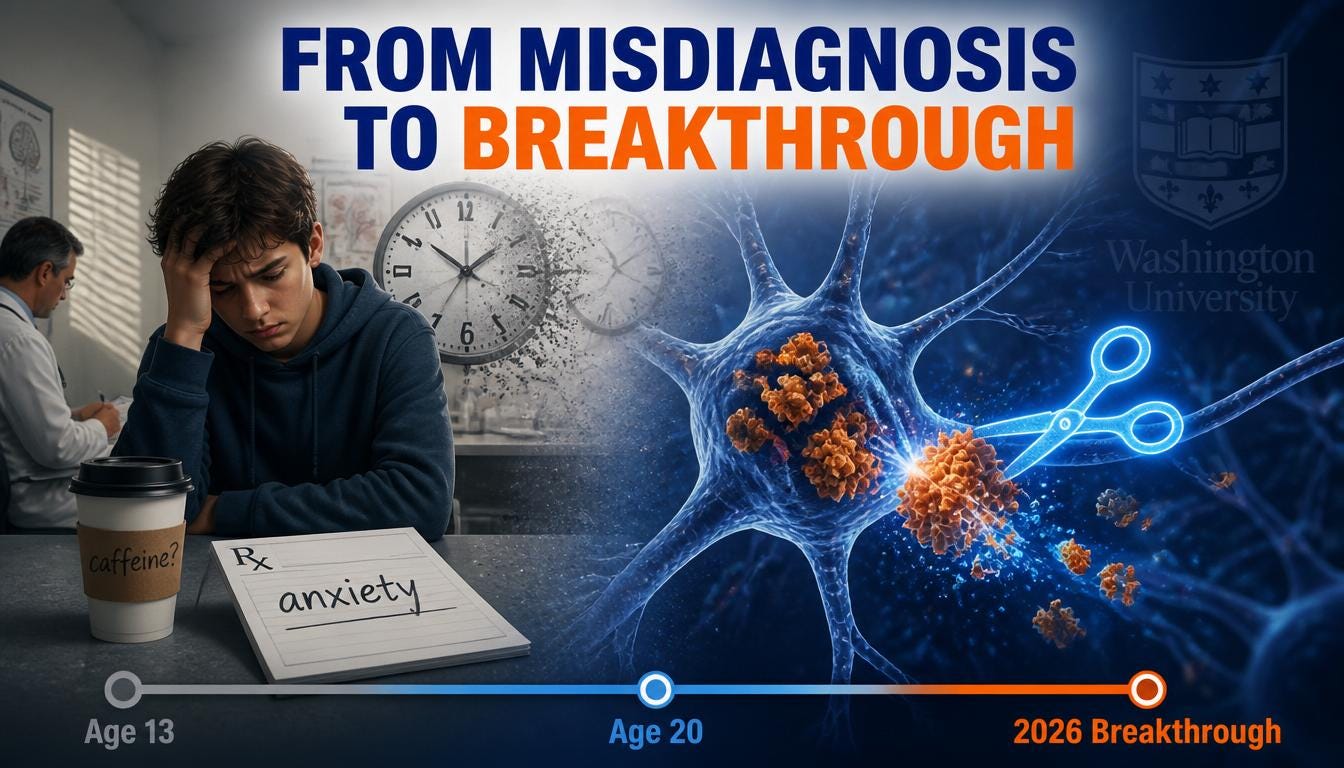
The greatest hurdle for a young adult developing EOPD isn’t a lack of science — it’s a lack of suspicion.
When an individual in their 30s or 40s develops a subtle finger tremor, persistent muscle stiffness, or sudden sleep disturbances, they rarely seek out a neurologist first. And when they do visit a clinic, standard clinical biases often get in the way.
Younger patients routinely have their early symptoms dismissed as:
- Chronic stress and high cortisol
- Generalized anxiety disorder
- Lifestyle factors (e.g., lack of sleep or excessive caffeine intake)
- Repetitive strain injuries or sports-related micro-traumas
Because Parkinson’s is fundamentally perceived as an “older person’s disease,” younger patients face a silent crisis of misdiagnosis. By the time classical motor symptoms become undeniable, years of critical time have passed — time that could have been used to protect remaining neurons.
2. The Cost of Delay: Missing the Neuroprotective Window
Why does early detection matter so much if neurodegeneration is progressive? Because the brain possesses a remarkable degree of cellular resilience, but it has a tipping point.
The Neuroprotective Window: The earliest phase of neurodegeneration where targeted interventions can actively preserve cellular structures before irreversible neuronal death occurs.
When symptoms are brushed off as lifestyle-induced anxiety, patients miss out on early-stage interventions — such as intensive mitochondrial support, metabolic optimization, and targeted anti-inflammatory strategies — that keep the neural architecture resilient for much longer.
3. The Therapeutic Breakthrough: Enter Engineered Enzyme Therapy
While the diagnostic pipeline struggles, the therapeutic pipeline is achieving the extraordinary. The true headline of neurodegenerative science is the emergence of Engineered Enzyme Therapy.
For decades, standard care relied almost entirely on levodopa or dopamine agonists. While highly effective at masking motor symptoms, these treatments do absolutely nothing to alter the disease’s underlying trajectory. They manage the smoke; they do not extinguish the fire.
Enzyme therapy changes everything. Rather than just supplementing lost dopamine, scientists are now engineering specific, highly targeted enzymes capable of entering the central nervous system to clear out the root cause of the damage: toxic, misfolded proteins (like alpha-synuclein aggregates).
[Misfolded Proteins / Aggregates] ──> Choke & Destroy Neurons
                                           │
                        (Engineered Enzyme Therapy Intervenes)
                                           ▼
                      [Targeted Clearance of Toxic Proteins]
                                           │
                                           ▼
                       Neurons Restored & Saved from Death
By actively degrading and clearing these cellular “clogs,” enzyme therapy offers a pathway to true neuroprotection. It halts the cellular degradation process, giving neurons a genuine chance to survive and function normally.
4. A Broader Horizon for Longevity and Cellular Health
The implications of engineered enzyme therapy stretch far beyond Parkinson’s disease. The capability to design enzymes that cross the blood-brain barrier and selectively dismantle toxic protein aggregates is a monumental victory for longevity science as a whole.
This exact mechanism is currently being explored to combat other neurodegenerative and age-related conditions, including:
- Amyotrophic Lateral Sclerosis (ALS)
- Alzheimer’s Disease (targeting amyloid and tau configurations)
- Systemic Cellular Senescence (cleaning up intracellular waste)
We are moving away from treating individual symptoms and moving toward comprehensive, cellular-level waste management inside the human brain.
The Road Ahead: Shifting the Paradigm
The medical breakthroughs of today are only as powerful as our ability to deploy them. Having a tool capable of halting neuronal death is an incredible milestone, but it demands that we identify patients before mass neuronal loss has taken place.
To fully unlock the power of next-generation enzyme therapies, the global healthcare system must dismantle its age biases regarding Parkinson’s. A tremor in a 35-year-old deserves the exact same rigorous neurological screening as a tremor in a 75-year-old.
True medical evolution requires both cutting-edge biotechnology and flawless clinical execution. When we pair early, unbiased diagnostic accuracy with targeted cellular therapies, we don’t just manage chronic diseases — we begin to solve them.
메타데이터
- post_id
- 936fc1c8f3f0
- slug
- beyond-the-tremor-why-2026-is-redefining-early-onset-parkinsons-and-cellular-healing-936fc1c8f3f0
- url
- https://medium.com/@alamihamou86/beyond-the-tremor-why-2026-is-redefining-early-onset-parkinsons-and-cellular-healing-936fc1c8f3f0
- canonical_url
- https://medium.com/@alamihamou86/beyond-the-tremor-why-2026-is-redefining-early-onset-parkinsons-and-cellular-healing-936fc1c8f3f0
- author_url
- https://medium.com/@alamihamou86
- status
- ok
- fetched_at
- 2026-06-20 20:29:01