What the Tariff Shocks and Stagflation Means for the Bay Area Restate Market
We’re in a strange moment right now — one of those rare times when nothing seems to be following the playbook. Bond yields are rising, the…
What the Tariff Shocks and Stagflation Means for the Bay Area Restate Market
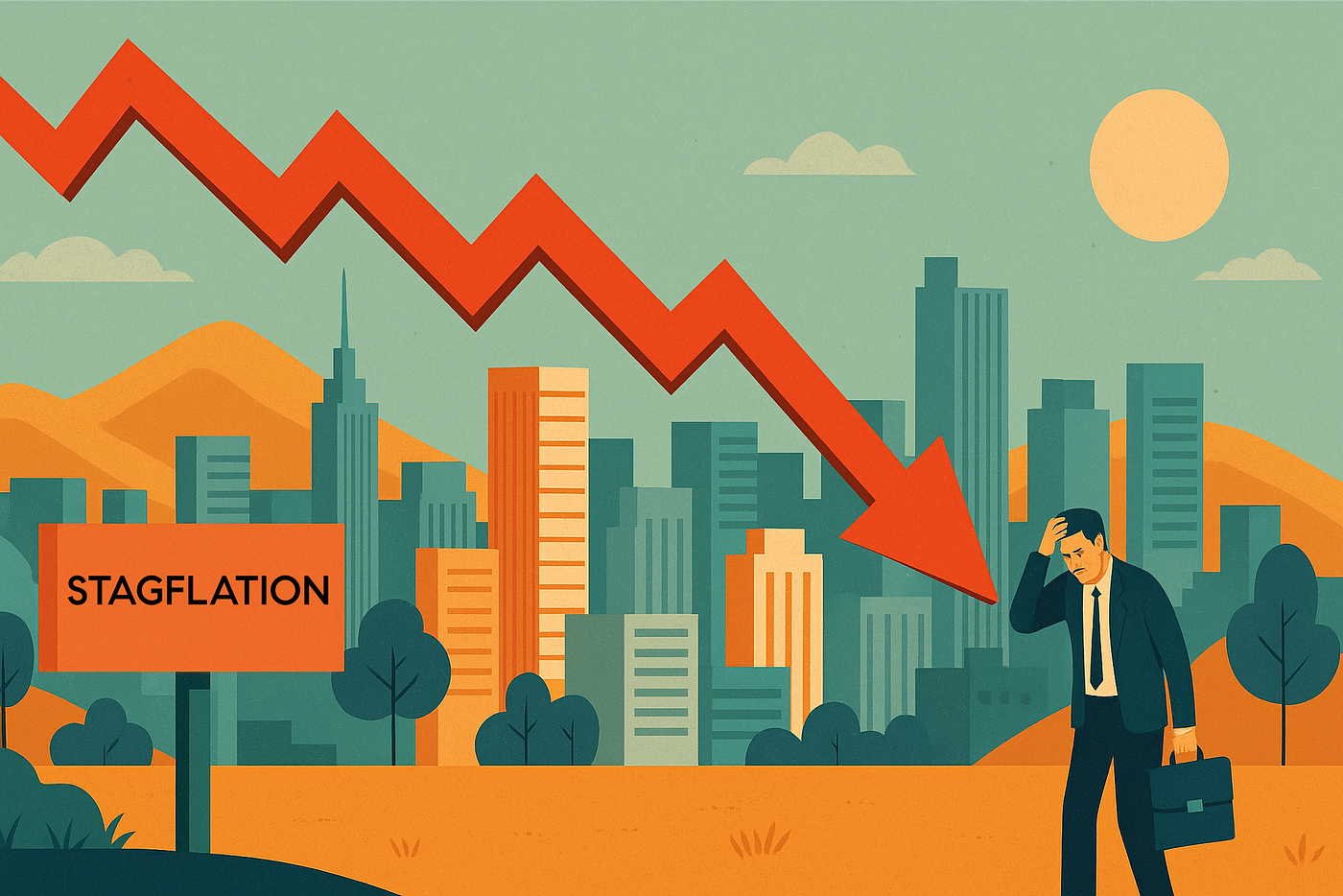
We’re in a strange moment right now — one of those rare times when nothing seems to be following the playbook. Bond yields are rising, the dollar is slipping, the Fed is holding off, and meanwhile, the real estate market is trying to make sense of it all. As someone who works daily with homeowners here in Silicon Valley, I want to break down what’s what the tariff shocks and the looming specter of stagflation means for Silicon Valley homeowners — especially for those thinking about selling their home or buying one in the coming year.
Tariffs: What They Are and Why They Matter
Let’s start at the top: tariffs. If you’ve been watching the news lately, you’ve seen the headlines. But what exactly is a tariff?
A tariff is basically a tax on goods coming into the U.S. Let’s say we import lumber from Canada. That truck has to stop at the border, declare its cargo, and pay a fee. That fee — technically paid by the importer (that is, the domestic U.S. company that placed the order for the imported products) — typically gets passed along to you and me as higher prices.
Sure, there are some high-margin products where the importer might just eat the tariff and not pass the cost on to the end-consumer, but in today’s competitive economy, there generally is not that much meat on the bone. At least a portion of most of these tariffs will show up in higher prices at the cash register in most cases.
So while politicians might talk about tariffs helping domestic industries or raising revenue, the truth is that we all pay the price. Simply put, companies will either raise their prices or stop bringing those goods in entirely. Jaguar, for example, recently decided it wasn’t worth the hassle to keep exporting cars to the U.S. So they stopped.
Now, this doesn’t mean every tariff leads to economic disaster. In fact, it’s rare for tariffs alone to trigger a recession. But what’s different this time is the sheer uncertainty surrounding them. Will the tariffs be imposed? Delayed? Doubled? Rescinded? That kind of unpredictability is toxic for business. It freezes investment, hiring, and expansion — all of which have ripple effects on the broader economy.
The Real Estate Impact of Economic Uncertainty
If you’re a home seller or buyer, here’s why this matters: uncertainty slows everything down. When businesses aren’t sure what the future holds, they stop hiring. They postpone raises, and they delay investing in plant, capital improvements, and employee development (training, etc.). And of course, when people don’t feel financially secure, and they get skittish about big investments — like buying a house.
Consumer confidence is critical to the real estate market. And right now, confidence is fragile.
Consumer Confidence Hits the Skids
Consumer confidence recently took a sharp downturn, signaling growing concerns about the economy among everyday Americans. In March 2025, U.S. consumer confidence experienced a significant decline, with The Conference Board’s Consumer Confidence Index falling 7.2 points to 92.9 — the lowest level since June 2022.
This marks the fourth consecutive monthly decrease, reflecting growing concerns among Americans about rising prices and the economic outlook amid escalating tariffs.
The Expectations Index, which gauges consumers’ short-term outlook for income, business, and labor market conditions, dropped nearly 10 points to 65.2, the lowest in 12 years. Such a low reading often signals a potential recession in the near future. Additionally, the Present Situation Index, assessing current business and labor market conditions, declined to 134.5. These figures indicate a significant shift in consumer sentiment, which could impact spending behaviors and, consequently, the broader economy.
The drop reflects heightened anxiety over persistent inflation, rising interest rates, and uncertainty around job stability and the broader financial outlook. When consumer confidence falls, people tend to spend less, which can ripple through the economy and slow down growth — especially in sectors like housing, retail, and travel. This decline could be an early indicator of shifting behavior as households tighten budgets and rethink major purchases in the face of economic uncertainty.
The Fed’s Dilemma: Rates, Inflation, and the Pause Button
Let’s talk about interest rates, because that’s the other big piece of this puzzle. The Federal Reserve is currently caught in a tough spot.
Before tariffs hit the headlines again, the Fed was in a holding pattern. Inflation was still above their target, but it wasn’t getting worse. Unemployment was low. Everything was… stable.
Then came the tariffs, and suddenly the Fed has to brace for two conflicting outcomes: rising inflation (from higher prices due to tariffs) and rising unemployment (from stalled investment and weaker business activity). In economic terms, this is called **stagflation**, and it’s a nightmare scenario.

A Brief Primer on Stagflation
Stagflation is an unusual and challenging economic condition where high inflation, slow economic growth, and high unemployment all occur at the same time. It’s often caused by supply shocks — like a spike in oil prices or a labor shortage — that drive up costs while also slowing productivity. Loose monetary policy can also contribute by flooding the economy with money, which increases inflation without boosting output. Curing stagflation typically requires a careful balance: tightening monetary policy to bring inflation under control, while also implementing structural reforms or targeted fiscal measures to encourage growth without overheating the economy. It’s a tough needle to thread, which is why stagflation is so tricky for policymakers.
Recent History of Stagflation in the United States
The U.S. last experienced stagflation from around 1973 to 1982 — a rare period marked by high inflation, high unemployment, and slow or negative GDP growth. It was largely triggered by two major oil shocks: the first in 1973 when OPEC slashed oil production, and the second in 1979 during the Iranian Revolution. These events drove energy prices up, which in turn pushed inflation into double digits — peaking at 13.5% in 1980 — while unemployment remained high, generally between 6% and 10%. The economy stagnated, and traditional economic tools weren’t working since efforts to fight inflation often worsened unemployment, and vice versa.
The turning point came when Federal Reserve Chair Paul Volcker dramatically raised interest rates — pushing the federal funds rate close to 20% by 1981 — to crush inflation. This led to a deep recession, with mortgage rates exceeding 18%, business slowdowns, and a temporary spike in unemployment. But it worked: inflation was finally brought under control, laying the foundation for a long stretch of economic stability and growth in the 1980s. Volcker’s aggressive policy is still viewed as the definitive example of how to end stagflation, albeit at a high short-term cost.
The Effects of Stagflation on Real Estate and Mortgage
During the stagflation era of the 1970s and early 1980s, mortgage rates soared to historic highs. These high borrowing costs made homes far less affordable, significantly reducing buyer demand.
As a result, U.S. home prices grew very slowly during that time, especially when adjusted for inflation. In many markets, real (inflation-adjusted) home prices actually declined. Even though nominal prices may have crept upward in some areas, those gains were often outpaced by inflation, meaning homeowners weren’t building real wealth. High mortgage rates and economic uncertainty made it a challenging time for both buyers and sellers in the housing market.
Look at these two charts below to see how real estate values performed during this period of stagflation:
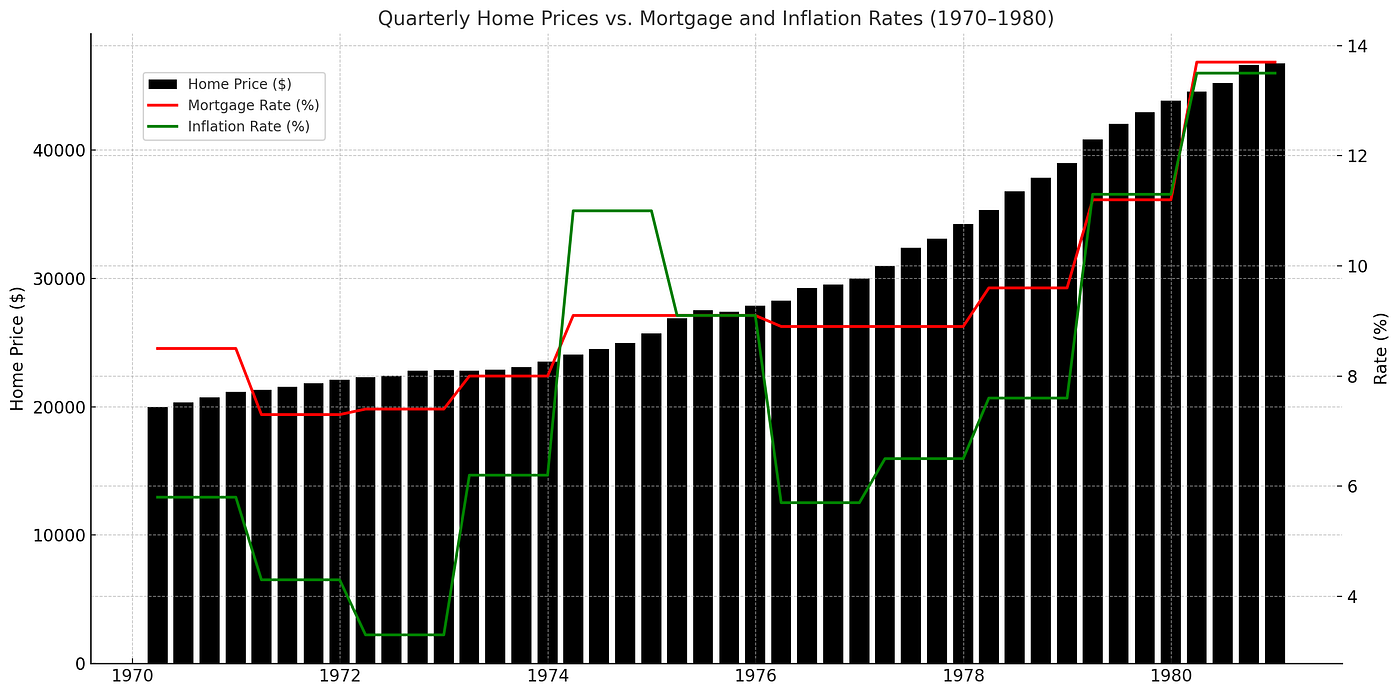
US Home Prices in Actual Dollars During Stagflation with Inflation and Mortgage Rates Overlaid
From the chart above, it appears that real estate prices did well over the 1970 to 1983 period when stagflation was strangling the U.S. economy. However, when you adjust those prices for inflation, there’s a completely different picture. The chart below shows inflation-adjusted home prices during that same period. As you can see, inflation-adjusted (“real”) home prices peaked in Q4 1972, and remained lower than that for at least the next decade.
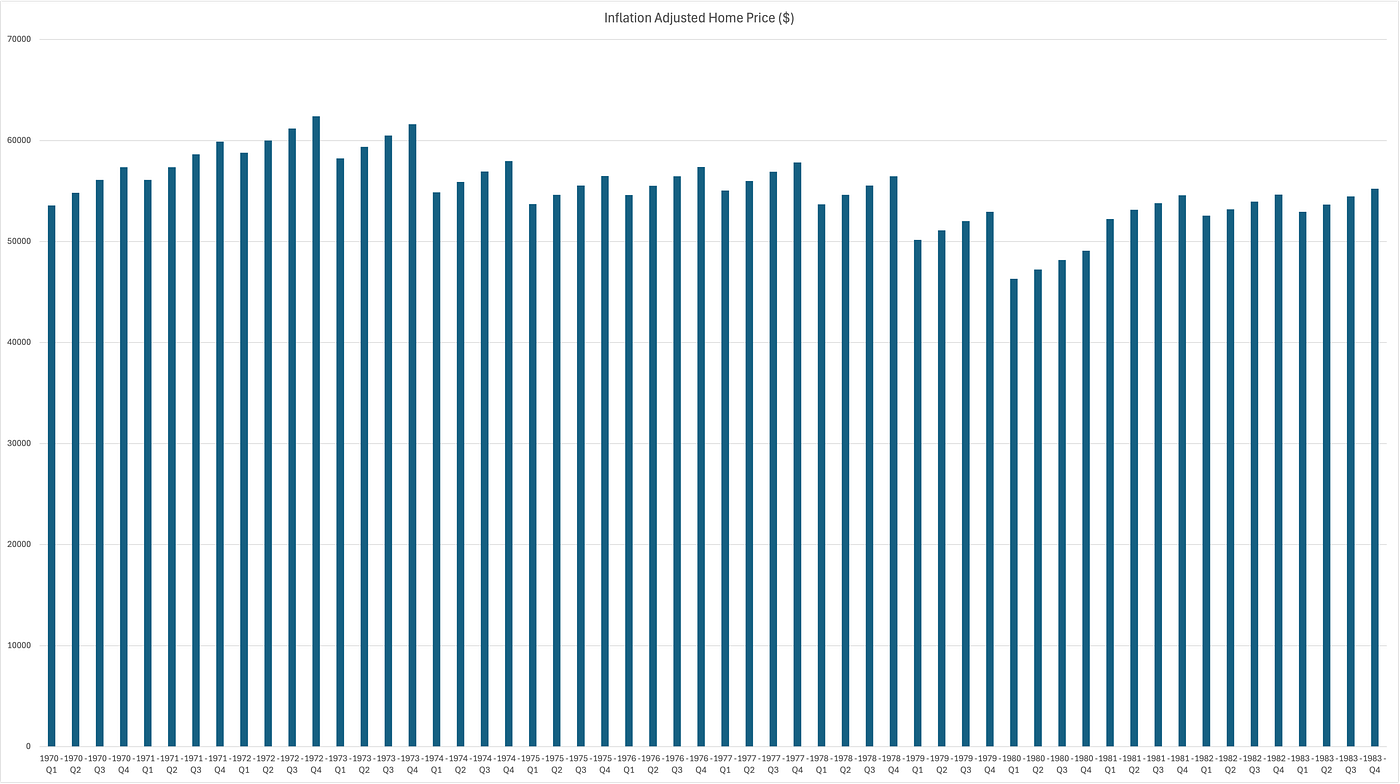
U.S. Home Prices, Adjusted for Inflation, During 1970s Stagflation
The Experience of Stagflation in the Bay Area
During the last period of stagflation in the late 1970s and early 1980s, the Bay Area real estate market felt the squeeze of soaring mortgage rates and economic uncertainty, just like the rest of the country — but with some local nuances. While inflation drove up the cost of living and the Federal Reserve responded with steep interest rate hikes (mortgage rates peaked above 18%), home sales volume in the Bay Area dropped significantly. Many buyers were priced out due to affordability challenges, and sellers who didn’t have to move often chose to wait things out.
That said, the Bay Area didn’t see the kind of widespread home price crashes experienced in some other parts of the country. Thanks to its already tight housing supply, strong job base (even then, tech and innovation were taking root), and desirability as a place to live, the region weathered the storm better than most. Still, home prices stagnated in real terms — meaning any nominal price gains were mostly wiped out by inflation. The market didn’t truly regain momentum until inflation was under control and interest rates began falling in the mid-1980s.
Mortgage Rates: Why They’re So Sticky
So what does the looming specter of stagflation mean for mortgage rates? Before all this tariff talk, we might have seen the Fed cut rates soon. I can’t tell you how many times people in the mortgage business have told me that lower mortgage rates are right around the corner. An aggressive set of Fed rate cuts, they say, could help push mortgage rates below 6% — which is believed to be great news for buyers and sellers alike. But now, with so much uncertainty in the air, the Fed is likely to sit on its hands and wait.
And of course, mortgage rates are only tangentially related to the Federal Funds rate. In reality, mortgage rates hew much closer to the 10 Year Treasury bond yield rate, and that went rocketing up when the details of the tariff plan — such as it is — were announced. The yield rate has come down some since then, but not to the point where we can expect to see any kind of easing with mortgage rates.
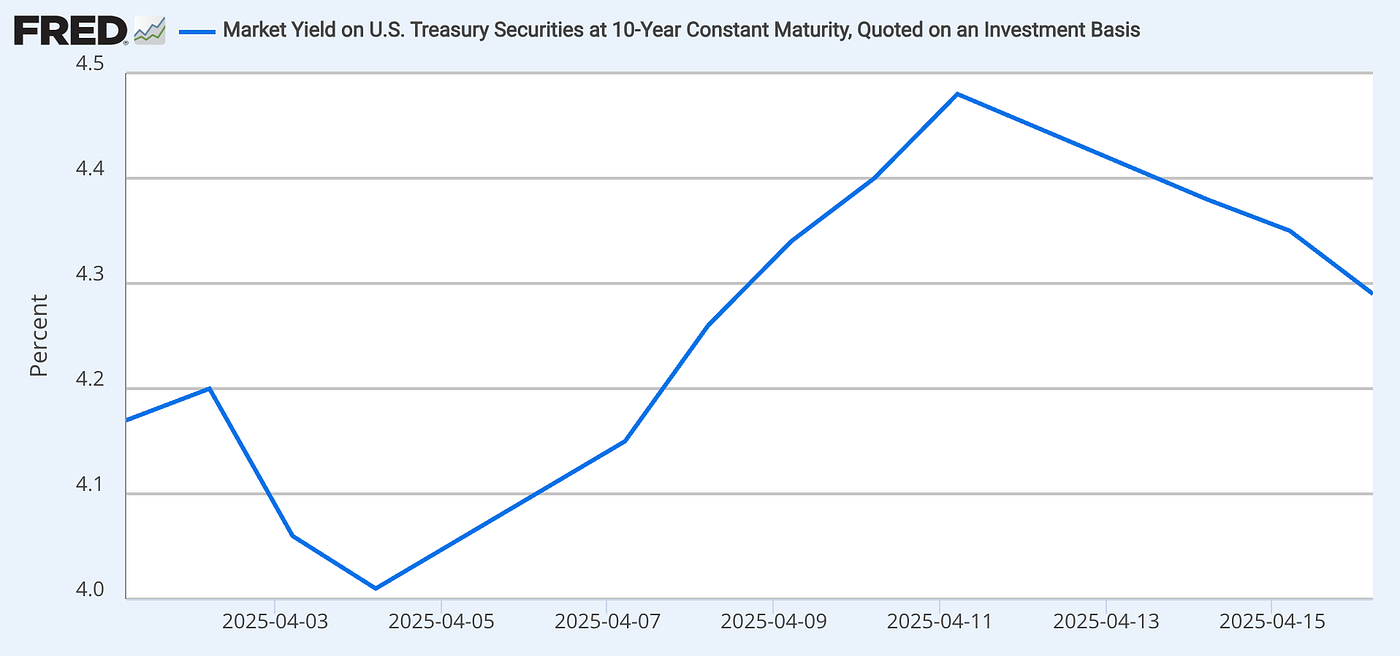
10 Year U.S. Treasury Bond Yield Rates Since April 1, 2025
Right now, the 30-year fixed mortgage rate is bumping up around 7%. And unless inflation falls significantly — or we enter a full-blown recession — that number probably isn’t coming down much.
Yes, if rates drop below 6%, we’ll probably see more buyers come off the sidelines. There’s so much pent-up demand in the market from folks who’ve been stuck waiting for better rates. Even a modest rate cut could unleash a surge in activity, especially here in Silicon Valley.
But if the only reason rates come down is because we’re sliding into a recession? That’s not the kind of buyer confidence you want. Low rates won’t matter much if people are worried about keeping their jobs.
Silicon Valley’s Unique Connection to the Stock Market
One thing that makes the Bay Area different from just about everywhere else is how tightly our real estate market is tied to the stock market. A huge chunk of local wealth is held in tech stocks, stock options, and RSUs. When the market wobbles, so does buyer enthusiasm.
A buyer who was ready to make a move last month might suddenly hold off if their 401(k) or company stock just took a 10% hit. Multiply that across hundreds or thousands of would-be buyers, and the market slows down fast. In fact, I saw this happen first hand. I had two buyers duking it out over one of my listings in San Jose, and one of them was about to go up in price to beat out the other bidder — which would have net my seller an additional $25,000 — but he held back, specifically citing the performance of his stock portfolio.
If you’re thinking about selling in the next 12 months, this is something to watch closely. When tech stocks rise, so does demand for homes. When they fall, buyers pull back, and lower home prices are likely the result.
Inventory, Builders, and the Supply Equation
Here’s another thing I’m watching: inventory levels.
Nationally, home sales have been hovering around 4 million annually — well below the historic average of 5.25 million. That gap has created pent-up demand. But supply has stayed tight, and that’s been a major price support. That’s because home prices are largely the result of the balance of supply vs. demand.
Builders are nervous. Tariffs on everything from Canadian lumber to Chinese electrical components make it harder and more expensive to build homes. On top of that, labor shortages (especially from south of the border) are slowing construction timelines. Builders are pulling back, which could keep inventory low for a while.
That’s good news if you’re a seller (especially if you’re in an area where buyers might also be looking at new construction in addition to resale homes) — low inventory tends to keep prices stable or rising. But it also makes it harder for buyers to find the right home, especially in the entry-level and midrange market.
What About a Recession?
Will we have a recession in 2025? There’s no way to know for sure; honestly, it could go either way. It’s not a foregone conclusion, but I’d say a recession is more likely than that we’ll see consecutive quarters of growth in 2025. At the very least, we’re in for slower growth. It’s too early to predict a crash in home prices, but the reality is that home price corrections are an episodic event in the California economy, and it’s been over a dozen years since we exited the last time the market had any kind of notable correction.
All of this volatility really came about from the announcement of this very aggressive tariff scheme. Yet tariffs alone don’t usually cause recessions. Even the infamous Smoot-Hawley Tariff Act of the 1930s didn’t start the Great Depression — it just made it worse. But of course, the issue isn’t just the tariffs — again, it’s the uncertainty and the chaos that is causing the current volatility in the market — and you add that with the tariffs, a weakening dollar, surging import costs, and, well, all bets are off.

Should You Sell Now or Wait?
This is the million-dollar question — and it depends on your personal situation.
If you’re thinking about selling in the next year, I’d suggest taking a serious look at doing it sooner rather than later. Why?
- Rates may stay higher for longer. The Fed has no clear path to cut rates aggressively unless inflation drops further. Yet that appears unlikely, at least, no time soon.
- Uncertainty is cooling buyer demand. That doesn’t mean prices will crash — but it could take longer to sell, or for not quite as much as you’d like.
- Low inventory is still your friend. With fewer homes on the market, well-prepared and well-marketed listings can still command strong prices. In fact, real estate prices hit a new peak in Santa Clara County in March 2025.
If you wait until next year hoping for better rates, you might also be facing more competition. You might also be looking at higher rates next year — after all, the last time we faced stagflation, interest rates went through the roof. It’s ancient history now (although I kind of remember it!), but rates climbed from around 8.5% in 1977 to over 16% by 1981, with a peak of 18.45% in 1981.
But even if rates stay the same, or go down, just remember: there’s pent-up supply, too — many sellers are sitting on the sidelines right now. If they all list at once when rates fall, you’ll be competing for attention. The balance of supply vs. demand which drives home prices is delicate, and anything that pushes significant more inventory on the market (such as more attractive rates, enabling people to move up or down size more affordably) could drive prices down.
The IPO Market and Local Wealth Creation
Another thing I’m watching is the IPO market — or lack thereof.
Even though tech stocks are climbing, the IPO pipeline is still dry. This matters because IPOs are one of the key ways wealth gets unlocked in Silicon Valley. When a company goes public, employees and founders cash out and suddenly become homebuyers. Without IPOs, that wealth stays on paper.
We’ll need a reawakening in the IPO market to see a big surge in high-end real estate demand. Until then, the market will move more slowly at the top end.
What I’m Telling My Clients
Here’s the honest advice I’m giving to my clients right now:
- If you’re selling: Start preparing your home today. Declutter, work on the landscaping, do those small repairs you’ve been putting off. A well-presented home still sells well, even in an uncertain market.
- If you’re buying: Stay flexible. Keep a close eye on rates and be ready to move quickly if the right opportunity comes along. Don’t let fear paralyze you — just make sure your financing is solid.
- If you’re waiting: Keep learning. This is the time to build relationships, understand your local market, and strengthen your negotiating skills. Economic cycles come and go — being ready is half the battle.
Final Thoughts
People have been predicting the fall of San Francisco Silicon Valley for years — COVID was supposed to flatten us, if you’ll recall. Remote work meant you could live anywhere. But guess what? The money, the venture capital, the AI boom — it’s still happening right here.
Tariffs may be making headlines, but the real story is uncertainty, and the increasing likelihood that we may be facing a period of stagflation in the U.S. economy. This is definitely brining a chill to the market — one which could potentially set in for the long haul. But if you zoom out and look at the big picture — strong demand, limited inventory, an economy still growing — it’s not all doom and gloom. While we may be in for a term of flattened (or somewhat reduced) real home prices in the Bay Area in the years ahead, the likelihood of a cataclysmic drop in housing prices seems remote.
These are certainly exciting times!
—
Seb Frey is a top Silicon Valley REALTOR® helping people get rich in real estate. Check out his YouTube Channel, SebFreyTV.
메타데이터
- post_id
- 938cf1400a9a
- slug
- what-the-tariff-shocks-and-stagflation-means-for-the-bay-area-restate-market-938cf1400a9a
- url
- https://medium.com/@sebfrey/what-the-tariff-shocks-and-stagflation-means-for-the-bay-area-restate-market-938cf1400a9a
- canonical_url
- https://medium.com/@sebfrey/what-the-tariff-shocks-and-stagflation-means-for-the-bay-area-restate-market-938cf1400a9a
- author_url
- https://medium.com/@sebfrey
- status
- ok
- fetched_at
- 2026-06-15 20:49:13