Follow This Foolproof Formula to Deliver Impactful Learning Experiences (Part 4 of 4)
Use these 5 easy strategies to inspire your participants.
This is Part 4 of a 4-part series on facilitation best practices.
Follow This Foolproof Formula to Deliver Impactful Learning Experiences (Part 4 of 4)
Use these 5 easy strategies to inspire your participants.

Photo by Jacob Lund on Shutterstock
Every effective learning experience is built on four essential elements — the 4Ns. These elements are simple yet powerful. When executed correctly, participants will leave your sessions feeling informed, engaged, entertained, and inspired.
Throughout this article series, we’ve explored five practical strategies for each element, supported by insights and examples from my over two decades as a Learning & Development professional.
Recap of the 4Ns
In the previous three installments of this series, we discussed strategies to inform, engage, and entertain your session participants. Visit the links to reread any of the articles or catch up on those you may have missed.
For a convenient recap, a description of each element, along with a synopsis of its associated strategies, appears below. Or, if you’re ready to dive into our discussion of the final N, skip ahead to the next section.
INFORM
Training is impactful when participants gain tools they can practice applying during the session and learn practical, concrete solutions they can implement following the session.

Photo by REDPIXELPL on Shutterstock
Five Strategies to Inform Your Learners
- Understand who your learners are by conducting an audience analysis, considering your participants’ diversity, and asking additional questions to understand why they are taking the training.
- Incorporate current, relevant content tailored to your learners to establish your credibility. Research industry trends, consult with your client or stakeholder, and use scenarios and activities which mirror your learners’ specific work environment.
- Explain the “why” behind the what by setting expectations, explaining the WII-FM (“What’s in it for me.”), and connecting the dots.
- Provide learning materials and supplemental resources, such as participant guides and handouts, to help participants embed their learning. Refer learners to supplemental resources after the session.
- Incorporate opportunities for hands-on practice and experimentation by giving your learners something to do.
ENGAGE
Training is impactful when participants have numerous opportunities to meaningfully interact with each other and with their facilitator.

Photo by JLCo Julia Amaral on Shutterstock
Five Strategies to Engage Your Learners
- Create and foster a psychologically safe environment by establishing community standards, practicing inclusion, modeling and rewarding vulnerability, and encouraging continuous feedback.
- Flex your facilitation muscles by incorporating movement, varying how you convey information, using questions skillfully, and demonstrating active listening.
- Foster active involvement by incorporating a mix of individual activities with small and large group activities.
- Appeal to all sensory learning styles through activities designed for participants who have visual, aural, reading/writing, and kinesthetic learning preferences.
- Embrace time as your helpful co-facilitator by chunking content and activities and incorporating breaks and energizers.
ENTERTAIN
Training is impactful when participants have fun, memorable experiences which reinforce the content and provide an outlet for creative expression.

Photo by maxbelchenko on Shutterstock
Five Strategies to Entertain Your Learners
- Create a stimulating learning environment. Configure the training space to maximize your learners’ engagement, set up learning vignettes which appeal to all learning styles, and make a positive and memorable first impression.
- Show your personality by being authentic, choosing clothing which honors your facilitation persona, showing enthusiasm, and using appropriate humor, naturally.
- Incorporate the unexpected. Employ an element of suspense or mystery, use props meaningfully, and switch things up by introducing change.
- Include purposeful fun elements. Start the fun with introductions, continue the fun with icebreakers and energizers, and ramp up the fun with friendly competitive games.
- Incorporate incentives and recognition including competition-based prizes and fun personalized certificates.
The fourth and final N is Inspire.
Training is impactful when participants are inspired to shift the way they approach how they live and work.
It makes little sense for learners to invest time away from their work responsibilities to participate in a training session only to then return to their workspaces without contributing some resulting benefit.
Impactful training inspires participants to activate their learning and apply their newly acquired knowledge, skills, and abilities for the betterment of themselves, their teams, and their organization.
Real-Life Example: Remote Management Course
The approach of this article is slightly different from that of previous articles in the series. Rather than highlight multiple learning experiences from my professional background, I will instead focus on one example.

Photo by Ground Picture on Shutterstock
I designed, developed, and facilitated Leading from a Distance: 4 Principles to Building Committed Remote Teams. This 4-hour course was a virtual learning experience geared toward people leaders with at least four remote direct reports.
During the session, we discussed numerous practical ways for leaders to (1) establish a healthy team culture; (2) promote effective communication; (3) foster productive collaboration; and (4) encourage meaningful connection on their remote teams to gain the commitment of their team members.
These four areas make up the Commitment Pyramid, with each successive level building upon the previous.

The Commitment Pyramid
Building a Committed Remote Team
Think of the pyramid as building a house, where the house is a committed remote team. To achieve commitment on their team, leaders must first lay a solid foundation. They do that by establishing a healthy team culture. Second, comes the framing of the house, or communication. Superior leaders promote effective communication with and among their team members.
Next is completion of the exterior and infrastructure of the house. Leaders accomplish that by fostering productive collaboration. Finally, the interior of the house. Leaders complete the interior of their team’s house by encouraging meaningful connection among their team members.
Once construction is complete, the house still requires ongoing maintenance. For example, in your home you routinely clean your gutters, change the HVAC filters, and test and replace the batteries in your smoke and carbon monoxide detectors. Within committed remote teams, the leader and their team members likewise need to be proactive in maintaining a healthy culture, effective communication, productive collaboration, and meaningful connection.

Photo by Jan Pietnuszka on BigStock
During the session, learners:
- Assessed and rated their remote teams in the four areas of the commitment pyramid
- Engaged in activities, exercises, and small group discussions with their peers to embed their learning
- Applied introduced concepts to devise solutions for their remote management pain points and challenges
- Began work on a preliminary action plan to successfully implement remote management strategies with their teams
Following the session, learners were encouraged to:
- Ask their team members to anonymously assess and rate their team in each of the four areas in the commitment pyramid
- Meet with their team to discuss the assessment results and complete/revise their action plan based upon their team’s feedback
- Access the playlists in the LMS for each area of the commitment pyramid to explore additional resources and continue their learning
- Attend an optional 45-minute follow-up session to share their insights, successes, and opportunities
With this background understanding of the architecture and mechanics of the Remote Management session, let’s transition to five strategies you can use to inspire your learners to shift the way they approach how they live and work.
Strategy #1: Ask the “Now what?” question early. And often.
In the Inform installment of this series, I emphasized the significance of facilitators articulating the “Why?” of the training for their learners at the beginning of the session.

Photo by Jacob Lund on Shutterstock
Articulating the “Why?” consists of:
- Introducing the goals of the training so your learners know what success looks like
- Explaining how your learners will benefit from the training and reinforcing what’s in it for them
- Connecting the dots between the session content and how it effectuates business goals and strategic priorities or advances the organization’s mission, vision, and values
Having explained the “Why?” at the beginning of the session, skillful facilitators devote time throughout the session to ask “Now what?” Put simply, now that you’ve acquired this new information, what will you do with it?
Here are several examples of “Now what?” questions you might ask:
- What was a key takeaway or “aha moment” for you from this module?
- What will you do differently as a result of participating in this session?
- What specifically will you start doing, stop doing, and continue doing as a result of what you’ve learned during today’s training?
- What action step will you take back to your workplace and share with your team?
- Which specific skill or knowledge do you plan to implement immediately?
- How will you apply what you’ve learned in your day-to-day work?
- How will you use the tools we introduced to improve how you work?
- How will you implement the strategies we discussed with your team?
Photo by AbsolutVision on Unsplash
Remote Management Example: “Now What?” Reflections
At the end of each module in the virtual Remote Management course, I asked learners to type their key takeaways and light bulb moments in the chat window. Alternatively, volunteers were invited to come on the line and share their thoughts.
In designing the interactive participant guide, I included an insights prompt text box after each activity and on the last page of each module section. Using the ample space provided, learners could capture and record their insights in real-time for easy recall later and further exploration after the session.
At the conclusion of the session, I set aside time for participants to reflect on their learning experience. I prompted them to share in the chat (or volunteer to come on the line) how they might apply one of the concepts we reviewed from the Commitment Pyramid to resolve a remote management challenge and to continue to build a committed team.
Strategy #2: Incorporate an action plan component in your session.
An action plan transforms the intention of a learner’s “Now what?” response into an organized “Here’s how!” detailed strategy for execution.
Photo by Mika Baumeister on Unsplash
Dr. Valerio Pascotto is the Founder of IGEOS®, which helps companies struggling with collaboration become more unified, productive, and extraordinary workplaces through powerful coaching and experiential workshops. He is also an official member of Forbes Coaches Council.
In his 2019 Forbes article entitled *Action Plans: The Key To Tangible Business Results From Trainings And Workshops*, he writes:
“Ultimately the best measure of a workshop is the impact on the business of what has been learned through practical application…The most indicative tool for promoting a learning experience and anchoring training/workshop results is an action plan that participants fill during and after a training/workshop.”
An action plan assists in learning transfer and knowledge retention by ensuring learners exercise the new skills and apply the new information they’ve gained during the session immediately to real-life work scenarios.
Note: Consider using the inclusion of action plans to make a convincing business case for your training session and to justify capital investment. A successfully implemented action plan, incorporating observable goals and accompanied by substantive behavior change in accordance with Level 3 of the Kirkpatrick training evaluation model, can help demonstrate concrete positive impact to business operations.
a. Remote Management Example: Team Assessment
Following an introduction to the session and a walkthrough of the Commitment Pyramid, I asked my learners to take 10 minutes to complete a brief assessment in their participant guide.
The assessment required the leaders to rate their teams using a scale of 1 (poor) to 5 (excellent) in each of the four areas of the pyramid, i.e., culture, communication, collaboration, and connection. To help leaders determine their ratings, I provided several contextual questions for each area.
For example, in assessing the culture of their team, I asked leaders to consider the extent to which they believed their team members:
- Trusted them as a leader and trusted one another?
- Felt psychologically safe to share ideas, make mistakes, take risks, and bring their full authentic selves to work?
- Knew each other’s roles and responsibilities?
- Knew each other’s strengths, weaknesses, work preferences, and communication styles?
- Engaged in transparent and open communication?
- Felt comfortable giving and receiving constructive feedback?
- Understood their unique contributions and were aware of who was helped by the work they do?
- Received appropriate recognition?
- Were afforded opportunities for professional development and career advancement?
- Had the necessary tools and resources to do their jobs successfully?
After rating their team in all four areas, I asked learners to identify one area where their team was doing well and one area that represented an opportunity for improvement.
For the first activity of the session, learners participated in breakout groups of four or five members. I gave them 15 minutes to share their name and role, the area they identified where their team was doing well and why, and the area they identified where their team could use improvement and why.
b. Remote Management Example: Action Planning
Following completion of the first portion of the healthy culture module and a scheduled break, we jumped into the action planning segment of the session. I reminded learners who had not already done so to download the interactive action planning document from the course in the LMS. Then we spent time reviewing an action plan example.

Photo by Kzenon on Bigstock
Here are the steps included in the action plan document for the Remote Management course, along with examples.
Step 1: Describe the challenge to be solved or change to be implemented.
To illustrate this step, we used the following hypothetical example of a team leader who was experiencing challenges during team meetings:
There is a very vocal minority in team meetings that tends to monopolize the discussion. Other team members are hesitant to participate in the discussions or share their ideas. A few team members have privately expressed frustration during their 1:1 conversation with me about this.
Step 2: Create a SMART goal.
The team leader in the hypothetical example began with a broad goal of building psychological safety on their team, which is a fundamental characteristic of a healthy team culture. By reviewing each element of the SMART acronym, I demonstrated how to convert the leader’s 10,000-feet original goal into an actionable SMART goal.

Example of SMART Goal
Five additional examples of SMART goals, broken down as shown above, were included in the appendix of the learners’ action plan document.
Step 3: Identify tasks that must be completed to reach milestones/goal.
Listed here are tasks required for the team leader to achieve her goal.

Step 3: Identify tasks to reach goal.
Step 4: Allocate resources (human, financial, or technical) to complete your tasks.
In this example, the team leader needed her company’s branded meeting agenda template and an online timer.

Step 4: Allocate resources to complete your tasks.
Step 5: Organize your tasks by priority (important vs. less important) and sequence (order in which tasks must be completed before others can be started).
The team leader prioritized and sequenced her tasks as follows:
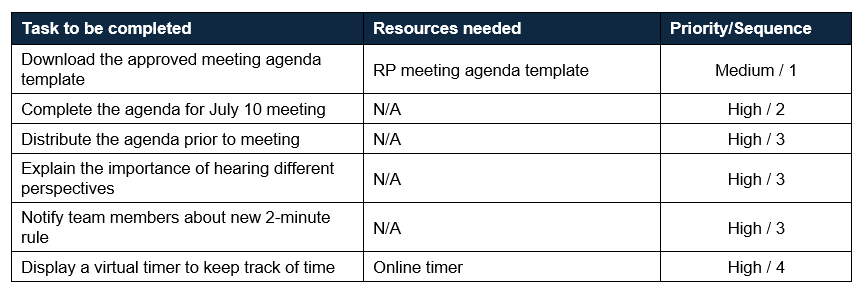
Step 5: Organize your tasks by priority and sequence.
Step 6: Set milestones and deadlines for tasks.
Where applicable, the team leader created milestones and a deadline for completion for each task.

Step 6: Set milestones and deadlines for tasks.
Step 7: Monitor and revise your plan.
Start-Stop-Continue is a helpful framework to determine which new ideas should be started, which ineffective or unnecessary behaviors should be stopped, and which successful practices should be continued. This step may also involve revising and updating information contained in Steps 3 through 6.
Below are the specific actions the team leader in the hypothetical example decided to start, stop, and continue following her plan’s implementation.

Step 7: Monitor and revise your plan.
c. Remote Management Example: In-Session Activity
Following review of the action plan components, I tasked my learners with brainstorming one goal to establish (or strengthen) a healthy culture on their teams. To jumpstart their thinking, I recommended they refer back to the same questions listed for the healthy culture topic that were included in the assessment they completed at the beginning of the module.
I gave them 15 minutes to work on Steps 1 through 3 in their action plan. I suggested they jot down their notes and ideas in a way that would be helpful when they returned to the action plan document later to add details and further refine their plan. To relieve any performance anxiety, I reassured learners that this was only a rough draft and they wouldn’t be sharing their work with the entire group.

Photo by Vadym Pastukh on Bigstock
After the 15 minutes elapsed, I prepped my learners for a second breakout session activity. This time, however, I assigned them to a different group of peers with whom they had not yet worked. I asked them to take turns introducing themselves and sharing their identified challenge, the draft of their SMART goal, and their list of tasks to be completed.
Each learner was asked to share feedback and insights on one another’s goals and tasks. I gave them 15 minutes in their room, and cautioned them to timebox accordingly to ensure everyone had an opportunity to share and get feedback.
d. Remote Management Example: Post-Session Assignment
At the conclusion of the course, I reviewed several key next steps with my learners. One of those included completing and executing their action plan over the next 45 days.
To do that, they might choose to resume the work they started during the session. Or, they might choose a different area of focus. I reminded learners that their action item did not have to be something large in scope. In fact, it could be a simple, small action such as the example we reviewed earlier of the team leader who wanted to spark greater participation during meetings.
I also suggested learners consider asking their team members to anonymously complete the same assessment they did at the beginning of the session. Analyzing those results might alert leaders to blind spots or dispel any misconceptions they had about their teams in the four areas.
By using their team members’ ratings, leaders could determine where their team fell on the commitment pyramid. The level where they saw the lowest average scores would likely be the ideal starting point for their action planning.
Strategy #3: Encourage learners to connect their action plan to their overall individual development plan (IDP).
This synthesizes the “Why?” (the benefits derived from this training) with the “Now What?” (how I will use and apply what I have learned to benefit myself and others) and the “Here’s how!” (detailed action planning).

Photo by Krakenimages.com on Shutterstock
As a valuable output of your training session tied to your learners’ continuing development, encourage them to integrate their goal and action plan with their IDP. This approach has several advantages:
- Requires minimal administrative work: A typical IDP includes SMART goals, actionable steps, milestones, and deadlines. Therefore, little if any extra work will be required as learners will have already thought through and addressed these components in their action plan.
- Shows solutions-focused mindset: Your learners’ managers will appreciate that their direct reports identified a challenge or an area of opportunity and are taking the initiative to solve or improve it.
- Strengthens partnership with manager: Learners can seek guidance from their managers on their plan and make refinements as needed. By leveraging their regularly scheduled one-on-one conversations, learners can update their managers on their progress, talk through any obstacles, and share milestone successes.
- Inspires accountability: When used as a tool for their continuous growth, a learner’s action plan inspires accountability. Realizing their performance review will be based in part upon their progress, learners will be extrinsically motivated to accomplish their goal.
- Results in increased engagement and retention: Importantly, as learners work to accomplish their goal, active involvement by their managers in their development can make a tremendous difference. Several studies suggest a strong correlation between a manager’s investment in their employee’s professional growth and the employee’s engagement and retention.
Strategy #4: Provide post-session check-in or one-on-one coaching opportunities.
In his Forbes article, Dr. Pascotto explains:
“The action plan requires follow-through. This could be in the form of one-on-one coaching with someone identified during the workshop to be the coach. Participants can be part of a buddy group to collaborate and co-coach each other on the implementation of their action plans and to discuss key outputs from the workshop. The coaching should focus on the implementation of key learnings, the impact of the activities undertaken, barriers and ways to overcome the barriers.”

As a facilitator, consider scheduling an optional post-session check-in on your learners’ Outlook calendars. You might use this time to gauge their progress and answer their questions. Your learners will benefit from having the opportunity to share their wins and get feedback and support from both you and their peers for road bumps they may be experiencing.
Hearing directly from their peers about what has worked and what hasn’t worked for them is valuable social learning. Sharing their best practices and advice inspires resilience and further motivates everyone to persist in working toward achieving their goal.
If you have a coaching background, consider making yourself available for 30-minute sessions for your learners who desire specialized assistance.
Remote Management Example: Post-Session Follow-Up
I scheduled an optional 30-minute follow-up virtual session for my learners. It was right around the 45-day mark, the recommended time for them to execute their action plan. Two learners attended, which was not surprising given that it was an optional meeting. Nonetheless, we had a productive conversation. One learner had completed their plan and achieved their goal. She shared her best practices with the other learner who was struggling to execute certain aspects of her action plan. They each worked in different areas of the business. A bonus at the end was they agreed to add one another to their professional network and keep in contact.
Strategy #5: Provide learners with supplemental resources.
I recently attended a virtual session on Instructional Story Design facilitated by Rance Greene of Need A Story. During his talk, he shared a powerful quote, “Training is an event. Learning is a process.”
As facilitators, we can help our participants successfully continue their learning journey after the training by providing them with helpful resources. For example, you might provide your learners with access to quick-reference guides, articles, and microlearning videos. They can use these resources to deepen their understanding of the concepts introduced during your session and explore new ideas and approaches for how they work.

Photo by Stock 4you on Shutterstock
In addition to their action plan, learners can incorporate completion of the supplemental learning resources into their IDP. During check-in conversations with their manager, they might discuss their major takeaways and how they might use those in their work.
Remote Management Example: Supplemental Resources
I created comprehensive playlists for each of the four areas comprising the Commitment Pyramid. The playlists were housed in the LMS and included articles, videos, quick reference guides, and podcasts. Links to all playlists were included in the participant guide.
The playlist for the healthy culture tier included the following resources:
- A Guide to Onboarding Remote Employees: 5 Tips for Any Remote Team Training Program (article)
- How to Build a Strong Culture with a Remote Team (video)
- Help Your Team Design a Culture They Love (article)
- What is Psychological Safety? (video)
- Twelve Exercises for Psychological Safety in Global, Virtual Teams (article)
- Three Apps for Building Team Culture in Microsoft Teams (video)
- Do’s and Don’ts of Remote Work and Culture (video)
*By applying these five strategies, you’ll inspire your learners to activate their learning and shift the way they approach how they live and work to better themselves, their teams, and your organization.*
I’m curious to learn which strategy resonated most with you and how you will implement it in an upcoming learning experience. Let me know in the comments section.
Stay tuned for a new facilitation series coming soon!
Source: Pascotto, V. (2024, August 12). Action plans: the key to tangible business results from trainings and workshops. Forbes. https://www.forbes.com/councils/forbescoachescouncil/2019/08/07/action-plans-the-key-to-tangible-business-results-from-trainings-and-workshops/
**4N Learning Consultants** provides comprehensive Learning & Development services. As your trusted instructional design partner, we will work closely with your team to provide original content for your sessions. We facilitate interactive in-person and virtual learning experiences for groups of all sizes, focusing on leadership development, talent management, and power (soft) skills. Use our end-to-end strategy consultation services for guidance on everything from alignment with strategic priorities to training program design, launch, and implementation. Finally, use our training program evaluation services to receive a detailed analysis of its strengths and opportunities and a blueprint with specific recommendations to help close gaps in employee performance. Contact us to schedule a free consultation today.
메타데이터
- post_id
- 938e8a446554
- slug
- follow-this-foolproof-formula-to-deliver-impactful-learning-experiences-part-4-of-4-938e8a446554
- url
- https://medium.com/4n-learning-consultants-the-facilitators-toolbox/follow-this-foolproof-formula-to-deliver-impactful-learning-experiences-part-4-of-4-938e8a446554
- canonical_url
- https://medium.com/4n-learning-consultants-the-facilitators-toolbox/follow-this-foolproof-formula-to-deliver-impactful-learning-experiences-part-4-of-4-938e8a446554
- author_url
- https://medium.com/@lisa.newman_82156
- status
- ok
- fetched_at
- 2026-06-16 19:09:56