AWS Strands Agents: The AI Agent Framework That’s Quietly Changing Cloud Engineering
AWS Strands Agents: The AI Agent Framework That’s Quietly Changing Cloud Engineering
AWS Strands
5 min read · AWS · AI Agents · Cloud Computing · DevOps
AWS Strands Agents: The AI Agent Framework That’s Quietly Changing Cloud Engineering How Amazon’s open-source framework is redefining intelligent automation on AWS If you’ve been following the AI space lately, you’ve probably heard the word "agents" thrown around a lot. LangChain agents. AutoGen agents. CrewAI agents. The ecosystem is noisy, crowded and honestly a little overwhelming. But in May 2025, AWS quietly dropped something that every cloud engineer and DevOps professional should have on their radar. AWS Strands Agents an open-source Python SDK that makes building production grade AI agents on AWS feel as natural as writing a Lambda function. And no this isn’t just another wrapper around ChatGPT. What Exactly Is AWS Strands Agents? At its core, AWS Strands Agents is an agent framework — a layer that sits between your application and the underlying AI model giving that model the ability to reason, make decisions and take actions through tools. Here’s the simplest mental model: A regular LLM takes a question and gives you an answer. An agent takes a goal and figures out how to accomplish it — step by step — using tools along the way. The "Strands" framework orchestrates this through what’s called an Agentic Loop: You send the agent a query or prompt The agent invokes a model (Amazon Bedrock Nova Premier by default) The model returns reasoning + tool selection The agent executes the tool (AWS API call, database lookup, anything) The tool returns a result The loop continues until the agent produces a final response It’s elegant. It’s composable. And it runs natively on AWS infrastructure. Where Does Strands Fit in the AI Stack? This is where it gets interesting for cloud and DevOps engineers. The AI agent ecosystem has three layers: 🟩 Applications — what end users interact with → AI Assistants like Claude or GPT, Coding tools like GitHub Copilot, Enterprise workflow automation 🟨 Agent Frameworks — where Strands lives → AWS Strands Agents, LangChain/CrewAI, AutoGen/LlamaIndex 🟦 Protocols — how agents communicate and use tools → MCP (Model Context Protocol) — for tools & data sources → A2A (Agent2Agent Protocol) — for agent-to-agent communication → ACP (Agent Communication Protocol) — for workflow automation Strands is positioned as AWS’s native answer to LangChain and CrewAI — but with first-class integration into the AWS ecosystem. If you’re already living in AWS, this matters a lot. The Architecture: What a Real Strands Deployment Looks Like A production Strands setup on AWS looks something like this: Streamlit UI — the user-facing frontend Application Load Balancer — routes traffic into your container ECS Fargate — runs your Strands agent as a containerized service Strands Agent + Agentic Loop — the brain of the operation IAM Task Role — securely grants the agent AWS permissions Amazon Bedrock Nova Premier — the underlying LLM powering reasoning AWS MCP Servers — providing tools like AWS Docs lookup and diagram generation The agent uses a built-in tool called use_aws which gives the LLM the ability to call AWS APIs — with guardrails managed through IAM. That’s powerful. That’s the kind of thing that used to require weeks of custom infrastructure. Why Should DevOps and Cloud Engineers Care? Let me be direct about why this matters beyond the hype.
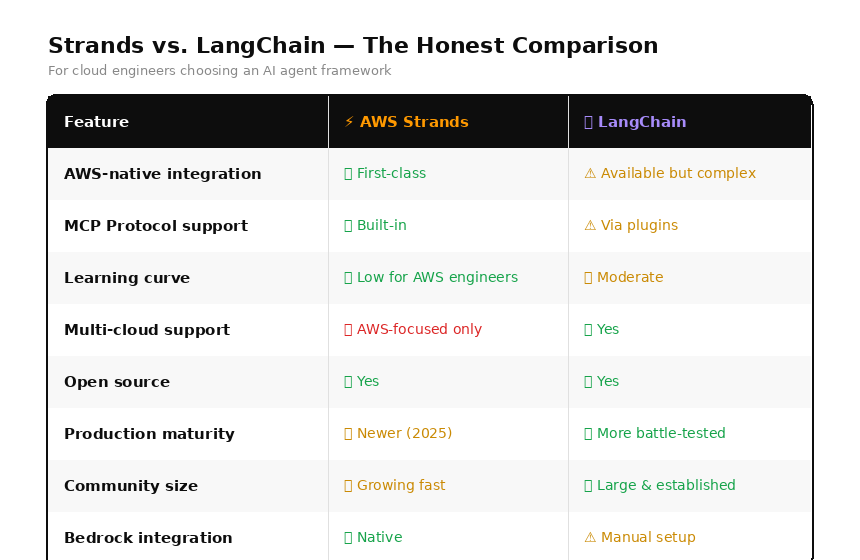
- It’s built for AWS-native workflows Unlike LangChain which tries to be everything to everyone, Strands is opinionated about AWS. It integrates cleanly with Bedrock, IAM, ECS, S3 and MCP servers out of the box. Less boilerplate. More time building.
- MCP support is a game changer The Model Context Protocol (MCP) allows your agent to connect to external tools and data sources in a standardized way. Think of it as a plugin system for AI agents. AWS already ships MCP servers for AWS documentation and diagram generation — which means your agent can look up current AWS docs before answering a question. That’s not a gimmick. That’s genuinely useful in production.
- Open source with AWS backing Strands is fully open-source on GitHub. You’re not locked into a proprietary API with rate limits and surprise pricing changes. You own the infrastructure. You own the code. AWS backs the roadmap.
- This is where cloud automation is heading CI/CD pipelines, infrastructure-as-code, auto-remediation scripts — these are the things DevOps engineers build today. Tomorrow, those workflows will be orchestrated by agents that can reason about what to do when a deployment fails, not just execute a predefined script. Strands is the foundation for that future. A Simple Code Example Here’s what building a basic Strands agent actually looks like in Python:
from strands import Agent
from strands_tools import use_aws
agent = Agent(
model="us.amazon.nova-premier-v1:0",
tools=[use_aws],
system_prompt="You are an AWS infrastructure assistant. Help users manage their cloud resources safely."
)response = agent("List all running EC2 instances in us-east-1 and flag any without proper tags.")
print(response)That’s it. The agent handles the entire agentic loop — invoking Bedrock, selecting the right AWS API call, executing it via use_aws and returning a structured response. No hand-rolled orchestration logic. No callback hell. Strands vs. LangChain: The Honest Comparison
strands vs langchain
The Bigger Picture: Agentic Cloud Is Coming We’re at an inflection point. Cloud computing started with virtual machines. Then containers. Then serverless functions. The next abstraction layer isn’t a new compute primitive — it’s intelligent agents that can reason about your infrastructure take actions autonomously, and handle complexity that no script can anticipate.
Getting Started 📦 GitHub: github.com/strands-agents/sdk-python 📖 Docs: strandsagents.com 🎯 Start with: The use_aws tool + a Bedrock-enabled AWS account 💡 Best first project: Build an agent that audits your AWS account for cost optimization opportunities Final Thoughts AWS Strands Agents won’t replace your Terraform scripts or your Kubernetes configs tomorrow. But it will start doing the thinking that sits above those tools — deciding when to apply them, how to respond when they fail and what to do next. The agentic loop is simple. The implications are not. If you’re in cloud, DevOps or backend engineering and you haven’t played with Strands yet — this weekend is a good time to start. Found this useful? Follow me for more content on AWS, cloud architecture and the intersection of AI and DevOps. I break down complex cloud concepts into things you can actually build. Tags: AWS · AI Agents · Cloud Computing · DevOps · Amazon Bedrock · Python · Machine Learning · Software Engineering
메타데이터
- post_id
- 939bfbd00c8a
- slug
- aws-strands-agents-the-ai-agent-framework-thats-quietly-changing-cloud-engineering-939bfbd00c8a
- url
- https://medium.com/@annyasif101/aws-strands-agents-the-ai-agent-framework-thats-quietly-changing-cloud-engineering-939bfbd00c8a
- canonical_url
- https://medium.com/@annyasif101/aws-strands-agents-the-ai-agent-framework-thats-quietly-changing-cloud-engineering-939bfbd00c8a
- author_url
- https://medium.com/@annyasif101
- status
- ok
- fetched_at
- 2026-06-09 15:37:30



