Unland: The Orphan’s Tunic (1997)…
The work’s subtitle draws directly from Paul Celan’s poem in Lichtzwang (Lightduress), where he writes of “the orphan’s tunic / torn…
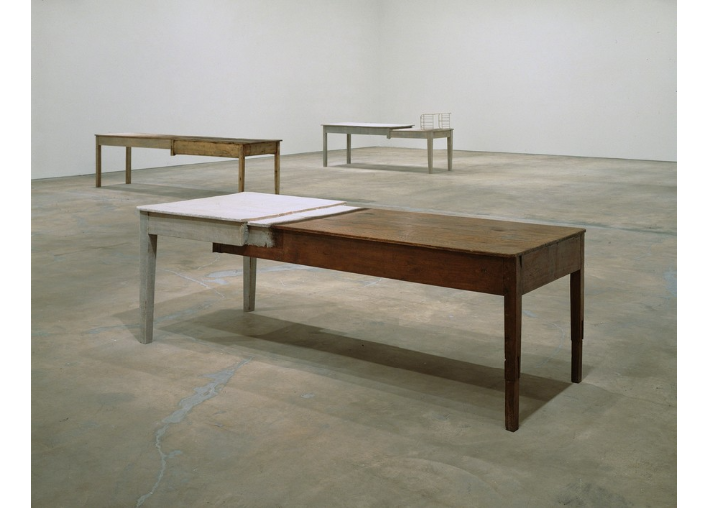
Doris Salcedo Unland: the orphan’s tunic, 1997, Wooden tables, silk, human hair and thread, 31 1/2 × 96 1/2 × 38 1/2 in | 80 × 245.1 × 97.8 cm
Doris Salcedo’s Unland: The Orphan’s Tunic (1997) is a work where sculpture becomes both elegy and testimony. Andreas Huyssen describes it as a “memory sculpture,” one that doesn’t monumentalize the past but instead materializes absence and loss in a fragile, almost private register (Huyssen, 2003, p. 110). The work consists of two disjointed halves of a wooden table forcibly sutured together, their broken legs concealed beneath a thin silk “tunic” stitched into the surface with thousands of strands of human hair. At first glance, the piece appears muted, almost domestic. But the longer one lingers, the more it reveals itself as a site of rupture — a silent monument to irreparable trauma.
The work’s subtitle draws directly from Paul Celan’s poem in Lichtzwang (Lightduress), where he writes of “the orphan’s tunic / torn, still warm, / sewn from the breath / of the disappeared” (Celan, 1970/2001, p. 45). Celan’s language, where fabric becomes breath and clothing becomes the skin of absence, underpins Salcedo’s approach. The “tunic” in Celan is not just a garment but a membrane between life and death, memory and erasure. By invoking this poem, Salcedo aligns her sculpture with a poetics of fragility and survival- an art that carries the trace of the disappeared without claiming to speak for them. Salcedo’s inspiration came from a Colombian girl who had witnessed her mother’s murder and continued to wear the last dress her mother had sewn for her every day in an orphanage. The dress became both a relic and a wound, a marker of loss and of identity (Huyssen, 2003, p. 112). In Unland: The Orphan’s Tunic, Salcedo does not recreate the dress; instead, she translates its emotional weight into a table covered by a silk “skin,” stitched to wood with human hair. The result is not representation but transposition: a movement from story into object, from memory into material. The table itself is crucial. As an archetype of communal life, it evokes meals, family, conversation- the ordinary fabric of social existence. Here, however, it is broken and forcibly joined, suggesting a community ruptured by violence. The silk covering is so thin it frays into the cracks of the wood, evoking a skin stretched over a wound, a surface trying to hold together what has been irreparably torn (Huyssen, 2003, p. 114). The human hair threaded across the surface amplifies this effect. Hair is both intimate and unsettling: a trace of life, yet often associated with death and mourning. Celan’s “sewn from the breath” resonates here; the hair becomes the last corporeal whisper of the absent body, a thread between memory and oblivion.

Poet Paul Celan
In Lichtzwang, Celan writes: “Memory sews with blind fingers, / each stitch a scar, / each scar a name not spoken” (Celan, 1970/2001, p. 46). Salcedo’s process literalizes this poetic image. The absurd, painstaking act of stitching thousands of hairs through wood- an almost impossible task- becomes a ritual of mourning and defiance. It acknowledges that the wound cannot be healed, yet insists on threading it into visibility, refusing erasure. The labor itself becomes a form of resistance, a “minimal hope,” as Huyssen calls it- not redemption, but the refusal to forget (Huyssen, 2003, p. 122). Unland: The Orphan’s Tunic also performs memory temporally. It does not strike the viewer with immediate clarity; instead, its meaning emerges belatedly, in what Freud calls Nachträglichkeit — a deferred action of understanding. The longer one observes, the more the fractures, stitches, and delicate materials unfold their narrative. In this way, the sculpture enacts memory itself: layered, delayed, and always incomplete (Huyssen, 2003, p. 120). Celan’s poem mirrors this temporality: “You hear it late, / the whisper through cloth, / a voice that has no mouth” (Celan, 1970/2001, p. 47). Salcedo’s table whispers in the same way: not loudly, not didactically, but through the almost inaudible presence of absence.
One of the most profound aspects of the piece is its relationship to absence. The table is there, but the chairs are missing. The silk is there, but the body it might cover is gone. The hair is there, but not the living head. This negative presence echoes Celan’s line: “What remains is what is not there / and yet presses upon you” (Celan, 1970/2001, p. 48). Salcedo makes this pressure palpable. The viewer becomes a secondary witness, drawn into an encounter with a story that can never be fully told, only felt through material traces (Huyssen, 2003, p. 123). Importantly, Salcedo resists turning this work into a public monument. Huyssen emphasizes that Unland: The Orphan’s Tunic addresses the intimate gaze of a single beholder rather than a collective audience, creating a private space of remembrance (Huyssen, 2003, p. 118). This refusal to monumentalize trauma prevents the work from becoming a substitute for memory; instead, it functions as a fragile vessel that keeps memory alive in its most vulnerable, personal dimension. In this, Salcedo aligns with Celan’s poetics, where language itself is hesitant, broken, whispering “across the unsayable” (Celan, 1970/2001, p. 49).
The work’s beauty is striking. The muted palette, delicate silk, and intricate stitching create an aesthetic allure that draws the viewer in. Yet this beauty is not decorative; it is what allows the viewer to stay with the pain without turning away. Huyssen calls this the “compelling beauty” of Salcedo’s work, a beauty that does not soothe but sustains the confrontation with trauma (Huyssen, 2003, p. 124). Celan’s poem again echoes this paradox: “The torn cloth shines / in its ruin, / and we call it beautiful / because we cannot call it back” (Celan, 1970/2001, p. 50).
Unland: The Orphan’s Tunic does not tell the girl’s story nor the story of countless orphans of violence. It cannot. What it does is create a bridge, a space where absence is held in material form, where the viewer is asked to carry a fragment of memory forward. As Salcedo stitches silk and hair over fractured wood, she threads together history’s wounds without claiming to heal them. Celan’s final lines from the poem resonate as a coda: “Sew, even as the cloth tears. / Sew, though the hands are gone. / Sew, because the memory is all that holds” (Celan, 1970/2001, p. 51). In that act of sewing- literal and metaphorical- Salcedo locates the essence of memory as both impossibility and necessity.

Artist Doris Salcedo
References
- Celan, P. (2001). Lightduress (P. Hamburger, Trans.). Green Integer. (Original work published 1970).
- Huyssen, A. (2003). Present Pasts: Urban Palimpsests and the Politics of Memory. Stanford University Press.
메타데이터
- post_id
- 939dc98e5a8d
- slug
- unland-the-orphans-tunic-1997-939dc98e5a8d
- url
- https://medium.com/@saaqibhat/unland-the-orphans-tunic-1997-939dc98e5a8d
- canonical_url
- https://medium.com/@saaqibhat/unland-the-orphans-tunic-1997-939dc98e5a8d
- author_url
- https://medium.com/@saaqibhat
- status
- ok
- fetched_at
- 2026-08-21 15:16:25





