The Aesthetics of Spontaneity
The thoughts that visit us ever so unexpectedly, unbidden, with total ease, resemble a shadow: in the attempt to seize them, they only…
The Aesthetics of Spontaneity
The thoughts that visit us ever so unexpectedly, unbidden, with total ease, resemble a shadow: in the attempt to seize them, they only retreat further.
In those moments when rays of inspiration descend upon us, as if illuminating and even gently warming the spirit, we ought to smile at this Sun and walk toward it, unafraid of being blinded — for the blinded is capable of learning to contemplate that which is inaccessible to the sighted. Then, our shadow shall alluringly follow in our wake.
Inspiration itself is something fleeting and ephemeral, and certainly does not suffice as a foundation where creation is of a constant, stable nature. And yet, it is a state to be trusted; if spontaneous creative impulses seek the light, they should be given rein at once, just as one must immediately attend to a birth once the labor pains have begun. At times, the role of the maieutic to one’s own thoughts comes to the thinker with ease; at other times, one’s offspring must be helped along and labored over. But one thing is undeniably certain: if a thought has begun to seek the light quite spontaneously, then the very moment it so asserts itself is the most perfect for its birth.
Spontaneity in creating cannot be learned; that would merely constitute systematicity. The spontaneous genesis of thoughts is akin to walking through a field, which is covertly a minefield: as one walks on, and sooner or later they step upon mines that will immediately detonate — with the sole peculiarity of imparting not a destructive force, but a creational one. A
n essential condition for spontaneous creation is unforcedness. There must be a readiness to create, but not an overanxious intention. By attempting to create deliberately, approaching it mechanically and as a matter of routine, one will obtain but a slack structure, and not a work of art abundant with ingenuity. This is akin to crafting an object but failing to sublimate it (with the gift of meaning and significance) — failing to breathe life into it, failing to invest it with a soul, as if Prometheus would mold man from clay with no Athena to bestow her bliss.
To “be invested with one’s soul” means to leave one’s unique imprint upon what is created. There is a certain kind of madness in attempts to resemble others while neglecting to resemble oneself; precisely like trying to fish amidst a mighty river without getting in a firm skiff.
The greatest of arts — the art of living — finds its core in the practice of becoming oneself to the ultimate possible extent. In moments of spontaneous enlightening, Life, so wise as she is, grants us a way to touch this highest of arts, allowing our “I” to speak. To its better self, as it were, this “I” offers praise in such stances, saying: “Look and listen; harken to the voice that echoes from the heights of my expressive longing.”
However, it is still indispensable to have the fitting eyes and ears for what has been created by the others in a surge of exalted feelings; he who is accustomed to the warm breath of the lowland air may not withstand the atmospheric pressure of the heights. The creator himself, having succumbed to spontaneity, is a receiver. It is as if fruits are poured upon him from without, like the honey of the spirit, whose ripening was hitherto hidden from the eyes. Rarely does the creator come to understand that it is not being poured upon him, but that he is pouring outward; out of his Abyss, all beauty and all honey overflow.
Spontaneity is the giving hand of that boundless depth, for in minutes of spontaneity there is no need to draw from it; everything seeks the exit of its own accord, for it has already ripened. But how can he help but to be surprised — he who knew not what was ripening within him, for he did not immerse himself in his own being nor explore his own depths? The creator pours out from within spontaneously, yet he perceives and lives through it all as if it were being poured upon him.
His bliss lies in giving away the blissful. No one is less parsimonious than this fortunate fisherman, into whose net the fish climb at their will — yet there is also no one capable of giving what he gives. To create means to give to all and everyone, but only not to oneself, for the created thing eventually alienates from its creator. The creator cannot stand but long for what abandons him.
To be, to love, to give, to create — are these not all one and the same?
The surrounding world is the clay, and the will is the sculpting hand.
I order the Natural Chaos out of a love for it, as if I ‘destroy’, ‘annihilate’ it, making it disappear ; but then, one day, Chaos is bound to ‘destroy’ me, out of a love called the Great Indifference.
But am I myself not a mere clay? Am I myself not a guided pawn? Yet every pawn still desires to become the leading one, and this striving endows one with mastery. Therefore, there can be no pawns, but each is a master — capable of commanding — only to the extent that he learns to command himself, having beforehand become one who can find himself. For him who has not found and enthroned himself, there still remains the path of a builder. The “I” is the temple and the throne — one’s biggest means to boon and give.
Who can ever say how much conscient suffering and overcoming of cowardice it takes to win the spontaneity as an ally? Who can ever fully relate to what the spontaneous man is capable of?
Spontaneity is a self-composing great poem and a harmonious dithyramb, a self-painting picture, a self-erecting temple and an eternal monument, a self-molding sculpture, a self-growing tree.
This call of the depths can be felt as a revelation from above, like a cry for help, pleading for assistance in birthing the beautiful. Its cause is never seen, its origin stays unknown; known only is the flow itself and the variegated, glittering jewels, exactly an Eternity cristalyzed. The beginning is unknown, known only is the path; the end is but arbitrary.
There is but the Becoming; spontaneity consists its concentration — and consequently, concentrated being. An endless fall into a bottomless well… or? An illimited flight toward an unreachable peak.
And how else, if not in a grand, magnificent soaring, would I have known that it is impossible to catch anything graspable, and therefore gave in myself to an incessant search for that which can be grasped? If not as if, being winged, I wished to cut off my too worldly wings to grow in their stead wings of pure rays of light; as if, with a strike upon a miraculous gong, I sought to awaken myself from a suffocating and tormenting waking dream; as if I wished to cast off all constraining garments from my soul and illuminate everything around with its glittering nakedness; as if I were a parched tree in a misty, chilling gloom, longing for the touch of a glittering and searing lightning — I surrender myself to spontaneity.
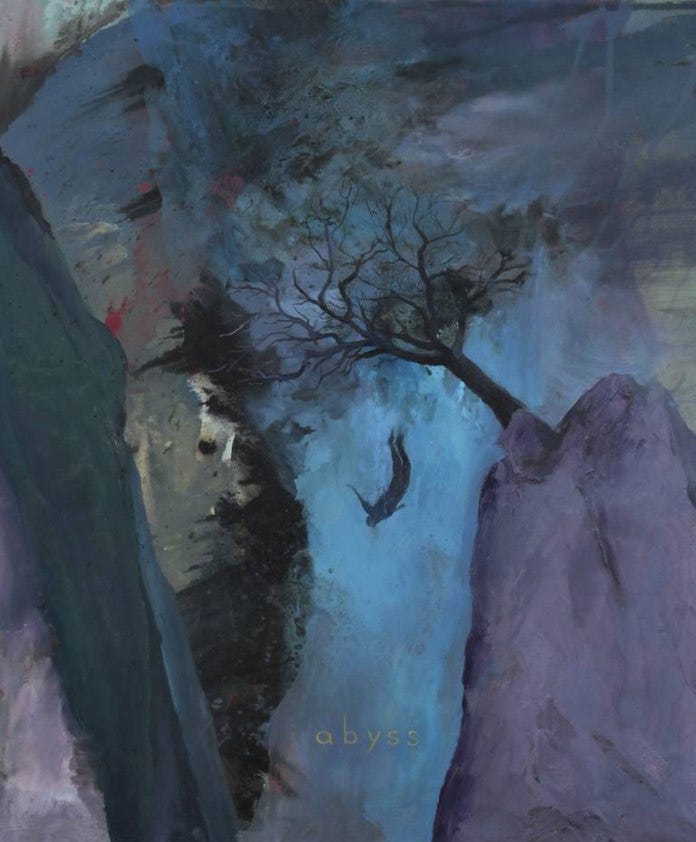
Abyss (by Jose Antonio Hinojos Morales)
메타데이터
- post_id
- 93a1386918ea
- slug
- the-aesthetics-of-spontaneity-93a1386918ea
- url
- https://medium.com/the-art-of-thinking/the-aesthetics-of-spontaneity-93a1386918ea
- canonical_url
- https://medium.com/the-art-of-thinking/the-aesthetics-of-spontaneity-93a1386918ea
- author_url
- https://medium.com/@LettersFromAThinker
- status
- ok
- fetched_at
- 2026-06-11 05:11:55





