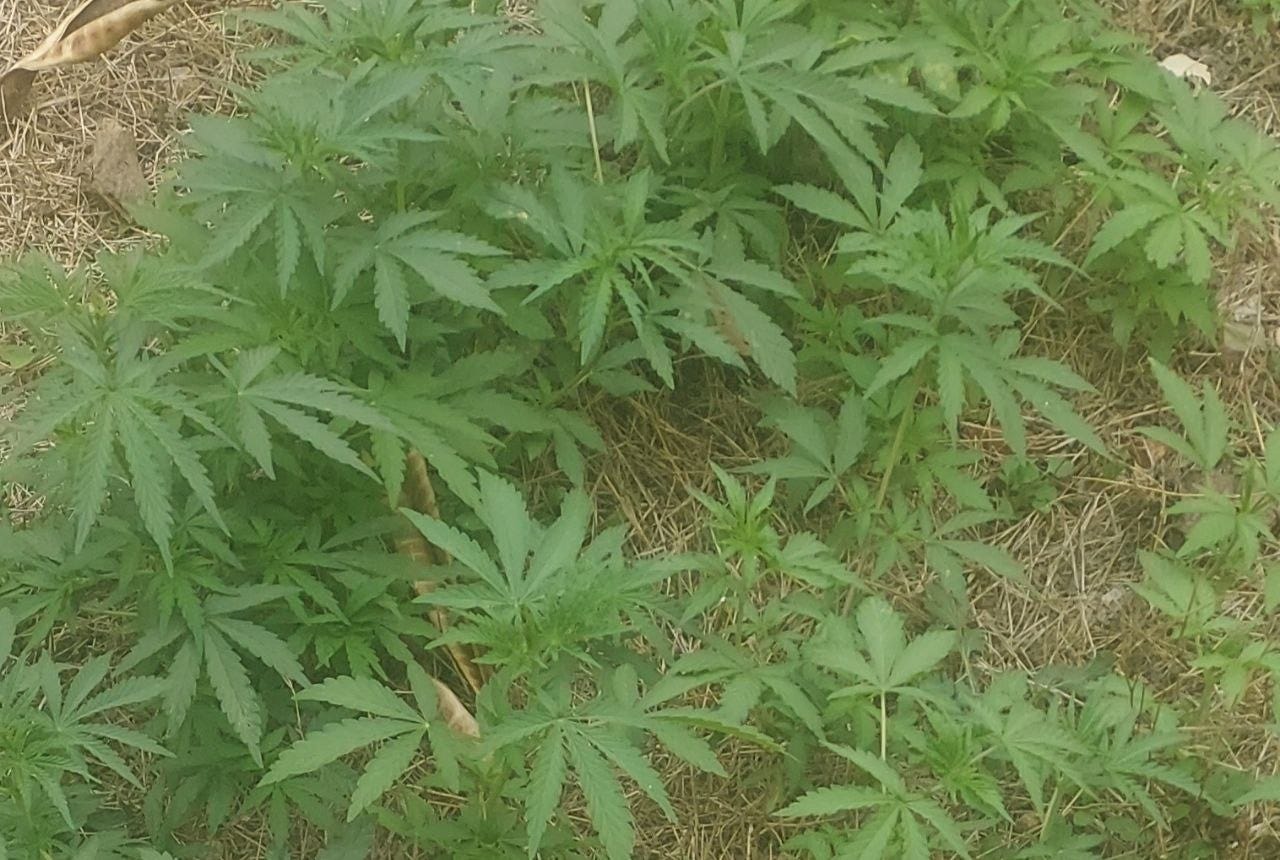
After Diamond Shruumz: Inside the Hemp Industry’s Year of Reckoning
A federal deadline is six months away, the FDA has missed its own implementation date, and a $28 billion market is about to find out which…
After Diamond Shruumz: Inside the Hemp Industry’s Year of Reckoning
A federal deadline is six months away, the FDA has missed its own implementation date, and a $28 billion market is about to find out which operators have been preparing for the cliff.
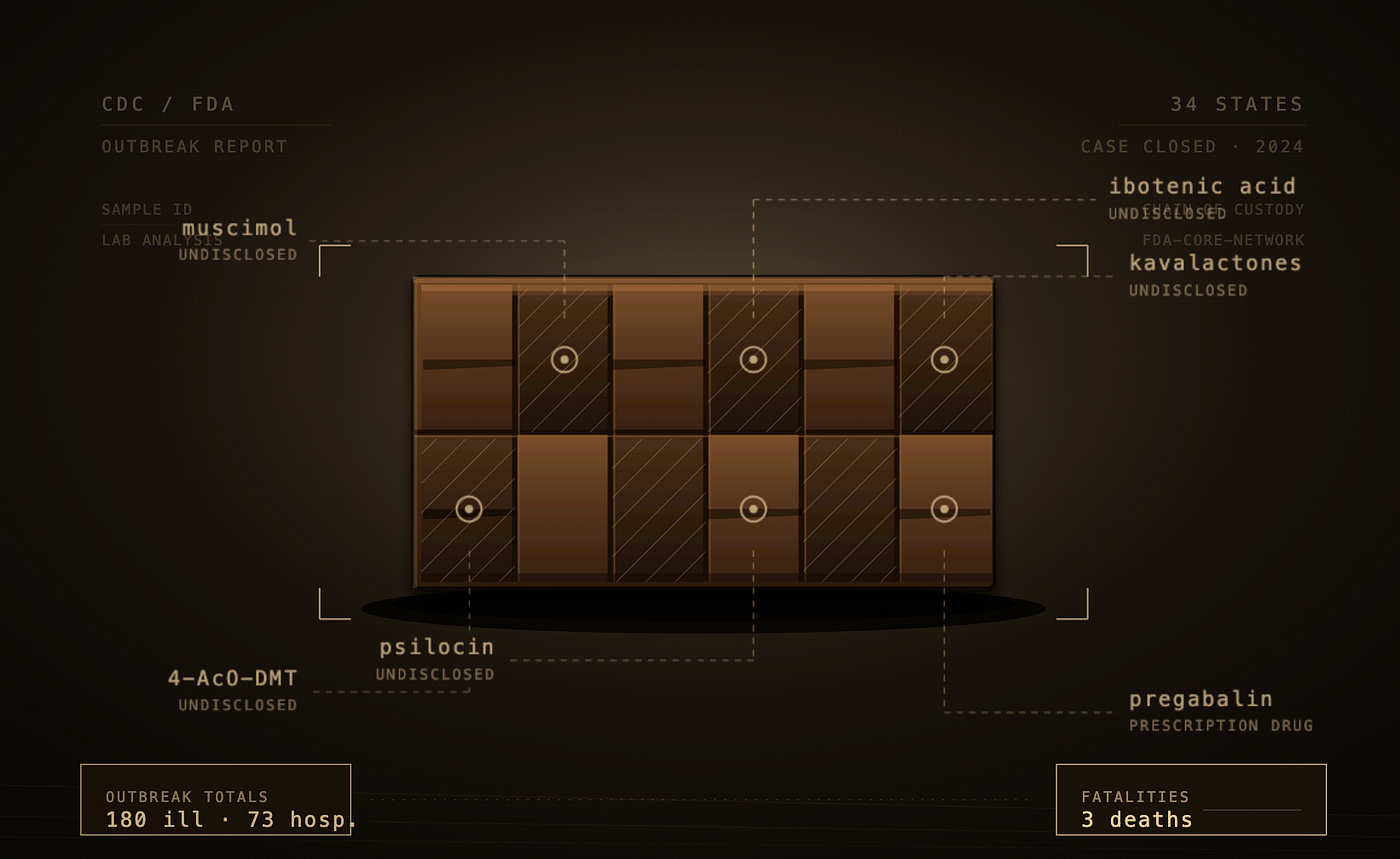
When the CDC closed its Diamond Shruumz investigation in an April Morbidity and Mortality Weekly Report, the toxicology summary read less like a confectionery panel than a cabinet of pharmaceutical errors. Across the brand’s chocolate bars, infused cones, and gummies, FDA testing had identified muscimol and ibotenic acid from Amanita muscaria.
4-acetoxy-DMT, a synthetic prodrug of psilocin. Psilocin itself, a Schedule I controlled substance. Kavalactones from the kava plant. And pregabalin, an FDA-approved anticonvulsant that no one buying a microdose chocolate at a Texas smoke shop expected to find in their dessert.
Of 180 reported cases of severe illness across 34 states, 73 people were hospitalized, 38 admitted to intensive care, 29 required endotracheal intubation, and several died. None of the additional compounds appeared on the product labels.
The manufacturer, a California operator called Prophet Premium Blends, ran the products through smoke shops, vape stores, and online retailers in 34 states before federal investigators caught up with the supply chain.
The case is closed in the regulatory sense. The FDA followed in late 2024 with a letter to industry declaring that Amanita muscaria and its psychoactive constituents do not meet the Generally Recognized as Safe standard for use in food. The MMWR offers a tidy epidemiological postmortem.
That should have settled something. Instead, Diamond Shruumz turned out to be the loud version of a much quieter story — a sprawling hemp and “functional” edibles market in which the compound on the label and the compound in the package have become loosely related concepts.
And as of November 2025, that market is operating under a one-year countdown to federal restrictions that almost no current operator can meet without significant reformulation.
The category, not the brand
Diamond Shruumz's illnesses were severe enough to generate national press. The wider pattern is arguably worse because it has produced fewer headlines.
A 2024 paper in Frontiers in Pharmacology tested 202 commercially available CBD products drawn from US retail. Fewer than one in four landed within ten percent of their stated potency. One product clocked in at 565 percent of label claim. Heavy metals turned up in roughly one in five samples, with lead the dominant contaminant; five products exceeded regulatory thresholds for it.
Residual solvents appeared in 90 percent of products tested. Pesticides in 15 percent. The study was co-authored by researchers at Jazz Pharmaceuticals, which makes the FDA-approved CBD drug Epidiolex, but the laboratory work itself was conducted by Ellipse Analytics, an independent contract lab in Denver.
Earlier industry-side audits documented the same gap from a different angle. A 2022 Leafreport review of 188 CBD brands and 4,384 SKUs reported that 7 percent of brands tested across the full contaminant panel — pesticides, heavy metals, microbes. The remaining 93 percent tested narrower, or tested a single SKU and reused the result across an entire portfolio.
Pediatric exposure data tells a parallel story. Researchers at Nationwide Children’s Hospital tracked delta-8 THC calls to US poison centers across the 24 months ending December 2022 and recorded a near-80 percent spike.
Of those calls, almost one in three involved a child under six. In Indiana, the state poison center logged a 41 percent jump in total cannabinoid exposures between 2022 and 2024; for children under five, the increase was 46 percent. The product driving most of those calls is a hemp gummy in a mylar bag.
Then came Section 781
On November 12, 2025, the Continuing Appropriations Act of 2026 (H.R. 5371) was signed into law. Tucked inside the omnibus, Section 781 rewrote the federal definition of hemp in ways the industry is still working to absorb.
The 2018 Farm Bill defined hemp as cannabis with a delta-9 THC concentration of no more than 0.3 percent by dry weight. That single metric, measuring one isomer rather than total THC, created the legal foundation for a multi-billion-dollar market in cannabinoids that were technically not delta-9: delta-8, delta-10, THCA, HHC, THC-O. The effects were functionally similar to delta-9. The chemistry was not.
Section 781 closes that opening. Effective November 12, 2026, hemp is defined by total tetrahydrocannabinols, inclusive of THCA. A 0.4 milligram cap on combined THC per retail container applies to finished products.
Any cannabinoid synthesized or chemically converted outside the cannabis plant is excluded from the hemp definition entirely, regardless of whether the resulting molecule is structurally identical to a naturally occurring phytocannabinoid.
For context: a standard 10-milligram delta-9 gummy contains 25 times the federal per-container limit. The U.S. Hemp Roundtable has estimated that roughly 95 percent of currently available hemp-derived cannabinoid products will become non-compliant the day the law takes effect — and, by operation of the Controlled Substances Act, default to Schedule I treatment. The trade group puts the affected market at $28.4 billion and roughly 300,000 jobs.
There is also a procedural complication. Section 781 required the FDA to publish, within 90 days of enactment, three lists identifying which cannabinoids are naturally occurring, which are THC-class, and which produce effects similar to THC.
That deadline was February 10, 2026. The agency missed it. A CBD Products Compliance and Enforcement Policy was submitted to the Office of Management and Budget in March and remains under review at the time of writing.
Legislative repeal efforts are running on a parallel track. The American Hemp Protection Act, introduced in late 2025 by Representatives Nancy Mace (R-SC), Thomas Massie (R-KY), Zoe Lofgren (D-CA), and James Baird (R-IN), would strike Section 781 in its entirety.
A separate Baird-led bill, the Hemp Planting Predictability Act, would push the effective date to November 2028 without altering the substantive definitional change. Neither bill has a clean path in a midterm election year.
What “preparing” looks like
Industry voices have begun to diverge. A faction is lobbying hard for repeal, betting on a midterm-year reprieve. A smaller faction has spent the last six months publicly arguing that the regulatory direction is correct, the deadline is survivable, and the brands that built operations as if regulation were already in the room will be the ones still operating in 2027. BudPop’s CEO recently published one of the more pointed versions of this argument on LinkedIn.
The framework that keeps surfacing in those statements is consistent enough to summarize, though operators generally describe it in pieces rather than as a checklist.
The first piece is testing infrastructure. The argument is that any product capable of intoxication, and any product making a wellness claim, should be tested by an ISO/IEC 17025-accredited third-party laboratory, on every batch, across a full panel — cannabinoid potency, residual solvents, pesticides, heavy metals, microbials, mycotoxins.
The Certificate of Analysis for the specific lot a consumer is holding should be accessible via QR code on the package, not a single historical COA stretched across a portfolio. The Hemp Beverage Alliance has published full-panel testing principles as an industry-internal version of this floor; the Leafreport 7 percent figure suggests how far the actual floor still has to rise.
The second piece is packaging and labeling. Child-resistant packaging certified to ASTM D3475–20 addresses the poison-center surge directly: pediatric exposures are happening because hemp gummies are being sold in mylar bags with the structural integrity of a candy wrapper. The international intoxicating cannabinoid product symbol, ASTM D8441/D8441M, drafted by ASTM’s cannabis committee in 2022 and already incorporated into the cannabis labeling rules of seven states, addresses the question of whether a product capable of intoxication is visually identifiable as one before it ends up next to the snack drawer.
The third piece is third-party certification. The U.S. Hemp Authority expanded its Adult-Use Hemp Product Certification in April 2024 specifically to cover intoxicating hemp, with additional compliance points for marketing, labeling, and age-gating. Operators in the prepare-for-the-cliff camp tend to treat the certification not as marketing collateral but as a public commitment to a third-party reviewer with revocation power.
The fourth piece is the one that splits the industry. A subset of operators has argued publicly that the FDA should be granted mandatory recall authority over the category , the authority the agency lacked when Diamond Shruumz product was being shipped to 34 states through voluntary-recall channels.
The case is that mandatory recall makes a market real. It is the precondition for major retailers, payment processors, and eventually pharmacies to engage with the category at all.
Quiet enforcement, loud deadline
While Section 781 waits for its November date, the FDA has been working the authority it does have. In September 2025, the agency issued a warning letter to Blue Forest Farms, a Colorado-based operator selling Amanita muscaria capsules, tinctures, and chocolate bars labeled as dietary supplements.
The letter cited the December 2024 GRAS determination and informed the company that its products were adulterated under the Federal Food, Drug, and Cosmetic Act. Similar letters have continued to issue at a quiet but steady cadence through the first quarter of 2026.
State-level action is moving faster. Texas Department of State Health Services total THC rules took effect March 31, 2026, ahead of the federal date.
California’s AB 8 prohibited hemp flower, prerolls, and inhalable products at retail beginning January 1. Several other state regulators have signaled they will move similarly through 2026.
What survives the cliff
Categories rewritten in a single legislative cycle tend to lose their most opportunistic operators first. The Section 781 sunrise is roughly six months away. The FDA’s missed February deadline created additional ambiguity but no additional time.
A consumer who scans a QR code on a hemp product in November of this year and finds a lot-level Certificate of Analysis, an ASTM intoxication symbol, child-resistant packaging, and a verifiable certification will be holding something that looks, in everything but legal classification, indistinguishable from a pharmaceutical product. That is the brand that survives the cliff.
A consumer who scans a QR code and finds a broken link, an outdated COA from a different batch, or no code at all will be holding the thing the FDA has spent six years writing warning letters about.
The Diamond Shruumz investigation closed in April with 180 cases of severe illness recorded across 34 states. The conditions that produced it -undisclosed compounds in a product sold as a microdose mushroom edible, manufactured by an operator that ASTM-accredited testing would have caught and that mandatory recall authority would have stopped within days of the first poison-center call -are the same conditions Section 781 was drafted to eliminate.
Whether the new law is repealed, delayed, or enforced on schedule, the operators who have spent the last three years building as if regulation were already in the room are the ones likely to find out, in November, that it always was.
메타데이터
- post_id
- 93a4d1fa0742
- slug
- after-diamond-shruumz-inside-the-hemp-industrys-year-of-reckoning-93a4d1fa0742
- url
- https://medium.com/@jesse_bernard/after-diamond-shruumz-inside-the-hemp-industrys-year-of-reckoning-93a4d1fa0742
- canonical_url
- https://medium.com/@jesse_bernard/after-diamond-shruumz-inside-the-hemp-industrys-year-of-reckoning-93a4d1fa0742
- author_url
- https://medium.com/@jesse_bernard
- status
- ok
- fetched_at
- 2026-06-09 15:37:30