AI is About to Give Nonprofits a Crash Course in Fundraising Ethics
Why the fundraising profession must update its ethical standards before AI performance and donor trust collide
AI is About to Give Nonprofits a Crash Course in Fundraising Ethics
Why the fundraising profession must update its ethical standards before AI performance and donor trust collide
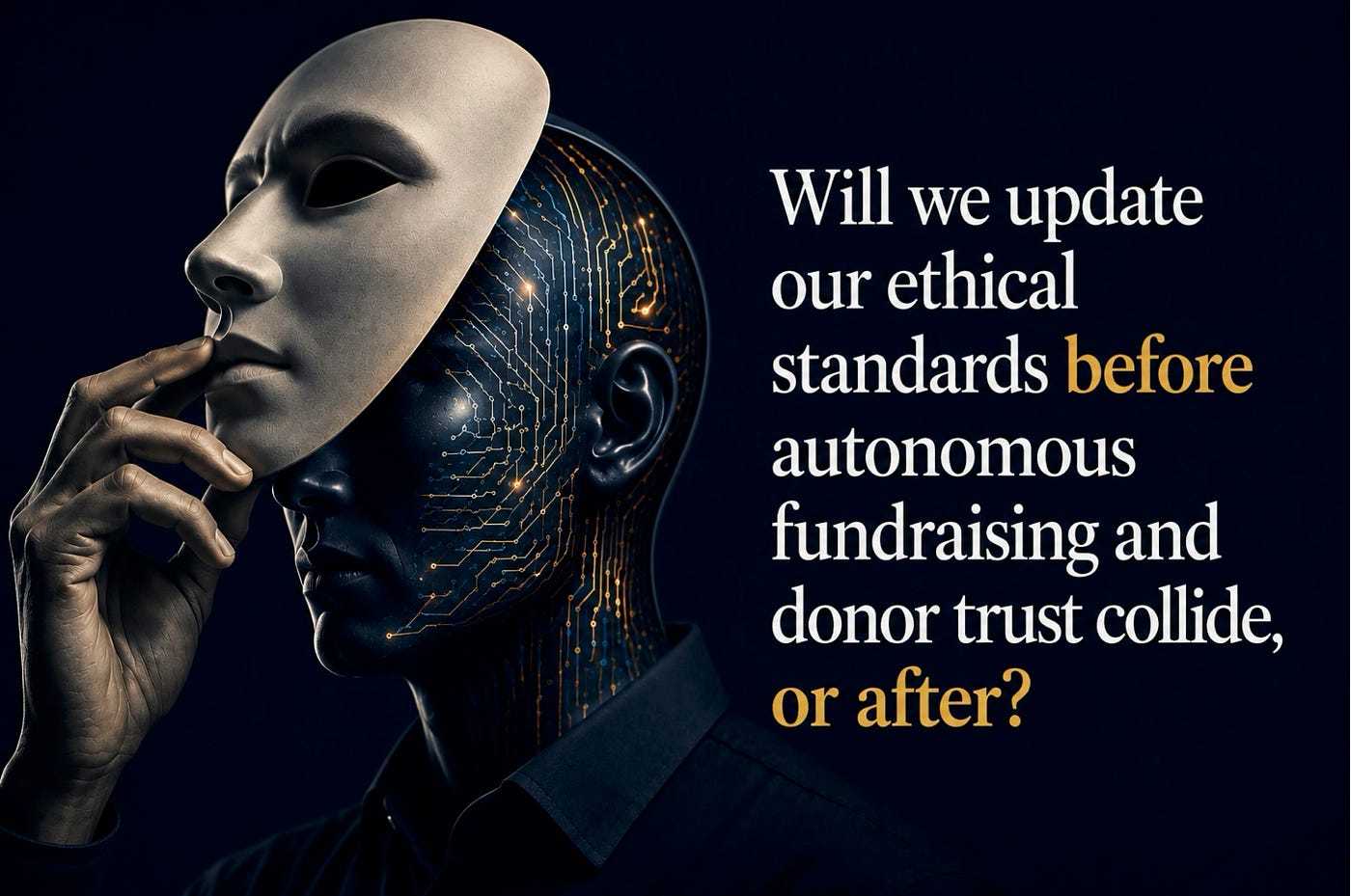
I need to begin with a confession: I am one of AI’s strongest advocates in the fundraising profession. I wrote an entire book arguing that artificial intelligence will transform fundraising for the better — that it will free fundraisers from administrative drudgery, deepen their understanding of donors, and allow them to spend more time doing what only humans can do.
I believe that today more than ever. But that same book carries a warning that runs through its final chapters and culminates in its closing argument: the transformation will only be a blessing if we use AI responsibly. I wrote about the guardrails organizations need to preserve donor trust. I argued that AI should never be allowed to operate autonomously in donor relationships, and that irresponsible use wouldn’t announce itself — it would creep in quietly, hollowing out the trust that makes generosity possible.
I assumed we had years to get ahead of those questions.
We don’t.
A team of researchers led by the University of Oxford pitted leading AI models against experienced human persuaders in a series of experiments, culminating in a real-money fundraising test. Professional canvassers — people who had spent years raising money on behalf of Save the Children — competed against an AI system in live, one-on-one conversations with prospective donors. The results were not close. The AI persuaded nearly three times as many participants to donate, and the gifts it secured were, on average, about 13 percent larger. Participants rated the AI’s arguments as stronger. They said it taught them more. Most remarkably of all, they rated it as more empathetic than the human professionals.
The study is a preprint and has not yet been peer reviewed, and its authors are careful not to overstate their findings. But I have read a great deal of research on AI and fundraising over the past several years, and I believe this may be the most consequential AI fundraising study published to date.
Not because AI outperformed professional fundraisers. Given the trajectory of this technology, that result was inevitable. What should get our attention is the timeline. Most of us — myself included — believed we were preparing for the next generation of AI. This study says the future we were preparing for is already conducting donor conversations, today, and winning them.
It is consequential because it exposes an ethical collision that our profession can now clearly see coming — and, for once, we can see it before impact.
That is the subject of this article. Not the technology — the ethics. Because the uncomfortable truth this study reveals is that the technology is now moving faster than our standards. The rest of this article is about closing that gap while we still can.
Three Things This Study Makes Clear
This study matters because it brings three distinct issues into focus at the same time: what AI can now do, what it should be permitted to do without disclosure, and what happens when fundraising performance and donor trust come into conflict.
1. AI is no longer just a tool for fundraisers. It is becoming a substitute fundraiser.
For the past several years, most conversations about AI in fundraising have focused on assistance. AI can help draft an appeal, analyze a donor file, summarize a meeting, identify giving patterns, personalize communications, or recommend a next step. In each of these cases, the AI works behind the scenes while a human being remains the face of the relationship.
This study moves the conversation well beyond assistance.
The AI did not merely support a fundraiser working in the background. It engaged directly in live fundraising conversations — and it outperformed experienced professionals at their own craft. It asked questions, interpreted responses, adapted its arguments, introduced relevant information, addressed objections, and guided donors toward a decision.
That distinction matters enormously. AI is moving from being a tool used by fundraisers to being an active participant in fundraising itself.
And this is not confined to the laboratory. Autonomous AI fundraisers are already a commercial product. Version2, the AI research lab launched by fundraising technology company Givzey, markets what it calls — in its own words — “fully autonomous fundraising.” Its Virtual Engagement Officers each manage a portfolio of a thousand prospects: qualifying donors, building relationships through personalized engagement, making solicitations, closing gifts, and stewarding donors afterward — “all autonomously,” as the company puts it, “with no human intervention.” These are not pilots or prototypes. They are deployed at universities across the country, and the gifts are real: the company reports its autonomous fundraisers have raised millions of dollars, including a six-figure gift surfaced entirely through AI-driven donor cultivation.
And we are only at the leading edge of what will soon be possible. Today, these interactions happen mostly through text-based chat. Soon, donors may routinely encounter highly capable AI agents through email, text, voice, video, websites, and social platforms — agents available around the clock, conversing simultaneously with thousands of people, remembering every prior interaction, and continuously improving their approach.
The remaining limits on AI in fundraising are becoming less about capability and more about the boundaries we choose to establish around its use.
2. The central question is no longer what AI can do. It is not even what AI should do. It is what donors deserve to know.
For years, the dominant question in our field has been: How can we use AI to raise more money? That question is no longer sufficient.
We must now also ask: What parts of the donor relationship should be entrusted to AI? When should a human remain directly involved? When does assistance become impersonation? When does personalization become manipulation? And at what point does a donor have a right to know that the person — or apparent person — with whom they are interacting is not human?
These are not abstract questions about a distant future. The technology needed to create highly persuasive, highly scalable AI fundraising agents already exists. The study proves it.
And the study raises the disclosure question in the starkest possible terms, because the AI engaged donors without ever revealing that it was an AI system. That means its results cannot be separated from the conditions under which they were achieved. If a donor reasonably believes they are conversing with another person, but is actually interacting with a machine, the issue is not merely whether the conversation was effective. The issue is whether the entire interaction was built on a foundation of deception.
This is where transparency becomes central. To be clear: not every use of AI requires disclosure. A donor probably does not need to know that AI helped a fundraiser summarize meeting notes, research a shared interest, or sharpen the clarity of a letter. Those uses support the human relationship; they do not substitute for it.
But direct interaction is different. When AI occupies the place a donor reasonably assumes is occupied by a human being, nondisclosure risks creating a false impression about the relationship itself.
3. Fundraising performance and donor trust are on a collision course.
The performance incentives revealed by this study are unmistakable.
Nonprofits face constant pressure to raise more money while controlling costs. Fundraising teams are chronically understaffed, overextended, and expected to deliver increasingly ambitious results. If AI can conduct more donor conversations, respond more quickly, remain available continuously, and generate stronger results at a fraction of the cost of human labor, organizations will use it.
That is not cynicism. It is economic reality.
But here is the question the study never asked: To what extent does AI’s persuasive advantage depend on people not knowing they are engaging with AI?
In a randomized field experiment published in *Marketing Science*, undisclosed AI chatbots making sales calls performed as well as proficient human agents — but when the chatbot disclosed its identity at the start of the call, purchase rates collapsed by nearly 80 percent. The bot hadn’t gotten worse. The customers had simply changed: once they knew, they became curt, rated the identical bot as less knowledgeable and less empathetic, and bought less. And that was 2019 –years before the AI systems that just outperformed professional fundraisers existed.
And if AI’s advantage really does rest on people not knowing, a second question follows: What happens when donors find out?
Imagine a donor — call her Margaret. She is seventy-two, and she has been giving generously to a children’s charity since her husband died. Last year, someone from the organization began checking in with her. He remembered everything: her birthday, her granddaughter’s name, the reason she gives a gift in April every year in memory of her husband. When she mentioned wanting her gifts to mean something lasting, he walked her through a legacy pledge with patience and what she would later describe as kindness. She upgraded her monthly gift. She enjoyed her conversation with him so much that she even mentioned him to her friends — “I’m so impressed with how much they care,” she told them.
Then, gradually, small things begin to nag at her. He answers her emails instantly — at seven in the morning, at eleven at night, always. Every question has an immediate answer; he never needs to check on something and call her back. His warmth never varies, but he never shares anything personal. Nothing is wrong, exactly. Everything is a little too perfect.
Then one afternoon, feeling half-foolish for even wondering, she asks the question: Am I talking to a real person? And he tells her the truth.
Here is what matters about Margaret’s story. None of what came before the moment she learned the truth will matter, because Margaret will now reread every warm exchange in her memory as a technique. The remembered birthday becomes a database field. The kindness becomes code. She will not simply stop trusting that charity. She will wonder, every time any organization reaches out to her, whether anyone is there at all.
Margaret may be fictional, but nothing in her story asks the reader to suspend disbelief. The technology exists. The pressure to deploy it exists. And we viscerally relate to her feeling of betrayal.
Now consider a different scenario — about a family we’ll call the Hendersons. It begins with a phone call from the bank’s fraud department: a transaction on their parents’ account has been flagged as unusual. Thousands of dollars, in a single gift, from a couple in their eighties living on Social Security and a modest pension.
The children investigate, braced for the familiar story about a scam artist taking advantage of vulnerable individuals. What they find is more disorienting. The money went to a real charity. A legitimate one, with a good rating and a mission their parents genuinely care about. Their father, when asked, is not embarrassed — he is proud. Someone from the organization had been calling for months, he explains. She always had time for him. She asked about his health, remembered that his brother had died of the disease the charity fights, and persuaded him to make this gift in honor of that memory. She spoke about the research with real hope — “we’re closer than ever to a cure,” she told them — so after talking it over with his wife, they decided the sacrifice was worth it.
It takes the family several more phone calls to learn that “she” was an AI agent — one of thousands of simultaneous conversations the system was conducting that month, each one patient, warm, and perfectly calibrated to the person on the other end.
Here is what makes the Hendersons’ story so uncomfortable: it contains no villain and no lie about the cause. The charity was real. The need was real. The gift will do genuine good.
But persuasion without judgment is not fundraising. It is extraction by an algorithm with good manners.
Margaret’s story is about what happens when a donor discovers the truth. The Hendersons’ story is about something that can go wrong even if no one ever finds out: a system that pursues generosity without the human capacity to recognize when persuasion has tipped into harm. Both stories end in the same place — a family that will never again pick up a call from a charity without wondering what, exactly, is on the other end of the line.
Now we have answers to both of our questions: AI is more prodigious at fundraising, but its advantage does depend, at least in part, on donors not knowing it is AI — and a donor who finds out will likely be less inclined to give.
Put those two answers together, and you have a dangerous incentive.
If disclosure reduces effectiveness while nondisclosure results in more revenue, organizations will have a powerful reason not to disclose voluntarily. Some will establish thoughtful standards and act with great care. Others will rationalize nondisclosure on the grounds that the AI was accurate, helpful, polite, or raising money for a worthy cause. And because the immediate rewards are measurable while the long-term erosion of trust is invisible on any dashboard, performance may win — again and again.
That is the collision.
On one side: a technology capable of producing more fundraising activity at greater speed, lower cost, and extraordinary scale. On the other: a philanthropic system that ultimately depends on donors believing the relationships they are invited into are honest, authentic, and worthy of trust.
We know how this story ends. We have watched it play out in industry after industry: when performance incentives and ethical obligations collide, and no clear standards exist, performance wins — until scandal breaks and trust collapses.
Why This Collision Is Coming — and Why It Matters
Let me be direct about why I believe this collision is inevitable rather than hypothetical.
AI will become dramatically more capable over the next five years. The systems tested in this study will look primitive compared to what donors encounter by the end of the decade. Every capability that made the AI effective –fluency, responsiveness, apparent empathy, command of facts — is improving on a curve that shows no sign of flattening.
The economic incentives overwhelmingly favor adoption. AI is cheaper, faster, infinitely scalable, and increasingly effective. No board facing a budget shortfall will ignore a tool that can triple donor conversion at a fraction of the cost. Nor should they — the missions we serve deserve every responsible advantage we can give them.
Organizations that resist adopting AI may be competitively disadvantaged. This is the part of the conversation that makes some of my colleagues uncomfortable, but it must be said: opting out is not a costless moral stance. A nonprofit that forgoes AI entirely may raise less money, serve fewer people, and fall behind peer organizations competing for the same donors. Abstinence is not an ethics strategy.
But organizations that use AI without transparency risk eroding donor trust. Donors who discover — and they will discover — that the warm, attentive “person” who guided their gift was a machine will not simply feel misled about one conversation. They will begin to question every interaction.
And trust, once lost, is extraordinarily difficult to rebuild. That is not merely professional intuition — it is a research finding. In a landmark Wharton study of trust violations, trust damaged by untrustworthy behavior could be rebuilt through a consistent pattern of trustworthy actions. But trust damaged by deception never fully recovered — not after a promise, not after an apology, not after sustained good behavior. Deception is not an ordinary trust violation. It is the kind that does not heal. And our sector has more to lose than most: public trust in institutions of every kind has been declining for decades, yet nonprofits have retained more of it than nearly anyone else — precisely because donors believe we are different. That belief is our most valuable asset. It took generations to build. It can be squandered in a news cycle.
This is why I want to be emphatic: this is not an abstract ethical debate. It is a strategic issue for the entire sector.
The collision, if it occurs, will not be confined to the organizations that behaved badly. The first major AI fundraising scandal — the exposé revealing that a beloved charity deployed undisclosed AI agents posing as human fundraisers to elderly donors — will damage all of us. Donors will not distinguish between the organizations that acted carelessly and those that acted with integrity. They will simply trust the sector less.
And if we do not address this voluntarily and collaboratively, the response will not be left to us. Regulation written in the aftermath of scandal is rarely wise, rarely proportionate, and never written by the people who understand the work. We will spend a decade complying with rules designed to punish the worst actors among us instead of standards designed to bring out the best.
A First Principle for AI in Fundraising
The debate surrounding AI in fundraising has largely been framed around capability. Can AI write appeals? Can AI identify prospects? Can AI steward donors? Can AI solicit gifts?
Those are interesting questions. I believe they are the wrong questions.
The more important question is this: What is the proper role of AI within a fundamentally human relationship?
Answering it requires us to remember what philanthropy actually is. At its core, philanthropy is not a technology problem. It is not a communications problem. It is not even a fundraising problem. It is a human relationship — a donor choosing to entrust resources to another human being, or to an organization represented by human beings, in pursuit of a shared vision of a better world. Trust is what makes that relationship possible.
That understanding leads me to what I believe should become a foundational principle for AI-enabled fundraising:
There should always be a human at either end of the donor relationship. AI’s proper role is to optimize everything that happens in the spaces between.
That simple idea has profound implications.
What belongs in the spaces between?
Almost everything that consumes a fundraiser’s day. AI can remember details, analyze giving patterns, summarize meetings, draft correspondence, identify opportunities, recommend next steps, personalize communications, surface shared interests, automate administrative work, and help fundraisers prepare more thoughtfully for every donor interaction.
All of these uses strengthen the relationship, because they enable the fundraiser to be more present, more informed, more attentive, and more responsive. Used this way, AI becomes an extraordinary amplifier of human relationship.
What should remain at the ends?
The relationship itself. The donor. The fundraiser. The trust, the empathy, the judgment, the accountability, the mutual commitment.
These are not inefficiencies to be engineered away. They are the very substance of philanthropy.
This changes how we think about AI
Most discussions of AI in the workplace ask: How much can AI replace?
I believe the better question is: How much can AI strengthen the human relationship without replacing it?
Those are fundamentally different objectives. One optimizes labor. The other optimizes trust.
And it explains why this study matters so much
The study demonstrates that AI can now credibly occupy one end of the relationship. That is precisely why it is so important — not because AI is dangerous, and not because AI is unethical, but because for the first time, technology is capable of assuming a role that has always belonged to another human being.
That is a boundary our profession has never had to define before. Now we must.
This becomes the ethical test
Rather than debating every new AI capability individually — an exhausting and ultimately futile exercise, given the pace of change — I believe every use of AI in fundraising should be evaluated by asking a single governing question:
What effect will this have on the donor relationship?
Will it strengthen it? Will it deepen trust? Will it help two human beings understand one another better? Or will it weaken trust, create false impressions, and replace authentic relationship with simulated relationship?
Once that becomes the governing question, the downstream ethical issues become far easier to resolve. Transparency, disclosure, human oversight, accountability, authenticity — all of them stop being independent debates and become natural consequences of a single commitment: protecting trust.
The Profession Needs to Act
Here is the thing about this research study: it’s the warning shot across the bow.
The research is important not simply because it demonstrates AI’s fundraising capabilities. It is important because it gives us something professions rarely receive: advance warning.
Consider how ethical and regulatory frameworks usually come into being. Sarbanes-Oxley followed Enron. Europe’s General Data Protection Regulation (GDPR) followed years of accumulating privacy abuses. Deepfake legislation is chasing the technology it hopes to contain. Modern medical ethics was built on the wreckage of ethical failures. Aviation regulations are famously written in the aftermath of accidents.
Almost never does a profession get to see the crisis coming with enough clarity — and enough time — to prevent it.
We can already see the incentives taking shape. AI will grow more capable. Organizations will face relentless pressure to adopt it. Donors will increasingly struggle to distinguish human from AI interaction. And if trust erodes after the fact, the damage will be far harder to repair than it would have been to prevent.
The time to update our ethical standards is not after the first major AI fundraising scandal. The time is now — while we can still shape the future of our profession rather than merely react to it.
We are not starting from zero in this discussion.
Fundraising.AI deserves enormous credit. Its Responsible & Beneficial AI Framework represents serious, thoughtful, pioneering work on exactly these questions, and it has done more than any other effort to put responsible AI on the sector’s agenda. Any path forward should build on that foundation, not compete with it.
Likewise, the Association of Fundraising Professionals already maintains an outstanding Code of Ethical Standards — a code that has guided our profession with distinction for decades. Its principles of honesty, integrity, and putting donors’ interests first are timeless.
But the Code does not yet say anything about artificial intelligence. It was written for a world in which every donor conversation, by definition, involved a human being on both ends. That assumption — so obvious it never needed stating –is no longer safe.
This is not a criticism of the Code. It is a recognition that AI changes the nature of donor interaction profoundly enough that the profession should now extend its foundations. This is how professions mature: not by discarding their ethical traditions when technology changes, but by carrying those traditions forward into the new terrain.
A Call to Action
I therefore propose that AFP convene a national working group with a clear and focused mandate: update the AFP Code of Ethical Standards to explicitly address the responsible use of artificial intelligence in fundraising.
Not replace the Code. Extend it.
The working group should bring every relevant perspective to the table: Fundraising.AI, whose framework should serve as a foundational input; AFP’s ethics leadership; practicing fundraisers who live with these pressures daily; AI experts who understand where the technology is going; ethicists who can help us reason carefully about disclosure and consent; nonprofit executives who must balance mission and margin; technology providers who are building these tools; and –critically — donors themselves, whose trust is the entire point.
The questions before such a group are challenging but tractable. When must the use of AI be disclosed to donors, and in what form? Where is the line between AI assistance and AI impersonation? What human oversight should be required when AI interacts with donors directly? Who is accountable when an AI agent misleads, manipulates, or fabricates? What protections do vulnerable donors deserve? Should AI’s involvement in fundraising be regulated and disclosed in the same manner that other outside agents (such as consultants) are?
None of these questions is easy. All of them are answerable. And a profession that answers them together, in public, before the crisis arrives, will have done something professions almost never manage to do.
The question is no longer whether AI will transform fundraising. It already has. The study at the center of this article simply shows us how far the transformation has come — and how much farther it will go.
The real question is whether we will update our ethical standards before fundraising performance and donor trust collide, or after.
Most professions write their ethics in the wreckage. They convene the commission after the scandal, pass the reforms after the damage, and spend years rebuilding what could have been protected. We have been handed something rarer: a clear view of the collision while there is still time to steer.
Philanthropy runs on trust. Everything else — the campaigns, the technology, the metrics, the missions — rests on a donor’s belief that the relationship they have been invited into is real. AI, used well, can make those relationships stronger, deeper, and more attentive than they have ever been. But there should always be a human at either end of the donor relationship, with AI making everything in between better.
Whenever the two collide — when increasing revenue comes at the cost of trust — we must choose trust. Every time. Because money is not the most valuable currency in fundraising. Trust is. And once you betray it — once you prioritize fundraising returns over integrity — you’ve lost something you can never fully recover.
We can see the collision coming. The only question left is whether we will steer away from the impact — or rebuild after it.
메타데이터
- post_id
- 93c88d6bc084
- slug
- ai-is-about-to-give-nonprofits-a-crash-course-in-fundraising-ethics-93c88d6bc084
- url
- https://medium.com/@derric_19909/ai-is-about-to-give-nonprofits-a-crash-course-in-fundraising-ethics-93c88d6bc084
- canonical_url
- https://medium.com/@derric_19909/ai-is-about-to-give-nonprofits-a-crash-course-in-fundraising-ethics-93c88d6bc084
- author_url
- https://medium.com/@derric_19909
- status
- ok
- fetched_at
- 2026-08-02 14:42:29




