Understanding Swift Concurrency: The Role of Task🧑🏻💻
- Prem Sai K Varma
Understanding Swift Concurrency: The Role of Task🧑🏻💻
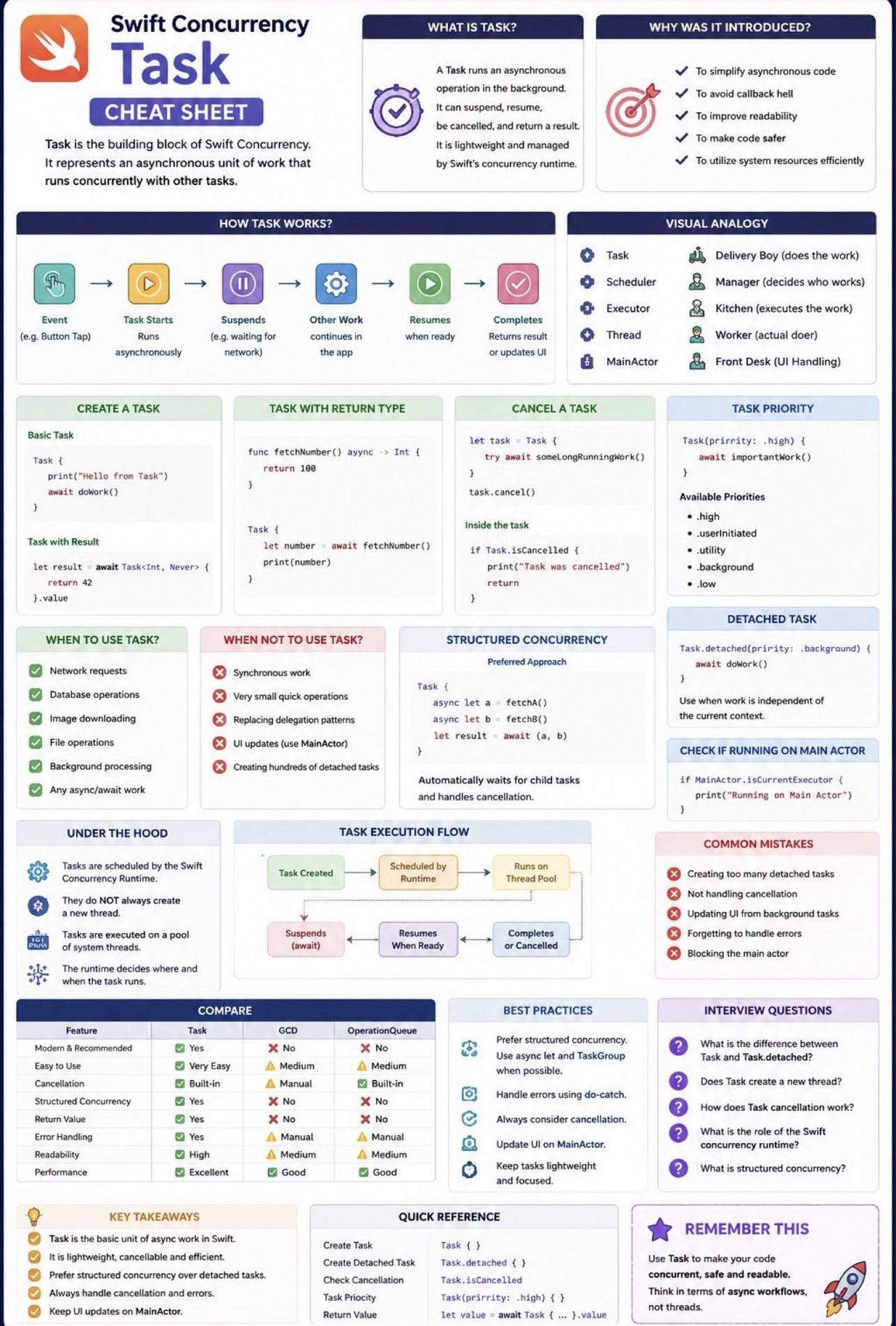
A Task is the smallest unit of asynchronous work in Swift, enabling code to run without blocking the current thread and enhancing app responsiveness.
Here are some key points about Task:
- Returns a value
- Managed by Swift Concurrency Runtime
- Runs asynchronous code Can suspend and resume
- Supports cancellation
Why was Task introduced?
Before Task, developers faced issues like:
- Callback Hell
- Complex GCD code
- Hard to read
- Difficult error handling
- Manual thread management
With Task, the benefits include:
- Cleaner code
- Easier to read
- Built-in cancellation
- Structured Concurrency
- Safer asynchronous programming
How Task Works:
- User Action
- Task Created
- Runtime schedules it
- Starts execution
- await? – Suspends
- -Other tasks run
- Task resumes
- Returns Result
Creating a Task:
Task {
await fetchUsers()
}
This creates a child task that follows Structured Concurrency.
Task Returning Value
let task = Task {
return await fetchUsers()
}
let users = await task.value
Task can produce values just like a function.
Task Cancellation:
task.cancel()
if Task.isCancelled {
return
}
Always check for cancellation in long-running work.
Task Priority:
Task (priority: high) {
}
Priority levels include high, medium, low, utility, and background, with higher priority indicating a preference for earlier execution.
When to Use Task:
- API Calls
- Database Queries
- Image Downloading
- File Operations
- Background Processing
- Al Requests
- Location Fetching
- Bluetooth Operations
When NOT to Use Task:
- Simple calculations
- Tiny synchronous work
- Ul updates without @MainActor
- Creating hundreds of Tasks
- Replacing every function with Task
Common Mistakes:
- Thinking Task creates a thread
- Ignoring cancellation
- Blocking MainActor
- Too many detached Tasks
- Forgetting try/await
- Updating Ul from background execution
Swift Concurrency and Task provide a robust framework for managing asynchronous work, enhancing both performance and code clarity.
SwiftUI #Xcode #Apple #SoftwareEngineering #MobileEngineering #Concurrency #StructuredConcurrency #Task #iOSArchitecture #Performance #Developer #Programming #Tech
메타데이터
- post_id
- 93cc5f8172b6
- slug
- understanding-swift-concurrency-the-role-of-task-93cc5f8172b6
- url
- https://medium.com/@premsaikvarmaofficial/understanding-swift-concurrency-the-role-of-task-93cc5f8172b6
- canonical_url
- https://medium.com/@premsaikvarmaofficial/understanding-swift-concurrency-the-role-of-task-93cc5f8172b6
- author_url
- https://medium.com/@premsaikvarmaofficial
- status
- ok
- fetched_at
- 2026-07-11 15:47:47