3D Architectural Visualization Software for Modern Real Estate Sales
Let’s be honest about something the real estate industry doesn’t say out loud often enough.
3D Architectural Visualization Software for Modern Real Estate Sales

Let’s be honest about something the real estate industry doesn’t say out loud often enough.
The sales cycle for an off-plan property is long. It involves multiple visits, repeated conversations, a constant stream of follow-up calls, and a buyer who keeps saying they’re “almost ready.” Weeks become months. Months eat into revenue projections. And the team grows tired of chasing decisions that should have been made long ago.
Most developers accept this as an inevitable feature of property sales. It isn’t.
The length of the sales cycle is almost always a function of how clearly a buyer understands what they’re buying. And **3D architectural visualization software**, deployed properly, is the most effective tool available today for creating that understanding fast.
The Real Reason Sales Cycles Drag
Ask a sales manager what stalls deals and you’ll hear the usual answers: price sensitivity, spouse approval, home loan complications, location concerns. These are real — but they’re often secondary.
The primary driver of a long sales cycle is uncertainty. A buyer who isn’t certain about what they’re purchasing finds reasons to wait. Every point of uncertainty — what will the interiors actually look like, will the view be what I’m imagining, do the room sizes actually work for our family — becomes a reason to delay the decision until that uncertainty resolves.
The traditional tools available to real estate sales teams — brochures, renders, floor plans, scale models — create awareness. They don’t resolve uncertainty. They can show what a project plans to include, but they can’t make a buyer feel certain about it.
Architectural visualization 3D technology, by contrast, doesn’t just show — it immerses. And immersion is what turns uncertainty into conviction.
What 3D Architectural Visualization Actually Delivers to the Sales Process

The phrase “3D architectural visualization” covers a broad spectrum of tools, from basic computer-generated renders to fully interactive real-time environments. The difference between the lower end and the higher end of this spectrum isn’t just visual — it’s commercial.
Here’s what properly executed 3D architectural visualization software delivers at each stage of the buying journey:
Discovery Stage When a buyer first encounters a project, photorealistic renders and aerial overviews set immediate quality expectations. A project that leads with high-quality 3D visualization signals developer ambition and product quality before a single conversation happens.
Consideration Stage This is where deals are won or lost. A buyer comparing three or four projects needs a reason to choose yours with confidence. Interactive walkthroughs, detailed amenity visualisation, and unit-level exploration give buyers the spatial and experiential certainty that pushes them from consideration to commitment.
Decision Stage At the point of decision, buyers are often managing a mix of excitement and anxiety. A clear, compelling visual record of exactly what they’re buying — the views, the interiors, the community — reduces that anxiety and reinforces the positive emotional case for moving forward.
Post-Booking The quality of visualization tools used in sales affects satisfaction after booking too. Buyers who made decisions based on genuine visual understanding experience far fewer “surprises” when they take possession — which means lower cancellation rates and stronger referral behaviour.
Case Study: Rustomjee Verdant Vista, Thane
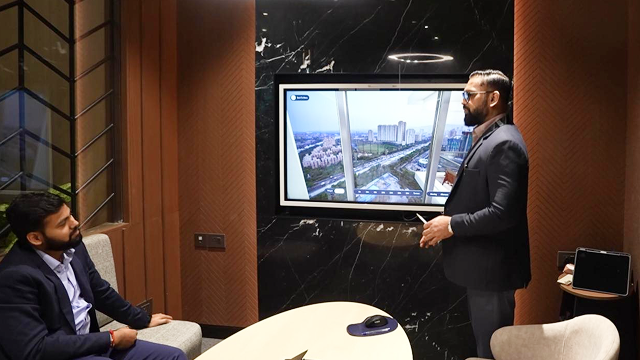
Rustomjee Verdant Vista is a large, amenity-rich residential development in Thane. With over 30 carefully curated amenities — wellness facilities, recreational spaces, landscaped greens, and more — communicating the full depth of the project’s offering through conventional sales tools would have required hours of explanation per buyer.
Instead, Verdant Vista deployed an immersive walkthrough experience through V-Estate that put the entire project in buyers’ hands.
The interactive masterplan gave buyers a clear understanding of the project’s layout and scale. The amenity walkthrough — visual, explorable, detailed — made each of the 30+ facilities feel real and tangible rather than like bullet points on a list. Live availability integration meant buyers could identify and reserve specific units during the same visit, removing the need for multiple follow-up sessions just to confirm inventory.
The outcome was a buying experience that matched the project’s ambition. Buyers who engaged with the** immersive walkthrough experience **left with the kind of complete understanding that makes decisions easy rather than anxiety-inducing.
For a complex project with multiple phases and a large amenity programme, this kind of 3D visualization real estate software isn’t just useful — it’s essential.
The Technical Architecture Behind Effective Architectural Visualization 3D
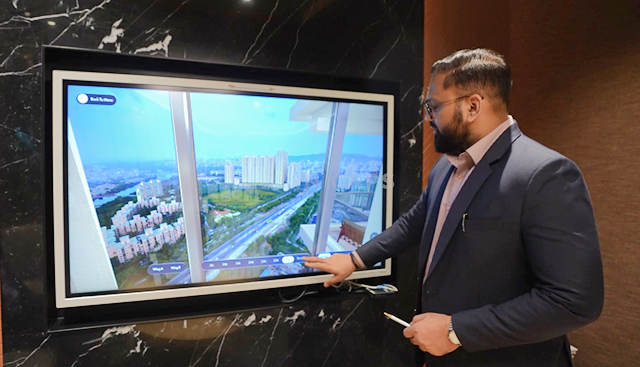
Understanding what makes visualization software genuinely effective for sales (rather than just impressive to look at) requires looking at the technical architecture that underpins it:
Real-Time Rendering Engines Modern 3D architectural visualization uses real-time rendering to create environments that respond instantly to user interaction — no loading screens, no buffering, no interruptions to the buyer’s experience. The fluency of movement through a virtual space directly affects how immersive it feels.
Digital Twin Technology A digital twin is a precise, interactive virtual replica of a property. Unlike a pre-rendered walkthrough video, a digital twin can be navigated from any angle, at any speed, with full spatial accuracy. Sales teams can use digital twins to answer specific spatial questions in real time — rotating the masterplan, zooming into a specific view corridor, showing how a particular unit relates to sun orientation.
Photorealistic Material and Lighting The quality of light and material rendering is what separates professional-grade visualization from amateur-level work. Accurate representation of how sunlight falls in an interior space, how materials like marble and wood read in different lighting conditions, and how the external facade looks at different times of day — these details are what make a buyer feel like they’re seeing reality rather than a simulation.
Multi-Device Deployment Effective sales visualization doesn’t live on a single screen. It needs to work across tablets for individual guided tours, large touchscreens for group presentations, video walls for maximum impact, and VR headsets for deep immersion. Platforms that maintain quality and performance across all these surfaces create consistent buyer experiences regardless of how buyers choose to engage.
Why India’s Premium Developers Are Investing in This Now
The shift among India’s leading developers toward serious investment in 3D architectural visualization software isn’t driven by FOMO. It’s driven by demonstrated commercial return.
When Hiranandani invests in a fully equipped interactive sales gallery for Belicia, or Rustomjee builds an experience centre for Matunga using digital twin technology and guided walkthrough architecture, these are calculated business decisions. The investment justifies itself through shorter sales cycles, higher conversion from enquiry to booking, and stronger buyer confidence post-sale.
The Mumbai and MMR market, in particular, is one where buyers are educated, mobile, and have high expectations shaped by global digital experiences. A sales environment that doesn’t match those expectations doesn’t just underperform — it communicates something unflattering about the developer’s attention to detail.
The best architectural visualization 3D platforms available today — V-Estate included — are built with this commercial context in mind. They’re not visualization tools that happen to be used in sales. They’re sales tools that happen to use visualization.
Your Sales Cycle Doesn’t Have to Be This Long
If your average sale takes 8 to 12 weeks from first visit to booking, and you’re running out of explanations for why, it’s worth looking at what the buying experience feels like from the other side of the table.
How much uncertainty are you asking your buyers to carry? How clear is the product at the point where they’re being asked to decide?
Better 3D architectural visualization software won’t solve every sales challenge. But it will solve the biggest one: the gap between what buyers are being asked to imagine and what they can actually see.
**Book a demo with V-Estate** and discover what your project looks like when buyers can truly experience it — not just read about it.
메타데이터
- post_id
- 93f31e254769
- slug
- 3d-architectural-visualization-software-for-modern-real-estate-sales-93f31e254769
- url
- https://medium.com/@vestateseo2024/3d-architectural-visualization-software-for-modern-real-estate-sales-93f31e254769
- canonical_url
- https://medium.com/@vestateseo2024/3d-architectural-visualization-software-for-modern-real-estate-sales-93f31e254769
- author_url
- https://medium.com/@vestateseo2024
- status
- ok
- fetched_at
- 2026-06-17 12:55:42






