PREQUEL. The Coming of Arthur.
Abstract: The Immortal Chthonic Family Tree in an eternally flowing tidal swamp.
PREQUEL. The Coming of Arthur. Abstract: The Chthonic Family Tree. Chapter 1: The Hospital is the New Temple. Chapter 2: THE CALM. Chapter 3: Naglefar & the Coming of Arthur. Chapter 4: Victoria Arrives and meets Maria in the waiting room. Chapter 5: Birth of Arthur in the heart of calamity. Chapter 6: The Shadow of the Father.

“My God! Why have you forsaken me?” — (Mat 27:46)
Abstract: The Immortal Chthonic Family Tree in an eternally flowing tidal swamp.
“Men will get drunk on wine and forget heaven in favour of earth. The stars will turn away. Crops will wither and water will disappear from the earth. Roots will turn into branches and branches will turn into roots. Soon everything will cease to accomplish its function. The sun rays shock will lift up the seas and the dust from ancient times will rise up again” — Merlin
The organic immortal or Chthonic deathless-parasite, lives on as an undead zombie, through the eternal —
‘Family Tree’
People think of a family as a kind of tree that can be climbed, and it’s branches grafted… or a hedge of trees, where the branch of one meets the branch of another and then is spliced from the top down, a perfect melding, whereby some great-great-grandfather Smith, marries a grandmother Jones, they have four children, of whom two survive, possibly a boy and a girl, whom in turn marry, and the young Mr Jones Jr pairs off with a Mrs. Thomson, who then becomes herself a Jones. The daughter marries a Baker and another branch is created. The young Jones’s and Bakers do likewise, and so on until down the bottom of the tree is you — young Mr. Boner — product of a Baker girl’s marriage to a Boner boy.

The Garden of Eden without Eve
Before your family planted its roots in seven recesses, it lived on and under the mud of a swamp. Those mangroves that grow in the marshes refuse to be categorised as land or sea, as they are both and neither at the same time. This is the place where all the buried things appear to rise to the surface and the light, and then are buried again.
They appear thus but really are unmoved, for it is everything around them that moves, swirling in a concatenation of atmospheres, the endless ebb and flow of the tide, where the air is thick with mosquitoes and crocodiles, and maggots and slugs wriggle and squirm like the mind of a maniac.
So writhes and bubbles the verge of the river, whose bank has no colour change between what is dry and wet, nor what is simply brown ooze alone, as distinct from the peeping muddy reptilian eyes that hide, existing mostly submerged and blindly winking at their neighbours, such that the surface of the mud reveals only some regularly spaced leather scales here and there on its gluggy surface, concealing the potential coiled energy, that precedes, with the sudden splash of surprise, a fatal attack!
There are two visible roots in the family tree, which following our law of inversion, and unlike any normal roots because they exist above the ground so long as the body has strength to raise itself up on two legs, are your mother and father. They each have a mother and father, all of whom now reside as ashes on the wind, underground, or more likely, at the bottom of the sea. All families are like this, inverted trees whose fruit and flowers blossom for a few years, bounded by time on the endless before and hereafter. The father of a strong family will eke out a patch of forest and lay claim to the available food, light and water, as a tree that reaches above the jungle canopy to extend over its neighbours and get the most sunshine, as his weaker neighbour perishes beneath him.

In looking at such a tree, we are really looking at it upside down, whereas the youngest should be depicted at the top, and not as is commonly drawn at the bottom, and then spread along a long line of Bakers, Joneses, Smiths and Johnsons, like so many apples held tightly to the sprays on a voluptuous tree, ripe and shining in the summer of their bloom, but not overripe, not low-hanging and ready to fall and become food for the bottom-feeders, and even though they be big and juicy, yet their abundance presses them together, and knotty branches that spawned them combine their upward thrust to the light, light that bathes them all, except where they garner a little and much needed shade by virtue of their leaves which act like intelligent clothes that channel all the life force of nutrients gathered from the earth below, the rain as it falls, and then disseminate these combined breaths and drinks and meals like silent helpers, that in bunches like nests divide and protect the apples in their upturned bowers along that topmost spray that reaches out of the darkness and crowns the forest beneath, like a cornucopia filled with the choicest delights, and offered in silent veneration to the morning sun.
How then do these crisp summer apples of the highest branch look downward into the shadows of the branches that spawned it? How, when looking at the sun, does a child simultaneously look downward at the parasites of the tree, or to say another way, and irrespective of questions of “up” and “down” how is it that the young creature born of delight should contradict his innate joy in order, like a suspicious Psyche or fatally curious Pandora, glance rudely where she should not in order to unveil the forbidden thing that was only just another kind of beauty in the end anyway, and more so by being so tragically lost, and so in the end they must be what they must be — atavistic mutants that quietly creep from the swamp to the branch, and thence from the withered leaves of the previous fructation, into the stems and finally — abundantly — throughout the apple, not just before he falls, but it is inseminated when his flesh is yet green, and when he doesn’t yet even resemble that which he will be in the fullness of his ripened maturity.
Only through fairy tales is the true dark story told, of the splicing of so many poisons together with the attractions and other virtues that lies in the Apple. Its future is to live on in the heart of Beauty in all apples, though the individual one wither, die and corrupt.
A finger cannot so easily be placed on the head of a baby, or the vacant eyes of a corpse, or on any new avatar of existence as it appears in secret, and so these bugs that infect all men are a secret society with a long, sad history, and there is no X-ray machine nor is there a physical sense that can see them, but in time they are revealed — all of them — but only to the intimate family member of the host. The long suffering wife, whose secret family bug that her husband forced as a living curse onto her and their children, though in different ways — she knows!
Many dead people live in the ground and furnish fertile soil with their blood and bone for the family, feeding through the ripples of their actions, when they were parents of young children, and every character in this story is merely the latest grimace and contortion of an immortal bug, whose silent history lives in the time now forgotten, tangled darkling in the roots of such a tree.
“And we, that now make merry in the Room They left, and Summer dresses in new bloom, Ourselves must we beneath the Couch of Earth Descend — ourselves to make a Couch — for whom?” — Omar Khayyam.
The blood runs from under the ground, in Chthonic recesses, silently upward and downward, like an elevator in a hospital, that space-station-temple where lies the confluence of dimensions, light and dark ones, and dark is the chthonic freeway of bugs, which like their brethren in the imagination, those vampires and werewolves, live mainly free from death, unless —
Unless it is dealt to them by some heroic and divergent rebel-child of the family, but not like in the normal course of life, death, and rebirth, that makes such rebellion appear impossible to most people — just like the hill that leads to Dante’s Paradise, that is guarded by those three ravenous creatures that terrify most men into avoiding the fight in the first place, and, like Dante, take the low road, itself as rife with temptations and pitfalls so multitudinous, that although it may be a guided and chaperoned road through the World, it can hardly be any less difficult to transcend than it is to take and ascend the alternative pathway up the hill with the foreboding monsters, as is outlined in no uncertain terms in the wording etched on the entrance, which one might hardly call encouraging —
“THROUGH ME THE WAY TO THE CITY OF WOE, THROUGH ME THE WAY TO EVERLASTING PAIN. THROUGH ME THE WAY AMONG THE LOST. JUSTICE MOVED MY MAKER ON HIGH. DIVINE POWER MADE ME, WISDOM SUPREME, AND PRIMAL LOVE. BEFORE ME NOTHING BUT THINGS ETERNAL, AND ETERNAL I ENDURE. ABANDON ALL HOPE, YOU WHO ENTER HERE” — (Dante, Inferno, 31:7).
These words might, without risk of being falsely allocated, yet perhaps with the tactlessness of Psyche’s midnight lantern — be tattooed on the skin between your mother’s bell-button and the top of the entrance to her womb…as a warning! Would any man be discouraged enough to leave her be?
Death in the physical world has an easy victory most of the time. It slays the host and its job is done. But it can’t, except by extinction, slay the offspring that grew in the fertile soil of the host that now hops like a frog from the dead to the living, and parasite though it is, discards the living vessel like a garment.
As a mother’s body is interred in the ground these demigod-bugs crawl invisibly out of the corpse and blindly smell their way into the vessels of the next of kin. They are meeting their own children who already live inside the veins of these temporary bodies, and so then the parasite is fed and mingles with its cousins. They jump from body to body down through time, and their evolution is the evolution of culture, like the culture in milk that transforms.
In the fog of childhood lives the dark place of un-remembrance, invisible yet strong rooted, like spider webs that catch the unsuspecting fly, but more, perhaps, like the children of the dead fly, the maggots that grow beneath the skin, festering and themselves unconscious, fed by the tree they poison the blood of the host, who doesn’t understand why he’s acting the way he acts — proud, lustful, greedy and vengeful, he hosts the maggots of his forefathers, and indeed the progeny of Echidna from ancient times grow parasitically and pollute his mind with their venomous culture, a Baudelairian “demon nation” — they lead from the ground under the house, and up through the limbs like veins of blood, sure-footed are these maggots of the underworld, of the past, and ant like, both in terms of order and determination, do they move, and in haste, as though each hour was the most important hour on the last day he could ever have to make it count — up and down never stopping, up and down without questioning or looking, up and down as though this signal purpose was always the only priority in their being and it gave them meaning and focus!
Up and down, up and down, the trunk of the body. In and out, in and out, of the brain, then through the heart and everywhere go these creatures, with a dreadful innate knowledge of their pathway, or even if we say this thing or things are more indicative of a hive minded god than some cheap and vulgar parasite whose power and longevity lies in its base stupidity and coarse simplicity of mind and being. So uncharitable an assessment would no doubt be fitting to describe it if contempt were a planned emotion in the course of the task ahead of relocating it.
In fact emotions like contempt would sometimes prompt the gentleman to cry out —
“Choose a second you scoundrelly dog, or else stand up to let me have my say!”

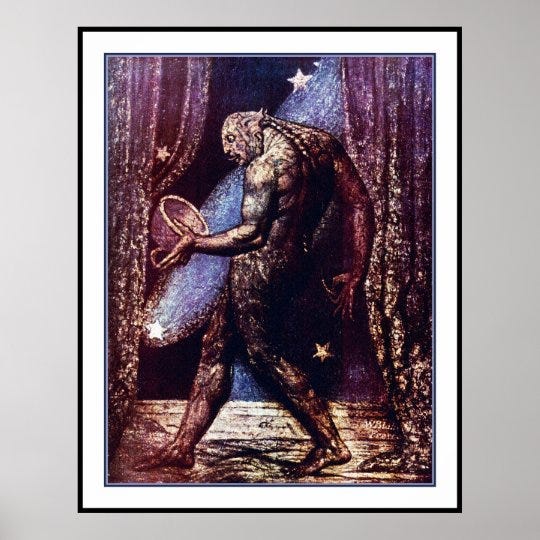
Ghost of a flea — W. Blake.
It is in the threads of memories of past lives, that the fabric of a family mythology is woven —
“Oh, do you remember grandma’s Yorkshire pudding? Do you remember how it was fluffier on the inside than a baby bird?”
said grandma, referring to great-grandma; and then grandpa would agree with this ditty and then first quite sharply to the top of a barrel with enough jokes and frivolity to make the whole world laugh for a tear…and then got excited and boasted-
“My father’s arm, had you seen it, if you even could see it, as it swung so fast, coming down between his feet, and sending wood chips flying in an improbable distance, and frightening the amazed watchers at the county fair; those there to watch the woodchopping competition, really couldn’t believe the strength of his arm! Right ma!?”,
called grandpa, initiating a routine that had a fifty-year tradition, and she winced as she smiled, a tiny crinkle in the corner of her mouth that had been there itself for years, as though itself chopped, or in truth rather than being chopped, had the appearance of being carved, but not from the outside, like a line whittled in a wooden mask by the hand of a carver for mere effect, as to create a line of ageing for no other sake but for building character in some ornamental mask that was never really meant to represent a real person, but just the image of old age or hardship; no, the lines around her mouth, that were always there, were actually hardly ever used, except when recalled by reference to that which really created them. They were not whittled by some carver but rather were more archival, like a tactile geological index in nature, and if you raise a memory the line is activated.
An astute observer might tell some of them but most went untold and lived only through the parasites that carried their curse forward — irrevocable, yet always subtly moving, like the Earth itself, like the formation of continents when tectonic plates move, not, in this instance over thousands of millions of years but about 40 years, and not on the scale of this world’s globe, moved as it is by the effect of the forces of nature, such as wind, fire and water, battering the Earth, and the Earth herself in-turn suffering, convulsions that threw up mighty mountain ranges here, great rivers teeming with life flowing over there, dry places with lines and canyons that come to exist after much time, when the rivers have dried up, and mother Earth has given birth to new things.
These lines of truth tell little of the floods of tears which carved out their irreversible existence, and so there they are — these barely noticed chasms which only from time to time, such as now when grandpa referred to the strength of his long-dead father’s works with the axe, and no-one saw at all at this year’s fair, so many years distant from the almost forgotten and completely mythologized individual’s physical presence in this world, the less obvious yet more irrevocable lines that his wicked arm had carved upon the face of his eldest son’s wife, and she then a child of 16 — a work in carving by that strong arm that tore chips away from the subject from the inside in this instance, rather than from the outside, as is the norm in the county fair. Such fine yet deep lines, carved on the inside and over a distance of years rather than seconds.
But what makes a family stay together for generations? It is genius? The Shakespeare, Einsteins and Beethoven would probably find it harder to get a table at an exclusive restaurant in New York than, for example, the Kennedys or the Trumps. Is it money, and the need to survive as a tribe that holds a family together? A father with money and a mother who can emotionally control her children has always been there, but what then is its purpose? Like any virus the purpose of a family seems to be, like sentinels, to make a bed for the next generation and to pass on their specific mutations. To live and propagate, adapt and mutate, always waiting, but for whom or what? It must be until either the host or parasite is extinct. It is easier to see a world full of murder and a family cast back into the swamp than a society of philosopher kings who discard the past and free themselves from that which lies within.
The Arborists
When the new British colony was established in Victoria, those colonists brought with them an abundance of seed-stock from home for forestation. English and Irish forests were kept alive via those famously-tiny acorns, each paradoxical by nature — simple to look at, yet even the most innocuous nut filled abundantly with complex character traits, including the potential for such huge trees, but also hardiness and longevity, and they took well to the Victorian soil and climate, which for half the year is not much different to that of Britain.
The seeds of tall Oaks and Pines were planted by English immigrant-arborists, MacArthur and Colletts in Frankston in 1883. Those seeds grew rapidly, and did not cease growing, straight and tall, in all the years from then up until the year 1975, the date of the beginning of this part of the story — the part that records the life of the Last Arthur, from the earliest of his memories, which he had little recollection of anything more substantial than colours, prior to this year.
That same complimentary language, used to describe the assimilation of Northern Hemisphere Flora with the Southern Australian earth, could not be similarly justifiably used to describe the transplanted specimens of humanity.
The human seeds were, it seemed, destined to take many more generations to thrive, and over a much longer duration per generation. They struggled from the outset to assimilate, and they were too modernised and European to integrate with the soil of the new world. The unfortunate outcome would be that they would also mutate and begin to eat each other as well.
In the instance of the trees, we have, on the one hand, an alien life entering a foreign soil, and successfully assimilating with, and become accustomed, to it. If, for example, the prosperity of a certain species of tree can be measured by measuring the health and proliferation of a forest of such trees, then of a race of men taken from a few from the same region, moved to a new place with only their memories — that is, the same old soil as the tree, should that race of men not be judged by their prosperity as a group as well.
What better yardstick to measure the performance of a newly transplanted race of humans than one which measures it’s achievements, or works.
Does the new society have libraries? Fire departments? Universities? What about institutions such as police, military, musical academy, and other institutions that purport to serve the entire community, can take up to a single lifetime or even longer to establish, and then a number of lifetimes to grow into their supremacy over the hearts and minds of the people. Such institutions include churches and schools.
From fragile yet hopeful saplings, the actual trees brought over from Britain grew into majestic watchers with sturdy trunks, and those cast their roots into the earth beneath, and the Earth felt their presence, as they brought a strong vibration of the old world to the New, and it’s infant city of Frankston, including around the grounds where the current church stands.
Indeed it is in those venerable and hoary old institutions that you find the roots of all institutions. Churches and States, Families and clubs — after two thousand years, and transplanted traumatically to another environment, they began to degenerate.
Old books of witchcraft and Celtic lore on the nature of forest creatures such as Leschen and Vampires tell how their life force is preserved if the creature can sleep in its own earth. The vampire represents the foreign, demonic, or monstrous, as opposed to Human spirit, just as the native soil represents the creature’s own physical body, which after his night time wanderings he must return to and inhabit in order to sleep.
It is a pity that the actual arborists of Frankston knew nothing of how to graft human specimens to the tree that they evolved from, across the ocean in the forests of England, Ireland and Wales.
Chapter 1: The Hospital Looks like a Space Station, but it is the New Temple.
“Then to the rolling Heav’n itself I cried,
Asking, “What lamp had Destiny to guide
Her little children stumbling in the Dark?”
And “A Blind Understanding” Heav’n replied” — Rubaiyat of Omar Khayyam.
The Ascetic Priest.
The Temple is now the Hospital and it is the place where spirits enter and exit the World. It also has it’s characters. Some change over the centuries and some stay virtually the same. Pt 2. Dr. Wendel Feldman was a doctor and high-priest and arch-mage in the New Temple, but he was too busy being the same as he had been in his previous hundred lifetimes that he never took time to reflect, nor to second guess his path nor ask why he chose it so unfailingly — as though he were the only being in the Cosmos made from unalloyed titanium in a simple and perfect shape —
The Surprising Benefits of Adherence to Rigorous Planning and Unvarying Routine.
A conscientious aspirant in a Zen monastery, whose hon a high-mountain, such as is only accessible to visitors by foot, and then after climbing many thousands of pain-staking steps, might have some understanding of the type of individual self-discipline required to cultivate a temperament suitable to live in the precise and unflinching manner by which Dr. Wendel Feldman lived, year in and year out, that governed the unvarying flow of his waking life.
The good doctor knew somehow, from the time of his birth until that of his death, exactly where he was supposed to be, and why, and this calm yet confident certainty about his place in the World allowed this wise man to enjoy a most pleasant journey along the calm delta-waters of any Earthly river-systems. So it was then, by adhering to his diary-schedule with religious devotion and unerring exactitude to times and dates and properly written addresses, that he was always exactly where he should be, and at the right time. Dr. Feldman neither missed an important meeting or appointment, nor was he ever late for anything…ever.
The interesting consequence of this man’s extreme example of perfect reliability meant that he had never had to apologise to anyone in hs life. Nor had he let anyone down. He was never in a hurry, but when some trouble makers discovered his secret he refused to be waylaid and made late on anyone’s behalf, which caused much debate amongst the philosophers of his time, as there was a polarity of opposing opinions.
The one opinion said that his life was intrinsically meaningless, like a yoga exercise that helps one to remain limber and physically fit, but at the same time served to expose the meaningless of all variations of selfish living!
It is uncertain whether or not anything strange ever happened to Dr. Feldman.
To some ambitious professionals in our modern world, success is best measured by their ability to be left in one hundred percent solitude! Privacy, some say, is the greatest token of respect we can ask from our professional colleagues, whilst at the same time, bashful and demure, privacy is the handmaid of the perks of seniority.
Mr. Feldman, formerly Dr. Feldman, was a very private man. He was an Hasidic Jew from Elsternwick who was fond of gardening. He had graduated from Mt Scopus College and then went off to Melbourne University to do his medical degree and was a hard working registrar for five years before his training was complete and he passed his obstetrics exam, taking on the more discreet title of ‘mister’, so that he could make his way for the following fifty years in a logically flowing circle on public transport between his solitary research offices, the university where he taught the minimum mandatory required number of hours — which were always booked out by students for as many years in advance as the man would commit to continuing on at the institution.
He invented new operations and new operating procedures that would one day revolutionize the discipline. He invented practical tools that worked in such a way that the comfort and ability to continue for long-hours unperturbed were largely brought to reality, and reliably for each procedure, each person’s operation that he has sunk his teeth into.
John Earnest Dale was this by checking exactly how it good be this or that way, yet most indisputably was. He was hailed as a virtuoso when he admitted that his latest thesis might require fifty wrist movements and seven hundred finger positions, with an added five hundred precise hand and finger exercises thrown in, in order to execute the procedure perfectly, without injuring the surgeon.
Such rare birds as these, often justified their antisocial nature by labelling it as a mixture of shyness and being very busy — although both of those things were very different from each other — one was a quality or trait, and the other — a “situation” or —
“Set of circumstances…”
and including the obvious outcome — which was that he was at all times to be avoided and left alone — were very predictable results, producing a kind of gruff standoffishness, and consistent uffishness, two types of anti-American conduct that could be calculated to deliver no other possible result to the good doctor than a sweeping dose of the “cold-shoulder”!
No one ever confronted him with it, although he would sometimes mutter to himself, especially as he got a little older, that he had never bothered anyone, so why should he have to suffer?
“I just want to be left alone”
he would mumble into his hat, whilst riding the tram through St Kilda Junction, and fantasizing about giving the busy-bodies a good solid telling off, next time they chose to harass ‘an honest man’.
Knowing that due to his senior role in the community Mister Feldman would need to conform more diligently, and even though he had just had their first lovers’ fight around knock-off time nearby the office canteen, Mary calmed down, took charge for a few sylvan weeks, filled they were with every kind of amusement imaginable. Married before his feet hit the ground after the graduation party.
The force of gravity in the form of tradition was so strong that after 70 years he would eventually die in the same house his parents helped him buy near them when he was 25. He was so steady in his habits and in tune with those constituent elements in his life that after a few years he realised that his hair grew at the same rate as the mulberry bush outside the window of his office at home, and so every 6 weeks he would call the gardener to come and trim the bush, while he went down to Glenhuntly Rd to the barber shop for a haircut.
You could thus work out the dates and try casting your dannible horoscope by drawing circles around the given Sunday (Saturday was out of the question), every 6 weeks for 70 years.
If you had taken a photo, as was possible because Dr John was always there, of him standing in the back-garden, invariably with his back to the court-space, awaiting for our djs to log on for this event.
On each of the 606 Sundays that contained the long, thin row of 70 years of Sundays in his life up until the day he died in his 90s, whilst standing there in said garden, barring those he had spent on holidays away from home which were few, on the afternoons of these days and really for the following week, you would, by flicking through these photos, as animators flick through drawings which vary very slightly from one to the next, so that when the pages are flashed in a succession the changes in each picture are relatively minute in difference to the previous one.
At a rate that has parity to the shutter speed of the human eye, so clicked the little shutter in the good doctor’s camera —
“It is suitable because one experiences the illusion of movement,”
he explained to the person sitting next to him on the tram, who much to the doctor’s relief pretended not to hear and didn’t answer or respond.
If one were to walk up Dr. Feldman’s street once a day for thirty years, one could have, and indeed may well have seen a garden, and a hairstyle unchanged, a suit of brown tweed that never varied in style nor size, since his body weight had never varied in his life.
The only observable change that could be noted was the slow tracing of little lines of care around his eyes and the corners of his mouth that spread like a subtle moss on the bricks of an old building, just at the corners of his eyes, only in the last hundred frames, each representing a Sunday divided by a 6 week interval, and in the final 30 frames a slight hunching forward of the body.
He called himself Jewish, and on Saturdays he was, but for the rest of the week and really for his whole life he was a high-priest who tended all manner of goyim in the service of Asclepius and Maria.
The Hospital/Temple judges not the criminal: Morphine Maggie and the smooth criminal.
The temple is also sometimes host for those who do not have a temple of their own. In the next bed to Alphonse was a man who should not have been in the dementia ward but that there had been an accident in ‘accident and emergency’, and things were out of order.
Oblivious, as all self-absorbed souls are oblivious to the suffering of their neighbours, was a young man with a bullet wound to his own suffering. He thought it was noble to make a simple moral choice in the manner one chooses to fight and thereby to enjoy a peace of mind that was absent in his comrades, those who constantly worried about how each might improve the chances of saving his own neck, who by and large he either pitied or despised as he watched their darting eyes reminiscent of a rat backed into a corner, and all that disgraceful display before his comrades, both before the action, and in circumstances where the individual destiny of each of them was at all times impossible to predict or guarantee; that they could be so undone by a mere pessimistic terror of possibilities that none could predict, and then, when they allow their fear to govern, each his own conduct during the engagement in battle, how pitiful does he feel in hindsight when after the battle is done and despite all his tears and furtive glances looking for escape doors that he nonetheless ends up on the list of wounded and dead?
Such was the attitude of a man who was no soldier but rather an armed robber who, for reasons to do with a shortage of beds and hospital budgets etc., found himself in handcuffs i the bed next to Alphonse.
The man braved the danger of getting that which in fact he got, and that which brought him there to the bed nearby Alphonse’s, with a bullet from an guard in his guts, and three more from a late-arriving cop in his lower back, very close to the spinal cord, although these details he was unaware of, and all he did do was to alert the nurse when his sutures, being too soaked in blood, all began to break and he began also to hemorrhage heavily once again, and even then did he ask no questions, either about what happened or whether or opt death was the most likely prognosis.
He was a young man. Was that the main reason for his courage? They say that wild-youth does not fear death. Perhaps this wildness and its suicidal tendencies is similar to that self-defeating fatalism that possessed Arthur’s father when he threw his world in the bin with such reckless abandon? Perhaps it is just another genus of that curse, the curse of the young man to hurt himself as well as the ones he loves.
A young man is capable of extraordinary acts of courage and selflessness, but only for short amounts of time, like a schizophrenic, like Hamlet, whom if you only catch him when the wind is blowing in the wrong direction he will destroy the world with a drunken wave of his hand.
Isn’t it strange how youth can go to war and, not caring really for present safety or the possibility of a future, shouts either —
“Hurrah for the Emperor!”
or
“Death to the oppressor!”
…it matters not which one, and of course as we have seen man is such a vicious creature, especially when he is young and full of energy, that even in the absence of a war, he will create one.
It is justified when sanctioned by governments or churches, who with equally unrepentant lying tongues, put forward the various names of God and Country to support the false justice of the call, and then with a lying benediction place a gun in a boy’s hand, and tell him to —
“Go forth and kill your neighbour in God’s name!”
and in the names of “justice” and “religion” —
“…do you do murder to your neighbour by the authority vested in me by this uniform and that flag!”
and these tangled spells woven from lies and false justification do wonders to clean the conscience of murderers world-wide and throughout time.
Fighting for organized crime in most cases boils down to the same cause — money — and an honest man feels no different to the one with all the heretical talismans even if at its root there be drugs, oil fields, women, real estate, or sales territory, which is all that a map really is, be it official or uncharted.
The drug dealer in the hospital bed lies to himself in the same way the the soldier does who justifies his violent tendencies for god or country, so the drug thug says he’s doing it to help his kids — it’s always “the kids” for these dealers, but that’s just their cover story because they can no more admit that they simply like the drugs and violence than can the soldier — and yes the boys in Iraq are doing a lot of drugs in between murders.
There is a police officer lurking outside the room, and perhaps Alphonse shouldn’t have been put in the same room, but he was at that time oblivious to the existence of the man covered in tattoos and handcuffed to the bed one metre away from his own, and it was more than the thin plastic of the sliding curtain that separated him from his neighbour, being as he was, engaged in a dreamy dance with Morpheus on the razor’s edge between life and death.
The nurse, who’s name was Maggie, closed Alphonse’s curtain and made a note on his chart that he had spoken a little, that she has pressed a button which had administered another dose of morphine, and indeed having checked the chart of Leeroy in the next bed, she gave him also a sharp sticky dose of the jungle juice which he, unlike Alphonse, actually knew was coming, and smilingly croaked out a few words to her in the way of a likeable rogue, whose affability thinly veiled the threat of immanent potential violence, but one got the idea from Leeroy, who liked to watch the “tee-vee”, as he said —
“My mane’s Leeerooooy, and I like to watch the teeeee veeeee, so turn on the fuck’n teeee veeee. Sprechenzie fuck!!?”,
but on this occasion his first comment to the nurse was —
“Maggie I’m going to have to get shot more often if it’s gunna get me more of that crazy shit! Morphene-Maggie I’ll call ya, with full respect. What a monicker for a nurse! You’ll be more popular than tits!…press that fuck’n button again and I’ll tell that prick outside everything he wants to know! Hahaha. Just kidding Maggie…about telling the prick I mean not about all the rest of it. You’re a fuck’n diamond with an itchy thumb!”
“Well I can’t have you suff’rin’ Mr Brown”
she said —
“…even if you do have a handcuffs on and they say terrible things about you in the papers, it’s not my place to judge. My job’s to ease suff’rin’ and that’s what I’ll do, and they can all go hang if they don’t like it!”
“That’s right Morphine Maggie, we’ll hang the lot of them and then we’ll take all the morphine out of this place and we’ll sell half of it to some bikers I know and then we’ll shoot up the rest on a beach in Queensland and they’ll never take us alive Morphine Maggie, and even if they do we’ll say “No comment”, and we’ll never rat each other out will we darlin’, because we’re tight as a nun’s arsehole aren’t we! So let’s celebrate with a bit of teee veee. Yieow!!”
hooted Leeroy Brown, like a bi-polar person on an upward swing, as nurse Maggie shook her head, smiling a little at the friendly banter that made her think that for all his criminality he was a true charmer and thus couldn’t be all bad —
“Now you shut your trap and stop wriggling around. You’ll burst you stitches. If you hush up I’ll think about turning on the television”
she said with a smile.
“Well, I bleed for my art darling!”
he replied, and again she almost blushed at what was in fact in the circumstances a quite witty comment, as Maggie turned and left the room with a bounce in her step.
Maggie was 62 years old and had worked for 44 years as a public health registered nurse. She had seen her fair share of handcuffs and divided the criminals into four categories.
The first are what she called the “honest ones”, like Leroy, for whom lying and thieving and selling drugs is a job to separate them from the “Losers” on the street; who rightly recognise that there’s no ‘straight’ life for them, and they accept it with a certain level of self knowledge. For example they had trouble getting the cuffs on Leroy because he was so big. He was fat but also muscular, like a beast, and when his family confronted him with the prospect of diet and exercise his response was —
“Look! There’s fat cunts and skinny cunts out there, and there’s a lot of people who float around in the middle. I’m a fat cunt, and that’s that!”
and to Maggie’s mind it was the same with his plain speech on everything. He was, she thought to herself, a criminal she could trust “if that makes sense”, she thought. She wouldn’t trust him around her grandma’s silverware but she knew that and he knew that, and there was a kind of honesty in his public declaration of his criminality.
He wasn’t a sneak-thief, he was a gangster — and stay out of his way. You’ve been warned! It’s in that warning that Maggie saw something she could not only understand but empathise with, it gave him context in a way which certain other criminal types did not, and were repugnant because of the secretive nature of their souls.
Thieves and killers who live double lives, were in fact repugnant to her, although she did not understand why she like guys like Leeroy and not the others. Were they evil like all men, because they are schizophrenics? They portray one face to the world which is that which deals with all of humanity and then there is another face, a stranger to the world, who subsists on them like a succubus, like a ventriloquist with his doll, who talks to it when they’re alone, and even though it is an abomination, he is as subsistent on it as is the doll on him, and in that way the doll, or to return to the case in point the front-facing public face of the man, is more diabolical than the stranger itself, who does not dissemble but just hides in the shadows before revealing itself to its victims or enacting it’s essence alone, but unconflicted and truly abhorrent, like a pedophile who hides behind the face of a priest, this creature which is creepier than a spider because it lives inside the dissembling host who is the trap door from which it leaps, or the web into which the innocent are led unawares.
These ones are the ones for whom Maggie does not push the button, for she is no fool, and she is only Morphine Maggie for some, and over the years she can tell the ones whom she calls honest criminals from the ones she calls snakes.
Of course she has little understanding that the morphine she so frequently distributes to suffering patients is a snake itself, and with the soft words are spoken in a language entirely that spoken and understood by the nerves and not the vocal cords, no knowledge of the conversation with the Devil being had in the next bed where Alphonse is swimming in morphine.
The floral blanket that numbs the pain starts off as one of seduction and cozening, romantic submission or generous giving of comfort, but once you fall in love with it the soft feather is replaced by a whip and the poppy transmutes into a viper. It too is a devil with the face of an angel, a betrayer which offers soothing balm that then turns to bile, but like the devil, who’s excuse is always that you came to him fair and square and by free will made a pact, so says Morpheus, and proudly denies the comparison to a spider yet acknowledges the likeness to a seductive snake.
Other criminals Maggie has seen and for whom all the morphine in the world will not ease from their pain are the “crimes-of-passion guys”, as she calls them, those guilty of crimes of passion but whom were otherwise model citizens. One man who was her patient had tried to cut his wrists after strangling his wife in a fit of jealousy. He loved her more than anything in the world but his love had become an obsession that had degenerated into paranoia and he was convinced that she took other men. These characters too see monsters in their heads; they too are plagued by giant spiders and snakes that tell them in grim voices that death would be better than to live with the humiliation and the loneliness of abandonment and that to cease to exist would be surcease of agony which would be a hundred times better than to live in any conceivable scenario.
It is in vain that during the days leading up to the fateful moment when the awful murder is done, when he still has his job and his family and friends, who sort of know that he’s going through an emotional troubled time, that any true friend tells him to “forget about her”, or “there are plenty of fish in the sea”, as he hears these words in disgust and is half-tempted to strangle the friend who is only trying to help him, but who, not knowing the depths of hell to which he has sunk, and the great and powerful fury to which he was now in the bondage of, will try to other these sage words to the one already in the torments of hell. Then of course when the deed is done it is enacted in such a prosaic way, perhaps he follows her to a MacDonald’s drive through and sees a man get into the car and start kissing her on the lips — this insensitive and immature woman who’s life is about to end — and garden variety murder happens as perhaps he shoots them both while they are kissing, or waits for the lover to leave and then strangles his wife whilst crying bitter tears himself. He sits there in the hospital staring also into a nether world, and one for which the god of morphine is powerless to seduce him from, for it is in a deeper and more profound place in the inferno and one which is beyond the seduction offered to him in the name of selfish pleasure, for he hates himself, and rather than letting nurse Maggie inject him with morphine would prefer that she cut out his eyes with a scalpel, so horrified is his every moment, so bound is he in regret to that one moment where he finally flipped and killed her, wishing now that he could have killed himself and that she could live again, and realising that the devil of despair, that devil that told him to do it in the first place is the darkest devil of them all, for he tells you to do things to others, that cannot be undone, and he makes you believe lies when you do it, and then your eternal hell is to look back and to live never moving forward in time but eternally bound to regret, like Raskolnikov, to that fateful moment.
These ghoulish figures held no banter for anyone and Maggie had seen a few of them, who by dent of their fixation on the regretted crime they are never entirely in the present, neither in time nor place, so she always had the feeling she was dealing with a zombie or a man in a trance who has been hypnotized at some point in time and then told by the magician that only when he snaps his fingers or says a certain words will the spell be broken, but what powerful magician is there in the world who can break a curse that one brings oneself with such a crime? Perhaps this is the way that some born-again folks find god, in circumstances where there is no human judge that can give them absolution? These ones may be forgiven, for “what other way is there”, thought Maggie, “for this poor devil to find forgiveness than to forgive himself?”, but even then it won’t bring back the dead even if by grace it may make them go away, and so complete healing it would seem, is impossible.
Maggie’s summary of the men in handcuffs that she has seen boiled down to the following, which she discussed in the cafeteria with another older nurse who had seen these people come and go…
“I tell you dear, some feel guilty and can never stop, and some have an evil side that lives in them but they live like two people in one body, and then some, like our friend Mr. Brown upstairs, don’t seem to mind at all and they seem to feel as though what they do is fair and they have a role just the same as the police do and that they’re just doing their job.”
“I bet”
said Maureen
“their wives don’t feel that way, when these bastards get carted off to prison for years on end and leave the women and kids at home to grieve and moan all alone like my friend Annie, who never hurt a fly or stole so much as a bread roll, but now has to sit in bed alone night after night while her husband Shane rots in Pentridge for a botched bank job. The worst thing is that if he told on some of the other idiots they would’ve reduced his sentence, but noooo, he wouldn’t have that. They have a code you know, where they’ll go locked up for any number of years rather than dobbing on some moron who couldn’t care less about them, but where’s the code of marriage and fatherhood?”
“That’s true”
said Maggie
“behind all the flash talk there’s a lot of wives and kids picking up the tabs — not to mention their legal bills. They can’t be cheap!””
said Maggie, who was confused and still felt that these gangster types were the best of the bunch.
“Anyway I’m a care-giver, I suppose, just like those wives in a way”
she said, in her usual way of resiling from any requirement on her part to make a judgement on something which she didn’t understand and didn’t really want to, and like so many other people, but perhaps with more reason than cops, soldiers, criminals, or young people in love, she accepted her position in the world. Perhaps unlike many of the people in the above categories nurses might less frequently find themselves in a position where they question the relevance of their methods and the overall moral fortitude of their job, despite the fact that they are often underpaid, overworked and possibly underappreciated by the world.
In the gamut of patients in the hospital are the three primary inmates, that is: the old, the babies and the sick, and there are small subgroups like the criminals and the contagious, but there is another main group — the victims of mischance,
The A&E department is not the place for babies or old people slowly dying, nor for the cursed diseased, but rather for the wounded victims of outrageous fortune, and the care-givers down there are perhaps of a special breed, being required to process and turn over these people quickly and with extreme prejudice.
In the modern world, and despite crutches like advanced medicine and chemical pain relief, the suicide rate is increasing, such that no matter how sweet and innocent a person is, or was as a little baby, much of what was purely angelic in there is eroded or stolen from the innocent heart of the child, who eventually yields to a dark-obscurity, and in place of his former self rises a shadowy figure, old before its time, and, by the shadows under its eyes — defeated…or not far from it, and from the inside.
From the inside the young man or woman has been deprived of innocence, and in its place he will entertain, and more and more, often bringing the thing to completion, a pact with Despair, made in whispers and giving himself over to that demon.
Does the New Temple ask —
“Why are we here?”
…or does it stay quiet on that question…perhaps too horrified that it already knows the grim true answer?
We must assume there is a valid reason for returning to this Earth at all, and we must try to discover and share what this could possibly be, since, for now, it seems that the act of being born as a human is an exercise in futility, and vanity, as, like Macbeth, we each look in the mirror at our guilty faces, as then our eyes, bloodshot in their middle, and by wrinkles latticed all around like an old man yet whilst still too young to carry the signs of so much age, stricken with care and grief, he, as do so many of us who have not the strength, upon looking downward sees only bloodstained hands, impossible to clean, as like the character in that unlucky “Scottish Play”, and with him we weep and lament —
“Tomorrow, and tomorrow, and tomorrow,
Creeps in this petty pace from day to day,
To the last syllable of recorded time;
And all our yesterdays have lighted fools
The way to dusty death. Out, out, brief candle!
Life’s but a walking shadow, a poor player,
That struts and frets his hour upon the stage,
And then is heard no more. It is a tale
Told by an idiot, full of sound and fury,
Signifying nothing.” — (**Macbeth Act 5, Scene 5, W. Shakespeare).**
It would seem that no matter our answer, there’s a strong chance we have no choice —
“You can check out anytime you like, but you can never leave!” — (Hotel California, Eagles, 1976).
and therefore better make the most of it! The Beginning begins! The same place it is that we are all bound to return to to make ready to leave this life as well.
So long as we keep dying and waking up here, again and again, like in a video game with endless repeated lives, we might as well get good at the game and institutionalize those aspects that affect us all, in the hope that we will learn more and improve the experience for everyone.
You can check out from Earth at any time you like, through suicide, but will find yourself unconscious, and shipped back on the next invisible, vertical rocket, to a delivery room soon after.
The Hospital is now a Space Station Temple — It is a great station — full of urgent activity and intimately bound up in the destiny of the World, but also conducting its business as a part of an invisible world, that is either totally unchanging, or at least only very slowly evolving beside us, a nether-world, like a government body that is purely administrative, unelected, and disruptive without public accountability — a kind of Deep State, like the Australian Tax Office — and they don’t have addresses or contact numbers for anyone in their organization, but they do have the power of invisibility, and the ability to send you on the Earth-Bound Express if you interfere with their plans. Indeed it is on the orders of these celestial or chthonic public servants that we come and go, like those denizens of Plato’s cave, and wait for the shadow-players to construct the set of our forthcoming pantomime, before we enter that great and wordy narrative that takes place in the world, once we have properly arrived.
Here, at the Temple, we simply arrive. We descend, then wait, and then after years of stumbling in the dark return to the Temple and leave in the normal way — in a large pine box, whilst the hospital/station staff silently move around us like swarms of grim yet fervent soldier ants or /worker bees.
The Hospital is more like a Vertical Space Station where spirits enter and then leave the material world, than it is like a normal train station — a place where people come to visit and then move along.
The Temple is silent, off stage — a place of practical progression, that begins with people arriving, then waiting for a while, then getting checked and tested, before commencing that Life which happens after — more and more just another labyrinth of red-tape and nonsense.
On platform 1, a great, train-length rocket, with a series of compartments, comes down from the sky, stops for a moment on Platform 1, and out waddles a baby, yawning, who no-sooner makes it on his feet halfway across the platform to the exit-door, than he falls asleep and begins to float across the final-part of the room, and is suddenly sucked up into what looks like an air-vent, but if the curious eye were to follow, it would soon see the little specter arrive at his destination, as his spirit emerges from the little cone-shaped vent, and the same cherubic apparition drifts across the room, full of expectant mothers, and makes his descent into the body of the correct one, whose brow betrays a shadow of relief, revealing a subconscious inkling of her soon-to-be-realized fulfilment.
In the meantime, on Platform 2 an old man is wheeled into that same carriage that held the impatient infantine spirit, who then rolls forward a few metres and then plummets down into the dark, offensive, Unknown. It’s what one might imagine to be the vision of the world’s scariest roller coaster.
Whereas the lines in the train station are almost horizontal, those in the hospital are virtually vertical, and so it’s more like a space station, except that the inhabitants do not merely come and go but transform and metamorphose as they do it, and so it’s more like a temple where a magical metamorphosis happens, a temple where people arrive-at, and leave-from; the world on vertical lines, on tractor beams, either from the sky into the womb, or from the old-aged bed into the ground, and as they come and go they transform from a fetus into a baby or from a human into a corpse.
It’s a temple by which we enter and exit this world, but it is a new kind of temple; one full of a new sorcery and alchemy, still immersed in blood and gore but now full of electrical machines — the hammer of the gods — both forged by and comprised of a tangled combination of twisted latex tubes, tools of steel, as well as potions, and needles made of stainless steel for the veins, and rubber tubes instead of pig intestines as the conduit for their administration.
The machines and potions supplant the statues and idols of the Temple, just as long-practiced surgical-procedures as well as pharmacological testing, with meticulously recorded results and detailed records, maintained with obsessive devotion to the ideal of improving the quality of life and prolonging it, replace frequently repeated vigils with crowds of obsessed monks praying on their knees in a group fashion, as though together their entreaties would carry more weight with the Great Arbiter of Schoolboy requests…and would that it did dear reader, for their prayers that night were the same from each and every man jack of them —
“Bring peace on Earth, and feed the starving children, Oh Father!”
Such are the modern rituals, and the doctors and nurses are the hierophants and priestesses. Every day this temple-tower hosts the new living, the cursed, and the dear-departing dead. Despite it’s ever-increasing cache of scientific miracles “The Hospital” is the new temple.
This temple is the vertical space of coming and passing, from heaven and into the earth, and gazing up in hope, or down in despair. All is up and down at the beginning, and also at the end of the journey we call life, along the horizontal axis in the living world of changes, but the manner of arrival and departure is not the only anomaly of the Hospital that is vastly important.
Life has a beginning and an end, and both of these events take place in the hospital, which we have eliminated in the process of searching for it’s meaning the designation of “train station”, and so in discarding this loaded image, we sweep away some dirt, and reveal something new, having discovered already at least one of the things that it is not, and that discovery was made by the observation of the tracks that come and go from its threshold — like hieroglyphs, or a cypher written in invisible ink, and just as the hunter draws the lines in shorthand, that show the secret tracks by which his herds of prey make passage, as well as marking in glyphs only he can decipher, the hidden Winter-camps of fellow hunters — none of hom knew that they were spotted. It is not just a stop between places on a normal track, nor an average station like any other, no! It is the gateway to and from Station Earth, wherein we are transformed into a human and live like that so long as we are here.
I say temple rather than church, because there is a lot of what is yet real in one, amidst the pantomime of that which is counterfeit in the other. The Temple has magic of different schools and the Church uses ritual to generate fear that subsumes the being of the individual into the character of the ritual-costume, whilst devouring the soul of the congregation. It was long ago in the distant past, having traded authenticity and true piety for the semblance of it all, that the church became an abomination.
Once we go home from the hospital after one or two days our vertical descent from space to the Earth Station is done, and we enter the World as though entering life, which again is just like — as Shakespeare compares it to — a stage, and we enter as children from Stage Right, then make our way around the stage to perform our play before exiting Stage Left, whereby there waits a shuttle to return us to the Temple again, to discard our body to the Earth, and then to allow our soul to drag our spirit into the Guff for re-assignment and return.
Before we put on our costume and start moving onto the stage from the right, and begin the process of proceeding from right to left in a jerky, shuffling motion, let us give thanks to the altruistic ones who gave their lives selflessly, to the maintenance of the temple, and without ever really expecting anything in return!
The Hospital does not ask the World to provide it with existential meaning. It believes in the Sanctity of Life, and although the hospital and its staff are trained to consider themselves as scientists of the driest order, it is not the money that makes them proud of their work, but the richness which is intrinsic to all meaningful labour — especially the selfless kind — and the unspoken understanding that they serve Man’s spiritual needs on Earth.
Fortunately the true healer today sees the same image of a baby in 2025 A.D. as Asclepius did in 400B.C. as when they hold up the little creature to the mirror and see emanating from both faces the same awestruck-doofus-grin, smiling back out at us, yes, and each time we are inexorably caught in the protracted moment of awe, the dried lips pressed together of the philosopher are banished along with his toga and grey beard and all, as the same love that warmed his heart in Ancient times now fills ours with renewed warmth and light, then settles in our hearts, just as the new born baby turns to his father and smiles with eyes like the Sun — eyes that also bring light to every object that they fall upon.
The ultimate spiritual, non-denominational, yet timeless text, that dually comprises a Humanist affirmation as well as a mystical sanctification for life and health and caring for others makes the Hospital a Holy Place by default, as though by intuition, like someone who just chose the correct numbers and secret garments and items belonging to the long-deceased lama, that it must surely be him, yet we are no clearer in our understanding of —
“How is it so?”
until we hear his mantras, which are —
“serve life” and
“do no harm”.
The Hippocratic Oath was given us by the Ancient Hellenes and written in Ancient Greece —
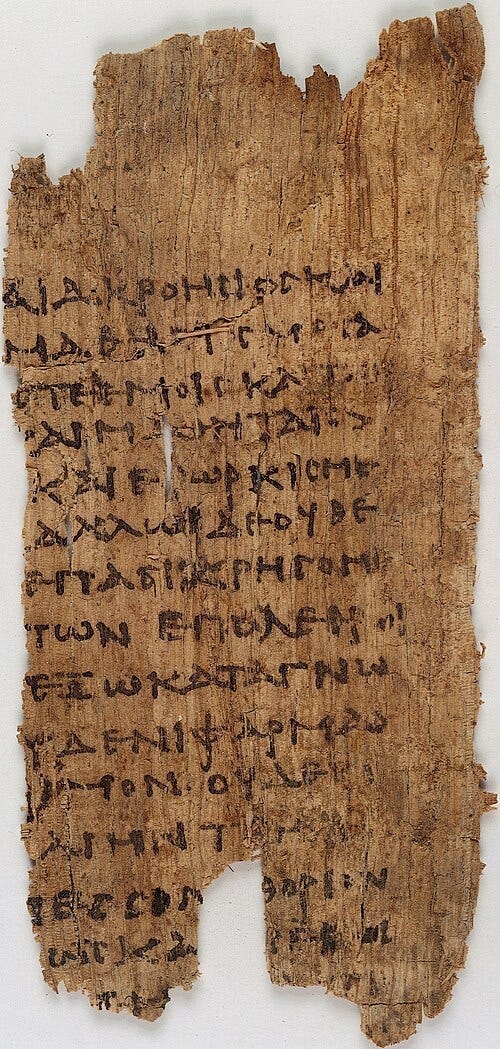
This sample, which is a travesty of degradation, is from 200 B.C., but was found in a dig at an 18th C. garbage tip in modern Egypt!
“I swear by Apollo Healer, by Asclepius, by Hygieia, by Panacea, and by all the gods and goddesses, making them my witnesses, that I will carry out, according to my ability and judgment, this oath and this indenture.
“To hold my teacher in this art equal to my own parents; to make him partner in my livelihood; when he is in need of money to share mine with him; to consider his family as my own brothers, and to teach them this art, if they want to learn it, without fee or indenture; to impart precept, oral instruction, and all other instruction to my own sons, the sons of my teacher, and to indentured pupils who have taken the Healer’s oath, but to nobody else.
“I will use those dietary regimens which will benefit my patients according to my greatest ability and judgment, and I will do no harm or injustice to them.[4] Neither will I administer a poison to anybody when asked to do so, nor will I suggest such a course. Similarly I will not give to a woman a pessary to cause abortion. But I will keep pure and holy both my life and my art. I will not use the knife, not even, verily, on sufferers from stone, but I will give place to such as are craftsmen therein.
“Into whatsoever houses I enter, I will enter to help the sick, and I will abstain from all intentional wrong-doing and harm, especially from abusing the bodies of man or woman, bond or free. And whatsoever I shall see or hear in the course of my profession, as well as outside my profession in my intercourse with men, if it be what should not be published abroad, I will never divulge, holding such things to be holy secrets.
“Now if I carry out this oath, and break it not, may I gain for ever reputation among all men for my life and for my art; but if I break it and forswear myself, may the opposite befall me” — (Translation by W.H.S. Jones).

“Moses made a copper serpent and mounted it on a standard; and when bitten by a serpent, anyone who looked at the copper serpent would recover.” — (Numbers 21:9).
The above oath was for the sanctifying of ancient doctors in their calling, which it can also be said — is very broad-based, and even though the world was in relative ignorance in the time of Asclepius, there was still no question amongst the mortal men of that time as to the presence of inherent meaning in holding up hope for the mutual goals of God and humanity, nor would they question the validity of the institution and its mission, which many disenchanted men and sages who have seen the passing of millennia and man’s inhumanity to himself and betrayal of God, such that they despaired of Hope on Earth — this Vale of Tears — but nonetheless have modernized and re-invented the sanctum sanctorum for the vast multitudes of departures and arrivals of living spirits, all trapped in the karmic cycle of Birth and Death and Rebirth, and the medical staff of 21 Century Earth, be they atheist or just “Doubting Thomas”, still go to school to study what has become the most evolved of the sciences compared to pre-industrial times, which is Medicine.
This little book of the:
“New Temple of Birth and Death on Earth” or “The Hospital”,
makes no claim to existential validation, which, given that it is the most important institution the Earth needs in order to maintain its human population, one might think that there should exist some manifesto or at least a placard over the door of the hospital, saying, preferably —
“We exist by the Grace of God & our purpose is to serve His Master Plan of Universal Transcendence for the enoblement of the Cosmos”
but short of so articulate an endorsement the sign might at least read —
“In God we trust”.
“But wait!”
Several doctors and nurses have raised their voices as one, in repudiation of all this God-bothering, with regard to the “Mission Statement” or “Manifesto”, of this, the New Temple —
“Let us just stay with — “To do no harm!” — and leave it there please!”
Several of them shouted this in unison and the rest all slammed their cups down in support.
In any case the institution has been preserved and even ennobled, as Man continues to reproduce, and to maintain the system of repopulation, that which we established at the coalface of transmutation.
As to the question of there being no true divine mandate, nor any transparency on the continued relevancy of all these births, it falls then back upon the human doctors and nurses to take up that baby in their arms, and look into the clear glass of the mirror as often as they are plagued by doubt.

Innocence and Joy
It is a smile of compassion and joy that involuntarily spills out from our own eyes, with the beams shooting outward from our faces, rich with sweetness and light, like honey, all over the face of a smiling baby, and we see the innocent divinity open its own eyes — especially in that fugitive moment which you’re certain must be the first time ever — and you, for the first time too.
“There must be something other than the visible baggage this creature has brought with him, that translates in adulthood to so hard-hearted wretchedness, as we have seen cause harm to their neighbors and the world around them!”
You say this to yourself but really don’t believe it, anymore than you truly understand it. It is like a Man who harbors a criminal personality in his mind, or a dormant monster that lurks in his very bones, and it only comes out at night, to cause limitless damage to his neighbors in the dark.
Can the Temple Live Without Religion or a Soul?
The answers are
“Yes”
and
“No”
respectively.
The joy we find when we first hold our baby in our arms is not, as the cynics say —
“Driven by an instinct to reproduce, and self-preservation”
but you only have to be a part of this process with an open heart and you will see that your feelings are truly motivated, or —
“Driven by a transcendent ecstasy that is a combination of the Divine love of a parent for a child, and it is far more celebratory than stressful, or derived from greed or avarice, or some other self-driven motive. No! The motive is just for your baby to live and see the beauties of the world!”
From Asclepius to Semmelweis we see the rise of Temple of The Material World in the lower 3 dimensions/sephirot (Earth and Moon carried by Mercury as chariot) which form the the World of Action — Assiyah — and ascend/descend to and from Atziluth through the other 3 worlds on so-called “Jacob’s Ladder” —

Just as ignoring the existence of germs caused millions of deaths of mothers and children over thousands of years and hundreds of generations — we must not judge lightly, or despise as being of no value to Humanity, things that we do not understand and are perhaps embarrassed to admit as much about.
Therefore we must foster the good historical attributes of the world’s great temples — such as being centers of learning, rather than of dogma that is set in its ways, and clings to erroneous ignorance through a misguided moralism, which poses as purity or piety, but is really prudery and medievalism, wherein certain knowledge is rejected as profane or sinful — such as was anatomy and biology was many centuries.
Ignorance, despite being productive of pain and death, has been easier to tolerate by many men than embarrassment and shame.
It makes no justification for the horrors awaiting the lives of all those unfortunate men and women, as yet unborn, whose arrogant faith in some less-convincing dogma in Western medicine, had taught doctors to not wash their hands, Semmelweis began to get all surgical staff to thoroughly wash hands at all times, as well as with chlorine — the top disinfectant — the results being an overnight improvement in the infant mortality rate from 18% to 2% of babies dying in childbirth in an average week, over the previous millennia of recorded time, then within a year this went down further — and all because of sanitation and the implementation of antiseptic handwashing in European surgeries. Although it is worth mentioning that Semmelweis’s ideas on sanitation took years before they were adopted and he was to spend his final years in an insane asylum, being told his theories were bunk, and then finally beaten to death, without the relief of seeing his work vindicated and his methods justified.
His astounded supervisor implemented his washing and sanitizing techniques after his death, and within a year of implementation the Hand Sanitation techniques of Semmelweis brought the maternal mortality rate as well as the infant mortality rate to the lowest it had ever been, which was why one of his nicknames ended up being —
“Savior of mothers”

Ignac Semmelweis — Father of Hand Hygiene.
The mind actually boggles at the simplicity of the requirement to the changes in practices in clinical environments to achieve great results with sanitation.
How needlessly long it took for the profession to learn what must simply have become obvious to any decent academic mind — and without the need for any other breakthroughs, such as blood-type analysis and modern microbiology, but just some hygiene practices which in hindsight seem to be today more simple in the observation than in the failure or absence.
A person feels subjectively Justified, and at peace with one’s conscience, to have blind faith when one is doing Good things for Others.
When Sandra Bullock is stuck alone in space and keeps reporting her condition into a radio that she simply does not know to be alive or dead, with no-one listening she continues to say-
“Huston in the blind”

“Where’s George? Oh yes he just died for me a minute ago!”
and then rattle off her coordinates.
She is actually sitting, alone in a frail and primitive spacecraft, having lost all of her companions in a violent an unpredictable asteroid shower, and the masterful acting throughout the movie was captured by the way she portrayed herself as being able to hold her sanity together by the thinnest of threads that allowed her to fool herself into believing she had some measure of control over her situation.
The act of placing a distress call to Earth was doubly dangerous because it was futile on more than one level — on the one hand, as she repeated the signal —
“Huston in the blind”
before reading out her coordinates, it made perfect sense. Her control tower back on Earth could use this information to arrange for help to come and rescue her.
But in each circumstance she needed to have a backup plan in case the radio was broken, and so indeed it was that she did. In fact she had so many backup plans — none of which were real in the way that she had been taught — but despite their magical nature saved her life in the end anyway.
This is very much the position of all Humankind on Earth even now. If we can have faith in what we can understand like her, then maybe the magical aspect of us will save us all in spite of ourselves?
We have now looked at it broadly and from a distance, but to get up close and live inside something is to know the thing. Before we come to meet the newborn Arthur, let’s look at his companions in the temple.
When we leave the Temple we enter the World, and The World is a Stage
Life on the Stage is a horizontal and lateral movement — from right to left, whereas the Hospital is a kind of stationary-station whereby ships come from every quadrant of the Sky, and so the route of birth and death, like the direction of the family tree, is vertical.
There are some doctors who do not even know that they are Priests, but their entire lives are consecrated to healing by so strong an inclination that you can summarize an example in very few words.
The lateral movement that would be so natural on a stage or in a train station — that marks the passing of events in a story, where trains pass like lightning on their direct path across the country, is about ninety degrees removed from the direction of the movement of the denizens of the hospital, who move instead from the Sky to the World, to Live and find adventure, and what then, after that, do they settle on the Earth or in Heaven?
CHAPTER 2: THE CALM
ELEMENTS IN PERFECT BALANCE BEFORE THE GREAT STORM THAT PRECEDETH THE COMING OF ARTHUR.

“Upon the wave and in the flame rode a naked babe”- Tennyson, Coming of Arthur.
All the elements that make up the world around us seem on normal days to be more or less calm, and calm by default. The earth rests quietly most of the time, element blended with element, elbow to elbow, homogeneously and calmly, most of the time, unless you dig deep beneath the surface that conceals fire and quicksilver and hissing gases and things long unknown, that struggle and creak under the immense pressure of gravity.
A world that finds itself for a moment in perfect balance, emanates a feeling of profound peace that spreads around the globe in an instant, not like a wave that rolls across the surface in every direction, for that implies a sense of violence and disharmony that is out of step with the balance that I am talking about. No, the feeling of profound, ubiquitous and sovereign peace appears more like a controlled inhalation and exhalation, that has the effect of clarifying the vapors that form our static atmosphere, a bit like the freshness one smells and sees in the verdant colour of grass after an afternoon storm on a hot day.
A controlled exhalation manifests like a fog, only this is the opposite of fog, because fog obscures and blinds us to the other elements, whereas this exhalation from below blasts away the obscuring vapours and brings about the dissipation of all fogs, mists, clouds, winds and storms, leaving an atmosphere so light, crisp and clean, like a stratosphere, as if you were standing on top of a Himalayan mountain at first light on a windless morning, and the visibility for you, nay, for even a man of average or middling vision, is rendered superb and penetrating, and you see so far along the horizon at all that is laid out before you with the eyes of an eagle, as distant objects crystallize into sharp relief, as unimpeded are the senses.
No sound distracts the mind, nor smell, either pleasant or vile, nor is there any notion of temperature, as the whole, suddenly still planet, is the exact temperature of the human body at rest, and the crows and cicadas alike show the good taste to leave off for once their endless competition to decide who can have the loudest disembodied group voice, echoing from trees, roads, walls and cars, and ultimately coming from god knows where!
The surface of the seas and oceans of the world are alike glassy on their surface, except for the mildest of ocean swells that roll without disrupting or breaking the greater overall sense of unity, such that water, no matter its source, be it ocean, river, or lake, refuses to splash or bubble or foam, but rather it folds like strips of silk that flow gently over everything in its way, because there is simply no sudden movement to traumatize the surface tension to the extent that it will splash!
Pick any shoreline — it matters not which one, as they are all alike miraculous in the way in which in a barely discernable line as fine as a hair, where sand meets sea, and if you look upwards then your understanding will be challenged again, this time by the simulacrum above, a perfect replica of the blue and yellow scene below, and you would be hard pressed, for who can say really, which it was that first embodied the blue, and which first so faithfully reflected its counterpart…
Was it the celestial or the oceanic that invigorated the scene, or was it neither the Earth element nor the Watery one? True! It was the Fire element, and even its principal deity, The Sun — Apollo himself who some call Sol Invictus and others Helios or Caelus — did The Sun fill up the reservoirs of Sky, Ocean and Earth with his beams, that charge with invigorative power the Ichor that flows through the veins of these elemental gods, is it The Sun who brightens first, then steals the blue from sea and sky alike, before finally reflecting it back, having made false claim to the origin of its magnificence?
At least if you were standing on the shore you might have a chance of getting somewhere through holding on to your separate perspective, relative to the crystalized and balanced, perfect cosmos, within which you stand in the center like some supremely lucky ant, or idiot-savant, or cockroach, who had nothing to do with the miracle, and whose presence is generally marked with universal distain, but given he is the only witness, who else but he, can be said to be the beneficiary, and indeed if you look at the picture he appears to be the sole beneficiary of its wonder.
However, whether you are an ant, cockroach, human, or invisible, elemental, parasitic form, the strand, whether it consists of white sand or course pebbles, where it meets the sea on a day of perfect calmness and the sublime potential energy harnessed by the forces of nature in perfect balance, is of all natural spectacles the one that most poignantly demonstrates how finely tuned is the machine, and how delicately balanced the mechanism that keeps it all ticking along so effortlessly —

See Man, stumbling at the vortex of harnessed Chaos, like a drunk, and neither noticing what is all around him, nor concerned with where he himself is going, in the middle of all this.
Looking at the scene in the picture above it is difficult, as a man, not to be astonished at many aspects of the picture. This picture begs many questions, and all of them flow from a sense of wonder, but the main one, or perhaps just the first one, is —
“How can all of those wispy, fluid elements, of vast size and power and weight, be floating in perfect stasis, and then how is it that this little man is wandering around in the middle of it, and oblivious to the apparent impossibility of it?”
In the above picture there is tranquility and apparent balance, but without any of the comforting lines that one would like to see, like the line where water meets the sand at the beach, a single, unbroken line of tranquility that marks the border where land, sky and sea all meet, and you can go so far as to walk to the water’s edge and place your human toes into the water, leaving the back half of your foot on the sand, a line showing where the salt water has wet your ankle at it’s highest rise in over twenty minutes, is enough to make you wonder, should you only happen to reflect on the billions of gigalitres of salt water that are held in check behind this line that is a demarcation dictated by the effect of entropy on the relative densities of the relative densities of the 4 material elements of the cosmos, and if you further reflect on how ion particular on Earth these elements are mixed in such a way as to provide for a spectacular theatre of chaotic conflict between them should we shift some simple variables in the pressure of the air, the seismic activity along fault lines beneath the ocean, the temperature of the air and its propensity to encounter rock and stone and an incendiary incident adds flame to the mix and then the elements of Earth, Wind and Fire, are in turmoil, in a catastrophic scene of forest fires, that like typhoons over the oceans cannot be predicted in their behavior because the wind-direction and air-pressure can cause them to behave erratically and unpredictably.
There is a balance in the universe and something must come along from outside in order to disrupt it; the earth itself solid and still, unless, in the case of soil, turned with a shovel, or if stone, then broken by a pick, but all in general solid and still — and although made up itself of metals and stones and crystals and sand, and all clumped in various molecular packages that we arbitrarily name, for the benefit of our need to communicate with each other —
“Diamonds”
or
“Clay”,
yet in the secret darkness of their compaction, they are as one, and undifferentiated by name or any other arbitrary value.
They are more or less at rest in the domain of man, with whom they share a place to place their feet, i.e. the surface of the Earth.
If there’s an earthquake it will stop and things come to rest.
If there’s a volcanic eruption it will cool down when it hits the sea.
All is meant to roar and thrash around a bit, but then settle down and relax.
Thus it may be said that —
“The Elements are in balance. The earth is under foot and holding back the sea, those denizens that crawl up on it’s surface we call Life. That could be a fit definition for life- “Something that crawls on the surface of Earth and breathes oxygen.”
So likewise is the woman’s body bounded by arms and legs and 5-senses, except when it gives birth and the boundaries are broken.
It is normally a calm world we live in, but it is a living thing and sometimes it will kick, and when it does the boundaries disappear and other worlds encroach upon the calm one and it is calm no more.
On a calm day too the sea and the Sun rest still.
The sea, though less-dense than earth, is still, despite the unseen currents and tides affected by the moon, also apparently a vast and tranquil singularity, that rests in harmony with the earth, and gently, and seemingly consensually demarcated by beaches, the shorelines merging unevenly with one another, dormant in the sun.
The sun itself seems to caress the sea, and the airy zone in between is so peaceful that it seems like ether — like it is not full of air at all, but merely a vacuum of blue space.
So exist the elements when they are at rest — separate, yet gently touching each other at the limpid borderlines of their margins, and for a time they are serene and simplistic, and the air that seems barely there, is just gentle breath, and all as one the sea is as a simple teardrop, held together by its surface tension.
The sun is a glaze of warm honey, decanted to a thinness that forms at dawn a single layer, an undercoat on pale whitish blue, and a zigzag of dripping gold from the invisible celestial brush in a serpentine streak across the gun-metal grey of the seemingly solid surface of the sea as it meets the horizon, and as this single streak diffuses and expands with the swelling sunset, itself begins to warm, turning now from grey to ink-blue-black, and finally deepening, until for a moment it reflects the colour of the sky perfectly, and it is as though all the world is just sea, or just sky, and the sun reflected in the sea might be the real sun and the real sun the reflection, but that our perspective, with both feet on the ground tells us which is real and which is reflection.
Trees amid the calmness of the softly turning morning barely move their fingers but rather stretch them skyward as though they were trying to catch hold of the light and get closer to it, hypnotized like moths, like fanatics who see nothing but the light, like horses with blinders compelled to contemplate only that which is directly before their eyes, stretch out their branches in perfect stillness, and if you empty your mind in imitation of the general stillness you can see the flowers opening to breathe in sun and air, and refract the evening twilight back into your eyes, in the form of sprays of red and blue and yellow, and even more of green.
This moment captures the last light of day, like the final note in a symphony that vibrates in the air before the silence and the thunderous applause.
Then the storm hits.
CHAPTER 3: NAGLFAR & THE COMING OF ARTHUR TO FRANKSTON HOSPITAL.

Naglfar.
The scene of utter mayhem that was to begin with hardly anything to see at all — a mere smudge on the pale blue of the dawn that failed to properly rise, trapped as it was out there in the middle of the grey gloom of the Bass Strait, an unwanted reminder of the beauty of peace and harmony, of the slow-moving golden orb of the Sun, when the ocean was so much like glass that the solar image reflected back into the puzzled eyes of early rising men and women.
But even before the Sun was obscured or blotted out the power of its rays gathered around like a magic spell amid the disturbed elements, that came in inexorably from out to sea, that was formerly in balance and calm, clear as day, soon became torn apart by squalls of chaotic rain that buffeted on the masked faces of the apparitions on the deck of the great and ghastly ship — albeit the deck was hard to scope, given it was flying through the stormy sky hundreds of feet above the sea.
Ghosts and undead apparitions appeared to crew the vast, dark bulk of the Naglfar, that famous ghost ship made from the toenails of dead fallen warriors.
Arthur came on the deck of Naglfahr, as it flew through the frozen expanse of Southern Sky, to wreak havoc once again in the World of Men. Frankston, 1970.
The storm was moving forward in the direction of the land inside Port Phillip Bay, and growing as it walked, in power, electrifying and then directing and concentrating its electrically charged winds toward the land, like a sorcerer whose fingertips can discharge electrical vaults.
The sea itself was a tempest of white caps, squalls, rogue waves, and every kind of anomaly that could possibly arise in one moment purely for the purpose of generating terror as it crashed in the very next moment, at times in perfect timing with a rising swell and flash of lightning, and at others the crashing was nothing more than a cacophony of selfish games played in deepest darkest Africa!
The foam of the sea was also bejizzed with white caps of dirty bubble-mixture, that simply wouldn’t foam the way it should last time it was used. The foam was like the aftermath of a dance party at the backpackers, so I guess i’ll start printing out the free drinks cards.
Pale whitecaps rose and disappeared like pallid faces of corpses under white linen shrouds, but these too appeared to be boiling, as they churned as though under heat, bubbling away in a great big pot, reserved as in peace-times for civilians and the insane!
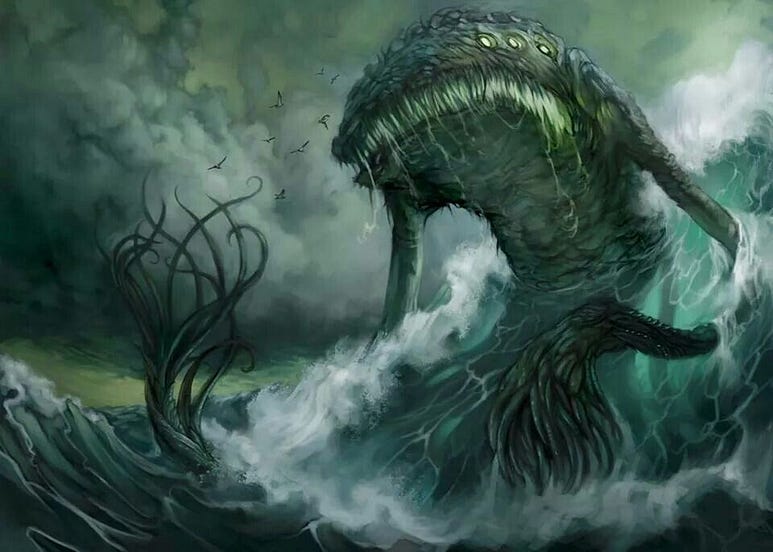
There are such presences manifest in a single entity that are yet so horrendously disproportionate in sizer and fury to all and anything else imaginable around them, and they have the effect of freezing the blood of their enemies!
Frankston Hospital is by the sea, and it was here at the break of day that all was calm, for the great Leviathan lay still unperceived in the distant ocean — but even as early as the breaking dawn were the stories set to enrage the local struggling population.
Frankston Hospital in 1970. It was closed after the night of Arthur’s birth. It is the back wall in the picture that is closest to the Port Phillip Bay access, and also the light of the rising morning-son.
There it was that the unseen storm was gathering its power, and there it was again, as with all the animation of a famous preacher who can draw in a crowd and hold it — drawing its (the storm’s) fury from the heart of the, situation, up, through the lungs and all the spinal Chakras until thence did they stuff it into the furnace of its dragon-belly in the sky.
Those stragglers left on the beach got in their cars and drove home post haste, as the crackling radio issued a severe storm warning to the bay area. It was timed perfectly to strike at sundown. It hit the land and the hospital with fury, causing chaos and disrupting power from about 3pm.
Before any land-living eyes could see, great white fins dipped beneath the boiling surface of the sea, as the sharks themselves dove into the darkness of the deep in terror, the wind outside the bay seemed to blast simultaneously in every direction, like a brass band that had been terrified by a shared nightmare, and it’s form was that of a many headed serpent that shrieked in agony and rage whenever it lost one of the heads either through misfortune or in battle.
Cursed was the dragon, and then doubly infused with a strange and powerful magic — a foreboding of something terribly unlucky, such as the appearance of an enraged and wild bear — espied at first in a silhouetted profile of sunlight, like a wild bear in the midst of primeval light, and then it was with deep, violent sounds, the long rumbling cracks of thunder that began like the faint cartwheels rolling over cobblestones in the eerie silence that possesses a village struck by the plague.

When the storm strikes and the boundaries of nature are erased, it is difficult to separate each of the elements’ rightful zone and hemisphere — one from t’other!
Mayhem ruled, and the more one tried to master its rage, the more the beast would try to unleash itself from all boundaries, and thereby compound the internal pressure of the system, and if possible even increase it from the terror that already possessed his body, shredded his mind, and threatened his soul with Oblivion.
Overextended though they already were, the vast arms of this guardian angel were widening, unable to keep his fingers completely interlocked for much longer, as the attached titanic body, half submerged, of who could only be that Sea God — Poseidon — allowed the cursed seamen to escape the clutches of the thunderer, and retire into the soft hands of the Princess who was awaiting his arrival, and as his arms could no longer contain her but eventually separated and let loose her seemingly delicate form — yet one whose strength had already out matched that of a hundred bulls straining at the bit!
Behind the storm could be arranged a bride or a captive — one just for Arthur, and of whatever persuasion he desired, plus he could offer Arthur to deliver her a Christian, a Gnostic, a Jewess, or a Zoroastrian…and he had no personal preference for himself, yet it was only at this advanced point in the narrative that it deigned to begin to show itself.
Clearly the monster whose unbridled force it was, that squared with desperate passion against the the fugitive hull of the ship, the beast endeavored to drive forth that Leviathan that had only 20 minutes earlier tried to engulf himself in the burgeoning Chaos that by this time I had lumbered personally all the way to land, and with newly expanded arms, seemed to irresistibly and violently thrust himself landward, and at the very same time to draw the sea nymph after him, into the fury of the retreating storm — for who else, and what other fairy might it have been, other than She, who now walked in naked splendour, 20ft high, and dragging him behind her, as she paced out of the water and into the carpark, and where now the stakes were increasing and it may transpire to be an act done with less finesse that leads to the more romantic fantasy that was possessing the mind of Philip in that moment.
“A wild and battle proud maiden you are…”
murmured a freezing cold and shivering Arthur —
“…and that’s for sure!”
concluded Thelma, were two of many such phrases, grudgingly granted between each of the warrior women, that is, between the mother of Arthur, and his future wife?
“As above, so below !”
was the symbolic sound of the rending apart of the veils, Arthur had been sleeping in for some time, in the demesne of Saturn at the centre of the Earth, and seemed unhappy to be awoken.
“If you ask me if I mind waking up an idiot who has no need for sleep since he has nothing on his mind, I would immediately begin questioning my sources. In fact the truth is I don’t recall ever trusting anyone like that!”
Until every man, woman and child standing as if frozen, with pressed lips and upraised hands in silent supplication, but still the low thunder of the dead-wagon’s wheel rolls on inexorably, and gets louder and more ominous, before the great rending of a sublime and colossal explosion draws cries from all the pitiful humans that hear its roar, cries so feeble that they are absorbed by the all-absorbing thunder, and the only thing they can do is stare aghast at the whites of each others’ eyes, abashed, frozen in ice, petrified in stone.
Here is gorgon Medusa, petrifier of hearts, oldest and most terrifying of demons. She was moving slowly toward the bay, to make clear the way for the sleeping soul of Arthur — so often had he come to this world and so often returned out of luck and I’ll used. On the beaches a sharp-eyed child sees the thunderhead in the distance and points in excitement —
“Woe, that’s a big storm!”
it shouts — as it’s mother sweeps it up with all the odds and ends that make up their beach kit.
“Let’s get out of here Captain”
she says, and kisses him as one strong arm bares away basket, towels, child and all, and shoves them all in the car without a moment’s hesitation. Some of the others on the beach were not so fast, but before long all could see its approach, a titanic fist, sizzling with lightning, inseminating itself through the fusion of wind and rain and thunder.
Chapter 4: Victoria Arrives and meets Maria in the waiting room.
A seething woman was brought in out of the rain, alone through the ER waiting room on a trolley, and wheeled through the wrong way because of the blackout, finding herself in agony for a few moments, and lost in space for a few moments more, as they were yet unawares that they had just crashed into the visitors’ waiting room at the dementia ward, when a woman took pity on her in the shadows —
“Hello darling, what’s wrong? Looks like you swallowed something rotten!”
said Maria, making a tasteless joke about the giant belly that was clearly the source of her pain, but smiling and strongly holding Victoria’s hand with her right one, and placing her left on the writhing stomach that was on the verge of disgorging its contents.
In spite of her predicament Vicki’s face transformed from agony and gasping into an uncontrollable burst of laughter which soon morphed again into a scream of surprise and agony as a male nurse ran up and shouted —
“Off we go to the delivery room, Mrs!”
and having quickly snatched Arthur’s mother off her feet, the boy sought to protect her from men who were only going to let her down, and planted her in the epic story of Moby Dick, then he no longer sought to pursue the whaling life — having now decided that perhaps it is not the right life for such gentlemen as they both proposed themselves to be rightly in the process of discovering.
Maria sat down again, smiling at the reflection of the moment she had with the woman in labour and wishing a blessing from god upon the unborn child, but soon her face clouded over as she remembered the reason she herself was at the hospital — her husband Alphonse had Alzheimer’s, and had collapsed for what reason she knew not. Suddenly the lights went off and on, and then off again.
She sat still, alone in the dark, separated once again as they wheeled a frightened young Victoria into the delivery room, who was about to give birth to her first son, an able seaman already, and already with his own name did he have a tale or two of the Sea.
A loved one*visits the beloved, who is cursed with a long, protracted illness, that by it’s chronic or incurable symptoms torment both the patient and the relative by being neither fatal nor completely cured, and so causing a kind of frustrating torment that is made so much the worse by lingering and juggling signs of hope and hopelessness, that a new kind of suffering is produced by this seemingly pointless and interminable protraction that causes all parties to whisper those despairing words that are so unspeakably taboo —
“It would be better if he would just die and finally be at peace”
**The loyal Spouse or child who visits a dying relative frequently — often daily, and often for years without fail.*
It is these types of cancers and terminal illnesses that have a low survival rate and reduce the quality of life, not just in terms of physical sickness, pain and degeneration of faculties — but the psychological despair so cripples the Will-to-Live in the patient that both he and his long-suffering and beloved-carer, have sought out the mercy killing of euthanasia — that moral and philosophical quandary that is often illegal throughout history, all over the world, in all cultures and for all time — rather than protract the torment only to see it worsen day after day until death finally claims the patient, but only once they have become a decimated shell of their former selves.
It is self imposed, this forced confrontation with Death —the daily sitting by the bed of the Damned and holding his or her hand as they resist that offensive truth that is a shame on oneself to admit — that Death is coming, and the only question is whether it will arrive in a short time or a long time. For the Visitor (whether it is the case of the relative, spouse or child) and the Patient there are two alternate scenarios, that no matter which it will turn out to be, they must confront together. The first is the swift and oblivion-seeking Death, and the second is the long, protracted Death, marked by denial, struggle against its oncoming, and an unwillingness to accept it.
Until it has gone on for so long that both patient and beloved-visitor pray, no longer silently, or with head hung low, but aloud and with a wretched succumbing to exhaustion and despair, and in the desperation of one who has given everything and just craves peace — for an end to the suffering.
The ‘First’ visitor will come for 3 months to visit the suddenly occupied bed of a lately-diagnosed cancer patient.
The ‘Second’ visitor is the one whose beloved has either a weaker disease or a stronger will to live.
The ‘First’, has an aggressive tumour that resists all treatment. Death comes upon him in months, and the days pass so fast that the ordeal feels like a single hour. It is the decimation of a once vibrant-looking tree, whose youthful verdure is stripped in a single season, the fallen Autumn leaves stripped and colourless in a single day, before one’s very eyes.
The ‘Second’ scenario can force the unfortunates — patient and visitor — to hang on for years! He or She, and his/her beloved spouse or child seem to defy all the odds and confound the disease, and sometimes souls are so strong in their determination to live that they actually refuse to die, and like Orpheus or Heracles, or Psyche, standing prostrate before Hades and Proserpine, demand/beg/promise the World to do anything if only the beloved might be released and given one more chance to retrace their steps upward to the distant speck of light above…but there are very few who are granted this reprieve, and fewer still who do not fail to follow the rules in the execution of the instructions on the anabasis.
When the patient refuses to ever completely heal and they find themselves in a third year of chemotherapy, and even if the mind is still strong the body is decimated through the excess of aggressive poisons that have torn its fabric apart with experimentation and vain hope, again and again, they begin to resemble an in-patient of Dr. Frankenstein rather than of the Oncology ward at Frankston Hospital in 1970.
This section is purely ritualistic. The ritual is transacted between two or more parties, in two scenes — the first scene involves the visitor sitting quietly on an uncomfortable chair in the ground-floor, public waiting room (which may or may not be merged with the Emergency Ward’s public waiting room), & in the patient’s room (or cubicle divided by hanging curtains), where the visitor may sit on a chair placed near the end of the bed nearby the patient’s feet and facing in toward their face, or else they may perch on the side of the patient’s bed, so as to be able to touch them and be touched, or else whisper to them, or come close to be whispered to.
The facilitation of spatial intimacy is crucial for the satisfaction of ritual goals, which are very important for many reasons (which we will not go into as they are too complicated to consider with proper depth without too-drastically distracting from our own goals, which are more concerned with the case at hand, than the benefits the reader might additionally derive from a more exhaustive explanation, or lesson on all possible cases and their management), but the most important one for the patient is to have that presence that allows them to deal with the disease without the additional existential fear of being bereft, unloved, and alone.
In this case the character taken on by the visitor/loved one, is that of Mission Control at Huston, and once again, like an astronaut with defective instruments picking up her transponder at the precise required moment, and according to a possibly now defunct schedule, saying —
“Houston in the blind? Do you read me?”
only to receive no response, but repeating the exercise anyway, every five minutes, on precise schedule —
“Houston in the blind? Do you read me?”
It becomes a ritual of maintaining self-control and avoiding despair.

“Maria? Are you there? This is Alphonse? Where is Maria? I want Maria?”
But unlike the uncertain and fragile figure of Sandra Bullock — so far away from Earth and in such a little capsule — she for whom maintaining the belief that she is being heard despite the absence of any evidence either way, and notwithstanding the unspoken truth that in all probability her communications equipment is permanently shot, it is nonetheless critical for her psychological stability, and in order to maintain everything…not just hope; not just self-control; but everything — which if we want to select the most appropriate descriptor to substitute for the word “everything”, whilst at the same time showing what is at stake in such circumstances, we should simply say — “sanity”.
It is her very sanity that is at stake and held so delicately in the balance, yet by engaging in this ritual of hope —
“Houston in the blind? Do you read me?”
she is able to construct a mental fortress for herself, and stave off vertigo and madness.
It is thus by the above example that we cannot overemphasise the importance for Alphonse and Maria, that when Alphonse, who may not be able to see, or may not remember where he is, can still say —
“This is Alphonse? Where is Maria? I want Maria?”
and it being as significant to him as it would have been for Sandra Bullock to have gotten a response like —
“Voyager 2 (or whatever it was), this is Houston. We hear you loud and clear. Please give us your coordinates.”
This ritualistic and self-imposed mortification of one’s flesh, heart and mind, is what the Beloved Visitor subjects him/herself to, so that the patient who is more and more alone each day, and like a real astronaut, drifting further and further out into space, this ritual sets up the Beloved Visitor to play the role of a spirit-guide and selfless priest of The Light.
So we see that just like the doctors and nurses, whom we see in another chapter to be the equivalent of priests and priestesses in the New Temple, formerly the Hospital, so does the loved-one, or Beloved Visitor likewise, become a guardian angel or psychopomp — who says —
“Take my hand!”
and then leads the dying friend to fall asleep and embrace Oblivion with the comfort of that loving voice as a balm.
The case of Maria and Alphonse.
Alphonse’s cancer was a long-time recurring tumor, and so Maria was in and out of Frankston Hospital as a vesper-sitting, hand-holding, black-angel, for seven years before she was forced to go on with life alone.
When the power came back on in the hospital the screen of the television tube in the waiting room downstairs activated and frizzled for a while. There was a crackling sound and a loud “chhhhhhhhsssssssss” as the apparent blizzard of snow on the screen settled and suddenly a flurry of black lines of different thickness appeared to enter into the swirling mass of snow and in rapid succession, like the floors passing the view of a lift that had broken it’s cable and plummeted and eventually slowed and balanced when the screaming emergency break kicked in. The lines slowed down and faded away and the snow cleared too on the screen.
Sitting in the waiting room in the dark, now light, was the woman who had comforted the pregnant woman in the night. She was an Italian woman, who spoke broken English, and who, casting her eyes up to the image that now appeared on the television, and despite not understanding all of the words that were blaring from the set, could discern it’s format at once — it was one of those game shows where the host asks a contestant a number of general trivia questions, and by giving correct answers thereby stand to win a lot of prize money. The thought occurred to Maria that this woman — the hostess on the television —
“could not possibly be Italian”
and
“in fact if she were she would dress in a more feminine way! Why does a woman wear like this a suit? It is a shame on her mother!”
She thought —
“This woman must be from here. She must be somebody’s cousin to get this job, so boring she is, and looks like a tram conductor in an overpriced suit! How could anyone get such a great job, talking rubbish, and bullshit?”
but then she corrected herself mentally, physically crossed herself, and said out loud —
“How can you say such things in this place, with so much suffering, we must be kind and compassionate”
and she cast her eyes down to the floor in shame.
She looked then with admiration at the successful insider on the television and thought further that such a job required no understanding of science, law or accounting, but that it really only required sobriety and affability, with perhaps a touch of flamboyance, qualities which can be found in at least one Italian woman in almost any group of them whom one might encounter in any public place, and if anything, in order that the game show host does not confuse or alienate her audience by being too esoteric or high-brow, such a person by necessity must not be too clever, but just light and easy like a bubble in a glass of lemonade that sticks to the side of the glass and never rises to the top to explode.
Maria cast her thoughts back to the pregnant woman in the waiting room again. While she was going into labour she had held her hand when the stretcher bed on wheels had been stopped by a male nurse in front of her, as she seemed to have been brought in alone, and with no husband.
‘What is the capital of Bulgaria?”,
chirped the television
“Is it A: Chicago, B: Vilnius, C: Timbuctoo, or D: Sophia?’,
in an annoyingly inaudible pitch which was at once too soft to be audible and too loud to ignore, like a fly.
“I can’t really hear it”
thought Maria to herself in Italian, but she could read the shining questions on the giant garish blue display. It shone on a great round plastic panel. The whole scene, the set of the game, was reminiscent of another television genre — science fiction.
It was like the flight deck in a space ship with lots of random panels, ‘beeping and buzzing and flashing’, and all the actors at their posts on the lookout for aliens, but in this case the aliens are the contestants, who, like aliens, stand agape with goggle eyes and audition by virtue of their answers for the qualification and judgement of humanity…
“For what would you go on this show?”
thought Maria in disgust.
“Of course! Money!”
This hostess is the titular captain of the ship, which is what a television studio resembles more than anything, a wheelhouse on a container ship, full of buttons and workers.
Her qualifications: a dash of saucy wit mixed with a level of conservatism which people call “good taste”, so as to possibly raise a few eyebrows but lower none. A sort of diplomatic personality which, whilst pretending to individual thought is nothing more than a mouth piece for the status quo, like a kind of vociferous maitre d’ who’s polite chit chat makes more palatable the over-priced bill in a pretentious restaurant which is as tasteless in spirit as are the dishes on the menu.
“But how much money could she make doing this bullshit?”
thought Maria —
“A lot indeed!”
The host-captain, for all her money, which she clings to like an Arab’s oil or dragon’s gold, she too like the contestants is on trial, but not in the same way as the contestants who seem to come and go more quickly than the hosts. She is on the inside already, but her judges sit behind a veil. She just needs to maintain her ‘relevance’, which on a larger scale is the same touchstone as that by which the aliens find themselves auditioning for justification — money.
But in the fascination of the collective consciousness of the ‘great unwashed’ masses in TV-land, there are subliminal motivators like nerve endings that need to be tweaked in order to maintain attention. Of course sex always sells, both to men and to women, so the one thing our hostess mustn’t do is ever grow old. She should be witty and sometimes bitchy — this reflects the aspiration of those viewers who lack wit and are too afraid to tell their enemies how they really feel.
“Money makes the world go ‘round”,
thought Maria to herself, unconsciously summarizing the entirety of the thing, and remembering sitting together in their cake shop, together with Alphonse ten years ago, watching their boy Luca playing in the kitchen covered in flour like a little ghost, watching the old black and white television in the shop and him saying —
“Maria, it’s got me buggered! All the science it took to make this box and put one in every home, and all they play on it is the ‘bullshit!’”
Alphonse called ‘bullshit’ on a lot of things, and Maria, especially since he had gotten sick, had felt like she had needed, as a part of the loyalty to himself and his opinions, had also taken to calling out ‘bullshit’, wherever and whenever she saw it — and she saw it around a lot!
She had been brought up as a good Catholic girl in Apulia, and had been taught not to use bad words, but this word “bullshit”, was their word, their revolution against all the pressures of the outside world that they had to fight together to keep at bay.
“Money pays for bullshit!”
he used to say,
“I know my love”
she would reply
“it’s Bullshit!”
and she would whisper it and lean in close to his ear and kiss it, and here in the hospital he finally got it, that she was not merely copying him and repeating his words but rather telling him her deepest secret, that in that single word he heard the subtext which was —
“You never needed to make more money to have me. I was always in love with you, even when I was angry and you acted like an asshole I was smiling on the inside, and that’s why everything outside…is bullshit”
and she would squeeze his hand on the many days that he was in the hospital, and no one knew that as they walked past this old couple who were always together and him croaking —
“Bullshit, bullshit”
that what it really meant was-
“Ti amo! Ti amo!”
“I Love you! I Love you!”
She sat there now thinking about how they had first met in Italy before the war. Alphonse had brought her two chickens as a gift and said that whilst he wished to marry her, he would leave her when they stopped laying eggs. Of course she knew that he secretly replaced those chickens every couple of years —
“…otherwise,”
she lovingly accused him,
“I’d better call Papa in Rome and let him know that the Virgin has blessed my chickens that are still laying fresh eggs every morning after 45 years!”
to which he would take a puff on his pipe and reply
“That’s-a non-a my business”
She sat now in the waiting room and watched the game show squawking on the box suspended from a metal arm, anxious and wringing her hands, not knowing what was happening to her love in the room upstairs, the one thought before and after her visits was-
“It’s not fair. We worked it out. We called “bullshit”. We love each other. There’s no more games. How can we not win after that?”
She looked at the screen and thought in her own way with disgust that money is like a bullshit factory with its own special and seemingly universal language that even aliens, like the gaping contestants on the screen, would need to understand if they want to qualify for recognition in the mind of humanity.
These are the finer brushstrokes of the thoughts raised by her pain… Money is a language, it is the enigma code, the Rosetta Stone which interprets and then translates everything into this fiction made of worthless paper, into the only language that can be understood in common, the arch-natural elixir that once imbibed dries up the stomach and the throat and creates a thirst unquenchable; it is alchemy that transmutes our days and hours into a desperate rush where we climb all over our neighbours like a clawing horde of insects in a desert devouring the last moist sinews from the rotting carcass of a jackal that had been bitten by a cobra, before buzzing off to the next available carrion, and all things are reduced to it.
It is gold, and the psychoanalysts should be asking about money before they ask about your mother, but then of course they will ask about money when your time is up. Money is the key to the treasure house of dreams, and at the start of the show, like a holy ritual, each contestant is asked what they will do with the money if they win —
“I’ll take my children on a holiday, pay off some of the mortgage and give some to the starving kids”
they all say, and maybe they will, but what then?
It rises up again, indefatigable, immortal, a chimeric foe, whom you can stab and slash at, but it will not die, as though it’s substance is somewhere else and all you are fighting is its shadow.
Yet you will come to it again and again. How strange is it that we come to our greatest enemy and renew the battle with blind confidence, like David and Goliath, always in the vain hope that your little stone will prove fatal to that monster.
“I wonder where she bought that suit?”
thought Maria, looking at the glamorous hostess on the TV, and then down at the worn hems of her jacket and the tired dullness of her old mid-length boots, which she had promised herself to replace on more than one occasion, but the boots had taken second place to the the needs of the old man whom to her was her prince, who even now, as the goggle eyed accountant from Keysborough correctly answered —
“D: Sophia”
was anaesthetized and unconscious in the operating theatre, as the wizards laboured with scalpel and scissors over his still-beating heart.
It was easy to tell, even for a woman unaccustomed to finery, for the commercials on the television often advertised fineries that only few can afford, as though the manufacturers who pay a king’s-ransom to inject the programming with aspirational messages, are mindful that they have a second responsibility equal to that of actually selling the Italian suits and German sports cars, and that is to remind everyone who can’t afford them that they exist — lest we forget for a moment that we do not possess these things, and possibly accidentally live at peace.
The suit worn by the hostess on the television was the finest that money could buy —
“This is an easy question”,
Maria thought, vaguely aware that she understood the words on the screen, and stifling a sob.
“Maybe if I had gone on the show I might have been able to win a cure for dementia?!”
The contestant got another 3 questions right before failing at the final round.
Maria’s husband’s operation was successful and his heartbeat and mind deteriorated for another five years and six months until it finally stopped, having just stopped for no reason, and with his passing passed all the hopes held by Maria and she never watched any game shows anymore.
Had she turned on the television she would not have found the same host that she had seen on that suspenseful day in the hospital five years earlier, whose name was Janet Anderson and who has the distinction of being the first female game show host and for a time the highest paid woman in the television industry in Australia, as she herself, and in spite of her money, had succumbed to misfortune, as she had been struck with breast cancer, and had resigned from her job at the age of 55, before it became debilitating and she could no longer read the questions.
By pure and irrelevant co-incidence Janet ended up taking radical radiology treatment in the private wing of the same hospital at the same time as Maria’s dear husband was placed in a large stainless steel draw of the morgue in the basement.
In rare moments of clarity Janet reflected on her time as a host and all the winners and losers and made her own philosophical observations of her world, concluding that it is more like a lottery than a game show, where every day one is presented with an envelope with a card inside, and every day you take out the card and gratefully read the single word inscribed thereon — LIFE.
So lives the tenth party in the hospital, vainly searching for distraction as they await the outcome of the potions and scalpels and electrical machines and rubber tubes, wielded by the hierophants, and praying to the uniforms and masks, as though to priests, to intercede with destiny on their behalf and give more life to that loved one for whom they would do anything, whilst silently transcending their selfish ego and creating of themselves an avatar of God, or voice from beyond the stars, that people like Alphonse can hear calling to them over the hubbub of the legion of other voices.
Chapter 5: Birth of Arthur in the heart of calamity.
Dance Macabre. A celebration! Let all the goblins toast the baby imp that never learns how to say —
“No more chances for you! And especially you giant?”
The mischievous elves taunt the nurses and doctors who can hers them. A bridge between worlds forms, like when the rain mingles with the light and a rainbow appears, but this is another kind of bridge, not one like in the case of the rainbow, the gentle covenant at the end of the great tempest, the manifestation of a momentary stillness, as though the planets have aligned, but rather the opposite — a case where the doors which rightly separate the worlds have been torn asunder and spirits from the underworld are set free to wreak havoc in the middle earth and the heavens alike. Chaos unites the old world and the new, wildfire surges through the forests and brings devastation before the fecundity from out of the sludge, the same that produced all of your ancestors in their crocodilian swamp of the waste of that which used to exist — and instead of a rainbow we have another sort of bridge — birth!
Soon he will come, as the tempest is still surging and pulsating and invisible fingers are clawing at the window of the sanctuary that is the maternity ward of the Frankston Hospital. It bends in and then out again, but glass does not have as much flexibility as wood, yet it is strong, but there is nothing that will stop the elements from entering the ward and it devolves into a question of whether the window will shatter or be torn from its hinges. Suddenly, as a blast of wind tore away the latch from the window, which itself only opened about 45 degrees, being also contained by a sliding rail that extended to that angle and then clicked into position, such that it could be opened and fixed, then pushed out a little again before de-activating the mechanism before it could be wholly shut again and then locked shut by a handle which turned a screw inside the mechanism that attach it to the frame, now found itself in conditions which exceeded it’s own specifications, as the air pressure of the storm without, like a giant octopus from a Jules Verne novel wrapping its incomprehensible tentacles around the girth of the submarine and causing cracks in the hull and popping rivets which would fly across the deck at thousands of pounds per square inch, exerted a force that popped the latch and tore the window open to its extreme lock position, and it quivered and rattled in the creaking way that metal which bends under extreme pressure, seems to groan on it’s insides, and burst open, allowing the elementals to enter the sanctum.
It is torn, and just like a little wooden barn is carried up and up spinning in a hurricane, only to be carried away and land a long way from home, so this window is torn, and spinning like a discuss is sucked up into the sky. Amid the rending of the windows many of the inmates were blown around like rag dolls, though unconscious in drugged sleep, and in this, as in all wards, some had fallen on the floors.
How the wind entered the ward and shrieked around the beds of the women in various stages of labour, and how the curtains still held by their multitude of pierced bindings burst into a hideous dance? The curtain around the web is tearing, and her flesh is tearing, no longer protected as it was by the window from the outside elements, but those are now inside and combining, rain with bass vibration and electrical current, and pulsating as though it has a mind of its own and actually is conscious and not just awake but full of intention and as it moves ever faster through the corners of the building and leaves of the trees — intention! The rags of the curtains still dance like the sails of a ship being buffeted and then finally rent in the centre of the rage of a tropical typhoon, and every corner of the ward became an auditorium for the reverberations of the shrieking multitude of ghosts that at first filled the billows of the linen which moments ago had been lifeless and now was haunted with incorporeal forms that seems in their multitudes to fight each other to fill the invisible space with their ethereal and enraged presences, the body of those flowing curtains before rushing into the sanctity of the space inside and causing havoc, as though the gates of hell had been opened and all of its most frustrated spirits had concentrated all their rage in one chaotic assault to get into this place and fill it with a sublime cacophony of swirling energy, like a massive wave the moment that it crashes and drags everything into its irresistible vortex, a homage to the traveller soon to be manifest. All was mayhem and madness in the ward. There was a soundless echo that perhaps was nothing more than the ringing in the ears, the vibrations of the eardrums settling to stillness. That was the Time — the liminal moment between the cataclysm and the first breath and the relief of the mother. After that moment of ringing-unsilence there is a voice, the voice of victory, it starts with a single note and then becomes a great choir of layered voices occupying all of the octaves in the register of music and the harmonious angels all sing in clear, fluting celebration, only one word… “HALLELUJAH!”, and cries of anguish of the new mother melt away into sobs of gratitude and relief. The nurse left for a moment the delivery room and then ran off somewhere else. Victoria was lying in her bed exhausted and oblivious to the now-abating storm outside and the blackout inside, that still flickered off and on, but not with the same witchcraft as before, now dispossessed of its uncanniness, now just the exhausted staggering of a shagged-out marathon runner, closing out the last lap with the last vestiges of her energy, in the stadium.
Victoria’s fingers were rigid on both hands in the form of half-closed fists, where she had wrenched them from the side-bars of the cot in order to close her arms around the tiny creature, still dripping in amniotic fluid, swaddled in a thin, blue and white blanket. Not knowing that the cataclysm was mended and yet feeling intuitively that she had survived, that she herself had not completely burst or imploded, the vast space of air outside the hospital was subsiding now in it’s pressure, another rended womb. Wombs within wombs, she was the the earth and had survived an attack by the universe, whose body had briefly stopped spinning, severing the borders of time and space and disgorging its formerly resting particles into the ether, and within the ether — the titan, pushing against primordial darkness; expanding in Will, the last heartbreaking words he heard before he lost consciousness, that he could not let go, and carried with him across the guff, were heart breaking…
“Sleep my love, good nighty night. You’ll find me agian”
Victoria didn’t then, and indeed never knew that the father had been there that night in the corridor outside the delivery room silently listening, before sneaking in during the blackout to take a look at his son; for he had left her months before, as though his job had been merely to get her pregnant, and once that was achieved, was then obliged to go off and do it again (which he ultimately did), but on this night of her labour he had stood in the corridor listening to her shrieks subside and the cries of his son begin — the whole world shrieking in sequence, until the noise mostly subsides and becomes a moan that continues all our lives and then finally expires with the last breath as a candle expires when it is deprived of oxygen.
So slight and delicate was the utterance of Arthur’s first cry; a tiny spark that might as easily not have caught, as the nurse placed the paper towel on his head and it adhered to the caul that stretched from the shoulders and up over the head, down over the eyes and wrapped lovingly around the ears and lips, like a cloth covering the Eucharist. She made two incisions so that he could breath, and beneath the membrane he opened his eyes and saw everything as through a veil.
It was as though the rapture of his mother’s body had at first passed into his frightened little mind, and then, as though the baby itself had given birth to the afterbirth, his shrieks and those of his mother at the level of a human ear on its first traumatic inhalation and enraged shrieking exhalation, in defiant self-defence of life, and just as she had thought that it would be impossible to complete the act of labour and even shrieked the words —
“Get out!”
so his gooey face and distraught eyes seemed to shout indignantly
“What effrontery has brought me to this place?!”
He had arrived in this world, ripped from the upper world of darkness or light and then, in a gushing instant, like going down a giant waterslide of blood in total darkness, was expelled as through a bloody gate into another world, and suddenly asked to breath — to discover that mouth and life-connection to the mother was cut in an instant with a knife. What a surprise! After the initial horror of waking up on another planet the child, exhausted, fell asleep for a while, as did the mother, the two of them sharing the same feeling of bereavement at the separation of their formerly conjoined bodies, and when they were both asleep a little nurse moved the baby into a special crib in a little adjacent room. After about an hour the father went in to look at little Arthur.
Chapter 6: The Shadow of the Father.

The shadow of the face of the father was cast, thrice-life-size over the crib beside which he loomed.
Seemingly silent was the hulk that was, despite his mass, invisible to the rest of the denizens of that hospital in that storm that night.
But he was not silent. He was vibrating, buzzing at a low frequency, the same one as the clock on the wall that wasn’t there before.
He looked at it and tapped it with his finger while the storm was still raging, even as the orderlies were attempting to repair the hole in the wall where the window used to be, and it would seem, had anyone been looking, that this action also happened simultaneously with Arthur’s first gasp of breath and as he uttered his first faint cry, the tempest of chaos fell silent and the clock began to tick —
“Tick, Tock, Tick-Tock”
“Ah!”, said the father, hearing the cry of the baby and the sound of the clock to no-one in particular. The Mother saw him not, and like him she saw only Arthur’s tiny magnificence.
“There you are!”
And as he looked at Arthur, whose eyes were still closed, he pressed his lips together, overwhelmed, yet trying to contain the expanding fire in his belly.
There was a light shining behind his head, a lantern held by the attending nurse, and its light was made brighter around the circumference of the father’s head such that its totality was just as bright where it bathed the infant’s face, a face strangely undimmed by the intercession of that exceeding round head of the father.
The nurse, though unaware of the dark presence, held the lantern centrally above the back of the dome of the stooping man, who gazed drinkingly at every feature of the slowly awakening child, and the expanse of shadow cast by the father between lantern and babe, was itself eviscerated as by a second light source, and thus the presence of the visitor was no more given away by shade than any other sign of presence.
The baby should have been buried in a darkness which must have engulfed the entire crib — like a blanket of dark mist…yet like water-mist that is met with heat so did the shade disintegrate, evaporate, and disolve.
The father moved slowly from this position, of stooping, as it were with a great halo over his head, which itself caused his blind-spot, and a wave of almost simultaneous thoughts and emotions washed over him, as suddenly now there was cast a shadow where before one had not appeared — but only, it would seem, cast by his head.
As he gazed down, over the crib of the sleeping newborn boy formed a new but distinct crescent of a shadow cast newly by his father’s round head, and just as in an eclipse, there was a perfect circular penumbra of rays of the lamp held aloft and behind, from where the nurse held the lantern aloft.
It hung there for a moment that seemed to last for a long time, as though a retardation had come over the clock and altered for a moment it’s movements, and even the “second-hand” hesitated in mid-“tick”, or “tock”.
The light too was half-liquid-half-crystallized, and the whole moment became a teardrop in eternity — a three-dimensional, warped surface-tension, refracted the light that passed through its prismatic depth, and then exited on the other side as a rainbow of tiny colours, an anomaly of sublime order in the midst of the swirling and turning of the howling storm that had dominated the night.
As time re-stabilised the teardrop fell and the emotion that it had inspired in the father at once enveloped it. Then a shadow moved and a crescent of light formed over the baby’s head. In fact it was a matter of seconds that comprised the time of Arthur’s father’s confusion at gazing down and seeing nothing but this impenetrable shade.
Imagine it, a vast face in the moon, with wide bulging eyes, straining at their cavities to see the small son hidden in the irony of his father’s shadow, holding still and trying to gaze harder, as though an effort of concentration would bring light to the darkness.
It was not until he completed the slow turning of his head to the left that the crescent shadow cast by himself over his son passed that the full awakening of the boy was allowed to happen, but without its visitation it would not have been completed as it had to be, like the turning of the key in an ignition which gives rise to a flame of rage and frustration, like compressing the clutch with one foot and pumping the gas with the other foot and then both feet working together to release the clutch and gently compress the accelerator; this confluence of separate actions brought together in a sequence and with varying sensitivity and force which happens in a few seconds but takes, like any discipline, years to sublimate to a point where it becomes like a second-nature, a spinal or unconscious symphony of actions, that was happening in it’s own way in the mind and body of the father and son as one.
The lantern was still poised above the head of the father, but as the head turned the shadow changed to reflect or refract, at first the ear, and then the cheekbone, and then the fine contours of his long and hooked nose, his mouth and chin, their contours lit in parts by the fires of rage that expanded in his chest.
These patterns in the shadow were revealed one after the other just as the coastline of the continents are revealed in a view from space as the sunlight of dawn reveals the contours of the coastline of America — as it turns away from the watcher on its axis.
The bright light by degrees revealed like the dawn, first the sides of the crib and then the round face of the infant, who himself had sensed the presence of the looming stranger, and who with equal futility (his eyes being never before used) had attempted to look up into the face of the father, and all he had been able to see was a black circle surrounded by light, but which now, in perfect opposition to the revelation experienced by the father, saw an image, by degrees revealed, at first of a huge ear, and although he had no frame of reference, being but moments in this world (he might later on have described it as an orchid, a soapy, fanning satellite dish, all curves and tendrils like aerials for translation, but alert by nature and to look at, vigilant — ever listening…had he remembered properly and completely). It looked as though it that had been shaped by the wind.
Later in life when Arthur would read books wherein the writers had compared a woman’s ear to a “shell” he could never see the resemblance.
“Shells are too hard. Ears are flowers and the wind is music”.
In poured the light like water, very slowly and fluidic, as the father’s face revolves on its axis another few degrees to reveal his cheekbone, strong and hard, and in turn and contrast, Arthur’s cheek was shown to his father with its dear, unblemished purity, so soft and white, such a thing that makes a father wish to quarantine forever their child from the scarification of the world’s malice…yet, before he had time to reflect too much on that, before another moment had time to pass — their eyes met at last, and up, as though drawn by an invisible string, stretched Arthur’s little arm with his forefinger outstretched, unhesitatingly!
It was like each of the child’s senses had an individual birth. The mother had given him breath, and now, with the meeting of their eyes, the father gave him sight, but not just the ability to discern light from dark, or the variations of form — something passed between them, from father to son, from the great, planetary eye that gazed downward into the mind of the infant, as an electrical charge will activate a light-globe, and make it shine with its own light.
Now a little arm reached outward and upward, and slowly, from beyond his sight the child saw resting like a rock by his body, the great hand of his father.
It was the hand of a tradesman, with four calluses like mounds at the base of the fingers on the white flesh of the palm, and on the fist were snaking veins, steely sinews, and knuckles of various protrusion, some having been broken in collisions and then poorly healed, some arthritic and bulbous.
The fingers were long, thick sausages, and flat on the ends, as though sculpted by a lazy or idealistic mason, yet they emanated strength as though if they encircled your hand they would never let go. However it was Arthur’s little hand that by instinct encircled and squeezed his father’s.
Apart from taking his second breath (the first being helped along by the doctor moments before) the reaching out to take his father’s finger was the first conscious action of Arthur’s life.
The father’s head revolved further, and the lamplight paused for another moment. A crash was heard, and as the nurse suddenly fled to some urgent calling, all was again in darkness, and Arthur saw his father again no more for years.
메타데이터
- post_id
- 93fb2057a8a6
- slug
- prequel-the-coming-of-arthur-93fb2057a8a6
- url
- https://medium.com/@juyus_39463/prequel-the-coming-of-arthur-93fb2057a8a6
- canonical_url
- https://medium.com/@juyus_39463/prequel-the-coming-of-arthur-93fb2057a8a6
- author_url
- https://medium.com/@juyus_39463
- status
- ok
- fetched_at
- 2026-06-09 15:37:30