Deciphering the Wow! signal, Part III
The Wow! signal encodes the Alpha Centauri planetary system…
Deciphering the Wow! signal, Part III
The Wow! signal encodes the Alpha Centauri planetary system…
For the authentication of the Wow! signal, please click there.
For Part I of this little decipherment series, click there.
And for the previous Part II, that’s your clickety-click right there.
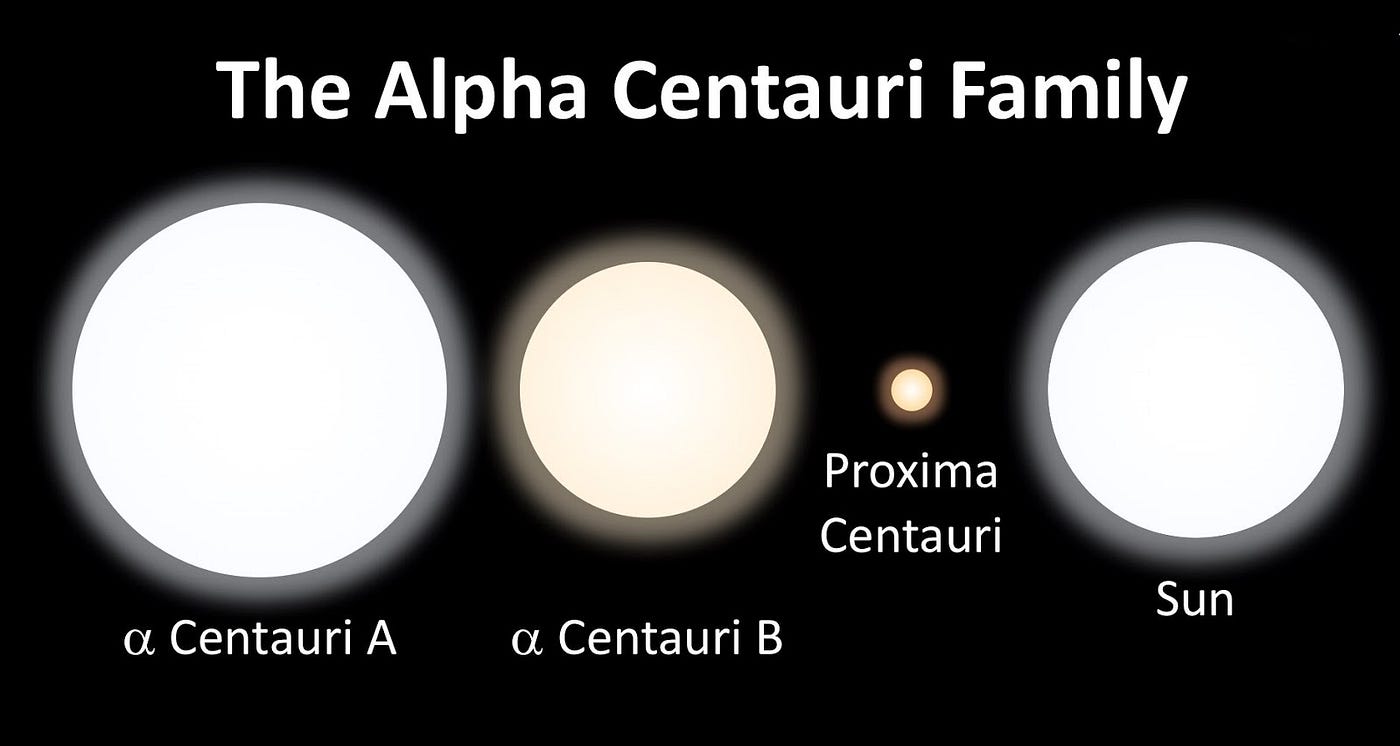
In that previous Part II, I talked about the application of game theory to SETI (search for extraterrestrial intelligence). Specifically, you have to start with METI (messaging ETI). If you are doing METI, after all, then you have to think about the recipient. What sort of message would they look for? How would they identify it as a message. What would they want from the message? That’s to say, what information would they like to know?
Likewise, if you are doing SETI, then you have to think from the METI’s point of view — remembering that the METI civilisation is thinking from your point of view (i.e. second level thinking, in terms of game theory).
I also argued that there is only a very short window, or timeframe, between a technological civilisation gaining the ability to do SETI (i.e. using radio telescopes), and acquiring the more advanced technology to answer the question themselves about whether there is any life out there. Advanced space telescopes (like the Space Interferometry Mission — which was cancelled of course) are one such, but not long after that you will have interstellar travel capability, and the first thing you’d do with that is send out an armada of little probes to all your nearest neighbour systems.
That timeframe will only last for perhaps no longer than a century (in human terms).
Given the velocity of light, this means there is a distance limit to SETI, namely about fifty lightyears. This is the radius of what I call a Galactic Sector. The reason is because by the time you’ve sent your message and received a reply, you have advanced to the end of that timeframe. So, for any psychologically intelligent/mature species, there is no point in doing SETI or METI beyond a fifty lightyear range.
This should, equally, be seen as a favourable point for a SETI-type organisation, because it cuts down the number of target stars. Any intelligent lifeform will, at least to begin with, restrict its SETI-type activities (including exoplanet hunting) to nearby stars, starting with the nearest.
So when you re-think the so-called Drake Equation, from a SETI perspective, you have to restate the question such that ‘how many civilisations are there within a fifty-light year radius who are within that century timeframe?’
I wouldn’t wager that the answer to that question is a big fat zero. It really would be a miraculous coincidence, after all, if there really was another civilisation who just happened to be at precisely the same stage of technological advancement as another civilisation in the same galactic sector. Absent premeditated intervention, that is (but we’ll leave that one aside for now).
The fact that our own SETI does not appear to think like this is a sign of either conspiracy to prevent the success of SETI activities, or simply a sign of psychological stupidity. One might argue it’s both (since concealment is psychologically immature), but again, let’s leave that to one side for now.
The corollary of this, is that the far greater likelihood, in the event of a SETI-type organisation receiving a message within that century-timeframe, is that the METI-civilisation sending that message already knows about the SETI civilisation.
As I have demonstrated with the authentication of the Wow! signal (along with Ozma and BLC-1), this fact has already been confirmed because the sender of these signals uses human date and time measuring systems. Metadata, that is. That metadata produces mathematical series. There you go.
So then, now we can use this insight to deepen our decipherment of the Wow! signal. Given the signal is related to Ozma (Epsilon Eridani) and BLC-1 (Proxima Centauri), this already gives us the information that the sending civilisation is interstellar — they are at Epsilon Eridani, and Proxima. You would have to infer from this that they know everything about this system, and also every other system in the sector.
And they would assume that the humans receiving their signals would be intelligent enough to work that out.
Thus, what would those humans want to know? If they were sending the message to a pre-interstellar civilisation, what would they tell them?
Well, even though it should be obvious, I’ll spell it out.
‘Clearly,’ says SETI, ‘there is life out there, as you have demonstrated. We are interested in the details of that life. Like where is it? As you know we are also engaging in exoplanet hunting, so can you help us with that? Or at least, help us get started. Perhaps you could tell us whether our nearest neighbour system is inhabited, if there’s a habitable planet there, and maybe a few details about that planet. Like, distance from the star, radius, rotation period, mass, atmospheric composition — that sort of thing. Our scientists can work out a lot of the rest from that basic information. Thanks in advance, by the way. Appreciate it. Ciao.’
‘Well,’ replies the METI people (hmm — there’s a cool name for a hippy band), ‘far be it from us to disappoint, seeing as you asked the right question and you asked it very politely, let us tell you a little about your nearest neighbour system. Alpha Centauri, you call it.’
Why have humans never sent a message like that to Alpha Centauri, by the way?
Now, first of all, please remember that the METI people will already know that the SETI people have achieved a sufficient level of astronomy capability to find out some basic information about the Alpha Centauri system. Namely, it’s a binary star (or trinary, if you count Proxima — but that’s, like, 0.21 lightyears away, so it doesn’t count — it’s hardly a three-body problem), that Alpha Centauri A is a little bigger than our sun, and B is a little smaller. A is in fact 1.1 times the mass, and 1.5 times the luminosity of our own sun, and B is 0.9 the mass, and 0.5 the luminosity.
The period of B relative to A is eccentric, ranging from a distance of about 11.2 AU at perihelion, to 35.6 at aphelion. They orbit about a common centre (a barycentre). A is called Rigil Kentaurus, and B is called Toliman.
To be honest, by the way, I would not be surprised in the slightest if the actual eccentricity ranges from 11.3 to 35.5. Why? Because 355/113 is an extremely accurate approximation of geometric Pi, accurate to six decimal places (3.141592). It’s known as *Milü*, from the Chinese.
I would also not be surprised if any intelligent lifeform who discovered that would not be able to help but make some spiritual or transcendent conclusion about the universe (or, if they insist on remaining materialist about these things, simply a conclusion about planetary system engineering by a very advanced lifeform with a cool sense of the aesthetic).
I would also be unsurprised if a SETI-type organisation on a dystopian world governed by a Brookings Report-style remit to conceal the existence of non-human intelligences from the public, would cover this up. ‘Thou shalt have no other non-human intelligences before me,’ and all that.
Anyway, I must not digress. METI would also guess that SETI would have calculated the orbital period of the binary system around the barycentre is approximately 79 (Gaian) years. What that is in the years of an inhabited planet in the system is also an intriguing question, and once again it would not surprise me if the answer also happens to be a meaningful number. Actually, we should add orbital period to our list of questions we want to know.
By the way, and this one is especially for fans of Game of Thrones, any inhabited planet in that system would have a 79-year long cycle (actually it’s about 79.7), with significantly extended seasons, like a long winter lasting, I don’t know, 15–20 years maybe. That would also have a significant influence on the evolution of life on the planet, given that evolution works through adaptation to the environmental conditions.
As my decipherment stands at the moment, I should add, I have not yet gotten to the stage where I’ve found the bit in the signal that tells us what the orbital period of the planet is. Either I need to do more thinking, or it’s not there, or it can be worked out from what is there (using basic physics, obviously — orbital mechanics, I mean — but I don’t have access to a computer model).
The other option, a little like the message in that movie *Arrival*, is that there are other pieces of this puzzle contained in other messages. Except if there are other messages, then unfortunately these appear not to have escaped the Brookings Report remit, and SETI are sitting on them without making it public. Maybe they aren’t intelligent enough to decipher the messages. Maybe they need my help? Or perhaps the decipherment scares them — given their clear lack of psychological maturity in these matters.
Still, makes you wonder, doesn’t it? What other genuine signals are SETI in possession of, which they have managed to prevent from reaching the public domain? They must’ve been mighty pissed when BLC-1 got leaked. So they had to do a damage limitation and cast doubt on it by inserting mirror signals into the data file.
Anyway. You’re wondering when I’m ever going to get to the point. Ok. The other thing METI would know SETI have a good idea of is the distance from here to Alpha Centauri. The most accurate, up-to-date answer to that is 4.344 lightyears.
Note well, by the way, that this is Gaian lightyears. It’s the distance light travels in one orbital period of our own home planet. No other lifeform in the galaxy would use such a measurement. Unless they are communicating with someone else who does use such a measurement, of course.
So when you look in channel four of the Wow! signal and you see the number 4344 then, well, you have to ask yourself some serious questions if you are still doubting the authenticity of this message, or the fact that the sender of the message has amply demonstrated that they know all about humanity.
Please also bear in mind that in 1977, when the Wow! signal was received, this level of accuracy for the distance to Alpha Centauri was not known. At that time the estimate was around 4.39.
The 4344, then, identifies the star system whose information is encoded into the Wow! signal.
You will want to refer to the printout detail again, naturally. Here it is for handy reference.
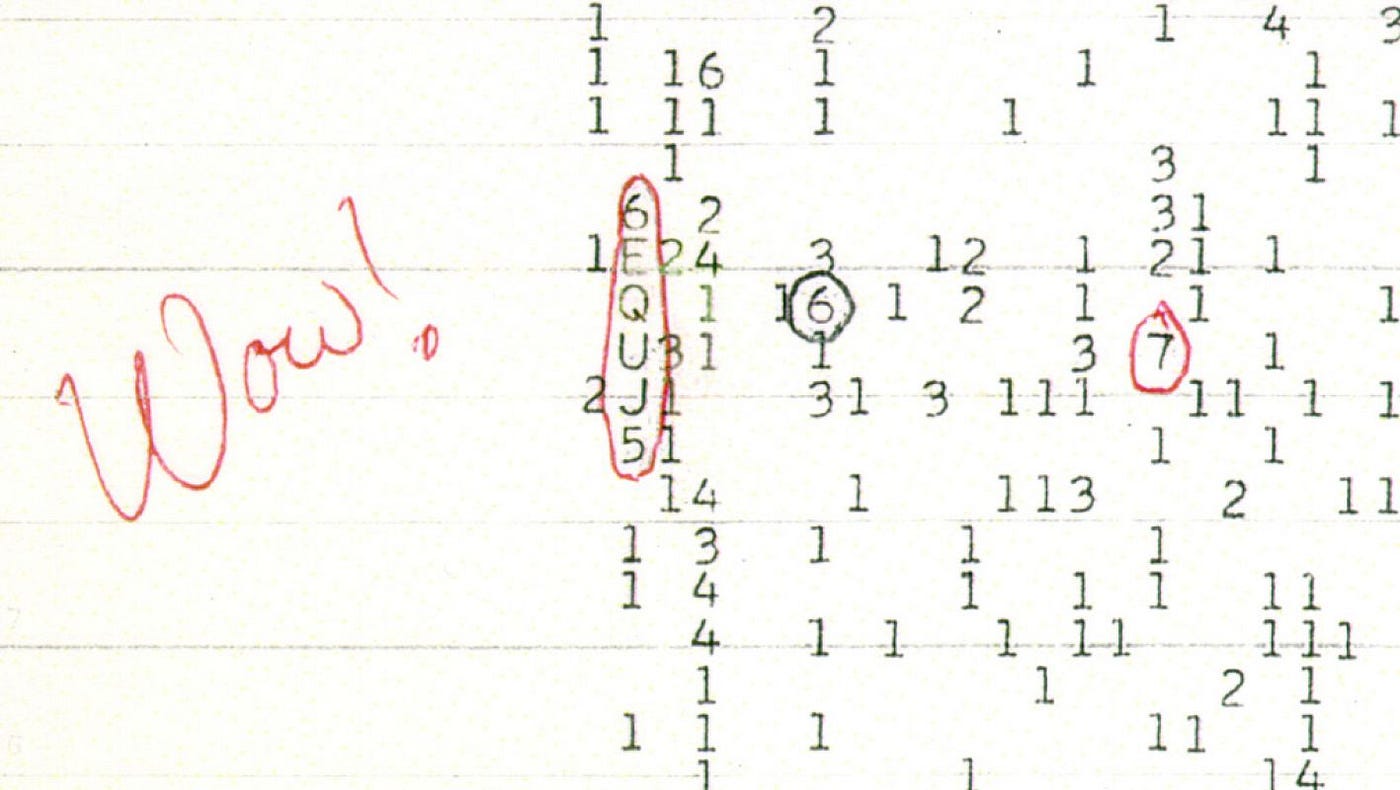
Read the channels from left to right
I should confess at this point that when I first looked into this signal I did think that the six numbers in channel two (the one inside the cartouche which most people assume is the signal) referred to a planetary system, perhaps with the numbers themselves referring to orbital distances from the star. Although I didn’t necessarily dismiss this outright, I did put it to one side because some of the numbers are too close together to be reasonable or realistic for two planets in a system, and also because I forgot that Alpha Centauri is a binary system.
On that last note, by the way — you can see the ‘1’ and the ‘2’ to the left in channel one. If we’re talking a binary system then, somewhat obviously, this is star number 1 and star number 2. If so, that solves our little issue about planets being too close together. It can mean the first three numbers refer to planets orbiting one of the stars, and the second three numbers to planets orbiting the second star.
Which is which, of course, is a moot point. But then again, METI would assume that SETI, being human, would think of star number 1 as the larger, namely Alpha Centauri A (Rigil Kentaurus).
Notice also that the first set of numbers — 6–14–26, add up to 46, and the second set to 54. That does look a bit like the ratio of sizes between Toliman and RK. So if that ‘1’ does mean star number 1 here is the smaller, then you will have to reverse most of what follows.
I should translate the alphanumerics into pure numbers for further reference. That’s 6–14–26–30–19–5.
Note that if these are distances in AU then it doesn’t work as a planetary system, especially not in the AC binary, what with the second star’s perihelion at only 11.2 AU. That point, by the way, is all important. And we’ll get to the conspiracy theory about them lying to us about exoplanet hunting data a bit later on. Although that would put the suspicious death of Carl Grillmair in a new light. Hold that thought.
If these distances don’t work — which METI would think is obvious — then the recipient needs to be a little creative. So how about we move the decimal place back one. That now gives us 0.6, 1.4, 2.6, 3.0, 1.9, and 0.5.
The last one, however, could rather be 5.1 (notice there’s a ‘1’ right next to it in channel 3). 5.2 is the distance of our own Jupiter from the sun. Notice also that there’s a 19 and a 30 in there, which likewise are the distances in AU of Uranus and Neptune respectively. Perhaps using those numbers is simply a pointer to tell the recipient ‘this is a planetary system in AU I’m describing here’.
5.1, in this binary system, would probably be the upper distance limit of a planet in a relatively stable (if highly eccentric) orbit, given the perihelion of Toliman. Although one intriguing option is if Toliman ‘captures’ a planet on its closest approach, then ‘returns’ it back again 79 years later. So the planet does a kind of figure-eight around both stars. I must admit that would be seriously cool.
Likewise, being a Star Wars fan, we do have the gorgeous twin sunsets thing going on.
We should remember the letters in the alphanumeric, though. Notice we have ‘E’, ‘J’, and ‘U’. If this is a planetary system then we can guess what those letters stand for in terms of our own planetary names. I don’t use that awful name ‘Earth’ by the way (it’s cold, lifeless, dirty, masculine — the opposite of what this living planet is — hardly a name to engender care or love, is it? Gaia, however, has better connotations, and those connotations do affect a person’s attitude. Think Sapir-Whorf, actually.), but the sender of the message knows that SETI does use that name (so they’d hold their nose and click send).
If this is true, then we have identified our ‘Earth-type’ planet in this system, as presented in this signal.
But I’m getting ahead of myself a little. The letter ‘V’ in the alphanumeric would be the number 31, and we do see that number next to the ‘U’. As for the ‘Q’, one might be forgiven for seeing that pictorially, in which case we could be talking about a ring system or a moon perhaps. And I’m sure I’ve seen that sort of thing multiple times in crop circles. But again, let’s leave all that to the side.
To read these literally, then, we have a translation that says something like this. 1 Earth-type planet, distance from star number 1 1.4 AU. Second planet from the star. The first one is 0.6 AU distance.
I would not be surprised if the first planet is described briefly in channel 4 — with the sequence 61–2411. Namely, the actual distance in AU is 0.61, and the planet’s radius is 2411 km. That would be reasonable.
There’s another (third) planet at 2.6 AU. That’s the ‘Q’ planet.
I personally wouldn’t be surprised if the fourth planet is the J(upiter)-type planet, and that may well be at 5.1 AU, a bit like ours. If so, this would leave two planets orbiting the second star, Toliman, at 1.9 and 3.0 AU respectively. Whether that makes sense or not in terms of planetary formation in a binary system, and whether there should be a more inner planet (or another one further out), is obviously an interesting question but, you will be pleased to hear, not one in which I am going to delve right now. I will say something about planetary formation later, but not now.
Besides, as far as the sender of the message is concerned, SETI are only interested in stuff that is like themselves. So we’ll focus on this Gaia-type planet.
What else did they want to know about the planet?
Well, given how long this has gotten already, I’m going to split this up into another part. So if you do want to know what else there is to know, you’d best click on the…
메타데이터
- post_id
- 93fcbf52726d
- slug
- deciphering-the-wow-signal-part-iii-93fcbf52726d
- url
- https://medium.com/@evelyn_brunswick/deciphering-the-wow-signal-part-iii-93fcbf52726d
- canonical_url
- https://medium.com/@evelyn_brunswick/deciphering-the-wow-signal-part-iii-93fcbf52726d
- author_url
- https://medium.com/@evelyn_brunswick
- status
- ok
- fetched_at
- 2026-06-09 15:37:30