Cream, Twice Removed: BUTTER NO ITOKO from Tochigi
“Delicious things are made of fat and sugar.”[1] At the first bite, that old tagline came flooding back — a line from a television…
Cream, Twice Removed: BUTTER NO ITOKO from Tochigi
“Delicious things are made of fat and sugar.”[1] At the first bite, that old tagline came flooding back — a line from a television commercial for some health tea, years ago now.

BUTTER NO ITOKO
BUTTER NO ITOKO — butter’s cousin (バターのいとこ). The sweet comes from a company in Nasu District, Tochigi Prefecture. The name is far too catchy, which is exactly why I have known about it for years. It began turning up in department store food halls a few years ago and seemed to go nationwide overnight, so I had always assumed it was from Tokyo. In fact, it went on sale in March 2018 — one of the sweets that came through the pandemic and grew. And every time I see it, the same question comes to mind. Why a cousin? Why not a child, or a sibling?
The answer, considerately, was printed right there on the paper bag:
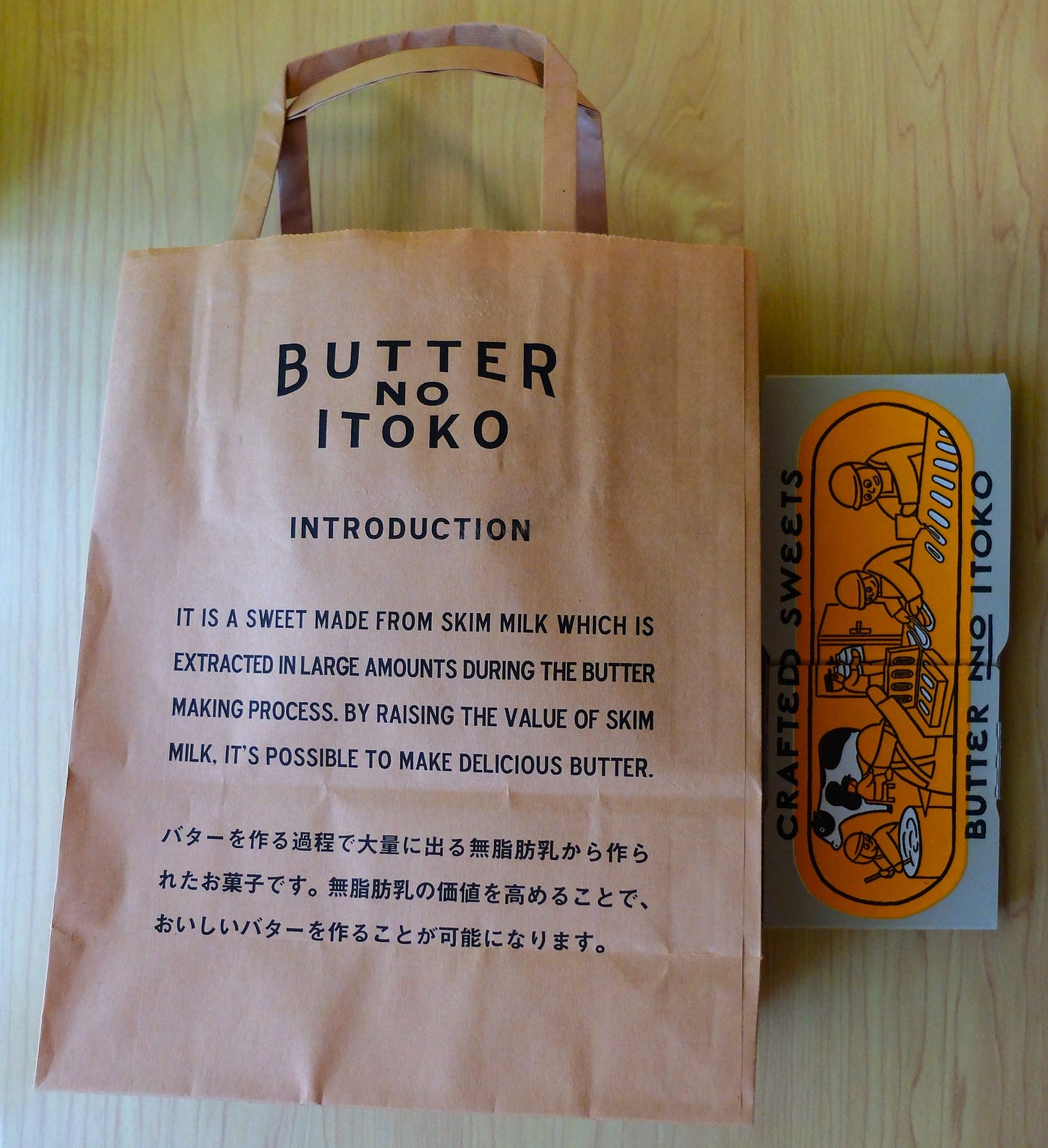
It is a sweet made from skim milk which is extracted in large amounts during the butter making process. By raising the value of skim milk, it’s possible to make delicious butter.
Tochigi is second only to Hokkaido in milk production, and dairy is serious business here. An interview with the developer turned up something I had not known: butter accounts for only four percent of raw milk, and most of the rest is sold off cheaply as skim milk. This sweet was created as an upcycled product — a way of raising the value of what was left over. Clever. And delicious.

For a sweet made from skim milk, what you taste first is butter. The family resemblance is unmistakable — rather too strong, in fact, for a mere cousin. Between thin, waffle-like layers sit milk cream and sugar crystals that crunch and shatter as you bite. Mine was salted caramel. Butter, sugar, milk cream, salted caramel — a combination like that cannot miss. Of the three in the photograph, I gave two away to my parents, and I regret it a little: I would have liked to try another flavor. But I can always buy more, and that is the one privilege of a sweet that has gone nationwide.
The packaging is lovely too — just the thing to bring a friend. The cakes are sold individually, so you can choose your flavors one at a time: gold paper of the kind butter comes wrapped in, then a layer of plastic film, then a box of kraft paper. For a single sweet, it looks like rather a lot. But butter seeping through would be a disaster, so this is excess that earns its keep. The front of the box shows how the sweets are made; the back gives 04 (butter), 06 (buttermilk), and 90 (skim milk) — the proportions of what milk becomes. It was only in looking all this up that I understood how much of what the makers care about is packed into this box.


The company behind it is a startup called GOOD NEWS, which sets out to solve the problems of regional Japan through design, with food as its medium. The factory where BUTTER NO ITOKO is made is also a certified employment support workplace: an arrangement under which people who face barriers to conventional employment — through disability or long-term illness — are hired on proper contracts and paid at or above the minimum wage.[2] The people who make these sweets come from all sorts of backgrounds: some have disabilities, some are parents working around childcare, some have other limits on when and how they can work.
Products built on ideals like these, I am told, rarely work out in practice. A workplace that doubles as employment support must take real effort in training; and when so much thought goes into wasting nothing, there must be a great deal more to worry about than simply making something delicious. And yet they have come up with a name catchy enough to lodge in your head whether or not you know any of this, wrapped it in packaging that betrays none of the difficulty, and made a sweet that more than holds its own beside anything else in the food hall — and sells across the country. Turning an ideal into something you can hold is hard enough. Turning it into something that can keep going is harder still, and that is what I admire here. Two pleasures in a single bite — no, three.
Posted: Thrifty, Generous BUTTER NO ITOKO of Tochigi (栃木県) on Sho-sho (処暑) — Around the time the heat begins to settle.
Next: Sweets of Ibaraki (茨城県) around Haku-ro (白露) — Around the time white dew begins to form on the grass.
[1] Tagline from a Japanese television commercial for Coca-Cola Japan’s Karada Sukoyaka Cha (からだすこやか茶). Original: 「おいしいものは、脂肪と糖でできている。」 Translation mine. Source: TCC Copira (in Japanese).
[2] Known in Japan as a Type A continuous employment support office (就労継続支援A型事業所), a service category under the Act on Comprehensive Support for the Daily and Social Life of Persons with Disabilities. Type A workplaces employ their workers on formal contracts at or above the minimum wage; Type B workplaces operate without employment contracts.
메타데이터
- post_id
- 93feb06b2bd5
- slug
- cream-twice-removed-butter-no-itoko-from-tochigi-93feb06b2bd5
- url
- https://medium.com/@kokuu04blue/cream-twice-removed-butter-no-itoko-from-tochigi-93feb06b2bd5
- canonical_url
- https://medium.com/@kokuu04blue/cream-twice-removed-butter-no-itoko-from-tochigi-93feb06b2bd5
- author_url
- https://medium.com/@kokuu04blue
- status
- ok
- fetched_at
- 2026-08-26 15:44:18