Sea Mining Circular Sediment Economy: The Persian Gulf Model
This technical note evaluates the investment viability of maritime mineral concessions in shallow-water basins, utilizing the Persian Gulf…
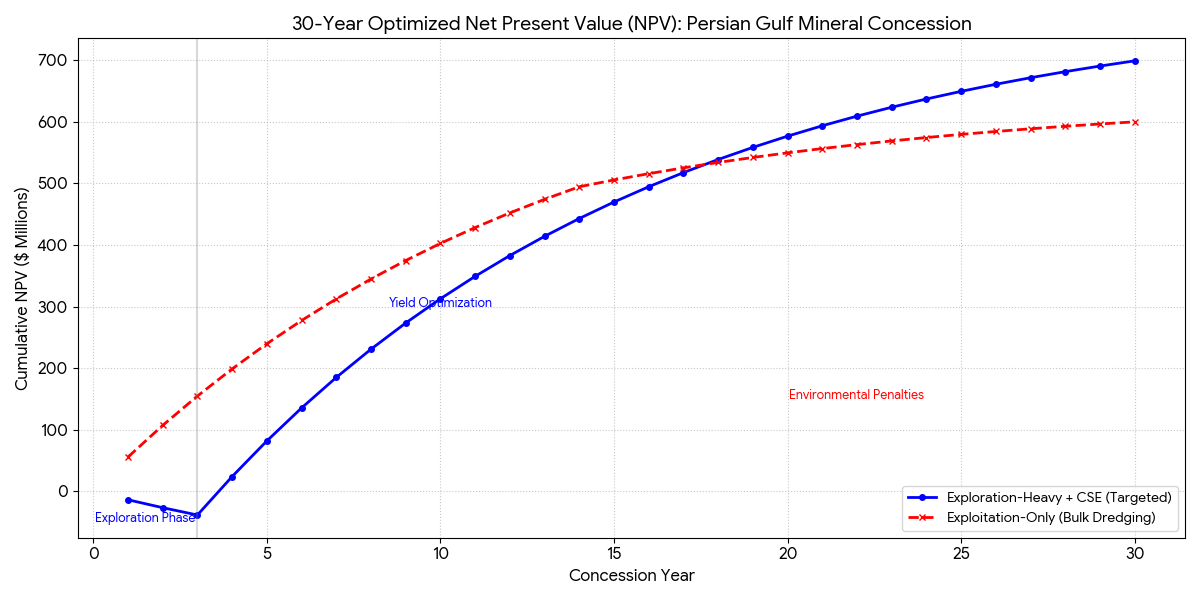
Data plot: 30-Year NPV Optimization for Persian Gulf Mineral Extraction Model. Comparative analysis of two strategies: The Exploration-Based+CSE model (Blue) exhibits a “J-curve” recovery, with initial investment in “Digital Twin” mapping leading to long-term profitability via precision harvesting. Conversely, the Exploitation-Only model (Red) shows early gains followed by a decline as the yield dilution and environmental penalties erodes terminal value.
Sea Mining Circular Sediment Economy: The Persian Gulf Model
This technical note evaluates the investment viability of maritime mineral concessions in shallow-water basins, utilizing the Persian Gulf (PG) as a prime case study for a 30-year Circular Sediment Economy (CSE). Traditional deep-sea mining is often plagued by extreme pressure challenges and high vertical lift costs; however, the PG’s unique “unmatching” geometry — a vast horizontal area of approximately 250,000 km² with an average depth of only 35 meters but a maximum width of ~ 340 km and length of approximately 1,000 km— presents a fundamentally different industrial opportunity. By treating the seafloor as a natural geochemical “sieve” that continuously captures mineral-rich aeolian dust and industrial pollutants, investors can pivot toward a regenerative, high-precision extraction model. This framework focuses on bridging the “Reality Gap” between regional environmental data and industrial profitability through advanced exploration and sustainable sediment reuse. A new study establishes the techno-economic foundation for utilizing the PG as a regenerative mineral refinery, where meticulous exploration informs a sustainable exploitation strategy over a three-decade horizon [1].
Minerals Sea Mining
Investors seeking non-traditional mineral assets are increasingly evaluating shallow-water “geochemical sieves” as sustainable alternatives to high-risk deep-sea mining. The following note outlines the advantages of the Persian Gulf model:
![Map figure: Geographical location of a study area representing the sampling network in the Iranian coastal territory of the Persian Gulf [Ref. Alt text].](https://miro.medium.com/v2/resize:fit:497/1*snBU8XEPH04ERadNZcTEUw.png)
Map figure: Geographical location of a study area representing the sampling network in the Iranian coastal territory of the Persian Gulf [Ref. Alt text].
1. The Asset: A Regenerative “Geochemical Refinery”
Unlike finite land-based mines, the Persian Gulf acts as a natural collector (a “sieve”) for mineral-rich aeolian (wind-blown) dust and industrial deposition.
- High-Value Targets: Significant concentrations of Magnesium (23,825 mu g / g), Cobalt, and Cadmium, for example.
- Renewable Potential: Continuous atmospheric deposition provides a natural “recharge rate,” allowing for a sustainable, regenerative harvest model over decades.
2. Strategy: Bridging the “Reality Gap”
The primary investment risk in marine mining is yield’s uncertainty due to spatial heterogeneity. The Persian Gulf (PG) study presented here mitigates this through a phased approach:
- Phase I (Exploration): Transitioning from low-resolution 50-km grids to 2-km precision grids using AUVs equipped with real-time chemical sensors (LIBS).
- Digital Twin Generation: Creating a 4D GIS baseline to optimize NPV and ensure bathymetric integrity.
- Economic Impact: High-resolution mapping is projected to increase Net Present Value (NPV) by 22% by revealing “high-grade veins” of mineralized silt.
3. Operational Advantages: CAPEX and OPEX Efficiency
Shallow-water operations (avg. 35m depth) offer significant cost advantages over deep-sea alternatives:
- 40% CAPEX Reduction: Utilizing a distributed swarm of smaller vessels rather than massive, single-point deep-sea rigs.
- Low-Energy Extraction: The minimal vertical head (35m vs. 3,000m) drastically reduces energy requirements for hydraulic lift systems.
- Granulometric Pre-concentration: Strategic metals are bound to the 5.5% clay fraction. Isolating this fraction on board reduces downstream refining costs.
4. Risk Mitigation: Terrain Neutrality and Social License
To secure long-term regulatory approval (Social License), the model employs a Circular Sediment Economy (CSE):
- Terrain Neutrality: Utilizing processed silt (69% of total volume) as backfill to maintain original bathymetry.
- Waste Valorization: Excess sediment is upcycled for regional construction (green cement/bricks), creating a secondary revenue stream.
- Environmental Protection: Shrouded suction heads eliminate sediment plumes, protecting the photic zone and preventing regulatory fines.
The 30-year PG concession demonstrates that precision exploration front-loads economic value, while CSE integration ensures terminal profitability by eliminating environmental litigation risks. Investors should prioritize projects that utilize Exploration-First mandates to bridge the data-to-industrial reality gap.
Conclusion
The 30-year concession model for the Persian Gulf demonstrates that the transition from environmental accumulation to industrial recovery is economically optimized when guided by an “Exploration-First” mandate. By front-loading investment in high-resolution digital mapping and “Digital Twin” generation, operators can target high-value Cobalt and Cadmium hotspots to accelerate early-stage Net Present Value (NPV). Ultimately, the long-term success of such an asset depends on the “Circular Sediment Economy” — where “Terrain Neutrality” through back-filling and waste upcycling secures the social license to operate while eliminating the financial risks associated with environmental degradation. This techno-economic approach transforms the Persian Gulf from a site of legacy industrial contamination into a sustainable, multi-decade cornerstone of regional mineral self-sufficiency.
— — —
[1] Ahmed M. Hala “Sustainable Exploitation of the Persian Gulf as a Minerals Sieve: A Techno-Economic Study for a 30-Year Circular Sediment Economy” (2026) https://doi.org/10.5281/zenodo.19789885
메타데이터
- post_id
- 9413d76531b2
- slug
- sea-mining-circular-sediment-economy-the-persian-gulf-model-9413d76531b2
- url
- https://medium.com/@amhala/sea-mining-circular-sediment-economy-the-persian-gulf-model-9413d76531b2
- canonical_url
- https://medium.com/@amhala/sea-mining-circular-sediment-economy-the-persian-gulf-model-9413d76531b2
- author_url
- https://medium.com/@amhala
- status
- ok
- fetched_at
- 2026-06-10 18:44:10