Futures Trading Signals and Risk Management: How to Trade With Discipline
Futures trading signals can help traders identify potential opportunities in fast-moving markets, but risk management decides whether those…
Futures Trading Signals and Risk Management: How to Trade With Discipline
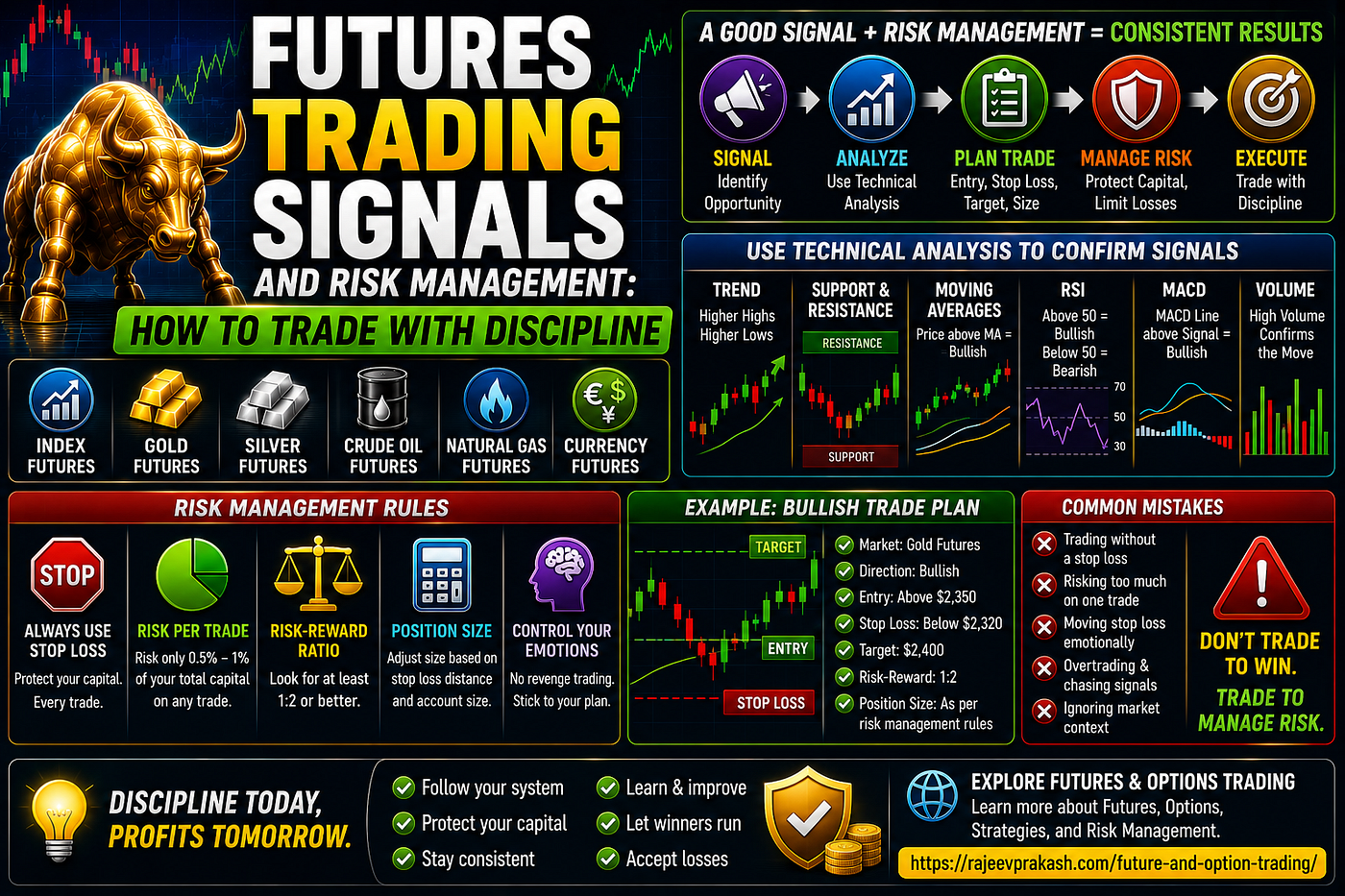
Futures trading signals can help traders identify potential opportunities in fast-moving markets, but risk management decides whether those opportunities are handled professionally or emotionally. Futures markets are powerful because they offer exposure to indices, commodities, metals, currencies, and other major financial instruments. However, they are also risky because futures contracts use leverage. This means profits can grow quickly, but losses can also expand quickly when a trader has no plan.
Many beginners focus only on the signal. They ask whether the signal is bullish or bearish, whether it says buy or sell, and whether it can deliver quick profit. Experienced traders ask better questions. Where is the entry? Where is the stop-loss? What is the target? How much capital is at risk? Is the risk-reward ratio favorable? Does the trade match the broader market direction? Is the trader emotionally prepared to accept a loss if the signal fails?
This is the real difference between gambling and disciplined trading. A futures trading signal is only a trade idea. Risk management turns that idea into a structured decision. Without risk management, even a good signal can damage an account. With risk management, even losing trades can remain controlled.
For traders who want to understand futures and options trading in a broader way, this guide on future and option trading is a useful related resource: https://rajeevprakash.com/future-and-option-trading/
The goal of this article is to explain how traders can use futures trading signals with discipline. It covers stop-loss placement, position sizing, risk-reward planning, market context, emotional control, trade journaling, and the role of technical analysis. It also explains why signals should support better decisions, not replace trader responsibility.
What Are Futures Trading Signals?
Futures trading signals are structured alerts that identify possible opportunities in futures markets. A signal may suggest buying index futures after a breakout, selling crude oil futures after a resistance rejection, watching gold futures near support, or monitoring currency futures after a macroeconomic event.
A useful futures signal usually includes the market, direction, entry zone, stop-loss level, target area, and reason for the trade. For example, a signal may say that gold futures are bullish above a certain resistance level, with a stop-loss below the breakout zone and a target near the next resistance. Another signal may say that crude oil futures are bearish if price breaks below support with strong selling volume.
Signals may be based on technical analysis, price action, volume, market momentum, volatility, macro data, or timing-based methods. Some traders also study financial astrology-based timing windows to understand when volatility may increase. However, no signal is perfect.
A signal should help traders prepare. It should not encourage blind action. The trader must still confirm the setup, calculate risk, and decide whether the trade fits their plan.
Why Risk Management Matters More Than the Signal
Risk management matters more than the signal because no signal wins all the time. Even a well-researched trade can fail. A breakout can reverse. A support level can break. A bullish signal can turn bearish after unexpected news. A bearish setup can fail if buyers return aggressively.
Futures trading is especially sensitive because leverage magnifies movement. A trader who risks too much on one signal can lose a large part of their account quickly. This is why disciplined traders think first about loss, not profit.
Before entering a trade, the trader should know the maximum amount they are willing to lose. They should know where the trade idea becomes invalid. They should know whether the target offers enough reward compared with the risk. They should also know whether the trade fits current market conditions.
A good signal may show opportunity, but risk management protects capital. Traders who survive losing trades can continue trading. Traders who ignore risk may not stay in the market long enough to benefit from future opportunities.
The First Rule: Every Signal Needs a Stop-Loss
A futures trading signal without a stop-loss is incomplete. The stop-loss is the level where the trader accepts that the trade idea has failed. It protects the account from uncontrolled losses.
For a bullish signal, the stop-loss may go below support, below a recent swing low, below VWAP, or below the breakout retest area. For a bearish signal, the stop-loss may go above resistance, above a recent swing high, or above the failed breakout zone.
The stop-loss should not be placed randomly. It should be based on market structure. If a long trade is based on price holding support, the stop should go below the support zone. If price breaks that level, the reason for the trade no longer exists.
Beginners often make the mistake of moving the stop-loss farther away when the market moves against them. This is dangerous. Moving stops can turn a small planned loss into a large emotional loss. A disciplined trader defines the stop before entry and respects it.
A stop-loss is not a sign of weakness. It is a sign of professionalism.
Position Sizing: How Much Should You Trade?
Position sizing is the process of deciding how large a trade should be. In futures trading, position sizing is critical because leverage can make even small price movements significant.
A trader should never choose position size based on excitement or confidence. Position size should be based on account size, stop-loss distance, volatility, and maximum acceptable risk.
For example, suppose a trader has a $20,000 account and decides to risk 1% per trade. The maximum risk is $200. If the stop-loss distance on a futures trade equals $100 risk per contract, the trader may trade two contracts. If the risk per contract is $250, the trader should reduce size or skip the trade.
This keeps losses controlled. A trader should not use the same contract size for every signal because different futures markets have different volatility. Silver may move differently from gold. Crude oil may behave differently from Nasdaq futures. Natural gas may be more volatile than many other contracts.
Position sizing helps traders stay consistent. It prevents one bad trade from damaging the entire account.
Risk-Reward Ratio: Is the Signal Worth Taking?
Risk-reward ratio compares the potential loss with the potential gain. A futures trading signal should only be considered if the reward justifies the risk.
For example, if a trade risks $300 and targets $300, the risk-reward ratio is 1:1. If it risks $300 and targets $900, the ratio is 1:3. A better risk-reward ratio gives traders more room to be wrong and still remain profitable over time.
Before entering any futures signal, traders should identify the stop-loss and target. If the stop-loss is too wide and the target is too close, the signal may not be worth taking. Buying directly below resistance or selling directly above support often creates poor risk-reward.
Good risk-reward does not guarantee profit. However, it improves the structure of the trading process. A trader who consistently takes trades with favorable reward potential can survive normal losing streaks more easily than a trader who takes random low-quality setups.
Reading Market Context Before Acting on Signals
Market context is essential when using futures trading signals. A signal can look strong on one chart but fail because the broader market does not support it.
Index futures depend on global equity sentiment, interest rates, earnings expectations, economic data, and volatility. Gold and silver futures depend on inflation expectations, the U.S. dollar, bond yields, safe-haven demand, and precious metal sentiment. Crude oil futures depend on supply-demand, inventories, OPEC decisions, geopolitical risk, and global growth expectations. Currency futures depend on central bank policy, interest rate differentials, and macroeconomic data.
For example, a bullish gold futures signal may be stronger if the U.S. dollar is weakening and silver is also rising. A bullish index futures signal may be more reliable if global markets are positive and market breadth is improving. A crude oil signal may need confirmation from inventory data or energy market strength.
A disciplined trader does not take signals in isolation. They check the environment first.
Using Technical Analysis to Manage Risk
Technical analysis helps traders manage risk because it defines levels clearly. Support and resistance show where price may react. Moving averages show trend direction. VWAP helps intraday traders understand session control. RSI and MACD help confirm momentum. Volume shows participation. Bollinger Bands show volatility. Fibonacci retracement helps identify pullback zones.
A futures signal becomes stronger when technical analysis supports it. For example, a bullish signal in silver futures may be more useful if price is above a rising moving average, bouncing from support, and supported by volume. A bearish signal in crude oil futures may be stronger if price rejects resistance, breaks support, and momentum weakens.
Technical analysis also helps define stop-losses and targets. Instead of guessing, traders can place stops beyond invalidation levels and targets near realistic price zones.
Risk management becomes easier when the chart provides structure.
Breakout Signals and Risk Control
Breakout signals are common in futures trading. A breakout happens when price moves above resistance. A breakdown happens when price moves below support. These signals can be powerful, but they also carry risk because false breakouts are common.
A disciplined trader waits for confirmation. A breakout should ideally include a strong close above resistance, rising volume, and enough room before the next target. A breakdown should ideally include a strong close below support and selling pressure.
Risk control is important because breakouts can reverse quickly. For a bullish breakout, the stop-loss may go below the breakout level or below the retest low. For a bearish breakdown, the stop may go above the broken support level.
Traders should avoid chasing late breakouts. If price has already moved far from the breakout level, the stop-loss may become too wide. In that case, waiting for a retest may offer better risk-reward.
Pullback Signals and Safer Entries
Pullback signals can help traders enter with better risk control. In an uptrend, price may pull back to support, a moving average, VWAP, or a previous breakout level. If buyers defend that area, a bullish signal may appear. In a downtrend, price may bounce into resistance before sellers return.
Pullback entries often offer better risk-reward because the trader enters closer to the invalidation point. For example, if gold futures are in an uptrend and pull back to a rising moving average, the stop-loss may go below the pullback low. The target may be the prior high or next resistance. This creates a clear plan.
Pullback signals also help traders avoid chasing. Instead of buying after a large rally, the trader waits for price to return to a logical area. This requires patience, but patience is part of discipline.
A pullback signal is strongest when trend direction, support, volume, and momentum agree.
Reversal Signals and Higher Risk
Reversal signals can be attractive because they may catch early trend changes. However, they are often riskier than trend-following signals because they go against the previous direction.
A bullish reversal may appear when price falls into major support, selling pressure slows, RSI forms bullish divergence, and price breaks short-term resistance. A bearish reversal may appear when price rallies into resistance, momentum weakens, and price breaks support.
Beginners should be careful with reversal signals. Trying to catch exact tops and bottoms can be dangerous. It is better to wait for confirmation that the market is actually changing direction.
Risk control is especially important with reversals. The stop-loss should be clear, and position size should be conservative. If the reversal fails, the previous trend may continue strongly.
Managing Risk During High Volatility
Futures markets can become highly volatile during economic data releases, central bank decisions, geopolitical events, inventory reports, and major news. Signals during high volatility require extra caution.
Volatility affects stop-loss placement and position sizing. When price swings are larger, stops may need to be wider. If the stop is wider, position size should be smaller. Traders who keep the same size during volatile periods may risk too much.
For example, crude oil futures can move sharply after inventory data. Nasdaq futures can swing after Federal Reserve comments. Gold and silver can react quickly to inflation reports or dollar movement.
During high volatility, traders should avoid emotional entries. They should wait for confirmation, reduce size if needed, and never trade without a stop-loss.
Discipline and Trading Psychology
Discipline is the bridge between signals and results. A trader may have a good signal, but without discipline, they may still fail. They may enter late, ignore the stop-loss, take profits too early, overtrade, or increase size after a loss.
Trading psychology matters because futures markets can trigger fear and greed quickly. A winning trade may make a trader overconfident. A losing trade may make them want revenge. A fast-moving market may create fear of missing out.
A disciplined trader follows a plan. They accept that losses are part of trading. They do not chase. They do not move stops emotionally. They do not risk too much on one trade. They review their mistakes.
Futures trading signals can support discipline only if the trader respects the signal plan.
Avoiding Overtrading With Signals
One risk of using futures trading signals is overtrading. If a trader receives many alerts, they may feel pressure to act on all of them. This is a mistake.
Not every signal deserves a trade. Some signals may be weak. Some may not match the trader’s time frame. Some may offer poor risk-reward. Some may appear during choppy market conditions.
A disciplined trader filters signals. They ask whether the setup is clear, whether the trend supports it, whether the risk-reward is favorable, and whether market context agrees. If the answer is no, they skip the trade.
Overtrading usually comes from impatience. Traders should remember that no trade is also a decision. Waiting is part of professional trading.
The Role of a Trading Journal
A trading journal is one of the best tools for improving discipline. It helps traders track signals, decisions, results, and mistakes.
A good journal should include the futures market traded, the signal type, entry, stop-loss, target, position size, risk-reward, market context, outcome, and lesson. Traders should also note their emotional state. Were they patient? Did they chase? Did they follow the stop-loss? Did they exit according to plan?
Over time, the journal shows patterns. A trader may discover that they perform better with pullback signals than breakout signals. They may learn that they lose money during high-volatility news events. They may see that most losses come from ignoring stop-losses or entering late.
A journal turns experience into improvement.
Futures Signals and Financial Astrology Timing
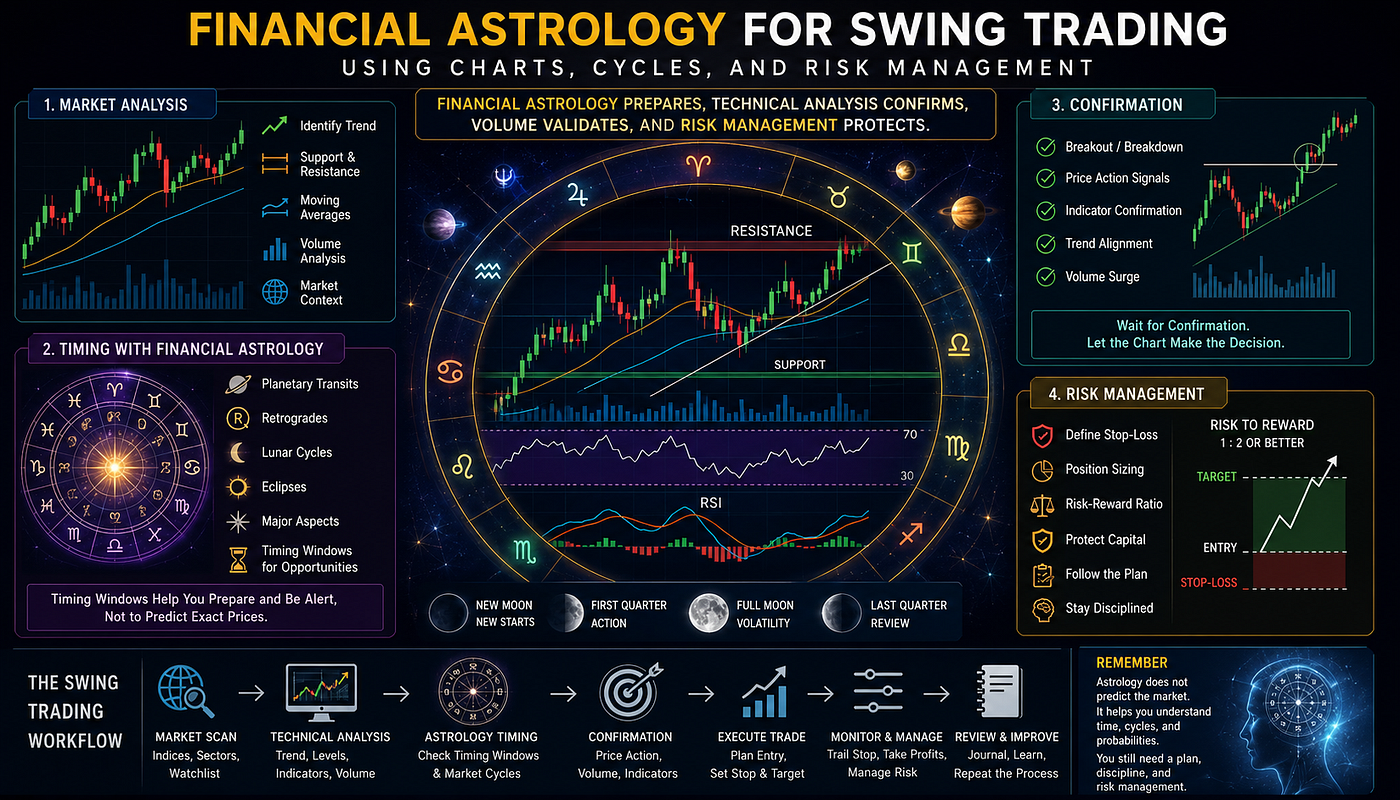
Some traders use financial astrology-based timing as an additional layer for futures trading signals. This approach studies planetary cycles, lunar phases, Mars-related volatility periods, Jupiter expansion windows, Saturn correction phases, Mercury retrograde periods, and eclipses.
This timing layer may help traders prepare for periods when markets could become more active. However, astrology should not replace technical analysis or risk management. It should be used as a timing perspective.
For example, if silver futures are near resistance during a timing window, traders may watch for breakout or rejection. If crude oil futures are consolidating before a volatility window, traders may prepare for movement but wait for price confirmation.
The key principle remains the same. Timing can help preparation. Price action and risk management guide execution.
How the Financial Astrology Terminal Supports Risk-Aware Trading
Risk-aware futures trading requires more than a signal. Traders need charts, market data, watchlists, global indices, commodities, technical levels, and timing insights. They need to know whether a signal fits the broader environment.
The Financial Astrology Terminal at https://finance.rajeevprakash.com/ helps traders and investors combine market data, charts, watchlists, global stocks, indices, commodities, and financial astrology-based timing insights in one platform. This can support futures traders by helping them review signals within a wider market context.
For example, before acting on a futures signal, a trader can check related commodities, global indices, support and resistance, market momentum, and timing windows. This helps reduce isolated decision-making. A signal becomes more useful when the trader understands what is happening around it.
The Financial Astrology Terminal can support discipline by helping traders organize their workflow. Instead of jumping between random charts and emotional alerts, traders can study markets in a structured way.
Common Risk Management Mistakes
One common mistake is trading without a stop-loss. This exposes the account to large losses.
Another mistake is risking too much on one signal. Even a strong signal can fail.
A third mistake is moving the stop-loss after entry. This usually comes from hope, not analysis.
Many traders also ignore risk-reward. They take trades where the possible profit is too small compared with the risk.
Another mistake is increasing position size after a loss to recover quickly. This is revenge trading and can be dangerous.
Finally, traders often ignore market context. A signal that looks good on one chart may fail because broader conditions are weak.
A Simple Discipline-Based Signal Routine
A disciplined routine begins before the trade. First, identify the signal and the market. Is it gold futures, silver futures, crude oil futures, index futures, or currency futures?
Next, check the trend. Is the market bullish, bearish, or sideways? Then mark support and resistance. Confirm the signal with volume, momentum, moving averages, or VWAP.
After that, define the entry, stop-loss, target, position size, and risk-reward. If the risk is too high or the reward is too small, skip the trade.
During the trade, follow the plan. Do not move the stop emotionally. Do not take profits randomly. After the trade, record the result.
This routine helps traders use futures trading signals with discipline instead of emotion.
Conclusion
Futures trading signals can help traders identify opportunities, but risk management determines whether those opportunities are handled responsibly. A signal is only a trade idea. It becomes useful when the trader applies stop-loss discipline, position sizing, risk-reward planning, technical confirmation, and market context.
The most important rule is to protect capital first. Every futures signal needs a stop-loss. Every trade needs a position size based on risk. Every setup should offer enough reward to justify the risk. Traders should avoid chasing, overtrading, revenge trading, and emotional stop-loss changes.
For readers who want a broader foundation in derivative markets, this guide on future and option trading is a helpful resource: https://rajeevprakash.com/future-and-option-trading/
For traders and investors who want a more structured market workflow, the Financial Astrology Terminal at https://finance.rajeevprakash.com/ can support futures signal analysis by combining market data, charts, watchlists, global stocks, indices, commodities, and financial astrology-based timing insights in one platform.
Trading discipline does not remove losses. It keeps losses controlled. Futures trading signals may help identify opportunity, but disciplined risk management keeps traders in the game.
메타데이터
- post_id
- 9425c68ef1f7
- slug
- futures-trading-signals-and-risk-management-how-to-trade-with-discipline-9425c68ef1f7
- url
- https://medium.com/@fintechastrodunia8/futures-trading-signals-and-risk-management-how-to-trade-with-discipline-9425c68ef1f7
- canonical_url
- https://medium.com/@fintechastrodunia8/futures-trading-signals-and-risk-management-how-to-trade-with-discipline-9425c68ef1f7
- author_url
- https://medium.com/@fintechastrodunia8
- status
- ok
- fetched_at
- 2026-06-09 14:34:10