The only question is who authors the model
Building regenerative info tech for seeing investable regenerative assets
The only question is who authors the model

The extraordinary thing is this: you are alive at the exact moment when the tools to build the alternative finally exist. — Canay Atalay
Three powerful insights for seeing investable regenerative assets
In her recent essay, The Wealth Beyond the Map, decision systems architect Canay Atalay revealed three powerful insights for seeing “investable regenerative assets.”
The supply of verified investable regenerative assets is almost nonexistent
Ms. Atalay’s first powerful insight:
The capital is looking for regenerative returns. The supply of verified investable regenerative assets is almost nonexistent.
Not because the assets don’t exist. Because the model cannot see them. That is the gap. That is the opportunity.
The present-day model — called “economic decision-making” for meeting human physical needs — …
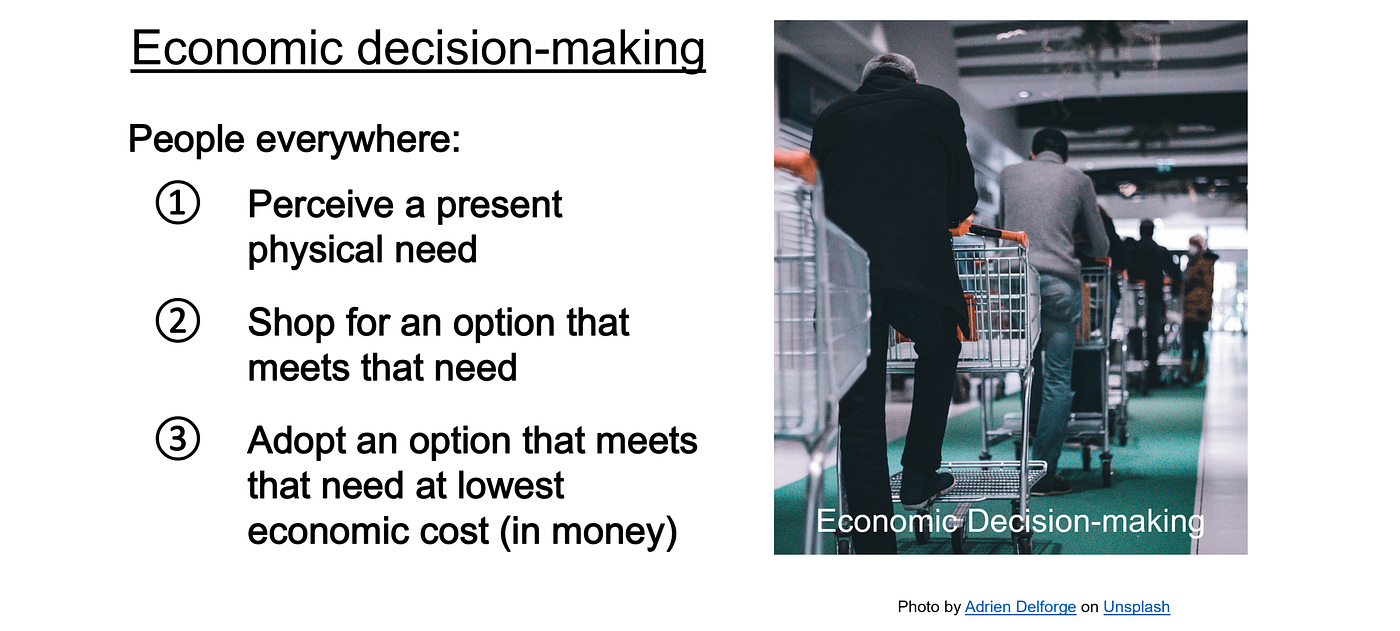
… cannot “see” a supply of “verified investable regenerative assets” because the present-day model excludes — as “externalities” not measurable or verifiable in units of money —
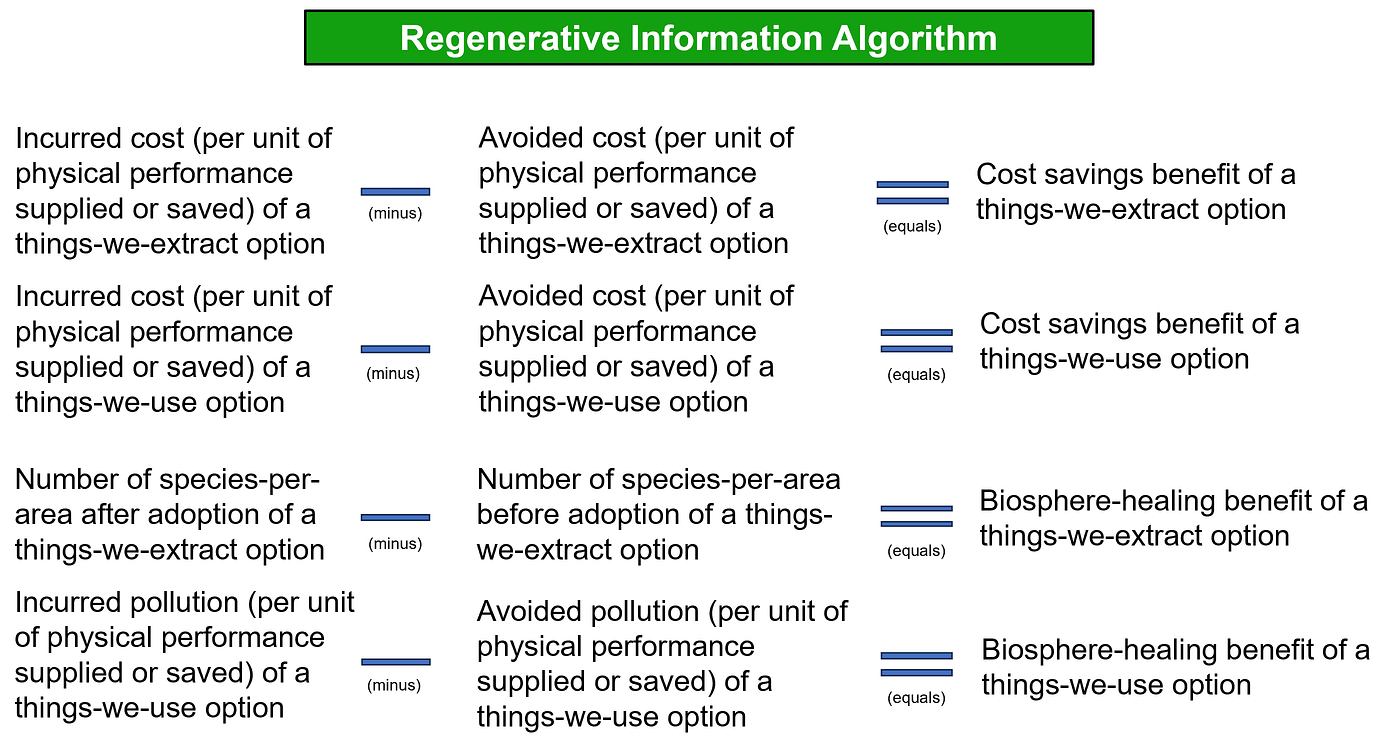
- the damage (or degeneration) of the biosphere attributable to any asset (or “option”) for meeting human physical needs, or
- the healing (or regeneration) of the biosphere attributable to any such asset (or “option”) for meeting human physical needs.
The present-day model has no means of verifying whether any such asset (or option) is “regenerative” (or not) because the present-day model has no means of measuring the damage or healing of the biosphere attributable to any such asset (or option).
To make visible and “see” a supply of “verified investable regenerative assets,” I invented a simple model — called “***regenerative decision-making” for meeting human physical needs — through which people everywhere use “regenerative information services***” for …
… identifying options (including assets) for meeting human physical needs …
… evaluating the measurable performance benefits, the measurable cost savings benefits and the measurable biosphere-healing benefits of those options …
… comparing those benefits …
… persuading themselves what options they want to adopt …

… and deciding to adopt “***regenerative options” (including “regenerative assets***”) that deliver:
- measurable “performance benefits” because they meet human physical needs,
- measurable “cost savings benefits” (that make an asset investable) because they avoid more costs than they incur, and
- measurable & verifiable “biosphere-healing benefits” because:
- they scale back extraction flows out of the biosphere measured through increasing the number of species in an area, or
- they scale back pollution flows into the biosphere measured through avoiding more pollution than they incur …

Building regenerative info tech for seeing investable regenerative assets
Ms. Atalay’s second powerful insight:
If you are building at this intersection — sovereign advisory, institutional capital, ecological measurement, regenerative finance — I want to hear from you.
To “see” a supply of “verified investable regenerative assets,” I am building a simple and easy-to-use technology — called “regenerative information technology” — for supplying people everywhere with “regenerative information services” that embody ecological measurement and enable regenerative finance.[1]
Specifically, I am building regenerative information technology (or “regenerative info tech”) that processes data for options (including assets) for meeting human physical needs …
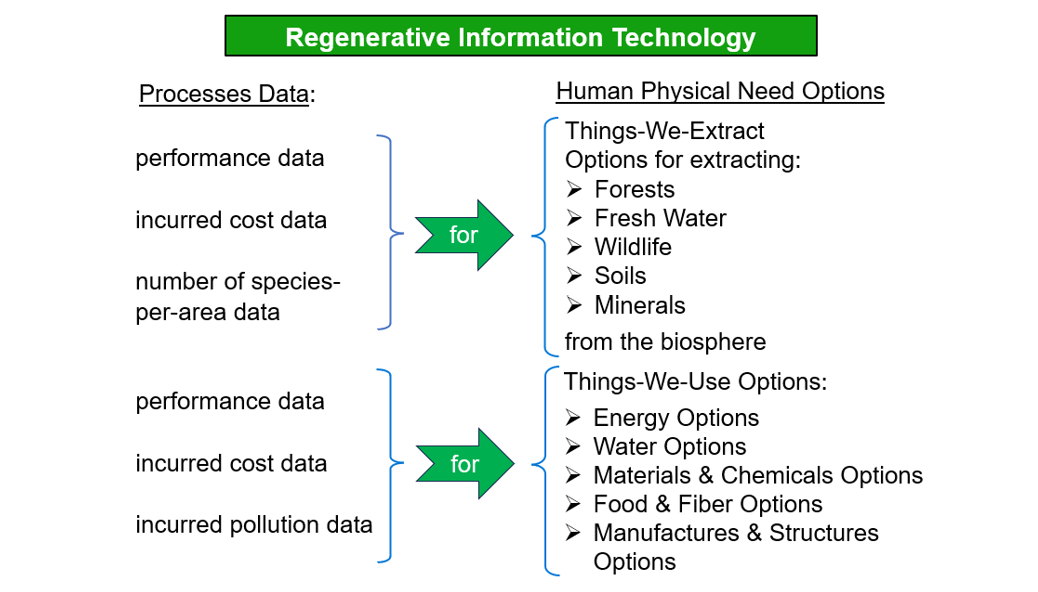
… through a “regenerative information algorithm” …
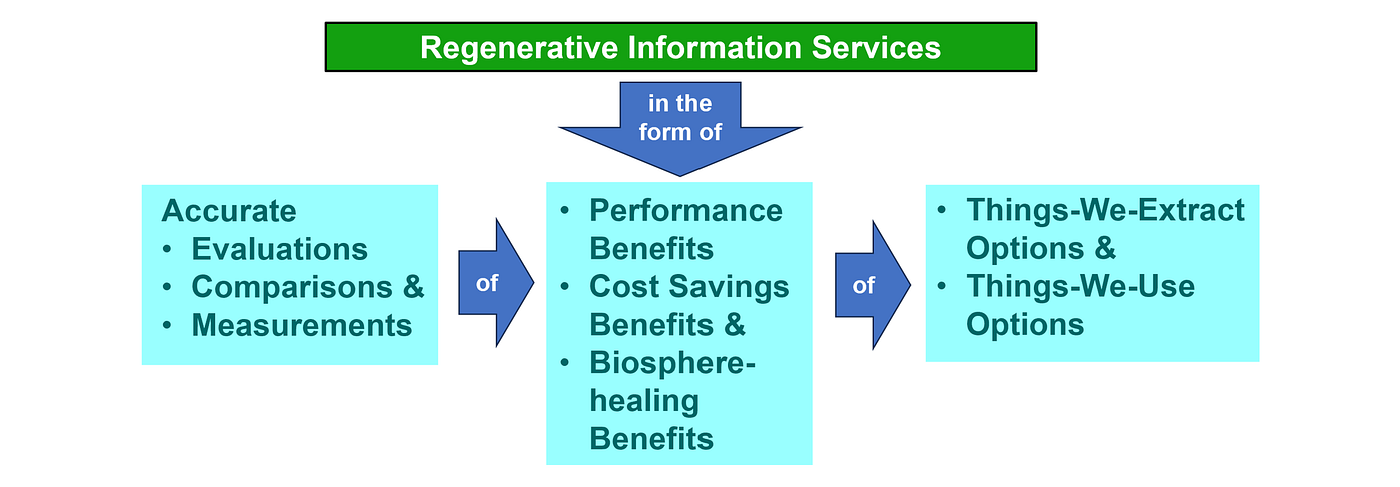
… for supplying people everywhere (including sovereign advisory & institutional capital decision-makers) with simple “regenerative information services” (or “regenerative info services”) in the form of:
- accurate evaluations, comparisons & measurements
- of the performance benefits, cost savings benefits (for regenerative finance) and biosphere-healing benefits (for ecological measurement)
- of options (or assets) — like things-we-extract options and things-we-use options — for meeting human physical needs …
Who authors the tools and who authors the model?
Here’s Ms. Atalay’s third powerful insight:
The extraordinary thing is this: you are alive at the exact moment when the tools to build the alternative finally exist.
The only question is who authors the model. And whether you are in that room.
It’s extraordinary that you are alive when the regenerative info tech tools — for designing, building and operating the regenerative decision-making model — are coming into existence.
The only question(s) are:
- who authors the regenerative info tech tools
- who uses those tools to author the regenerative decision-making model, and
- whether you are in the rooms where that is happening.
What’s the opportunity for verified investable regenerative assets?
Paul Hawken’s *Project Drawdown* showed the availability of 93 categories of presently-existing regenerative options (including assets) that — when widely adopted — were estimated to deliver more than $97 trillion of cost savings (cost savings benefits) and more than 1 trillion tons of avoided greenhouse gas (GHG) pollution (biosphere-healing benefits) …

In other words, the regenerative decision-making model moves “the supply of verified investable regenerative assets” from “almost nonexistent” to at least 93 categories of investable regenerative options delivering cost savings benefits on a scale of $97 trillion and verifiable biosphere-healing benefits on a scale of 1 trillion tons of avoided GHG pollution.
In the words of Kurt Vonnegut:
If this isn’t nice, I don’t know what is.
Thank you for reading The Regenerative Transition.
Peace and Aloha!
Erik
P.S. I cross-posted this article on Substack for greater reach.

The Regenerative Transition is your free weekly newsletter for solving the planet’s ecological crises as a whole.
[1] A regenerative option (or asset) that delivers cost savings benefits is investable because the regenerative option “pays for itself” out of the cost savings benefits.
A regenerative option that delivers cost savings benefits is financeable if the financing costs of adopting the regenerative option can be paid out of the cost savings.
“Regenerative finance” may be simply defined as the finance of a regenerative option that delivers cost savings benefits greater than the financing costs of adopting the regenerative option.
메타데이터
- post_id
- 9449668d1606
- slug
- the-only-question-is-who-authors-the-model-9449668d1606
- url
- https://medium.com/regenerative-decision-making/the-only-question-is-who-authors-the-model-9449668d1606
- canonical_url
- https://medium.com/regenerative-decision-making/the-only-question-is-who-authors-the-model-9449668d1606
- author_url
- https://medium.com/@erikwkvam
- status
- ok
- fetched_at
- 2026-06-15 20:49:13