🧠 Neural Theorem Provers: How Reasoning AI Is Learning Formal Math (and What It Means for…
From “good-sounding answers” to machine-checkable proofs: why the next wave of AI won’t just talk about being right — it will prove it.
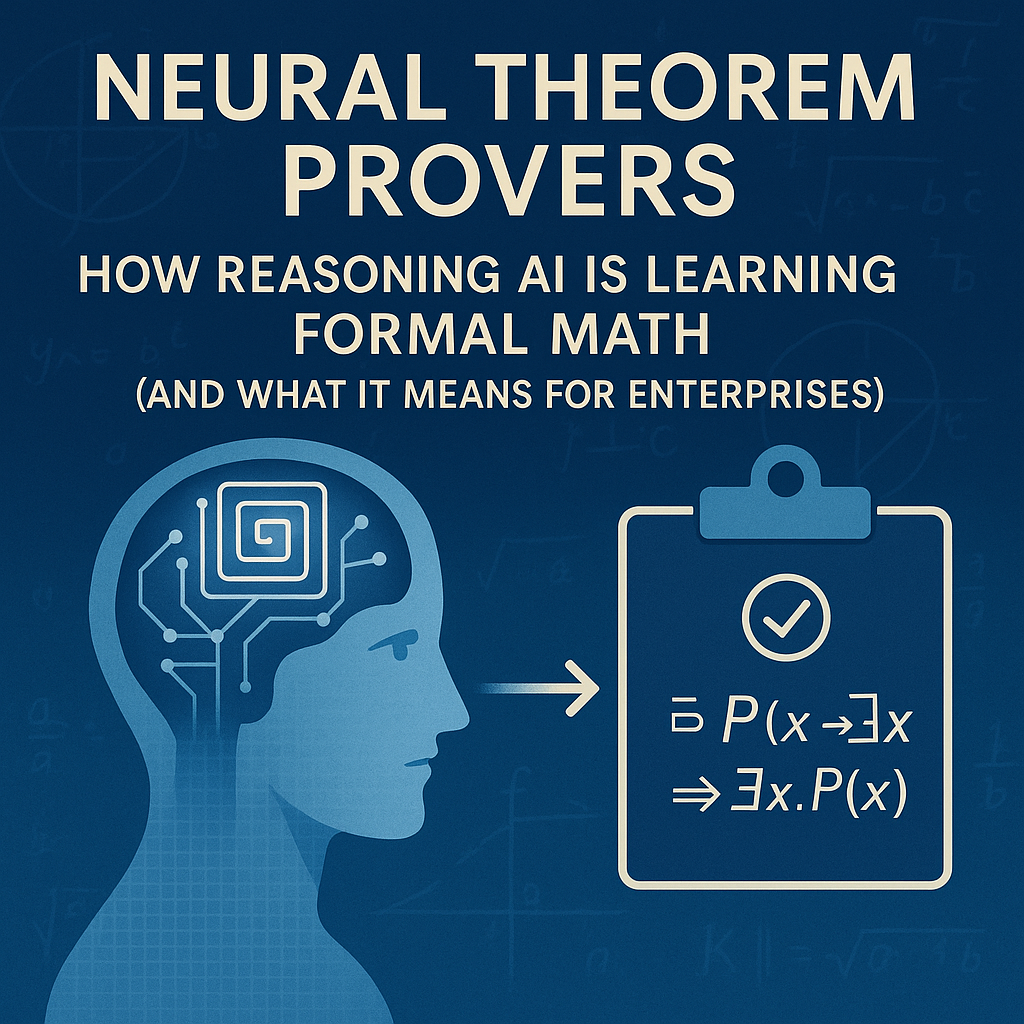
Neural Theorem Provers: How Reasoning AI Is Learning Formal Math — and What It Means for Global Enterprises
From “good-sounding answers” to machine-checkable proofs: why the next wave of AI won’t just talk about being right — it will prove it.
Executive Summary
In the last two years, AI has quietly crossed a new frontier: models from Google DeepMind and OpenAI have started winning gold medals at the International Mathematical Olympiad — solving competition-level problems that challenge top human students.
Behind these headlines lies a deeper structural shift: we are moving from AI that guesses well to AI that can prove it is correct.
This shift is powered by Neural Theorem Provers (NTPs) — systems that combine large language models with formal proof assistants like Lean and Isabelle/HOL to construct and check rigorous mathematical proofs.
At the same time, research in autoformalization is teaching AI to translate human-written mathematics into formal logic, while process-supervised reasoning models like OpenAI’s work on step-level feedback are raising the bar for mathematical problem-solving.
For enterprises in India, Europe, the U.S., and elsewhere, this is not just academic. The same infrastructure that can prove an Olympiad problem can, in principle, help prove that:
- a trading algorithm will never breach a risk limit,
- a workflow cannot bypass a crucial safety check, or
- an AI agent cannot execute a policy-violating action without being caught.
This article explains, in plain language:
- what Neural Theorem Provers are,
- how they relate to autoformalization and reasoning models,
- why they matter for enterprise AI governance, and
- what CXOs can do today to prepare.

1. From “chatty” AI to formal reasoning

Today’s large language models (LLMs) are exceptional at plausible language. They learn patterns, predict next words, and produce content that sounds right — useful for drafting, summarizing, or coding.
But they’re still probabilistic pattern matchers, not proof engines. They can hallucinate. They can’t give hard guarantees.
Formal mathematics lives in another universe: every step must follow strict inference rules. A proof is either accepted or rejected — no “maybe.”
Traditional proof assistants like Coq, Isabelle/HOL, and Lean are reliable but notoriously hard to use — like ultra-strict lawyers: meticulous, trustworthy, and unforgiving.
Neural Theorem Provers bridge these worlds. They use neural networks to explore possible proofs while the proof assistant acts as a logical judge.
If the assistant accepts the steps, the result is no longer just a convincing story — it’s a machine-checkable guarantee.
2. What exactly is a Neural Theorem Prover?

A Neural Theorem Prover (NTP) does three core things:
2.1 Understands the goal
Receives a theorem — a structured logical statement the proof assistant understands.
2.2 Selects what to use (Premise Selection)
Chooses relevant lemmas from large formal libraries using neural semantic search.
2.3 Searches for a proof
Explores a massive tree of proof states and tactics — rewriting, splitting, simplifying — guided by neural predictions, with every step verified by the proof assistant.
Early systems used neural networks only for premise selection. Later ones added tactic choice and proof search.
State-of-the-art models such as DeepSeek-Prover-V2 integrate both informal reasoning (natural language) and formal reasoning (logical proofs) in a single loop — achieving ~89% accuracy on the MiniF2F benchmark.
That’s a leap toward AI that doesn’t just “sound right,” but can prove it’s right.
3. Autoformalization: translating human math into machine logic

Most real-world math — and nearly all enterprise specs — are in plain text, not logic form. Autoformalization uses LLMs to translate human language into formal statements that proof assistants can process.
Google Research and University of Cambridge demonstrated that LLMs can formalize a significant fraction of competition-level problems into Isabelle/HOL, creating valid training data for NTPs.
For enterprises, the analogy is clear: natural language policies or contracts → become “formal-ready” → enabling logical verification of compliance or safety properties.
We can’t yet autoformalize entire business workflows, but research (see NeurIPS Proceedings) shows that gap narrowing fast.
4. Breakthroughs: from math Olympiads to industrial verification

OpenAI’s Lean-based NTP solved high-school and Olympiad problems. DeepSeek-Prover-V2 now dominates academic benchmarks. Process-supervised reasoning models reward each correct step — improving transparency and reliability.
Together, these innovations show that AI can now “do math” the way formal systems verify it — a crucial difference between belief and proof.
For enterprise leaders, that means a new level of reliability and auditability.
5. How Neural Theorem Provers “think”

Take the theorem: “For any triangle, the sum of its interior angles is 180°.” A Neural Theorem Prover:
- decomposes it into subgoals,
- retrieves relevant lemmas (e.g., “angles on a straight line sum to 180°”),
- applies tactics step by step,
- learns from success and failure through feedback loops.
The distinction is profound:
- LLMs generate plausible text.
- NTPs generate verifiable sequences of logic.
That difference turns explanations into evidence — a foundation for auditable logic in enterprises.

6. Why enterprises should care: from math contests to mission-critical systems
Most high-stakes enterprise questions can be phrased as:
“Can this system ever do something it must never do?”
Finance (India, EU, US)
- Can a trading engine exceed a regulatory limit?
- Can credit scoring use prohibited attributes?
Infrastructure & Energy
- Can a grid controller reach an unsafe configuration?
Healthcare & Public Sector
- Can a workflow skip a mandatory check?
Traditional audits, simulations, and checklists can’t guarantee “never.” Formal verification and Neural Theorem Provers could.
Imagine expressing:
“Funds above ₹X / $Y can’t transfer without dual approval.”
Proof assistants encode it; NTPs attempt the proof. If verified, you get a mathematical guarantee — not a probabilistic one.
NTPs also complement verifiable AI stacks — **Proof-of-Action (PoA), Trusted Execution Environments (TEEs)**, and policy-aware orchestration.
They are the logic engine beneath trustworthy automation.
7. What organizations can do today
- Monitor the ecosystem — Track Lean, Isabelle/HOL, Coq; identify in-house verification teams.
- Start small — Pilot a narrow, high-value property (e.g., risk limits).
- Invest in “formal-ready” specs — Encourage structured requirement writing.
- Engage regulators — Align proofs with audit frameworks (e.g., EU AI Act).
- Integrate into governance roadmaps — Position NTPs alongside RAG, telemetry, and secure enclaves.
The message isn’t “rewrite everything in logic” — it’s “start where proof would change the conversation.”
8. Constraints and Open Challenges
- Formalization bottleneck — messy, evolving specs need expert refinement.
- Model brittleness — domain shifts still break formal proofs.
- Scale limits — distributed and human-in-loop systems remain complex.
- Proof transparency — verified doesn’t always mean understandable.
- Governance — organizations must decide how to use proofs in audits.
NTPs aren’t magic, but they unlock a new level of assurance for critical systems.

9. From plausible answers to provable guarantees
For years, enterprises faced a trade-off: flexible AI vs. guaranteed safety.
Neural Theorem Provers — combined with autoformalization and process-supervised reasoning — begin to bridge that gap.
They point to an AI future that:
- communicates in natural language,
- reasons in formal logic,
- proves when the stakes demand certainty.
The real story isn’t that AI can solve Olympiad problems — it’s that AI is learning to operate within our rules, and prove it.

10. Glossary
Neural Theorem Prover (NTP) A system that uses neural networks to guide the construction of formal proofs inside a proof assistant such as Lean or Isabelle/HOL.
Proof Assistant Software that checks whether a sequence of logical steps constitutes a valid proof within a formal system (e.g., Lean, Coq, Isabelle/HOL).
Autoformalization The process of translating natural-language mathematics into formal statements and proofs that a proof assistant can process.
Premise Selection The task of choosing relevant lemmas and definitions from a large formal library to prove a given theorem.
Process Supervision A training method where AI models are rewarded for each correct reasoning step, not just the final answer.
Formal Verification The use of mathematical methods to prove that a system (hardware, software, or workflow) satisfies a given specification.
Proof-of-Action (PoA) A concept where AI agents provide cryptographic or logical evidence describing what they did, enabling auditability.
TEE (Trusted Execution Environment) A secure enclave in hardware that isolates code and data, protecting them from external tampering or inspection.
Agentic AI / Autonomous Agents AI systems that take actions on behalf of users or organizations, often across multiple tools and applications, with some degree of autonomy.
11. FAQ: Neural Theorem Provers for Enterprises
Q1. How is a Neural Theorem Prover different from a normal LLM like GPT-4 or Gemini? A normal LLM generates text based on patterns in its training data. It can sound right without being formally correct.
An NTP, in contrast, operates in a formal logic; every step it proposes must be accepted by a proof assistant. The end result is a proof that can be mechanically re-checked, not just a persuasive explanation.
Q2. Are Neural Theorem Provers ready for production use in banks or critical infrastructure? They are not yet a plug-and-play solution for general enterprise systems. Today, they are most mature in mathematical domains and tightly scoped verification tasks.
However, the trajectory suggests they will increasingly support formal verification in safety-critical and regulated environments.
Q3. Do we need to rewrite all our systems in formal logic to benefit from NTPs? No. A pragmatic approach is to focus on a few high-value properties — for example, “funds above a certain threshold must always have dual approval” — and explore how formal methods and NTPs can prove those invariants for specific components.
Q4. How does this relate to regulations like the EU AI Act or sectoral guidelines in India and the US? Regulations are converging on requirements for transparency, auditability, and risk management.
Neural theorem proving offers a way to provide stronger technical evidence that certain risks are structurally impossible (under defined assumptions), rather than simply unlikely based on testing.
Q5. What kind of talent do we need to explore Neural Theorem Provers? You need a combination of:
- formal methods / verification expertise,
- software and systems engineers, and
- AI / ML specialists familiar with LLMs and reinforcement learning.
Partnerships with universities and research labs can accelerate this journey.
Q6. How should we start if we are a bank or telecom operator in India or Asia-Pacific? Begin with a small, high-impact sandbox:
- choose a clearly specified property,
- collaborate with academic partners on formalization,
- use open-source proof assistants and NTPs to experiment,
- and integrate lessons learned into your broader AI governance roadmap.
References
- OpenAI Research Blog — Process Supervision & Mathematical Reasoning Models (2024)
- Google DeepMind — Mathematical Reasoning and Theorem Proving Benchmarks (2023–2024)
- DeepSeek-Prover-V2 — Large-Scale Formal Proof Search
- University of Cambridge — Autoformalization Using LLMs
- Reuters Technology — AI Models Reach Gold-Medal Performance at IMO
- NeurIPS Proceedings — Advances in Neural Theorem Proving and Proof-Guided LLMs
메타데이터
- post_id
- 944aa356fb06
- slug
- neural-theorem-provers-how-reasoning-ai-is-learning-formal-math-and-what-it-means-for-944aa356fb06
- url
- https://medium.com/data-and-beyond/neural-theorem-provers-how-reasoning-ai-is-learning-formal-math-and-what-it-means-for-944aa356fb06
- canonical_url
- https://medium.com/data-and-beyond/neural-theorem-provers-how-reasoning-ai-is-learning-formal-math-and-what-it-means-for-944aa356fb06
- author_url
- https://medium.com/@raktims2210
- status
- ok
- fetched_at
- 2026-06-09 15:37:30