From Being Questioned to Being Watched
How women’s cricket turned noise into applause
From Being Questioned to Being Watched
How women’s cricket turned noise into applause
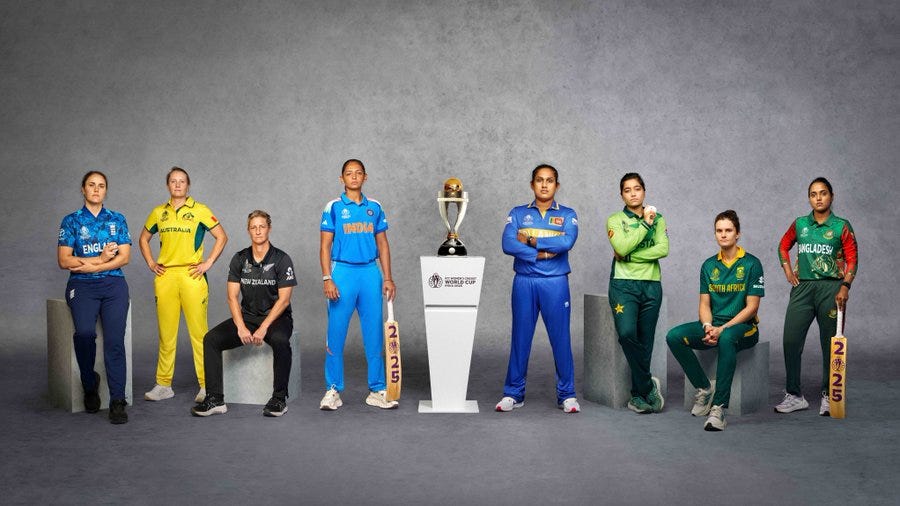
Team captains pose with the trophy ahead of the ICC Women’s Cricket World Cup 2025, Image from X
This piece examines how visibility, familiarity, and sustained attention helped reshape the place of women’s cricket within the wider sporting landscape.
There was a time when women’s cricket was discussed more than it was watched. The conversations arrived before the attention did.
Questions about quality. Comparisons with men’s cricket. Assumptions about entertainment value. Doubts about whether there was enough interest to justify bigger broadcasts, larger investments, or wider coverage.
For years, women’s cricket has carried a burden that many sports never have to carry. It was expected to prove its worth before being allowed to be fully seen.
Looking back now, that may have been the biggest challenge of all.
Not a lack of talent. Not a lack of commitment. Not even a lack of quality.
A lack of visibility.
Because the history of women’s cricket is not a story about a sport suddenly becoming good. It is a story about people finally paying attention to something that had been developing for decades. That distinction matters.
When discussions around women’s cricket become more positive today, there is sometimes an assumption that the sport has recently reached a new level. While professional structures, leagues, and investment have certainly improved the landscape, excellence in women’s cricket did not suddenly appear out of nowhere.
It was already there.
Long before packed stadiums, prime-time broadcasts, and viral highlights, players were building careers, setting standards, and carrying the sport forward with far fewer resources and far less attention than their counterparts. The skill was not waiting to be invented.
It was waiting to be broadcast.
For a long time, women’s cricket also carried the burden of comparison. Matches were rarely allowed to stand on their own. They were constantly measured against men’s cricket, as though their value depended on how closely they resembled a different version of the game.
The comparisons were predictable: scoring rates, power, pace, and spectacle. The conversation spent so much time measuring the differences that it rarely stopped to appreciate the game itself. Women’s cricket did not need to become men’s cricket. It needed the chance to be understood as women’s cricket.
What often got lost was a simple truth: sports do not become meaningful because they look identical. They become meaningful because audiences learn how to appreciate what makes them unique. That understanding took time.
And perhaps that is where visibility became so important. Because people do not become invested in a sport overnight. They become invested through familiarity.
They learn players, rivalries, storylines, and eventually the unique rhythms of that sporting environment. They begin to understand what pressure looks like within that version of the game.
The more people watched, the more they understood. The more they understood, the more they cared. Investment followed attention. Not the other way around.
That is why some of the most important figures in women’s cricket are not simply remembered for records or statistics. Players such as Belinda Clark, Charlotte Edwards, Mithali Raj, and Jhulan Goswami represent something larger than individual achievements. They stand as reminders that elite women’s cricket existed long before many audiences were regularly watching it.
Their careers helped build foundations that others would eventually stand upon.
And when the spotlight finally grew brighter, a new generation was ready for it. Players like Ellyse Perry, Meg Lanning, Nat Sciver-Brunt, Hayley Matthews, Amelia Kerr, Smriti Mandhana, and Jemimah Rodrigues did not create the quality of women’s cricket. They helped make that quality impossible to ignore.
Their performances arrived in an era where women’s cricket was beginning to receive far greater attention than before. More cameras were covering matches, broadcasters were investing more consistently, and audiences that had often overlooked the sport were starting to follow it more closely. While this shift did not happen overnight, the increased visibility of the last few years helped bring the game’s existing quality to a much wider audience.
That combination changed everything. Because visibility creates momentum. Momentum creates conversation. And conversation creates growth.
The rise of domestic leagues across different parts of the world accelerated that process even further. Competitions such as the Women’s Big Bash League and the Women’s Premier League did more than provide entertainment. They created familiarity. They gave audiences regular access to players and stories that previously appeared only during international tournaments.
The result was significant. Cricketers became recognizable. Fans began forming connections. Young players suddenly had role models they could watch every season instead of only every few years.
The sport became part of the weekly sporting conversation rather than an occasional exception to it. Perhaps that is one of the clearest signs of growth in any sport. Not when people praise it, but when they begin treating it as normal.
When matches become part of routine discussions. When performances are analysed rather than merely celebrated. When audiences stop viewing participation as progress and start debating selections, tactics, and results. That shift reflects something deeper than popularity. It reflects belonging.
And once that happened, attitudes started changing.
Empty seats became fuller. Broadcast windows became larger. Highlights became easier to find. Conversations more informed.
What was once treated as a niche interest gradually became a genuine part of mainstream cricket culture.
As someone who grew up primarily watching men’s cricket, I can honestly say that my own relationship with women’s cricket followed a similar path. Not because the quality wasn’t there, but because the visibility wasn’t.
What began as an occasional curiosity gradually became a genuine investment. The more women’s cricket entered regular sporting conversations, the more I found myself following players, anticipating tournaments, and remembering performances long after they ended.
At some point, the distinction stopped feeling important. It was no longer about choosing between men’s cricket and women’s cricket. It was simply about watching good cricket and wanting to see more of it.
Of course, none of this means the journey is complete.
Women’s cricket still faces challenges involving investment, scheduling, infrastructure, and opportunities that vary dramatically across different countries. Progress has not arrived evenly, and many players around the world continue to navigate obstacles that their male counterparts rarely encounter.
But acknowledging those challenges should not distract from recognising how significant the shift has already been. Because one of the most remarkable aspects of women’s cricket’s rise is that the transformation did not happen solely on the field.
It happened in the stands. It happened in television studios. It happened in broadcast schedules. It happened in homes.
Most importantly, it happened in the minds of audiences.
For years, women’s cricket was often viewed through the lens of what it lacked. Now, more people are watching it for what it is. That may sound like a small difference.
It is not.
It changes the entire conversation.
When people genuinely watch a sport, they stop treating it as a concept. They start experiencing it. They celebrate innings. Debate selections. Follow rivalries. Anticipate tournaments. Develop favourites. Form memories.
The sport stops asking for space. It begins occupying it naturally. And perhaps that is the most meaningful change of all. Women’s cricket did not become worthy of attention overnight.
The players did not wake up one morning with talent they did not possess the day before. The foundations were already there. The stories were already there. The quality was already there.
What changed was the audience.
And perhaps the most important shift happened alongside that change. Women’s cricket did not suddenly become worthy of attention.
People finally started paying attention.
Thanks for reading my story.
메타데이터
- post_id
- 9456796bfa5f
- slug
- from-being-questioned-to-being-watched-9456796bfa5f
- url
- https://medium.com/beyond-the-scoreboard/from-being-questioned-to-being-watched-9456796bfa5f
- canonical_url
- https://medium.com/beyond-the-scoreboard/from-being-questioned-to-being-watched-9456796bfa5f
- author_url
- https://medium.com/@ms.whatsit
- status
- ok
- fetched_at
- 2026-07-11 15:10:52