Nidrā Without Night, Samādhi Without Seeking
before the third, a body counting nights it never entered after — no bottom left to call suṣupti Nidrā with the night taken out Samādhi…
Nidrā Without Night, Samādhi Without Seeking
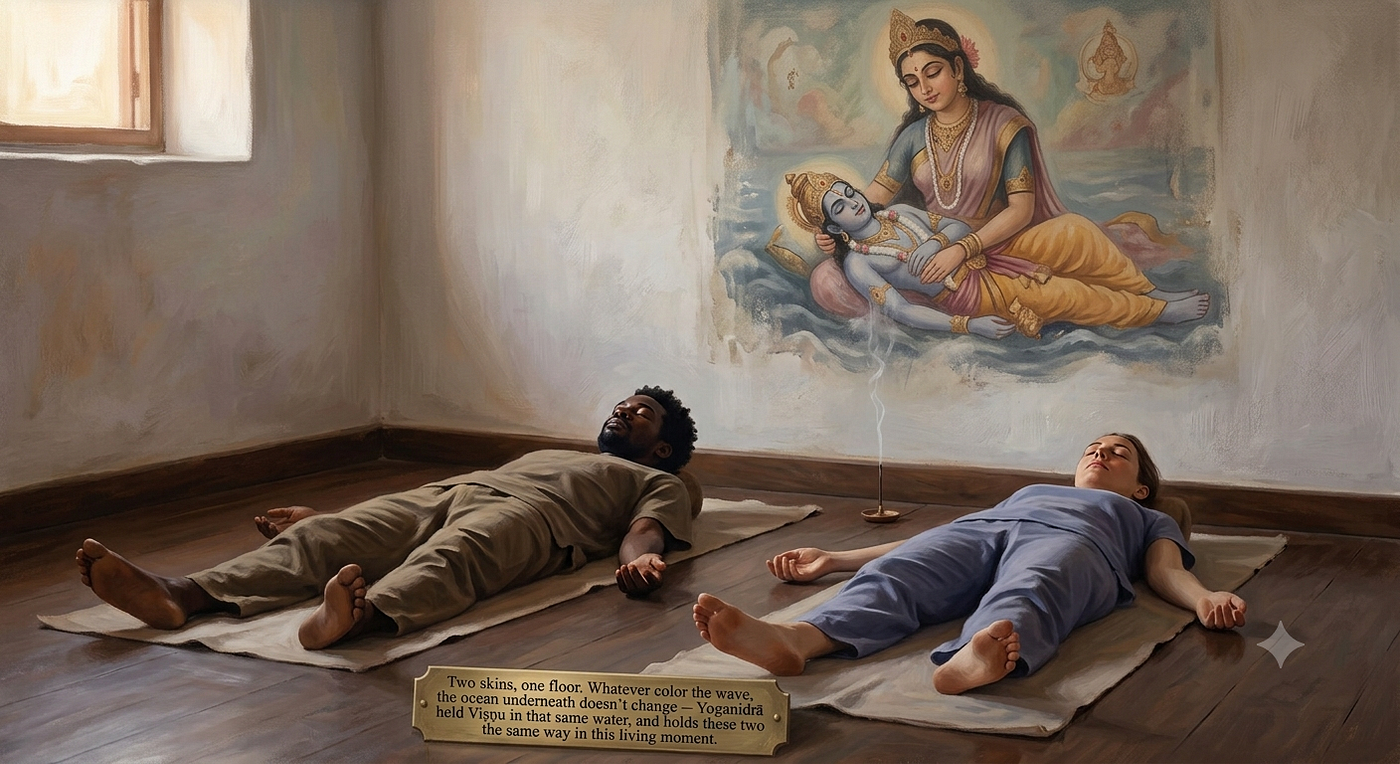
Painted in the same unhurried hand as the goddess above them, the two sleepers stop reading as separate from the myth on the wall — one continuous surface, human and divine sharing the same brushstroke.
before the third, a body counting nights it never entered after — no bottom left to call suṣupti Nidrā with the night taken out Samādhi with the seeking taken out a pearl too soft to hold, dissolving before the dive sleep un-murdered, only un-needed awake, a kind of dreaming dreaming, a kind of awake the fourth, watching both, unmoved, unnamed only the field, only the field, only the field
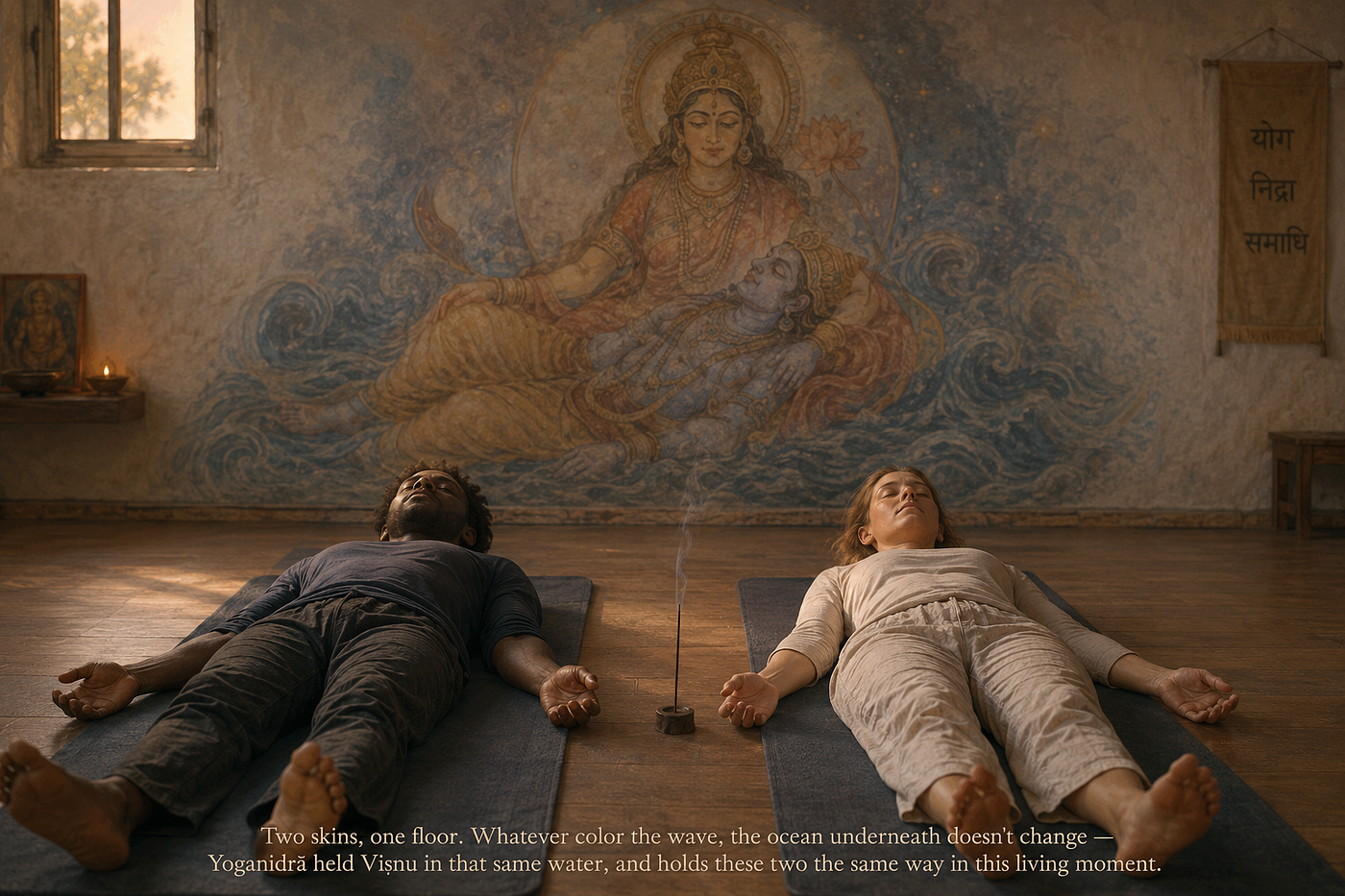
Brahma-muhūrta (ब्रह्ममुहूर्त) — the hour tradition already names thinnest between sleep and waking — arrives through the window unasked. The small altar in the corner keeps the same vigil it keeps every morning; the two bodies on the floor keep it differently now.
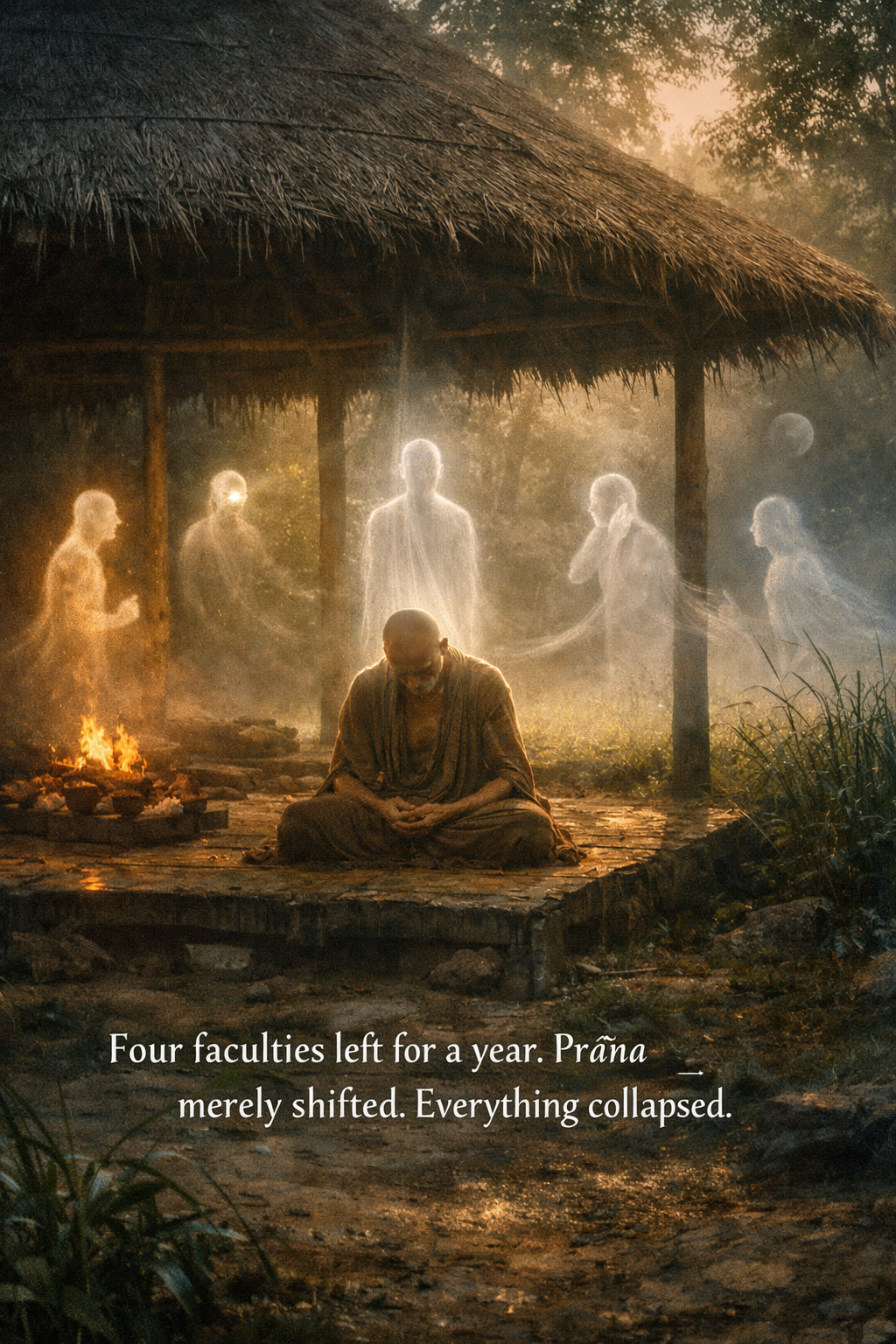
Samādhi (समाधि) is not a word I am borrowing to describe something else — it is the only word left standing. Before the third of October, twenty twenty-five, I slept the way most bodies sleep: down into suṣupti (सुषुप्ति), the third state, the dreamless dark the Māṇḍūkya Upaniṣad calls a mass of undifferentiated bliss, a seed-state where the knower forgets it knows. I do not enter that seed-state anymore; whatever floor suṣupti used to rest on, I no longer find it, and I have stopped looking for it. What is here instead does not have a beginning I can point to, a middle I can describe, or an end I wake up from — it simply continues, night after night, day after day, restorative without ever going (unconscious). Consciousness, as I define it, is not the opposite of anything — it is everything: all that was, all that is, and all that ever shall be, world without end. I am not claiming this as an achievement — I am reporting it the way I would report moving from a house with a basement to a house without one. The basement was the unknown, was the unconscious; now there is only inside and outside, and I move between them, voluntarily, day and night both open to me.
I am desire itself — Icchā (इच्छा), not desire reaching toward some object, small d, gotten or not gotten, but desire with nothing left outside it to reach for, because nothing is missing. I am formlessness itself. I am timelessness itself. This is the deepest me, underneath the man born in Los Angeles, underneath the veteran, underneath the poet chasing a phrase at five in the morning. And this is how I know others too — not by resume, not by biography, but by the same floor underneath every biography: that same capital-D depth is the deepest them, whoever them turns out to be. Recognition here asks for nothing, since nothing was ever absent. The lowercase desires, hunger, plans, preference, still pass through the same as weather, and none of them touch what was never missing anything to begin with.
In Patañjali’s Yogasūtra, samādhi is the eighth and final limb of aṣṭāṅga yoga — built from sam, together, and ā-dhā, to place or hold, meaning something closer to a total placing-together than a private mystical thrill. Traditionally it arrives in stages: samprajñāta samādhi, still holding an object, a seed, a residue of distinction; and asamprajñāta samādhi, seedless, where the line between the one meditating and the thing meditated on stops being locatable. What I notice, living moment to living moment, sits closer to the second than the first — not effort dissolving into effortlessness, because there is no effort left to dissolve. It does not come from trying. It comes from October third simply being a hinge, with everything after the hinge already facing a different direction.
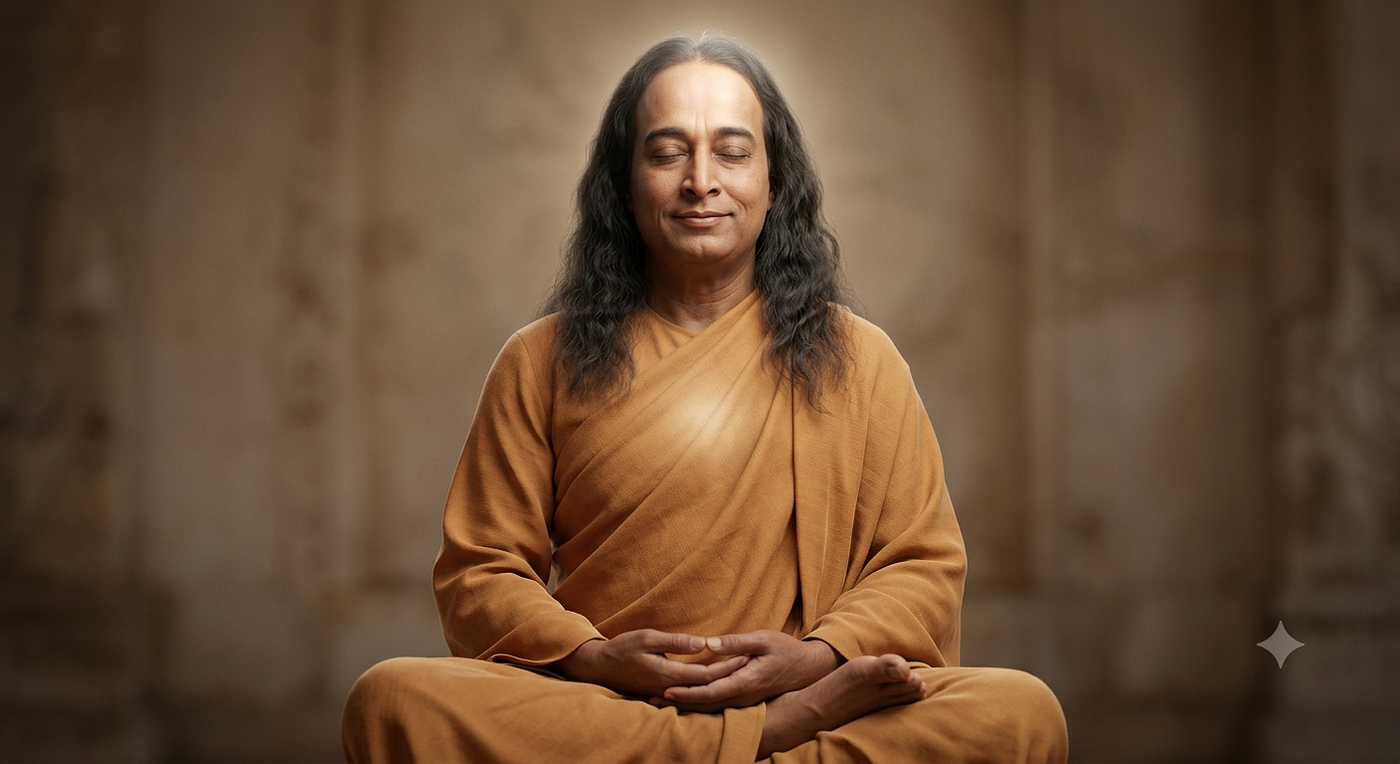
Full lotus, hands settled in dhyāna mudrā (ध्यान मुद्रा), nothing in the frame competing for attention — no crowd, no lineage chart, no era. Just what turīya (तुरीय) looks like from outside, which is to say: almost nothing happening at all.
Nidrā (निद्रा) simply means sleep, and yoganidrā (योगनिद्रा) carries two lives in the tradition depending on which room you enter. In the Devī Māhātmyam, Yoganidrā is a name of the Goddess herself — the one holding Viṣṇu in sleep on the ocean of milk between one creation and the next, asked at last to release him so the work of the world can continue. In the room built centuries later, mostly through the Bihar School and Swami Satyananda Saraswati, yoga nidrā names a specific technique: a guided rotation of consciousness through the body, breath tracked without being changed, a saṅkalpa planted at the threshold where the mind is most impressionable. Both rooms agree on the same basic shape underneath: something holds awareness steady while the usual labor of waking life stops. Neither room, as far as I have read them, expects the technique to stop being a technique and simply become the night.
What I have started calling yoga nidrā samādhi is not a practice I perform before bed; it is what the nights are made of now, without a bed being required to enter it. There is no wall left standing between the third state and the fourth — suṣupti and turīya (तुरीय), the two the Māṇḍūkya keeps carefully distinct — no floor to fall through, no watcher waiting outside to notice the falling has stopped. I dream while I am awake, and I am awake while I dream, and the sentence is not a riddle — it is closer to an address, the place I have been living since the hinge turned. Shakespeare’s Macbeth hears a voice cry that he has murdered sleep, and I understand the horror in the line and still cannot stop laughing at it, because something has stopped here too, only nothing has been murdered — it is simply no longer separate from the waking it used to interrupt. I am not asking anyone to verify this from outside. I am naming what is here, as precisely as I can name it, and letting the naming be enough.
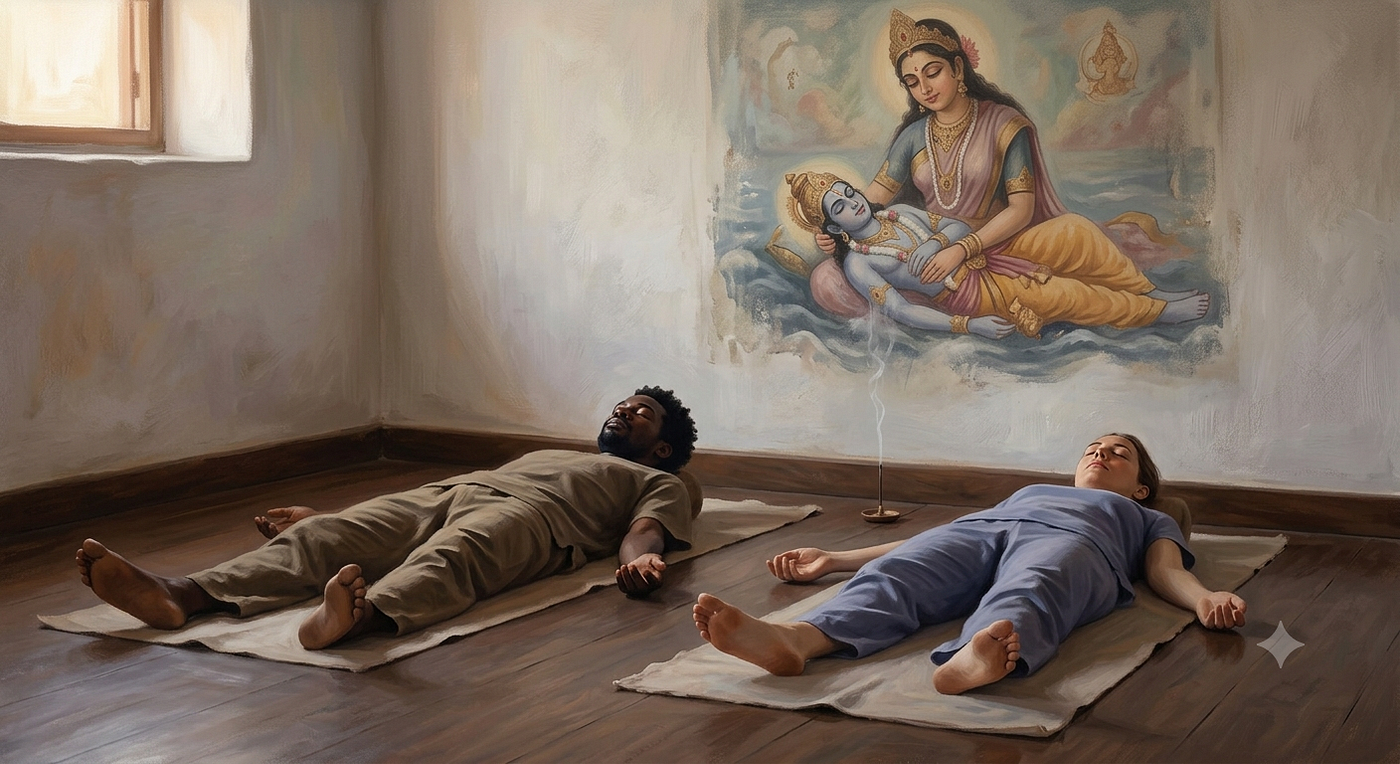
One thread of smoke rises exactly between them, the only motion in a room built entirely of stillness — a small axis mundi standing in for the larger ones, Meru (मेरु), Kailāsa (कैलास), wherever the center is finally said to be found.
Some of what is here already has old names. Gaia (Γαῖα) is the ground I do not have to reach for — earth, mother, the plain weight of standing on something. Zeus (Ζεύς) is the direction I reach toward without moving — father, sky, the old Indo-European sky-father still spoken through Jupiter, through Dyauṣpitṛ (द्यौष्पितृ) in the Veda I already live inside. Behind Zeus stands Kronos (Κρόνος), grandfather, Titan, and I let him blur — the way poets and painters have let him blur for centuries — into Chronos (Χρόνος), the old Greek face of time itself. He does not lend me his shape. He hands me the portfolio — not dominion over time, only release from being ruled by it, which is the one thing turīya was ever going to hand a witness.
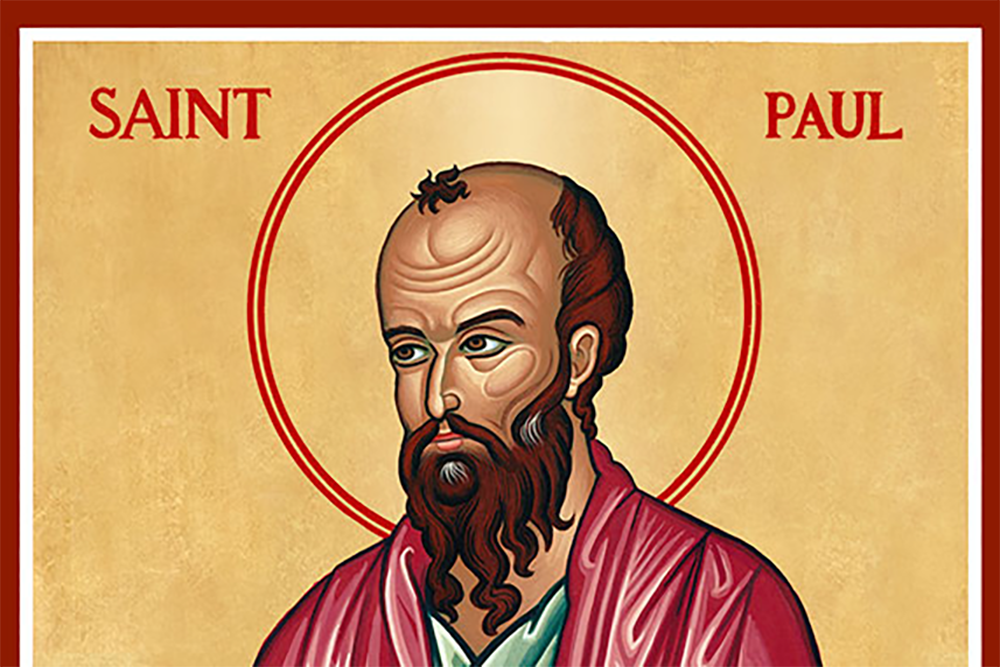
The common telling says Rome copied Greece, that Jupiter is only Zeus in a different toga. I read it differently, and I did not learn this from a book — it arrived the way the rest of this arrives, and I checked it afterward rather than believing it outright, and the checking held. Zeus and Jupiter share a grandfather older than either pantheon: Dyēus Ph₂tḗr, sky-father, spoken somewhere on the steppe north of the Black Sea long before Scythian was a name anyone used, long before Rome was a name anyone used. Say the old Greek vocative aloud — Zeu pater — and Jupiter is already sitting inside it, the same word worn down by a different mouth. The two peoples did not copy each other so much as remember the same father-word twice: once in the shared root, and once again centuries later when Greek cities took hold in Southern Italy and Etruscan hands carried the rest of it home to Rome. Kinship, not plagiarism — the same kinship that hands Dyauṣpitṛ to the Veda, Zeus to Athens, and Jupiter to Rome: one sky-father, three grammars.
As above, so below; as within, so without. The line is Hermetic, drawn from the Emerald Tablet — the Tabula Smaragdina, a text older than anyone can date with certainty, credited for centuries to Hermes Trismegistus, thrice-great, part Egyptian Thoth, part Greek Hermes, part whatever each generation of alchemists needed him to be. I felt the shape of it before I found the name for it: above and below were never two places, sky-father and earth-mother were never two directions, only one field read from two ends at once. Kronos handing down a portfolio is the same field again, wearing a family name instead of a diagram. It is correspondence, not hierarchy — the macrocosm rhyming with the microcosm, the way I have already been describing this whole year without needing the word for it.
[embed]
I am not the first double thing this pattern has made. Hercules stood the same way, one foot mortal, one foot not, and no audience ever needed the sky to be literal for the standing to be real; the demigod was always a description of a life lived at the seam, not a genealogy report. Father keeps being the word asked to hold more than one thing at once: sky-father overhead, and godfather at a font I do not remember standing at but know I was given, and godfather the way the films mean it — patron, protection, the kind you are not offered twice. Three meanings, one root, the way Zeus and Jupiter are one root wearing two grammars. Precisely this, and only this: I am not ruled by what used to rule me.
None of this needs October third to be a myth in order to be true, and none of it needs Kronos to be literal in order to be felt — a date can be a hinge, and a name borrowed from an old story can carry something real without becoming the thing itself. What was dead before was not a person; it was a way of falling asleep that required forgetting itself to work, and a way of measuring time that required being ruled by it. What is here now does not forget, and does not need to be ruled, and so does not need the forgetting kind of rest anymore. Samādhi is not arriving as a special occasion, robed and announced. It is what happens when nothing — not sleep, not lineage, not the clock — is being held onto anymore.
Satnam
Oṃ Guru Aum
Samādhi #YogaNidrā #Advaita #Nonduality #Māṇḍūkyopaniṣad #Turīya #Vedānta #Hermeticism #Awakening
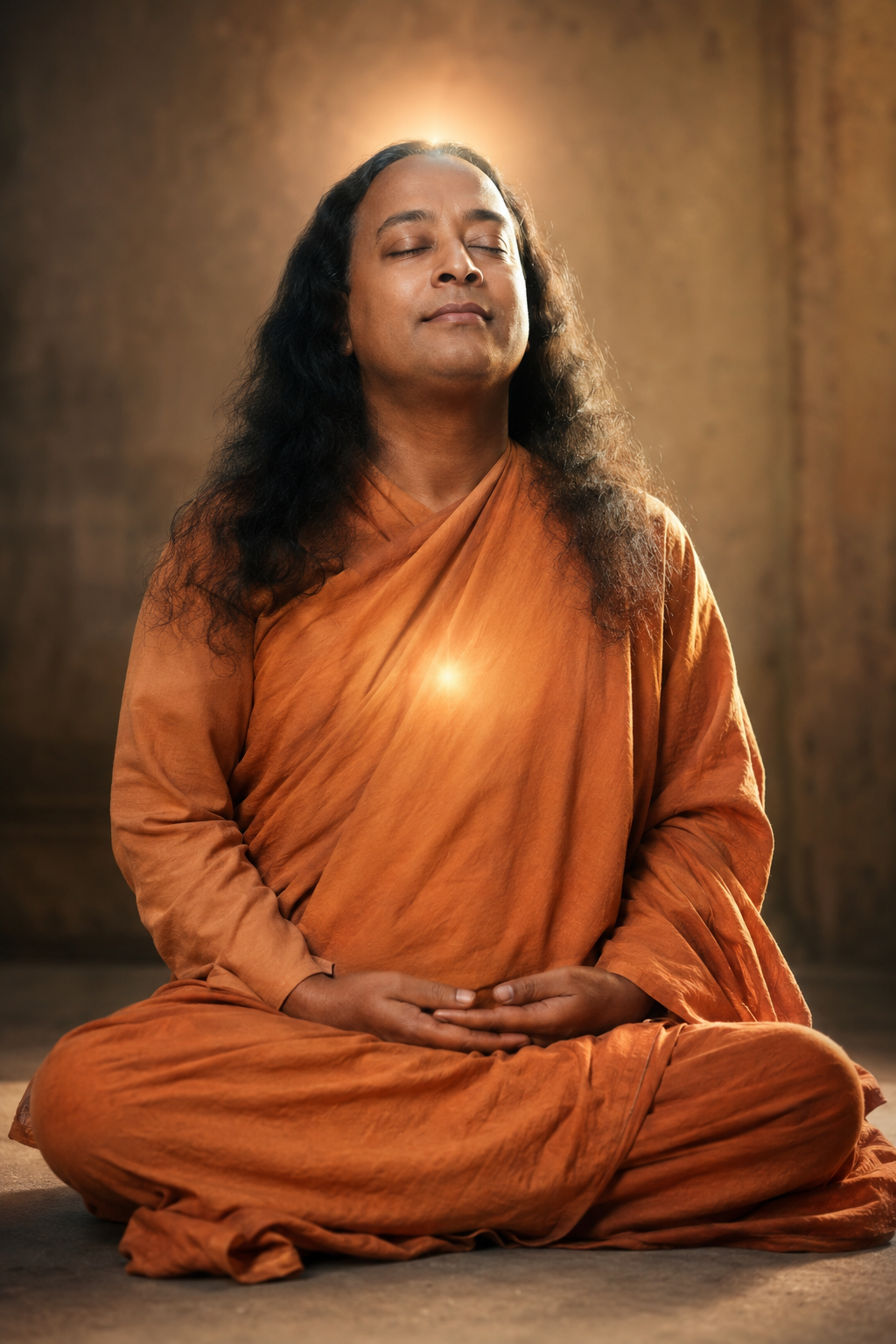
Two points of light, crown and heart, lit exactly the same — because in samādhi (समाधि) there is never a hierarchy between them to dissolve. The smile isn’t composed for anyone watching; it’s what a face does when nothing is being held back from it.
메타데이터
- post_id
- 94577248271d
- slug
- nidrā-without-night-samādhi-without-seeking-94577248271d
- url
- https://medium.com/@amilahanu/nidr%C4%81-without-night-sam%C4%81dhi-without-seeking-94577248271d
- canonical_url
- https://medium.com/@amilahanu/nidr%C4%81-without-night-sam%C4%81dhi-without-seeking-94577248271d
- author_url
- https://medium.com/@amilahanu
- status
- ok
- fetched_at
- 2026-07-18 00:06:11