Notes on Making Research Slides Less Ugly
Most research slides are built like papers. They shouldn’t be.
Notes on Making Research Slides Less Ugly
Lately my LinkedIn feed keeps showing me the same complaint: AI-generated slides are taking over conference talks. And they often are bad. I agree they often are. But if you watch enough talks, AI slides are just one of two ways a slide goes wrong.
Two ways slides go wrong
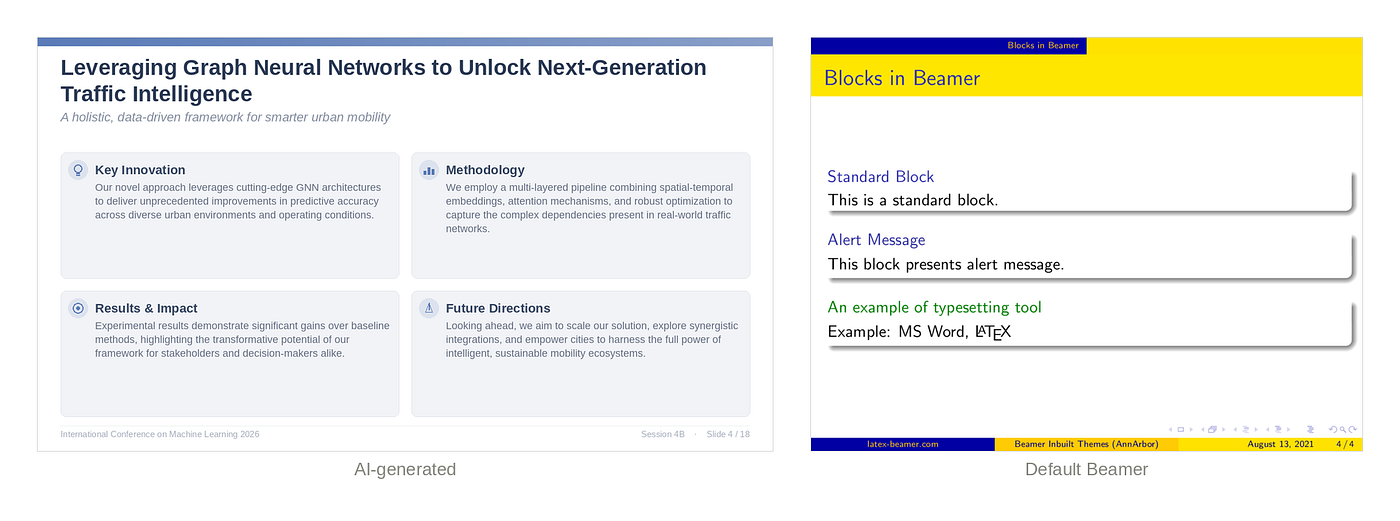
The first kind is AI-generated. They look clean. Good layout, even spacing, nothing obviously broken. But the person presenting never really made them their own. The tool produced something generic. So you get a slide stuffed with text, three ideas fighting for attention, and a talk that’s hard to follow even when there’s solid work behind it.
The second kind is the classic LaTeX Beamer theme. More effort clearly went into it, it’s homemade, and the content is usually better thought out. But it looks dated. Often still 4:3 in 2026, dense, fonts too small to read past the third row.
Different problems, same result: the slide gets between the work and the audience instead of helping.
A slide is not a paper
Here’s the thing I think both kinds forget. A slide is not a paper. A paper is made to be read, on paper, at your own pace, with the option to go back a paragraph when you lose the thread. A talk slide is made to support someone listening to you in a room, once, in real time, with no rewind. Those are two different jobs, and most bad slides are really just papers projected onto a wall.
Michael Alley makes this case in The Craft of Scientific Presentations, and a presentation course I took a while back made the same point with a couple of numbers worth repeating. The audience only takes in a fraction of your methods section, somewhere around 20 to 40 percent. The bottom tenth of your slide often isn’t visible from the back of the room, so anything you put there is wasted. People are reading and listening at the same time, and they’re not good at doing both at once.
What that means in practice
Once you accept that a slide is for listening and not reading, a lot of choices stop being about taste and start being practical:
- One idea per slide. If you’re explaining two things, that’s two slides.
- Text big enough to read from the back row. If you’re shrinking the font to fit more in, you have too much in.
- Just enough data to make the point, not all of it. The rest goes in the paper or a backup slide.
- Cut anything that isn’t doing a job. Decoration competes with your point for the audience’s attention, and your point loses.
None of this is new. It’s just rarely applied, because the default tools don’t make it easy and the default templates work against it.
What I ended up building
That’s the gap I wanted to close, in a small way. I built a Beamer theme called Jacquenetta, named after a PowerPoint template I borrowed the look from. It’s black and white, the text stays simple, you can emphasize what matters with sensible proportions, and nothing is so small the back row can’t read it. And because it’s LaTeX, equations stay easy to typeset, and the source stays plain text, so it’s also easy to hand to an AI tool if that’s how you like to work.

Jacquenetta Beamer theme
About Me
Hey! I’m Samuel Manchajm, an ML Engineer currently doing NLP research at the University of Montreal. I’m passionate about open source and I try to share my tools whenever they can be useful to others. If you’re into this kind of stuff, I’ll be writing more about the tools and workflows I build day to day.
I just started on Medium, I’d love to hear your feedback and contributions to this side project :)
**GitHub · [LinkedIn](https://linkedin.com/in/smanchajm)**
If you found this useful, a clap would encourage me to write more.
메타데이터
- post_id
- 947afcf2fa35
- slug
- notes-on-making-research-slides-less-ugly-947afcf2fa35
- url
- https://medium.com/@samuel.manchajm/notes-on-making-research-slides-less-ugly-947afcf2fa35
- canonical_url
- https://medium.com/@samuel.manchajm/notes-on-making-research-slides-less-ugly-947afcf2fa35
- author_url
- https://medium.com/@samuel.manchajm
- status
- ok
- fetched_at
- 2026-06-24 23:31:39




