How SaaS Companies Are Reducing Churn With AI-Powered Customer Success
Churn is the tax SaaS companies pay for acquiring customers they didn’t fully understand, onboarding them poorly, or failing to connect…
How SaaS Companies Are Reducing Churn With AI-Powered Customer Success
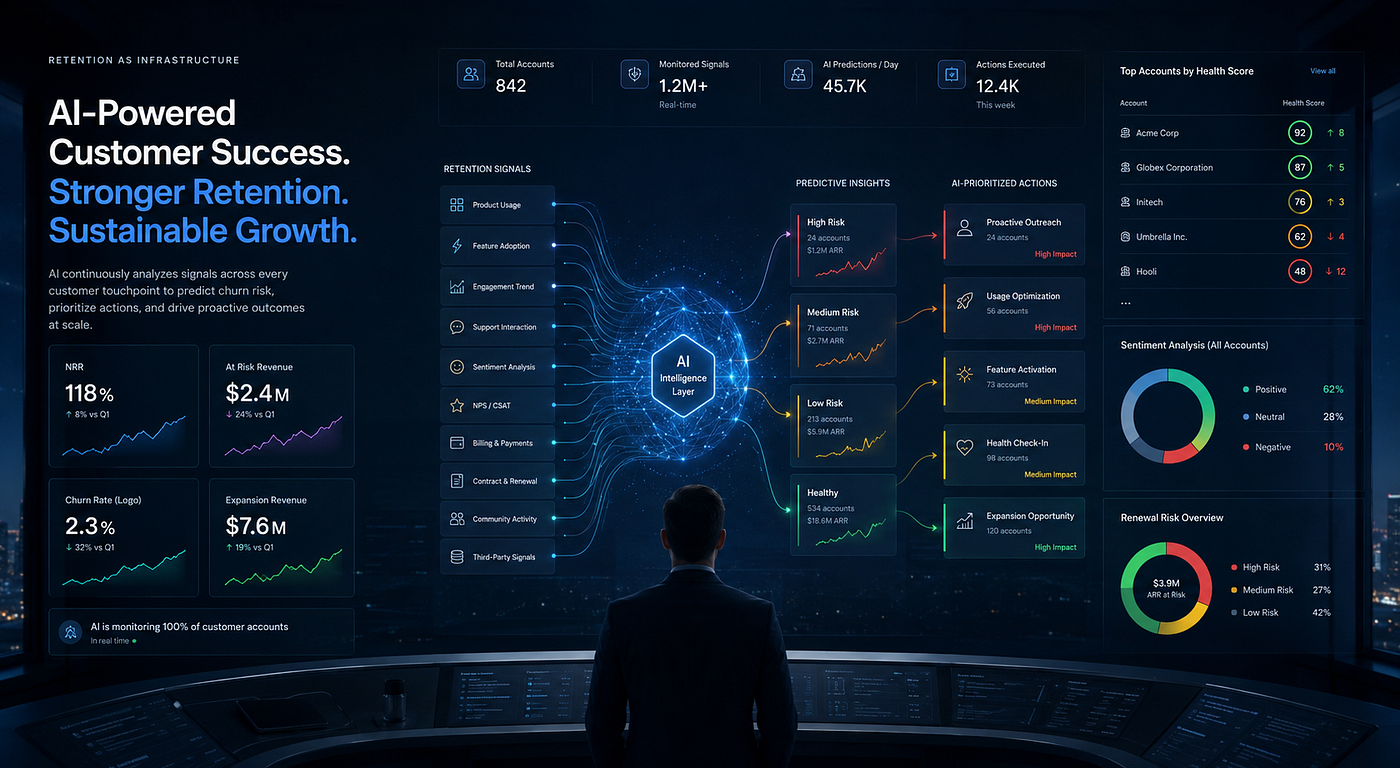
Churn is the tax SaaS companies pay for acquiring customers they didn’t fully understand, onboarding them poorly, or failing to connect them to ongoing value before a competitor did.
Most CS teams have spent years trying to reduce that tax by adding headcount, refining playbooks, and logging more calls. The growth of customer success as a function was itself a structural response to churn being too expensive to ignore.
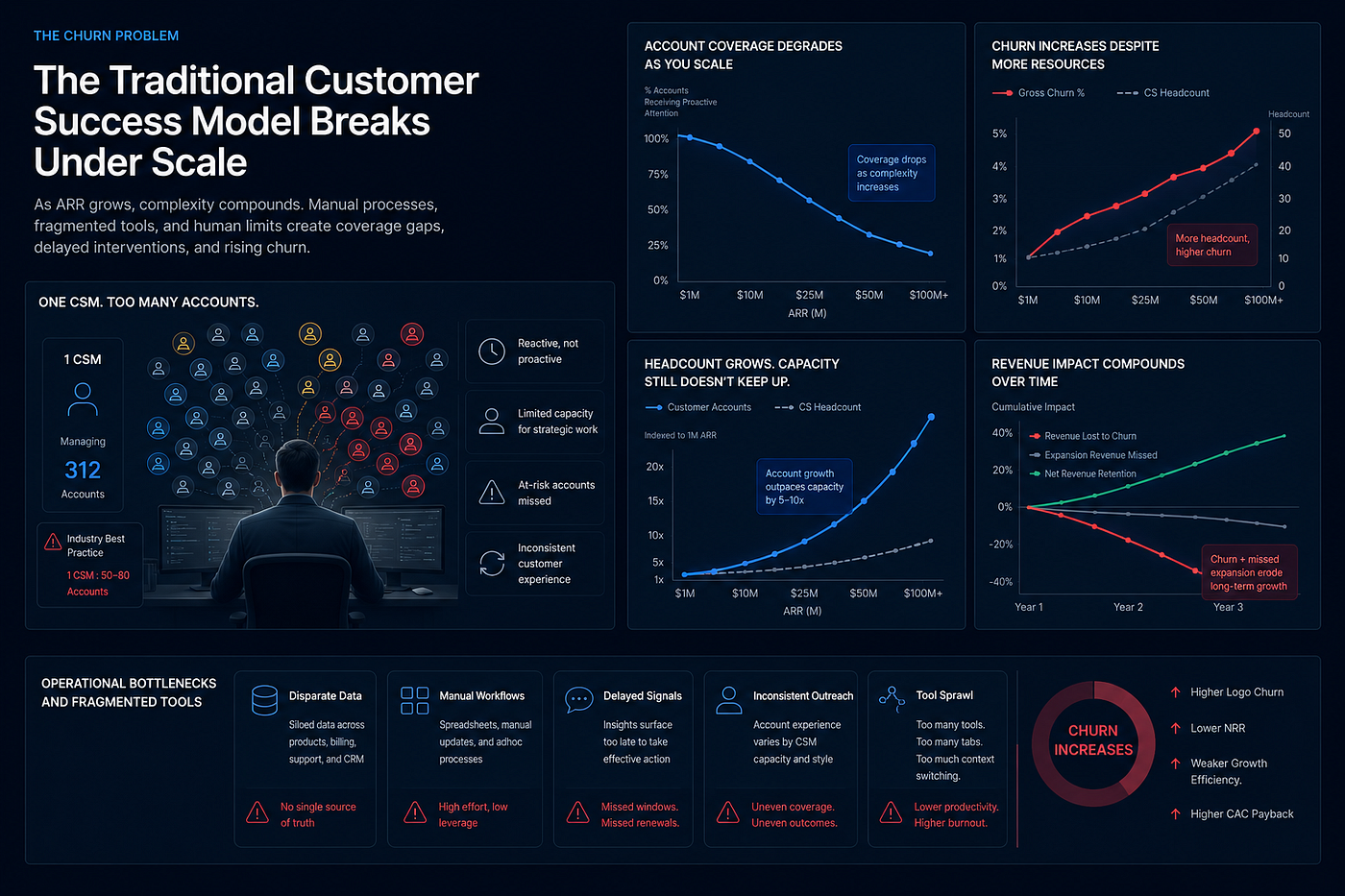
The problem is that the traditional CS model has a ceiling — and most SaaS companies hit it somewhere around $10M ARR. At that point, the CSM-to-account ratio becomes economically irrational. You either hire more CSMs and watch CS cost compound as a percentage of ARR, or you ask existing CSMs to manage more accounts and watch coverage quality degrade. Neither option improves churn. They just redistribute it.
AI-powered customer success doesn’t layer on top of this model. Done properly, it restructures it — changing what CSMs do, when they intervene, how accurately they predict risk, and how many accounts one person can meaningfully cover.
Companies using AI-powered customer success platforms report a 27% average reduction in churn within the first year of implementation, according to Forrester’s Q1 2026 Wave report. That reduction flows directly into NRR — the metric that drives SaaS valuations more than any other in 2026. ChurnZero’s 2025 Customer Revenue Leadership Study found that teams running on a customer success platform average 100% NRR, compared with 94% for teams without one. Product at WorkChurnZero
A six-point NRR gap compounding annually across every customer cohort is not an operational metric. It’s a company trajectory.
Why Traditional Health Scores Are Failing
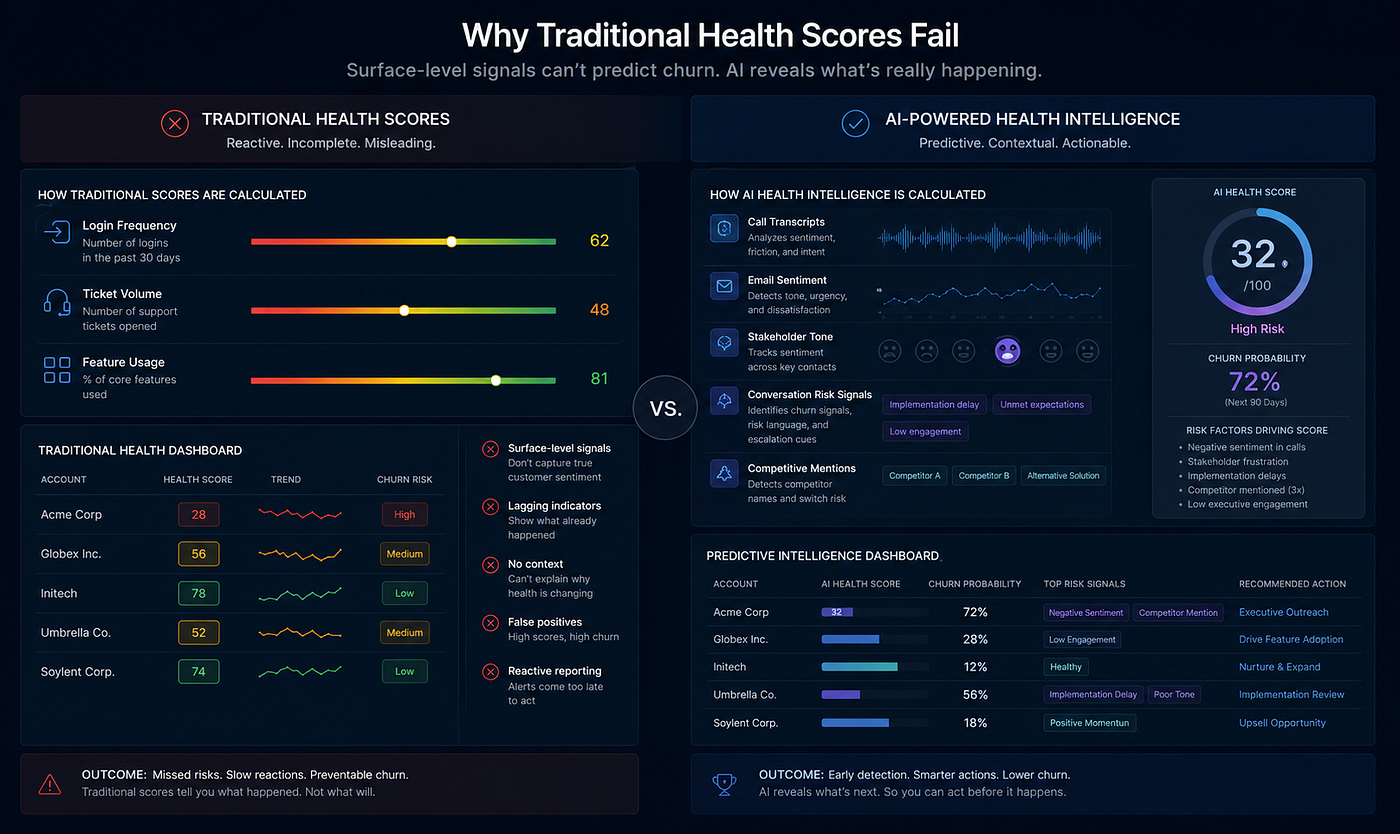
Here’s the uncomfortable reality most CS platforms won’t put in their marketing: 73% of CS leaders say their current health score doesn’t reliably predict churn — almost always because of data quality, not tool choice. Product at Work
The legacy model pulls login frequency, feature adoption breadth, and support ticket volume into a dashboard, assigns weights, outputs red/yellow/green, and asks CSMs to work the red accounts. It’s better than nothing. It’s worse than it looks.
Traditional health scores are built on structured behavioral data. That data tells you what a customer did. It doesn’t tell you what they’re thinking, what the internal champion said to their VP last week, or whether procurement is quietly running a competitive evaluation.
The biggest accuracy gains in 2025–2026 came from incorporating unstructured conversational data using LLM-based embeddings. A customer whose CSM hears the phrase “we’re evaluating options” on a call is 4–6x more likely to churn within 90 days — a signal invisible to behavioral-only models. Product at Work
The most predictive churn signals are qualitative. They live in call transcripts, meeting notes, QBR conversations, and email threads. Legacy CS platforms can’t process them. The result: risk surfaces too late, interventions are reactive, and saves require heroics rather than systems.
A health score that turns red the week before renewal isn’t a prediction. It’s a post-mortem.
The Retention Signal Stack: A Framework for AI-Powered CS
The reason most AI-powered CS deployments underperform isn’t the AI. It’s that teams apply AI to the wrong signals in the wrong sequence. The highest-performing SaaS CS operations in 2026 have structured their retention intelligence around what we’ll call the Retention Signal Stack — four signal tiers organized by predictive lead time.
Tier 1 — Conversational Signals (lead time: 60–120 days) The earliest and most predictive signals live in human language: call transcripts where stakeholders express frustration, QBR conversations where the economic buyer is conspicuously absent, email threads where tone shifts from collaborative to transactional. LLM-based processing of these signals — across Gong call recordings, Intercom support threads, and CSM meeting notes — now produces churn predictions with substantially higher accuracy than any behavioral model alone. Forrester’s 2025 Customer Intelligence Wave found that companies combining quantitative product data with qualitative conversation data achieve 23% higher prediction accuracy than quantitative-only approaches. Product at Work
Tier 2 — Behavioral Signals (lead time: 30–60 days) Feature adoption depth, session frequency, workflow completion rates, and integration usage. These are the signals most CS teams already capture — but the difference between basic tracking and AI-powered behavioral analysis is the ability to detect subtle pattern changes across large account portfolios simultaneously. A 20% drop in feature usage by one user might be noise. A 20% drop across three power users in the same account within two weeks is an organizational signal. Rules-based health scores can’t distinguish the two. ML models can.
Tier 3 — Relational Signals (lead time: 30–90 days) Champion turnover is one of the highest-risk events in B2B SaaS and one of the most consistently underaddressed. When the person who drove the original purchase leaves the company, the account is vulnerable regardless of product performance. AI systems that monitor access log changes, email pattern shifts, and stakeholder engagement frequency to detect champion departure — before the CS team finds out through a missed renewal conversation — are now a real capability in mature platforms.
Tier 4 — Transactional Signals (lead time: 0–30 days) Billing events, contract renewal dates, payment delays, downgrade history. These are the signals most CS teams catch, but they’re the last line of defense — not the early warning system. By the time a transactional signal fires, the save play has a narrow window and low probability.
The strategic implication: Most SaaS CS teams are running their retention programs almost entirely on Tier 4 signals. AI-powered CS shifts the operating layer to Tier 1 and Tier 2 — where intervention windows are 60–120 days instead of 7–14 days, and save rates are dramatically higher.
Real-time scoring enables intervention windows of 30–90 days before cancellation. Batch weekly or monthly scoring shrinks that window to 7–14 days — often too late for B2B saves that require executive escalation, custom contracts, or product commitments. Product at Work
The Four Operational Layers of AI-Powered Retention
Layer 1: Predictive Health Scoring
Multi-signal ML models trained on historical churn and expansion data, drawing from all four tiers of the Retention Signal Stack. Modern churn prediction models reach 78–85% accuracy when trained on combined product usage, conversation sentiment, support tickets, and billing data — versus just 55–65% for usage-only models. Product at Work
The model doesn’t replace CSM judgment. It directs CSM attention — surfacing the accounts that need intervention, with enough context about the specific risk driver to make the intervention targeted rather than generic.
Layer 2: Autonomous Workflow Execution
Identifying risk without acting on it is theater. When a health score crosses a risk threshold, AI should trigger the appropriate playbook autonomously: drafting re-engagement outreach, scheduling check-in calls, flagging accounts for executive escalation, or surfacing targeted adoption resources based on the account’s specific usage gap.
“Customer success management has moved from ‘dashboards humans interpret’ to ‘AI agents that propose actions and CSMs approve them.’” CSMs stop being reactive operators scanning dashboards. They become approvers and directors of AI-proposed interventions — a higher-leverage and more sustainable operating model. ThriveStack
Layer 3: CSM Productivity Amplification
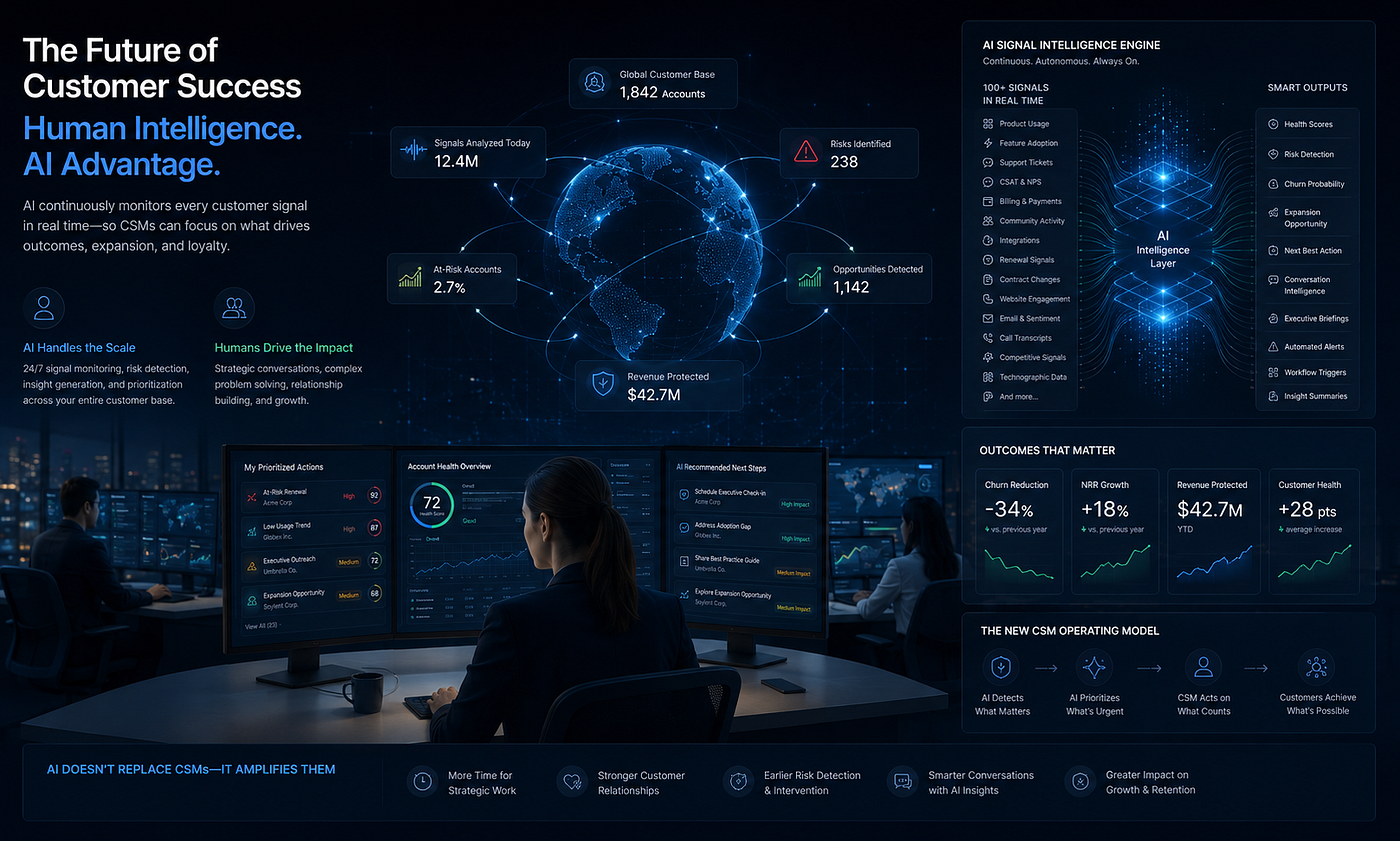
The CSM-to-account ratio has nearly tripled — from 1:25 in 2022 to 1:60 in 2026 — purely because AI handles the administrative load. QBR deck generation, account summary compilation, call note logging, renewal risk reporting — these tasks consumed CSM time without generating any customer value. AI eliminates them. Product at Work
ChurnZero CEO You Mon Tsang predicts the average CSM will have 25–50% more bandwidth by end of 2026 — not by working longer hours, but by working differently. That bandwidth gets redirected to the high-judgment work AI cannot replicate: executive relationship management, complex escalation handling, and strategic expansion conversations. ChurnZero
The model is not AI replacing CSMs. It’s AI making each CSM capable of covering a substantially larger portfolio without sacrificing quality at the account level.
Layer 4: Expansion Signal Detection
Churn prevention and expansion are two sides of the same NRR equation. AI-powered CS identifies expansion signals alongside churn risk: usage spikes in features correlated with upsell readiness, team size growth triggering seat expansion logic, workflow patterns indicating readiness for an adjacent product.
Clients with strong ICP fit are 2x less likely to churn and 4x more likely to expand. AI CS platforms that surface expansion signals in the same workflow as churn risk signals turn the CS function from a retention cost center into a revenue expansion engine.
The Platform Landscape: Who’s Actually Delivering
The CS platform market has matured, but most vendors are selling more AI sophistication than they’re actually delivering. Here’s the honest breakdown by segment:
Gainsight is the enterprise standard. Comprehensive, deeply configurable, and built for complex CS operations at scale. Starting price around $30K/year, scaling well beyond $100K for enterprise deployments. Implementation at 8–12 weeks. Justified for organizations above $50M ARR with a dedicated CS Ops function to manage configuration. Buying Gainsight at $15M ARR without a CS Ops person to run it is a consistently expensive mistake.
ChurnZero is the mid-market default for good reason: 80% of Gainsight’s capability with 40% of the complexity, at 4–6 weeks to implementation. For Series B to pre-IPO SaaS companies with 3–15 CSMs managing accounts in the $5K–$100K ACV range, ChurnZero is the defensible choice in most situations. Techno-Pulse
Totango (+Catalyst) offers genuine modular flexibility and the only meaningful free tier in the category — making it accessible to early-stage CS teams that need structured health scoring before they can justify $20K+/year in platform spend.
Gong is not a CS platform — but it’s one of the highest-value data inputs for any AI health scoring model. Call transcript processing at scale, sentiment detection, and competitive mention surfacing make Gong’s output the primary source of Tier 1 conversational signals. Any CS platform evaluation that doesn’t include a Gong integration assessment is missing the most predictive signal category available.
The honest evaluation rule: Above 5 CSMs and 100+ accounts, a dedicated CS platform pays for itself in CSM efficiency and early warning signals within 6 months. Below that threshold, your CRM with disciplined account management is defensible. Above $30M ARR with material churn, a CS platform is no longer an optimization — it’s a retention infrastructure requirement. Thecscafe
The Interventions That Actually Reverse Churn
Prediction without intervention architecture is just expensive reporting. The retention plays that consistently move the needle:
The Executive Escalation Play. When AI detects executive disengagement — the champion has gone quiet, QBR attendance has dropped, the economic buyer hasn’t engaged in 60 days — the required intervention is executive-to-executive, not CSM-to-CSM. AI platforms that route escalation requests to the right internal stakeholder automatically shorten the time between risk identification and appropriate response from weeks to hours.
The Value Realization Reset. A significant percentage of B2B churn is not caused by product dissatisfaction. It’s caused by customers who never fully understood what value they were receiving. AI that auto-generates account ROI summaries from usage and outcome data — giving CSMs evidence to walk into renewal conversations with rather than anecdotes — transforms QBRs from product update sessions into retention-driving business reviews.
The Feature Adoption Intervention. Many at-risk accounts are underutilizing the product and haven’t internalized enough value to justify renewal. AI that identifies specific feature adoption gaps — “this account purchased but has never activated the capability most correlated with renewal” — enables targeted adoption plays that address the actual risk driver rather than scheduling another check-in call.
The Champion Departure Protocol. Internal champion turnover is one of the highest-risk events in B2B SaaS and one of the most consistently underaddressed. The accounts most vulnerable after a champion departs are those where no secondary relationship was built. The CS teams with the lowest post-champion-departure churn rates have embedded multi-threading into their account management model as a standard practice — not a reactive save play.
The ROI Calculation CS Leaders Aren’t Running
G2 and TrustRadius surveys show an average return of $4–7 in protected revenue per $1 spent on churn prediction AI. That ratio already justifies the investment. But it understates full ROI because it only counts churn prevention — not efficiency gains, expansion revenue, and avoided headcount. Product at Work
The full model for a $20M ARR company at 10% annual churn:
Protected ARR: A 25% reduction in annual churn rate — the low end of what well-implemented AI CS delivers — recovers $500K in ARR annually. Compounded across cohorts, the three-year impact is materially larger.
Headcount efficiency: AI helps CSMs reclaim 8–10 hours per week. At a fully loaded CSM cost of $130–150K annually, doubling each CSM’s portfolio capacity is the economic equivalent of adding a half-time hire per CSM — without salary, benefits, or ramp time. Coworker
Expansion uplift: Accounts where AI surfaces expansion signals and CS acts within the intervention window convert at higher rates than accounts where expansion conversations happen reactively. Even a 10% improvement in expansion conversion on a $20M ARR base with 15% expansion potential is $300K in incremental NRR annually.
The question is never whether AI-powered CS delivers ROI. It’s whether your data infrastructure is clean enough to support it and your CS team disciplined enough to act on it.
The Mistakes That Undermine AI-Powered CS
Buying the platform before auditing the data. No AI health model produces accurate predictions from incomplete product tracking, stale CRM records, or disconnected billing systems. The pre-implementation audit — can you produce a clean, unified customer record combining product, billing, support, and CRM data? — is the work that determines whether the platform investment succeeds or fails. Most teams skip it.
Treating AI as a reporting layer. Platforms purchased as dashboard tools rather than operational infrastructure produce no behavioral change and no retention improvement. The AI has to be embedded in daily CSM workflow — surfacing signals in the tools CSMs already use, not requiring a separate login to a separate platform that gets checked monthly.
Over-automating enterprise accounts. Automated touchpoints for long-tail SMB accounts are appropriate and efficient. Automated renewal outreach to a $200K enterprise account is a relationship risk. The tiering discipline — knowing which accounts require genuine human investment and which can be served digitally — is the judgment call that AI assists but cannot make alone.
Ignoring CSM adoption as the real success metric. Platform capability is irrelevant if CSMs don’t use it. The change management required to shift CS behavior from reactive account management to AI-assisted portfolio management is consistently underestimated and undertreated as an organizational challenge rather than a technical one.
Frequently Asked Questions
At what ARR stage does AI-powered CS become necessary? At $5M ARR with a growing customer base, manual health scoring starts breaking down and risk signals get missed at scale. That’s when a dedicated platform pays for itself within 6 months. Above $15M ARR with meaningful churn, AI-powered CS is no longer an optimization — it’s a retention infrastructure gap.
How long before you see measurable churn impact? 3–6 months for signal quality to stabilize, 6–12 months for measurable retention improvement. The fastest results come from companies that enter implementation with clean data. The slowest spend the first quarter fixing data problems they should have audited before signing the contract.
Is the health score concept still useful in 2026? The concept is sound. The single composite score is obsolete. Modern health scoring is multi-dimensional: separate scores for adoption, relationship, financial, and support health — each triggering different interventions. Flattening these into one number loses the signal precision that makes AI-powered CS actually work.
Gainsight vs. ChurnZero at $15M ARR — which is right? ChurnZero, in most cases. Faster implementation, lower total cost, and sufficient capability for the account complexity at that stage. Gainsight becomes justified when Salesforce integration depth is non-negotiable, or when a dedicated CS Ops admin can manage the configuration overhead. Without that person, Gainsight’s capability advantage disappears into implementation debt.
Conclusion: Retention Is Now an Infrastructure Decision
The SaaS companies winning on retention in 2026 are not winning because they have more empathetic CSMs. They’re winning because they built the infrastructure to see churn forming 90 days out — and the operational discipline to act on those signals systematically rather than heroically.
Most churn is not a surprise. It’s a signal that went undetected, a risk that surfaced in a conversation nobody processed, a value gap that compounded quietly for two quarters before showing up as a cancellation request.
The customers who churn were almost always telling you they were going to. You just weren’t listening at scale.
AI-powered CS is the infrastructure that makes listening at scale possible. But the infrastructure is only as good as the data feeding it, the playbooks acting on it, and the organizational design built around it.
A well-implemented churn prediction system delivers a 20–35% reduction in annual churn rate within 12 months. For a $20M ARR company, that’s $400K–$700K in protected revenue annually. Not from a new product. Not from a new market. From the customers you already have. AdaptNXT
That’s the most capital-efficient growth lever in SaaS — and most companies are leaving it on the table.
For CS leaders and revenue operators building retention infrastructure:
We’re compiling benchmark data from B2B SaaS companies implementing AI health scoring, predictive renewal architecture, and autonomous CS workflows across different ARR stages and customer segments. Subscribe to receive the research, operator teardowns, and implementation frameworks as they’re published.
메타데이터
- post_id
- 94853dcdebc0
- slug
- how-saas-companies-are-reducing-churn-with-ai-powered-customer-success-94853dcdebc0
- url
- https://medium.com/@averiqsolutions/how-saas-companies-are-reducing-churn-with-ai-powered-customer-success-94853dcdebc0
- canonical_url
- https://medium.com/@averiqsolutions/how-saas-companies-are-reducing-churn-with-ai-powered-customer-success-94853dcdebc0
- author_url
- https://medium.com/@averiqsolutions
- status
- ok
- fetched_at
- 2026-06-23 03:48:11




