Why Static Knowledge Is No Longer Enough for Building Reliable AI Agents
AI Agents Are Getting Smarter. But Can They Keep Up With the Real World?
Why Static Knowledge Is No Longer Enough for Building Reliable AI Agents
AI Agents Are Getting Smarter. But Can They Keep Up With the Real World?
Why static knowledge is no longer enough for AI agents that need to research, reason, and act on real-time information.
The future of AI isn’t about knowing everything.
It’s about knowing what’s happening right now.
Have you ever asked an AI assistant about something that happened yesterday, only to discover that its answer was already out of date?
It’s a strange experience.
On one hand, AI can explain complex scientific concepts, write software, summarize research papers, and help develop a business strategy in seconds. On the other, it can miss a product launch that happened this morning, overlook a newly published report, or rely on information that has already changed.
That doesn’t necessarily mean the AI is unintelligent.
It means its knowledge has limits.
Most AI models learn from information collected during training. That knowledge can be remarkably broad, but the world doesn’t stop changing once a model is trained.
New companies emerge. Products launch. Regulations change. Vulnerabilities are discovered. Research evolves. Markets move.
As AI develops from conversational assistants into agents capable of researching, planning, analyzing, and taking action, the limitation becomes much more important.
The question is no longer simply:
“How smart is the model?”
It is becoming:
“How effectively can the model understand what is happening right now?”
The World Changes Faster Than AI Can Learn
Consider how much information can change in a single day.
A startup announces a new funding round.
A cybersecurity vulnerability is disclosed.
A government introduces a new AI regulation.
A competitor launches a product with features you haven’t seen before.
A research paper challenges an assumption that seemed established only weeks earlier.
Humans adapt because we continuously observe, read, compare, and learn.
A model operating only on static knowledge cannot do that by itself.
For casual conversations, this limitation may not matter much.
But consider an AI agent responsible for monitoring competitors, researching markets, tracking regulations, analyzing customer sentiment, or supporting business decisions.
In those situations, outdated information isn’t simply inconvenient.
It can change the outcome.
This is why real-time information is becoming a fundamental requirement for more capable AI systems.

AI Is Moving From Answers to Action
Large Language Models have transformed how we interact with information.
They have made writing faster.
They have accelerated software development.
They have changed customer support.
They have made research and information discovery more accessible.
But the next generation of AI is expected to do more than answer questions.
It is expected to take action.
Imagine asking an AI agent to:
- Monitor competitors every morning.
- Track changes in government regulations.
- Analyze customer reviews across multiple platforms.
- Research a company before a sales meeting.
- Compare products launched this week.
- Monitor emerging security vulnerabilities.
- Identify new developments in a specific market.
These aren’t futuristic concepts anymore. They represent increasingly practical use cases for AI agents.
But an agent cannot perform these tasks reliably using only information it learned weeks or months ago.
It needs a way to continuously discover what has changed.
And that introduces a deeper challenge.
The Problem Isn’t Internet Access
The obvious response is:
“Why not simply give AI access to the internet?”
It’s a reasonable question.
But the web isn’t a neatly organized database.
It is a constantly changing ecosystem of websites, news articles, PDFs, research papers, product pages, documentation, forums, blogs, databases, advertisements, duplicate content, outdated pages, and conflicting information.
Finding information is one problem.
Turning that information into reliable intelligence is another.
A capable AI agent needs to do much more than retrieve a webpage.
It needs to discover relevant sources, navigate web content, extract useful information, identify meaningful changes, preserve context, and convert scattered information into something that AI systems can work with.
In other words:
Web access is not the same as web intelligence.
That’s where the real infrastructure challenge begins.
From Web Access to Web Intelligence
Imagine opening ten browser tabs about the same topic.
One article is outdated.
Another contradicts it.
A third contains valuable statistics but provides little context.
Several repeat the same information.
A human reader can compare these sources, recognize patterns, assess relevance, and decide what deserves attention.
AI agents need a reliable infrastructure layer that helps them work with information in a similarly structured way.
A useful way to think about this is:
Discover → Crawl → Extract → Structure → Understand → Reason → Act
The more capable AI agents become, the more important this pipeline becomes.
The future of AI isn’t simply about building larger language models.
It’s about connecting powerful reasoning with fresh, relevant, structured information.
That combination is what can move AI from simply generating responses toward supporting more informed decisions and actions.
Why Real-Time Web Intelligence Matters Across Industries
This isn’t limited to one industry.
A marketing team needs to understand emerging trends.
A product team needs to monitor competitors.
A sales team needs current information before engaging with prospects.
A security team needs visibility into newly emerging threats.
A researcher needs access to the latest publications and developments.
An analyst needs to understand what is changing in the market.
In each case, historical knowledge alone isn’t enough.
The information that matters most may be the information that changed today.
That’s why live web intelligence is becoming increasingly important for AI applications.
Instead of relying only on what a model already knows, AI systems can be connected to continuously changing external information and use that information as part of their workflows.
This creates a more useful relationship between AI and the world around it:
The model provides reasoning. The web provides fresh information. Infrastructure connects the two.
The Missing Layer: Web Intelligence Infrastructure
As AI agents become more autonomous, developers face a growing infrastructure challenge.
Building an agent that can reason is one thing.
Giving that agent dependable access to changing web information is another.
Teams often have to combine different technologies for crawling, scraping, browser automation, content extraction, parsing, and data processing.
That can work for individual experiments.
But as AI applications move toward production, fragmented workflows can introduce additional complexity, maintenance requirements, and scaling challenges.
This creates a need for a more unified approach:
An infrastructure layer designed to help AI applications interact with the web more effectively.
That’s where Ollagraph fits into the picture.
Where Ollagraph Fits In
Ollagraph is built around the idea that AI applications need a more practical way to work with web information.
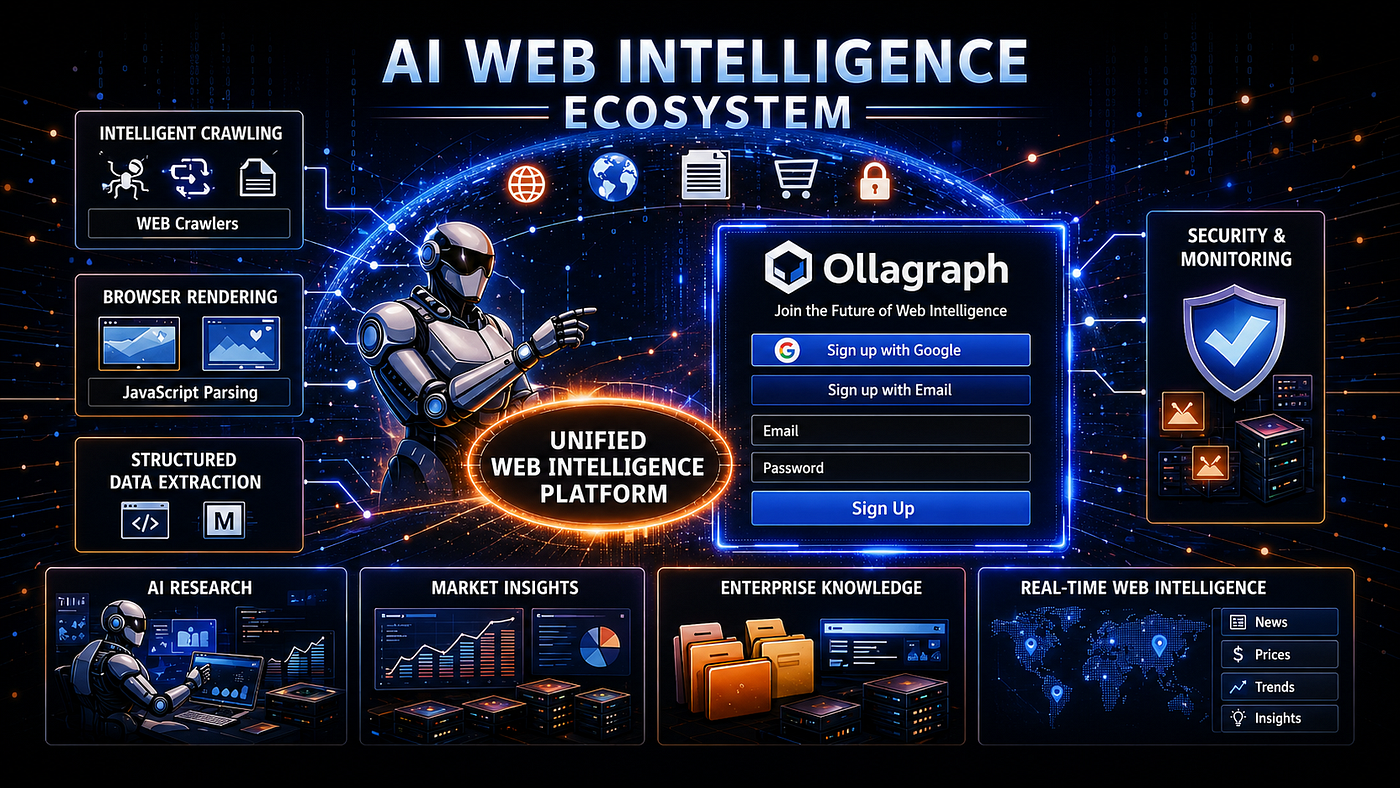
Rather than treating crawling, scraping, extraction, and AI-ready data workflows as completely separate pieces, Ollagraph brings these capabilities together into a unified web intelligence platform.
The goal isn’t simply to collect more data.
It’s to make web information more accessible, structured, and usable for AI applications.
That creates a bridge between two constantly evolving worlds:
**The reasoning capabilities of AI
The continuously changing information of the web**
And as AI agents become increasingly capable of researching, monitoring, analyzing, and acting, that bridge becomes increasingly important.
The Next Advantage in AI May Not Be the Model
AI has made extraordinary progress.
But the next chapter of AI may not be defined solely by larger models or better benchmarks.
It may be defined by how effectively AI systems can connect reasoning with reality.
An agent that can reason brilliantly but operates on outdated information has limitations.
An agent that can access massive amounts of web data but cannot organize or reason over it has different limitations.
The real opportunity lies in bringing these capabilities together.
Fresh information. Reliable web infrastructure. Powerful reasoning. Meaningful action.
That combination could define the next generation of AI agents.
Static knowledge helped create intelligent assistants.
Live web intelligence can help create AI agents that are better connected to the world they operate in.
And perhaps the most important question for the next phase of AI isn’t:
“How much does an AI model know?”
“How effectively can it discover, understand, and use what is happening right now?”
What do you think?
As AI agents become more autonomous, will access to real-time information become just as important as the models themselves?
Share your thoughts in the comments.
Explore:
If you’re interested in exploring web intelligence for AI applications, here are a few useful resources:
- Ollagraph Website: https://ollagraph.com
메타데이터
- post_id
- 949eb32a9313
- slug
- why-static-knowledge-is-no-longer-enough-for-building-reliable-ai-agents-949eb32a9313
- url
- https://medium.com/@sushma_359/why-static-knowledge-is-no-longer-enough-for-building-reliable-ai-agents-949eb32a9313
- canonical_url
- https://medium.com/@sushma_359/why-static-knowledge-is-no-longer-enough-for-building-reliable-ai-agents-949eb32a9313
- author_url
- https://medium.com/@sushma_359
- status
- ok
- fetched_at
- 2026-08-20 04:26:24