Everything I Know About the Battle of Adwa
Reflections on a specific kind of violence
Everything I Know About the Battle of Adwa
Reflections on a specific kind of violence
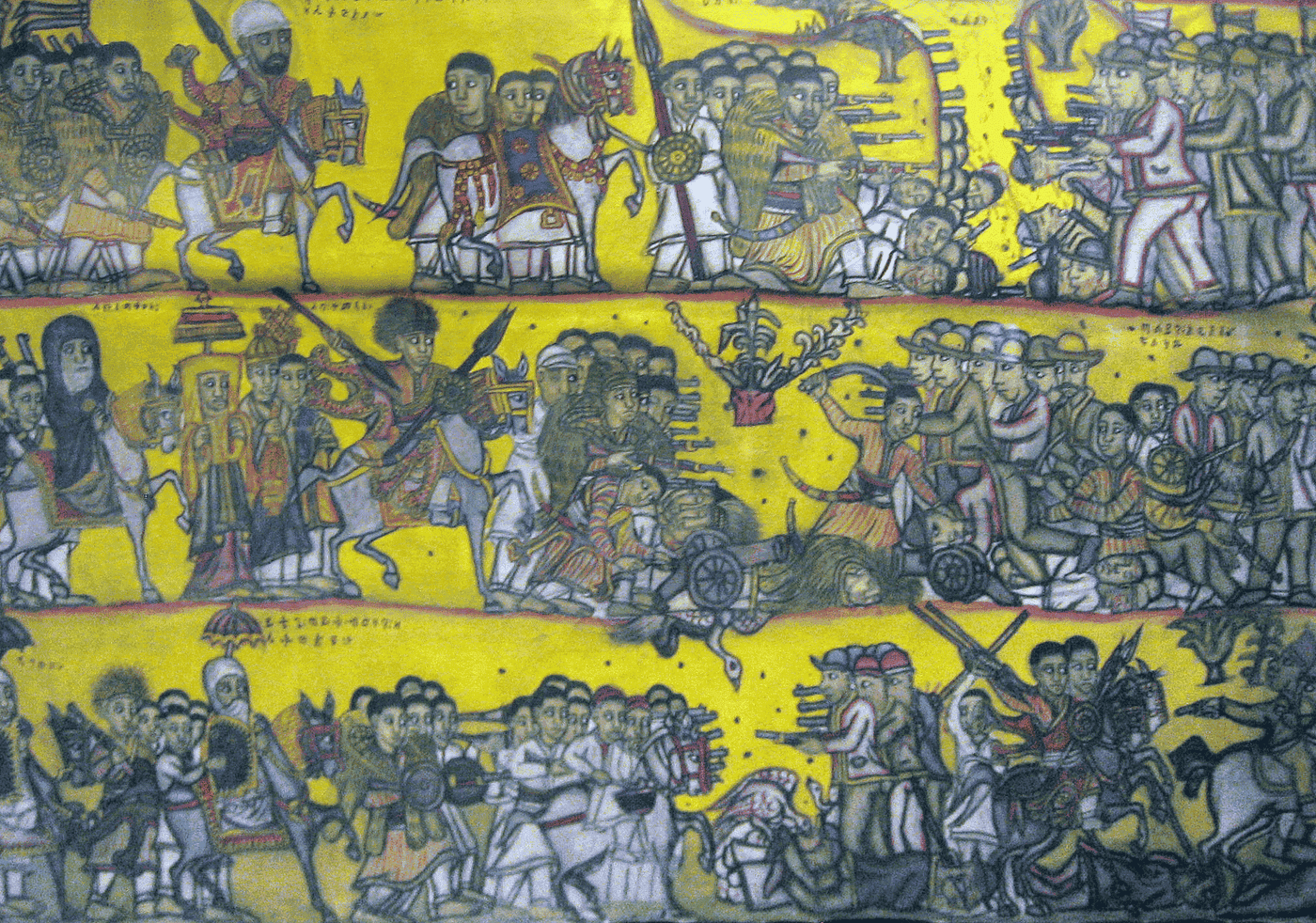
Painting of the Battle of Adwa. Catalogue # E261845–0, Dept of Anthropology, NMNH, Smithsonian Institution. Photo by Joshua Sherurcij, 2007.
Popularity itself is a popular topic online. Many people ask: What makes something popular? I can’t answer that yet.
Today, I’m going to show you an essay I wrote that proved extraordinarily popular. It’s something you’d expect would not be popular, and indeed its popularity remains an absolute mystery to me, too.
It’s about castration in a certain military battle over a century ago. I’m not an expert in 19th-century Ethiopian military history. I wrote a version of this story a while ago, and in placing it here, I’m not pretending to be an expert, but rather I’m attempting to satisfy the many people — nearly 30,000, in fact — who seem to want this story to continue to exist.
Before I start, a small pitch: Though I myself am not popular, I do have a very old, dusty email list that I’d like to resurrect as I try to publish a strange poetry book. My poetry mentions the Battle of Adwa, as I’m about to explain. The poetry is history tinged with speculative fiction. I’ve been working on this book for many years. **Provide your email** if you’d like to be notified when the eunuch ghosts come out of the box. Please only sign up if you like to be captivated and weirded out.
130 years ago, a significant battle between Ethiopia and Italy
While researching handwritten papers in an archive that became the foundation for my 2020 book, ***Ten Past Noon***, I found a note about the “Battle of Adowa.” I didn’t recognize the name, and it was a little tricky for me to look it up, in part because the English spelled it Adowa, the Italians Adua, and the Ethiopians Adwa. I learned it referred to a famous battle in an Ethiopian town of that name.
It’s near the Red Sea and the Gulf of Aden. On the other side of Saudi Arabia is the Strait of Hormuz.

Wikipedia map
While Ten Past Noon is prose nonfiction that has been out in the world for several years, I’ve decided to rewrite it as poetry. I’m currently seeking a publisher for the new poetry version. That’s how the Battle of Adwa is slightly linked to my new poetry project.
To better inform myself, some years ago I read Raymond Jonas’s *The Battle of Adwa: African Victory in the Age of Empire*. A website, battleofadwa.org, supplements the book.

Bookshop
More recently, I came across a new comic book called Zufan (ዙፋን), billed as “1896 Italian invasion of Ethiopia as Sci-fi…Black history that’s not taught in schools (but should be!)” It’s from **Etan Comics, and the team raised a heck of a lot of money [on Kickstarter](https://www.kickstarter.com/projects/etancomics/zufan-graphic-novel)**. Good for them.

So of course I got a hold of that.

I guess I oughtn’t show you the whole 140+ page book, but here’s one panel showing the futuristic sci-fi rendition of the Battle of Adwa.

Oh, and you can get the book in Amharic if you prefer.

So, here’s my Battle of Adwa article
Now that you’ve got that context:
Again, what I’m about to share is a newly revised version of my all-time most popular blog post, which has had nearly 29,000 views over 11 years. If that’s what you want, please continue.
However, if you don’t want to read about battlefield castration, this post won’t be your thing. (For what it may be worth to you, I also wrote some poems about something else entirely, and you can skedaddle to read those instead.)
Castration at the Battle of Adwa (1896)
In the late 19th century, many repeated an expectation that Europe would someday conquer all of Africa. Britain (sparring against France) sought to control the Red Sea, and to that end, Britain encouraged Italy to occupy Ethiopia.
In 1889, Ethiopia and Italy signed the Treaty of Wuchale. One point in particular was interpreted differently by each party: Ethiopia believed itself to have been given the option of conducting international communications through Italy, while Italy asserted that the treaty had converted Ethiopia into its protectorate and that therefore Ethiopia, as it was not an independent nation, would be required to conduct all diplomacy through Italy whether it wished to or not. This was a major misunderstanding. Italy thenceforth tried to enforce its rule over Ethiopia.
But on March 1, 1896, the Battle of Adwa turned the tables: the Ethiopians beat back the invading Italians and forced them to retreat permanently. An estimated 4,000–5,000 Ethiopian soldiers died and 8,000 were wounded, while 7,000 Italians died and 1,500 were wounded.
Molefi Asante has said that the outcome of Adwa gave Ethiopia “a special importance in the eyes of Africans as the only surviving African state…emblematic of African valour and resistance, the bastion of prestige and hope to thousands of Africans…”
A few decades later, Benito Mussolini began another Italian plot against Ethiopia, and though Italy’s bombs killed many people in Ethiopia in the mid-to-late 1930s, Ethiopia remained an independent nation.
“Adwa opened a breach that would lead, in the aftermath of world war fifty years later, to the rollback of European rule in Africa. It was,” Raymond Jonas wrote, “an event that determined the color of Africa.” Furthermore, it also reinforced Christianity in Ethiopia. Ethiopia’s monarchy was Christian; the 19th-century Emperor Yohannes had sought to force Muslims to convert to Christianity. By preserving the monarchy, the Battle of Adwa upheld Christian institutional power.
Military context of the battle
Ethiopia’s Christian Emperor Tewodros, whose rule began in 1855, said the slave trade must end and so must the taking of trophies from enemy corpses — i.e., no more castration of fallen soldiers. British consul Walter Plowden applauded Tewodros for this. Jonas points out, however, that both practices did continue under Tewodros, and later under Yohannes and Menelik.
In January 1887, five thousand Ethiopian soldiers outnumbered and defeated the Italians at Dogali. There, the invading Italians numbered only 540, plus 50 local men fighting for them (askari, that is, mercenaries), and only 80 Italians survived.
Ethiopia put up a monument to its victory on the site.
Italy likewise inscribed the names of its five hundred dead under a looted Egyptian obelisk that had stood in Rome since ancient times. This artistic choice “suggested continuity between old Rome and a new Rome being born,” Jonas wrote, as Italy hoped to drum up support for its ongoing military campaigns in Ethiopia. Today the square is still known as Piazza dei Cinquecento (Plaza of the Five Hundred).
Following Emperor Yohannes’ combat death in 1889, Menelik became emperor, calling himself “negusa negest, king of kings.” Though Menelik had, as Jonas describes him, a “carefully cultivated image as a wise, humane, and Christian African leader,” he failed to enforce laws against slavery and basically tolerated the enslavement of Muslims, prisoners of war, and household servants. Furthermore, his soldiers, failing to receive payment from their king, resorted to begging, looting, kidnapping and enslaving.
That was the soldiers’ condition when they met and defeated the Italians at the Battle of Adwa in 1896.
(Despite Steven Pinker’s suggestion in the New York Times last year, there’s no controversy over whether Africans participated in slavery. They did; historians know that. Jonas notes that Menelik gave enslaved people as gifts to his allies “as late as 1903.”)
What’s the meaning of battlefield castration?
Sending soldiers home alive with any kind of mutilation, all the more so one that prevents them from fathering children, creates a lasting reminder of their nation’s defeat in that battle.
Soldiers wounded this way usually didn’t survive. The victor, by taking a souvenir of his victim’s body, proved who had subjugated whom. A scrotum, like a skull, is “metonymy — a stand-in for the entire subjugated body of the vanquished,” Jonas explains.
He adds: “Even on the battlefield the distinction between real and symbolic gestures never entirely breaks down.”

Menelik II at Adwa. French newspaper “Le Petit Journal.” Wikimedia Commons
Some men did survive this kind of wound, however. Ernest Hemingway’s 1926 novel *The Sun Also Rises* has a fictional character, Jake, an American in Paris, recovering from his wound in the First World War:
Of all the ways to be wounded. I suppose it was funny…
My head started to work. The old grievance. Well, it was a rotten way to be wounded and flying on a joke front like the Italian. In the Italian hospital we were going to form a society. It had a funny name in Italian. I wonder what became of the others, the Italians…the liaison colonel came to visit me...I was all bandaged up. But they had told him about it. Then he made that wonderful speech: “You, a foreigner, an Englishman” (any foreigner was an Englishman) “have given more than your life.” What a speech! I would like to have it illuminated to hang in the office. He never laughed. He was putting himself in my place, I guess. “Che mala fortuna! Che mala fortuna!”
I never used to realize it, I guess. I try and play it along and just not make trouble for people. Probably I never would have had any trouble if I hadn’t run into Brett when they shipped me to England. I suppose she only wanted what she couldn’t have. Well, people were that way. To hell with people. The Catholic Church had an awfully good way of handling all that. Good advice, anyway. Not to think about it. Oh, it was swell advice. Try and take it sometime. Try and take it.
For the Ethiopians, what did it mean?
On a purely physical level, the threat of castration can be used to persuade men to surrender in combat.
More symbolically, for Italy to have ruled over the Ethiopians would have been felt as a “political emasculation,” Jonas says. This sentiment would have textured the meaning of physical castration in combat.
On a different level of symbolism: Body parts taken in war may have been (in the late 19th century) considered to possess “talismanic, restorative, or therapeutic qualities.”
Separately, from Christianity, under a Christian emperor, the Ethiopians would have heard the Biblical prohibition on castrated men from entering “the assembly of the Lord.” Some, Jonas explains, saw David’s killing and circumcision of the Philistines as a reference to castration. Castration was reported among Muslim warriors in the Oromo cavalry too, at least in an earlier French travel account, *Voyage en Abyssinie *(1838) by Edmond Combes and Maurice Tamisier. (“Abyssinia” was what the Europeans usually called Ethiopia when they weren’t speaking directly to powerful Ethiopians.)
Ethiopians did not typically take prisoners; nonetheless, Emperor Menelik is supposed to have said, “Bring me the man, not the testicles.” When prisoners were taken, they’d be dropped in a natural stone cell inside an amba (a flat-topped mountain like a mesa) reachable only by a rope and guarded by eunuchs.
For the Italians, what did it mean?
Apart from the most well-known European association with castration — that boy sopranos were castrated to preserve their voices, a practice outlawed in Italy only 26 years before the Battle of Adwa — Jonas mentions a few more international examples. Many Italians could have been aware of these.
- In 12th century Paris, Abelard was castrated to punish him for his affair with Heloise. Also in Paris, the corpse of the Protestant admiral Gaspard de Coligny was castrated during the massacres of St. Bartholomew’s Day in 1572, and fallen men were reportedly castrated in the Paris Commune revolt in 1871.
- In Britain, following the foiled Gunpowder Plot of 1605, the perpetrator was sentenced to castration and then execution.
- In the United States, castration was often a tactic in anti-Black lynching.
Nonconsensual castration, when enacted as a physical assault, is common enough throughout history worldwide that if you attempt to make a list of all the examples the list will never be finished. I don’t say this lightly. It is literally what my book of ghost poetry is about.
What happened at Adwa?

Bookshop
Tsehai Berhane-Selassie says that some warriors “threw down the seleba” (severed male genitalia) in front of their commanders. Warriors likely shouted “Aha bel gume! (‘Say blood money!’) as they threatened their enemies, as they understood themselves to be seeking retribution. Foreigners seem to have misheard the war cry as “Ebalgume!,” a nonexistent word, which they assumed meant “Reap!” They didn’t quite guess the connotation of retribution.
Returning to Jonas’s book:
At Adwa, 1,900 Italians and 1,500 of the askari who served with them were taken prisoner. Hundreds of askari were punished for treason by amputation of their right hand and left foot, while the Italian hostages were to be ransomed. Eduardo Ximenes, who buried the Italian dead at Adwa, reported that on one day he noticed that about half of forty corpses had been castrated. Furthermore, 30 of 461 wounded Italians who returned from Adwa were castrated, according to the historian Raffaele Ciasca, writing in 1938 in *Storia coloniale dell’Italia contemporanea: da Assab all’impero*.
Alberto Woctt, a captain in General Dabormida’s brigade, saw “mutilated bodies” illuminated by “a horrifying whiteness under the silver moonlight.” The sergeant Giovanni Tedone — who was “quite possibly a victim of such practices,” according to Jonas — described the mutilation as “two lateral cuts, and then a cut from the bottom up and that’s it.” Tedone claimed it could be done in a way that didn’t cause a man to bleed out, and he said he saw a soldier who’d been stripped, castrated, and left alive on the battlefield. Later, he said that a powerful villager in Harar bragged of having killed eight Italians and castrated their corpses. Luigi Goj, a soldier who surrendered, heard someone calling for water (“acqua”) from a pile of dead bodies, and he saw the man had been castrated.
Berhane-Selassie says in Ethiopian Warriorhood, of Mussolini’s assault on Ethiopia decades later, that Ethiopians complained of the “Italian aerial bombing of the earth ‘for no reason at all’ — the earth that had done them no harm.”
You might enjoy this novel
*Princess Mersabel* is a fictional story set in the 19th-century kingdom of Kaffa in what is today southwestern Ethiopia. After the princess’s brother dies, her only real friend is her bodyguard, the eunuch Marebath, who teaches her vigorous exercise: “big game hunting, vaulting with untamed horses, and swimming in dangerous rivers during the rainy season.” I wrote about the novel several years ago.

A castle at Gondar in northwestern Ethiopia. Image by Heiss from Pixabay
Books to read
These are the books I referenced. Where I’ve provided affiliate links, if you click and end up buying a copy, I’ll receive perhaps fifty cents:
- Raymond Jonas, *The Battle of Adwa: African Victory in the Age of Empire*, The Belknap Press of Harvard University Press, 2011
- Beserat Debebe and Stanley Obende, Zufan (ዙፋን), Etan Comics, 2026
- Tsehai Berhane-Selassie, *Ethiopian Warriorhood: Defence, Land & Society 1800–1941*, James Currey (Boydell & Brewer), 2018
- Waltenegus Dargie, *Princess Mersabel*, Lamsi Publishing, 2021
How popular this article was
When I first came across the handwritten place name “Adowa” without recognizing it, the topic interested me enough that I scribbled an informal summary of what I learned. I posted it on my Google blog that no one reads (nor need read, truly). I did not expect that, of the three thousand blog posts I’ve written in my lifetime, “Castration at the Battle of Adwa (1896)” would be far and away the most popular.
Since I posted that article on May 25, 2015 (exactly 11 years ago today), it’s been viewed 28,800 times. Nonconsensual automated scraping to train LLMs likely accounts for a spike in web traffic in late 2021, but that can’t account for all the activity. The article is just simply popular. It has been and must continue to be popular with humans as well as bots. But I couldn’t tell you who has been visiting this article or why.

11 years of Blogger stats on ‘Castration at the Battle of Adwa (1896)’
In my ongoing longitudinal experiment to find out what the internet wants from me, today I am removing the post on the Battle of Adwa from my old blog and relocating it here. Will this kill off the web traffic forever? Or will it renew interest?
I’m also resurrecting my email list via which I haven’t sent out anything in four years. Again, please **provide me your email** if you’d like to receive updates about the near-future publication (let’s hope!) of my ghost poetry book that mentions the Battle of Adwa.
메타데이터
- post_id
- 94b0d5a46d8b
- slug
- everything-know-battle-adwa-1896-94b0d5a46d8b
- url
- https://medium.com/@tuckerlieberman/everything-know-battle-adwa-1896-94b0d5a46d8b
- canonical_url
- https://medium.com/@tuckerlieberman/everything-know-battle-adwa-1896-94b0d5a46d8b
- author_url
- https://medium.com/@tuckerlieberman
- status
- ok
- fetched_at
- 2026-07-23 10:24:43