THE $1.8 BILLION QUESTION:
How Trump Created a Taxpayer-Funded Slush Fund for His Allies.
THE $1.8 BILLION QUESTION:
How Trump Created a Taxpayer-Funded Slush Fund for His Allies.
In a move that legal scholars are calling unprecedented in American history, President Donald Trump has engineered the creation of a nearly $1.8 billion fund — drawn entirely from taxpayer money — that critics across the political spectrum have labeled a slush fund designed to reward his political allies, pardoned January 6 rioters, and others who claim they were victimized by what his administration describes as a “weaponized” government. The fund, officially dubbed the “Anti-Weaponization Fund,” emerged from a settlement of a lawsuit Trump himself filed against the Internal Revenue Service — a government agency he controls as president. It is a move without precedent in the long history of the American presidency, and one that has set off alarm bells in Congress, the courts, and watchdog organizations across the country.
From the moment the fund was announced on May 18, 2026, the reaction from Democrats was swift and furious. Senator Elizabeth Warren of Massachusetts called it “an insane level of corruption — even for Trump.” Senator Ron Wyden of Oregon warned that if Trump followed through, it would represent “the most brazen theft of taxpayer dollars by any president in history.” Representative Seth Moulton of Massachusetts went further, calling it “blatant corruption” and a “cash grab.” Even some Republicans on Capitol Hill expressed visible discomfort, with Senate Budget Committee Chair Jodey Arrington of Texas stating publicly that guardrails would be essential to ensure the fund did not become a mechanism for handing money to politically connected allies without legitimate claims.
But what exactly is the Anti-Weaponization Fund? How did it come to exist, who stands to benefit from it, and why are legal experts so alarmed? The answers to those questions reveal a story about presidential power, self-dealing, and the potential erosion of democratic norms at a scale that has few parallels in modern American governance.
The Lawsuit That Started It All
To understand the Anti-Weaponization Fund, you first need to understand the lawsuit that gave birth to it. In January 2026, President Trump, along with his sons Donald Trump Jr. and Eric Trump, and the Trump Organization, filed a $10 billion lawsuit against the Internal Revenue Service and the Department of the Treasury. The suit alleged that the IRS had been responsible for the leak of Trump’s private tax returns to The New York Times — a leak that occurred between 2018 and 2020, during Trump’s own first term in office.
The IRS leak case itself had a known culprit: Charles Edward Littlejohn, a former IRS contractor, was identified in 2023 as the individual who had provided Trump’s tax returns to the Times. Littlejohn pleaded guilty and was sentenced to prison. Legal experts noted at the time that the matter had, in the conventional sense, already been resolved through the criminal justice process. Yet Trump chose to press forward with a massive civil suit against the agency — an agency that, as president, he directly oversees through the executive branch.
This is where the situation becomes extraordinary. The spectacle of a sitting president suing his own government — agencies under his direct command — for $10 billion struck many constitutional law scholars as legally dubious from the outset. When court deadlines began to approach that would have required the Trump administration to justify why the case should proceed, the Department of Justice moved to settle the lawsuit. The settlement terms: Trump and his family members would drop the case “with prejudice,” meaning they could never refile the same claims, and in exchange, the Justice Department would create the Anti-Weaponization Fund with a budget of $1.776 billion — a figure chosen as a nod to the year of American independence.
“Donald Trump was functionally on both sides of the case.” — Legal analyst Steve Ballou
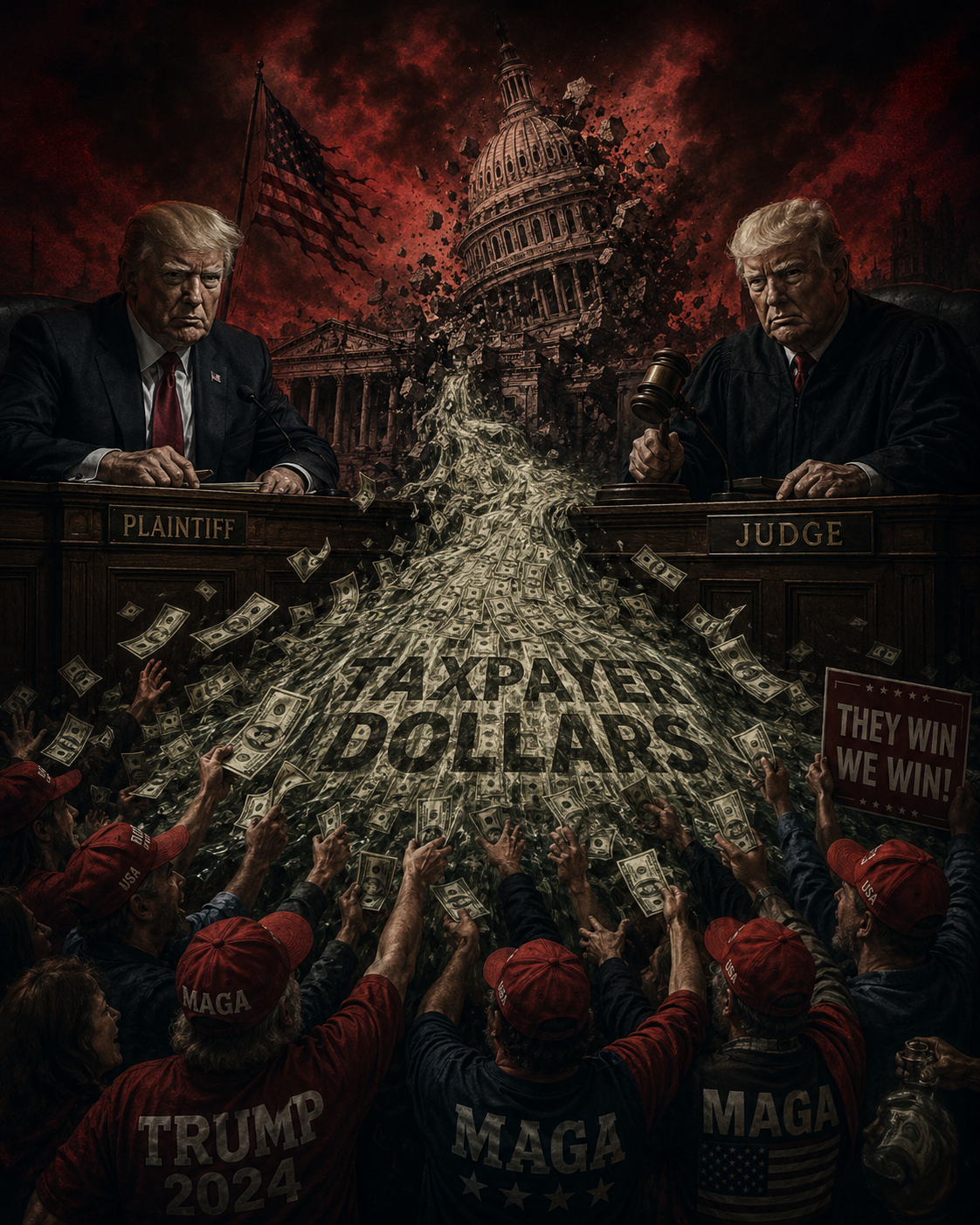
The structural problem here is glaring. As one legal analyst, Steve Ballou, put it: “Donald Trump was functionally on both sides of the case.” As president, Trump controlled the Justice Department, which was the defendant in the suit. He was simultaneously the plaintiff. The settlement he reached was with himself. The result of that self-dealing was the creation of a nearly two-billion-dollar fund — paid for by ordinary American taxpayers — that his administration now controls the distribution of.
Who Controls the Money — and Who Gets It
The Anti-Weaponization Fund is to be administered by a five-member commission. Four of the five commissioners will be appointed by the attorney general — an official appointed by and serving at the pleasure of President Trump. The fifth commissioner is to be appointed in consultation with congressional leadership, though acting Attorney General Todd Blanche acknowledged during Senate testimony on May 19 that he was unsure whether Trump himself would suggest names for that position as well.
The official stated purpose of the fund is to compensate individuals who claim they were victims of government “weaponization” — a term the Trump administration uses broadly to describe any prosecution, investigation, or legal action taken against Trump allies during the Biden administration. Administration officials have argued that the fund is nonpartisan, with Vice President J.D. Vance goes so far as to say, in a White House briefing, that “Republicans can apply for it. Democrats can apply for it. If Hunter Biden wants to apply for this particular fund, he is welcome to.”
In practice, however, the pool of potential applicants maps almost precisely onto Trump’s political base. The Trump Justice Department has identified several broad categories of people it believes suffered under what it characterizes as Biden-era overreach: the thousands of defendants charged in connection with the January 6 attack on the Capitol, all of whom Trump pardoned as one of his first acts upon returning to office; pro-life activists who faced prosecution under the Freedom of Access to Clinic Entrances Act during the Biden years; and individuals the DOJ describes in its own 2026 Task Force report as having faced “anti-Christian bias.”
The January 6 angle has drawn the most intense scrutiny. Trump pardoned nearly 1,600 individuals who were charged or convicted in connection with the Capitol riot — including people convicted of violently assaulting police officers. Under the terms of the Anti-Weaponization Fund, those pardoned rioters now appear to have a mechanism to seek taxpayer-funded compensation for their prosecution.
One of the most striking examples to emerge publicly involves Jake Lang, a January 6 defendant who was accused of using a bat to attack police officers defending the Capitol. Lang, whose trial was pending when Trump ordered the case dismissed and released him, confirmed publicly that he intends to apply for compensation through the fund and expects other January 6 defendants to do the same. Lang estimated that misdemeanor cases might receive “several hundred thousand dollars” each, while cases like his own — involving more serious felony charges — “may be looking at upwards of a million dollars.”
“If you sacrifice for your country… you will be rewarded for your bravery.” — Jake Lang, pardoned January 6 defendant
Lang framed his expectation in terms that will strike many Americans as deeply troubling. “If you sacrifice for your country, if you do the right thing in the face of evil, you will be rewarded for your bravery, for your patriotism, for the love of your country,” Lang said. “That’s the message President Trump is sending.” Critics noted that what Lang described as sacrifice and patriotism was, in the eyes of twelve juries and hundreds of judges, a violent insurrection against the constitutional transfer of presidential power.
Beyond the January 6 defendants, the fund could also benefit high-profile former Trump administration officials and campaign figures who were subjects of Justice Department investigations during the Biden years. Former Trump campaign official Michael Caputo, for example, has already indicated he intends to pursue compensation, arguing that he suffered during what he calls the “dark era of political weaponization” when federal investigators examined Russian interference in the 2016 election.
The Legal Challenges Mount
The fund has already attracted multiple lawsuits from critics who argue it is unconstitutional, illegal, or both. Two major complaints were filed within days of the fund’s announcement.
The first was filed in federal court in California by the city of New Haven, Connecticut, which has been targeted by the Trump administration for its immigration sanctuary policies. New Haven’s complaint includes the case of a local resident named Caravello, who was arrested in 2025 during a protest against an immigration raid and subsequently acquitted in April 2026 on a felony assault charge that he described as baseless. The lawsuit argues that the secretive structure of the Anti-Weaponization Fund violates existing federal law governing how the government’s Judgment Fund — the mechanism through which legal settlements are paid — must operate.
The second complaint was filed in federal court in Washington by Citizens for Responsibility and Ethics in Washington, known as CREW, one of the most prominent government watchdog organizations in the country. CREW’s suit argues that the fund’s secrecy provisions deliberately allow the administration to evade public disclosure requirements that would normally apply to government disbursements. “The Slush Fund Order’s secrecy provisions enable Defendants to circumvent the Judgment Fund statute’s public disclosure requirements,” the complaint states. CREW further argued that the arrangement enables the administration to award taxpayer money to pardoned insurrectionists — including at least one who was later convicted and sentenced to life in prison for child sex abuse crimes — without public accountability.
Legal experts have described the fund as lacking precedent in American law. A 2014 law review article in the University of Pennsylvania Law Review addressed the concept of “presidential settlements” and raised concerns about the constitutional implications of a president negotiating on both sides of a legal dispute. But experts consulted by multiple major news organizations in the days following the fund’s announcement said they were aware of no historical parallel for what Trump had done — suing his own government and then settling that lawsuit in a way that created a massive discretionary fund under his own control.
“In the most brazen act of presidential corruption this century, President Donald J. Trump has created a $1.776 billion taxpayer-funded slush fund.” — CREW lawsuit filing
The CREW lawsuit’s language was notably blunt for a legal filing: “In the most brazen act of presidential corruption this century, President Donald J. Trump has created a $1.776 billion taxpayer-funded slush fund to finance the insurrectionists and paramilitary groups that commit violence in his name.”
Republican Unease — And Its Limits
Perhaps the most telling indicator of how unusual this situation is comes from the reactions of Republicans themselves. The fund has generated a level of public Republican discomfort that is rare during Trump’s tenure — a period in which the Republican Party has generally aligned itself closely with the president’s agenda regardless of controversy.
Senator Arrington of Texas, the House Budget Committee chair, was notably cautious. While defending the broad concept of compensating victims of government overreach, he explicitly warned that the fund must not become “a quote, slush fund, where you’re doling out monies to political allies that don’t have legitimate claims.” He suggested that guardrails should be established — either through the upcoming budget reconciliation package or through a formal agreement — to ensure accountability.
Multiple other Republican senators told reporters they wanted greater clarity about how the fund would operate and who would ultimately benefit from it. The concern, unstated but unmistakable, was that the optics of taxpayer money flowing to January 6 rioters — especially those convicted of violent crimes before their pardons — would be politically toxic.
Democrats, for their part, have made no secret of their intention to force Republicans to take a public stand on the fund. Senate Minority Member Chris Coons argued that the president should not be able to direct his attorney general to distribute more than a billion dollars in taxpayer money “without any review by a judge or any review by Congress.” Senator Adam Schiff of California called it “grotesque” and “the worst form of self-dealing and self-enrichment I think we’ve ever seen.” Representative Joe Neguse of Colorado called it “one of the most brazen examples of corruption we’ve seen from this administration.”
Democrats were planning to bring the matter to a vote — potentially as early as the week of May 20, during marathon voting sessions on the Republican reconciliation bill — in an effort to put Republican senators on the record about whether they support or oppose the fund.
The Broader Pattern of Presidential Self-Dealing
The Anti-Weaponization Fund does not exist in isolation. It is the latest and perhaps most financially significant example in a pattern of conduct that watchdog organizations have been documenting throughout Trump’s second term: the use of presidential power to benefit Trump himself, his family, his business interests, and his political allies.
Critics have pointed to a range of earlier actions: the pardoning of January 6 defendants, many of whom were active political supporters; the use of executive orders to direct federal contracting in ways that benefit companies with ties to Trump associates; and the targeting of political opponents through regulatory and law enforcement mechanisms while shielding allies from similar scrutiny.
The Anti-Weaponization Fund takes this pattern to a new level. Rather than using presidential power to create advantageous conditions for allies, or to shield them from legal jeopardy, the fund creates a direct monetary transfer: taxpayer dollars flowing through a government-controlled commission to individuals chosen, at least in part, on the basis of their political relationship with the president.
There is also the matter of the gun rights angle. Legal analyst Ballou noted that Trump’s mass pardons had already restored the gun rights of many January 6 defendants who had been convicted of felonies. “They can get money, they can get guns,” Ballou observed. “And right now they have the endorsement of the president showing that they will be financially rewarded for their violence.”
The Question of Congressional Oversight
One of the most significant constitutional concerns raised by the Anti-Weaponization Fund involves the separation of powers and Congress’s traditional role as the holder of the federal purse. Under Article I of the Constitution, Congress — not the executive branch — controls federal spending. The creation of a nearly $1.8 billion fund through a presidential lawsuit settlement, with distribution controlled by commission members appointed by the attorney general, raises fundamental questions about whether the executive branch has bypassed Congress’s appropriations authority.
Senator Coons made this point explicitly: “We have the power of the purse. We just need to exercise it.” But exercising that power in a Congress where Republicans hold the majority — and where challenging Trump carries significant political risk — is far easier said than done.
The fund’s defenders in the administration have argued that it is analogous to historical settlements reached under previous administrations. Acting Attorney General Blanche cited settlements from the Obama era as precedent. Critics, including constitutional law scholars, have responded that there is a fundamental difference between a government settling a lawsuit brought by an outside party and a president settling a lawsuit that he himself brought — against his own government — and then controlling the distribution of the resulting funds.
The DOJ’s own press release on the matter acknowledged that the plaintiffs in the IRS case — Trump, his sons, and the Trump Organization — would receive “a formal apology but no monetary payment or damages of any kind.” The $1.776 billion does not go to Trump himself. Instead, it goes into a fund that Trump’s attorney general controls, distributed to individuals that the Trump administration determines were harmed by a “weaponized” government. The distinction between Trump benefiting personally and Trump’s political movement benefiting from a fund he engineered is, critics argue, a distinction without a meaningful difference.
What Happens Next
The fate of the Anti-Weaponization Fund is now playing out on multiple fronts simultaneously.
In the courts, the lawsuits filed by New Haven and CREW are in their early stages. Legal observers expect more suits to follow. The central legal questions — whether the fund violates federal appropriations law, whether its secrecy provisions are constitutional, and whether a president can legally sue his own government and then settle that suit to create a discretionary fund — are questions that will ultimately need to be resolved by federal judges, and potentially by the Supreme Court.
In Congress, the political dynamics are fluid. Democrats lack the votes to unilaterally block the fund, but they can force votes that put Republican members on record. If public opposition to the fund intensifies — particularly if it becomes clear that violent January 6 defendants are receiving large taxpayer payouts — the political calculus for Republicans could shift. As of the time of publication, it remained unclear whether any Republican senators would actually vote to block the fund or simply express concern while ultimately allowing it to proceed.
In the executive branch, the commission that will administer the fund has not yet been fully constituted. The appointment process for commissioners remains underway. Until the commission is fully seated and has established its rules and procedures, no payouts have been made. But Jake Lang and others have already announced their intention to apply, and given the administration’s own framing of the fund, it is difficult to see how claims from pardoned January 6 defendants could be denied without the administration contradicting its own stated rationale for the fund’s existence.
Meanwhile, police officers who defended the Capitol on January 6 have filed their own lawsuit against the fund, a move laden with bitter irony. The officers who were beaten, pepper-sprayed, and attacked with flagpoles and fire extinguishers during the riot now find themselves watching as the people who attacked them may receive million-dollar taxpayer payouts, courtesy of the man who pardoned them.
Conclusion: A Test of Democratic Norms
The Anti-Weaponization Fund is, at its core, a test of whether the guardrails of American democracy are strong enough to withstand the kind of executive overreach its critics are describing. It is also a test of whether the Republican Party — which controls Congress — is willing to exercise any meaningful check on a president from their own party when his actions raise constitutional questions that cut to the heart of the separation of powers.
The fund’s defenders argue that it represents a legitimate response to genuine government overreach during the Biden years — that pro-life activists, political figures caught up in the Russia investigation, and others genuinely suffered from a politicized Justice Department and deserve compensation. Even if one accepts that premise entirely, however, the mechanism chosen to provide that compensation — a self-dealing settlement in which the president sued his own government — raises structural concerns that go beyond the policy merits of any individual payout.
The United States has never before had a president who sued his own government for $10 billion and then settled that suit in a way that created a nearly $2 billion discretionary fund under his own control. That this has happened without triggering an immediate constitutional crisis is itself a measure of how significantly the norms of American governance have shifted.
Whether the courts, Congress, or the public ultimately force a reckoning with the Anti-Weaponization Fund remains to be seen. What is already clear is that the fund represents something new in American political history: not merely a president bending the rules to help his allies, but a president rewriting the rules entirely — and billing the American taxpayer for it.
Bored? Play Tic Tac Toe — completely FREE! No sign-up, no downloads, no catches. Just pure, classic fun right in your browser. Challenge a friend or go solo anytime, anywhere. Visit now and play instantly. 100% free, always. What are you waiting for?
메타데이터
- post_id
- 94d313e18f7c
- slug
- the-1-8-billion-question-94d313e18f7c
- url
- https://medium.com/@garythatcher608/the-1-8-billion-question-94d313e18f7c
- canonical_url
- https://medium.com/@garythatcher608/the-1-8-billion-question-94d313e18f7c
- author_url
- https://medium.com/@garythatcher608
- status
- ok
- fetched_at
- 2026-06-09 15:37:30