Fano’s Vitruvian Man
Italian professor’s perseverance pays off
Fano’s Vitruvian Man
Italian professor’s perseverance pays off
It’s not easy to picture professor Paolo Clini endowed artistically with an extra set of arms and legs and bereft of attire standing spread-eagle inside a perfect circle and a perfect square.
Even so, the 63-year-old scholar of ancient Roman architecture is the consummate Vitruvian Man, and cannot but evoke Leonardo da Vinci’s sepia drawing revered as one of the most iconic images in human history.
Clini’s nascent renown derives from his three decades of effort in the centuries-long quest to find the remains of a building designed and constructed by the man considered the “Father of Architecture” in Western Civilization, a search that bore fruit early this year.
Two thousand years old, its remnants buried for most of that time, its whereabouts and even existence speculated upon during the half-millennium since Renaissance luminaries lauded its architect as one of the Classical World’s cultural titans, the Basilica of Vitruvius finally has been found.
Though the mystery lasted ages, Clini, an unassuming and jovial teacher of architectural history at Marche Polytechnic University in Ancona, has known for quite a while where it was: smack in the centro storico of Fano, a charming Roman-era city on Italy’s Adriatic coast that is his and supposedly was Vitruvius’ hometown.
The epochal find was announced Jan. 19th at a press conference in Fano’s Mediateca Montanari. Mayor Luca Serfilippi called it “the discovery of the century” and Marche Regional Governor Francesco Acquaroli compared it to the unearthing of Tutankhamon’s tomb in 1922. Italian Minister of Culture Alessandro Giuli, linked from Rome by video, said “architectural history is now divided into before the discovery of the Basilica of Vitruvius and after the discovery of the Basilica of Vitruvius.”
Why the tendency toward hyperbole? Because Vitruvius has for centuries been considered the patriarch of the profession of architecture in Western culture. The ruins uncovered in Fano are those of the only building known to have been designed by him and constructed under his day-to-day supervision.
And what a building it was. Defined principally by 18 columns 15 meters tall (the 16 of the Pantheon in Rome are just under 12 meters) supporting a second floor and a massive roof, it would have stood taller than a modern five-story structure.
The name Marcus Vitruvius Pollio might not ring a bell for most people. Non-architects who recall having heard it might think of Leonardo’s beautiful and enigmatic illustration of a long-haired, naked and superbly fit human male who, outfitted by the artist with eight limbs, exhibits his ideal dimensions within both a square and a circle.
“The proportions of the human figure after Vitruvius,” the Tuscan genius called the study he made circa 1490 on a folio only slightly larger (34.4 x 24.5 cm) than a page from a loose-leaf notebook. He said it represents the natural harmonies between man and the cosmos.
It was Vitruvius’ abiding admiration of nature’s inherent structural geometry that made Clini choose the builder-author as his principal and career-long subject of study.
“How does Vitruvius invent the architectural order? He does it by looking at a tree. A tree has roots, then the column that rises up to the canopy, the capital. The tree is the archetype of architecture,” he says.
His 1997 doctoral thesis on Fano’s Vitruvian basilica kicked off a renewed effort to locate the structure’s remains. “Being from Fano, when deciding the topic of my doctorate, I said to myself, let’s see if I can do something beautiful regarding this city.”
With his late-middle-age paunch and decidedly unathletic mien, professor Clini resembles not a bit da Vinci’s lean muscular divo. But in the weeks since the discovery, he has become its face and premier authority, sought out by media and professionals in various fields from near and far with overtures and proposals for books, films and lecture tours.
That Clini knew the remains of the fabulous basilica were hidden somewhere beneath the paving stones in downtown Fano was not the product of preternatural intuition or even his long perseverance in the quest. After all, Vitruvius himself had written that it was there. It was more a matter of keeping the faith.
“Basilica” in modern usage generally refers to an ecclesiastical structure, but the ancient meaning is that of a civic building or public hall. Roman basilicas served as sites for the administration of municipal business and included spaces for hearings and trials, meetings among merchants, citizens’ assemblies and social interaction common to all Italian piazzas.
Clini, whose at-rest visage has a lingering hint of a smile, says a consensus had emerged in academia that the basilica “did not exist,” that its description as real by Vitruvius must have been wishful thinking or self-promotion. Of himself and the relatively few others who persistently contended it must be there, he says, “They did not believe us.”
It took 15 hundred years for Vitruvius to come into his own. Though he eventually would be hailed as a giant, little is known biographically about the man. He is believed to have been born around 80 B.C. in Fanum Fortunae, as Fano was then known, but spent most of his adult life in Rome. He was an engineer and an architect and his main job was that of building and maintaining war engines such as ballistae — the huge catapults that hurled heavy projectiles at fortified walls — and siege towers.
In his later years he wrote De Architectura, a ten-volume treatise that went mostly ignored for more than a millennium before its “rediscovery” by Renaissance maestros. The only extant comprehensive text on construction from antiquity, it so impressed architects Andrea Palladio and Leon Battista Alberti, as well as the summa cum laude from Vinci, that it came to be considered the foundational work of the science of architecture in Europe and the Americas.
De Architectura covers dozens of subjects, from philosophy to aesthetics to building materials and “directions of the streets, with remarks on the winds.” But its bedrock and still-hallowed teaching, referred to in university architecture departments around the world as the Vitruvian Triad, is articulation of the three essential qualities of an excellent building: firmitas (strength), utilitas (utility) and venustas (beauty).
Despite its eventual transcendence, the book is not decidedly original. Vitruvius was a cultural conservative, and much of his writing is a compendium and canonization of Greek models and usage. Hellenistic ideas of symmetry and proportion, as codified and commented upon by Vitruvius, were employed extensively by Alberti and Palladio, with the latter’s oeuvre eventually exerting powerful influence on building design in the fledgling United States of America.
The White House, for example, is eminently Palladian. (At least it always has been. Trump’s plan for a gargantuan ballroom flies in the face of Vitruvian principles.) Thomas Jefferson was a devotee of Vitruvius and applied his teachings in both of his architectural masterpieces, the Monticello manor house and the Rotunda at the heart of the University of Virginia.
The first step of the discovery came late last fall when a team of mostly young archaeologists from the Rimini-based adArte research and restoration firm were overseeing excavation underway as part of the upgrading of Piazza Andrea Costa, which includes Fano’s main fish market. Italian law requires such supervision when construction takes place in an area where culturally or historically significant material might be underground.
The observers noticed something being uncovered that was substantial and curved. The backhoe was sidelined and further, more careful, digging revealed the stump of a massive column, five Roman feet (1.5 meters) in diameter. Adjoining the base was a portion of a pilaster like those Vitruvius noted in Book 5 of De Architectura when describing the basilica he had built in Fanum Fortunae.
“It was a lucky strike,” said Clini.
The archaeologists, using directional indication from the pilaster and a floor plan of the basilica Clini had spent years composing and refining, in the following weeks uncovered the remains of three more columns and part of a wall. Each new find reinforced the feeling that at last the elusive edifice had been found, but local and regional authorities wanted to be absolutely certain before making such an earthshaking claim.
Antonio D’Ambrosio, an Urbino-raised archaeologist on the adArte team and an expert in geolocation, was tasked with effecting la prova del nove, the Italian expression for an acid test providing irrefutable evidence. The conclusive element would be the basilica’s northeast-corner column.
With Clini’s diagram, GPS and a drone, D’Ambrosio plotted a point on the pavement in Piazza degli Avveduti, contiguous with Piazza Costa, where that pillar’s remains should be found. Authorities said they did not want to completely impede traffic around D’Ambrosio’s spot, and ordered that the hole to be dug must be a small one.
On the afternoon of Jan. 16, D’Ambrosio and a phalanx of administrative and cultural notables watched as a crew of road workers and archaeologists broke through the asphalt in a space only a meter and half square. Dusk and night soon fell, flood lights were brought out and the hole got deeper.
“And the damn column doesn’t appear, and doesn’t appear,” says D’Ambrosio over an aperitivo of focaccia, pane nociato and pecorino cheese along with his wife, Annalisa D’Onofrio, another archaeologist on the adArte team. He’s laughing now, but even these several weeks later his words carry more than a trace of the juncture’s extreme tension. “I was sweating bullets,” he says.
“Then, in a corner of the pit, I see some white powder that looks like lime, which would have been used in this type of Roman construction, and we opened the hole more on that side. And there it was, what remained of the column.”
“It is a moment I’ll never forget as long as I live.”
In the years following his doctorate, Clini’s main sources of information to further his search were historical and archival. But the task gained momentum from technological advances in the new millennium and the formation of a project dubbed ArcheoFano involving Marche’s two leading universities and cultural and government entities. Clini, who in 2010 had co-founded Fano’s Vitruvian Studies Centre, was named the group’s Scientific Coordinator.
“We knew where the Roman forum had been situated, and Vitruvius said his building was adjacent to the forum. A forum is rectangular, and we spent years exploring first the side we thought most likely, then the next most likely, then the third.”
Those efforts, which relied in great part on ground-penetrating radar and laser-based technologies now crucial to archaeological research worldwide, produced no big breakthrough. But the process of elimination prompted him to reconsider the Piazza Costa side, which earlier had appeared to be “the least promising.”
In 2013, he modified the placement and orientation of his basilica floor plan superimposed on a contemporary map of Fano’s historic centre. As things turned out a dozen years later, he had succeeded in placing it almost exactly (less than a half-meter “off”) where the structure was definitively found.
The professor acknowledges that “it made sense that many doubted the basilica’s existence. Because the structure Vitruvius describes was so tall, it seemed it could not have been built with the materials and construction techniques of that period.” The audacious dimensions (with its roof, it reached 18 meters in height) have led him to an irreverent supposition, one that falls just short of a conclusion.
“That is what makes me think it collapsed,” he says.
According to Clini, such an outcome would have been neither surprising nor, in the longer run, thoroughly negative.
“Architecture for many centuries evolved only by way of trial and error. It evolved when the building fell down. This edifice was visionary, at the limit or maybe beyond the limit of what was possible at the time.”
The Goths overran and destroyed much of classical-era Fano in the sixth century. They may have knocked the basilica down if it was still standing. But Clini, whose first of several university degrees was in civil engineering, thinks it probably ceded to the laws of physics and inadequate materials long before the arrival of the bellicose northerners.
“If indeed it did fall down, it would have been an enormous moment in the history of architecture,” he says.
Clini shares Vitruvius’ conviction that construction is not just a matter of successfully stacking bricks. He believes, as did the old master, that the practice of architecture must comprise an array of other kinds of knowledge and values.
In Book 1 of De Architectura (Harvard University Press 1914 edition) Vitruvius writes: “The architect should be equipped with knowledge of many branches of study and varied kinds of learning… Let him be educated, skilful with the pencil, instructed in geometry, know much history, have followed the philosophers with attention, understand music, have some knowledge of medicine, know the opinions of the jurists, and be acquainted with astronomy and the theory of the heavens.”
The polymath Clini thinks his own broadened perspective, one not relying on expertise in a single field, helped him remain for so many years in the vanguard of the search for the basilica.
He has a high-school and university formation in Classics and can read Latin and Ancient Greek; a civil engineering degree from Marche Polytechnic; a PhD in archaeological analysis from the University of Florence’s school of architecture; a Masters in the history of architecture from Roma Tre University. He did a post-doc in design in the engineering school at his alma mater in Ancona, where he has taught the history of Roman architecture for 20 years.
That CV, he contends, enables him to see with enhanced clarity the big picture of Vitruvius’ relevance.
“This current event involving Vitruvius is not an archaeological event, it’s not an architectural event. It is an event of much greater breadth,” he says. “An event about which I, having assembled these different types of knowledge, have a particular ability to tell the story. I’m in a position to tie things together, to tie Vitruvius to everything — to Palladio, to the Greek world, to America, to Leonardo — and to construct, with a 360-degree perspective, a network around Vitruvius.”
The discovery in Fano affords Clini the opportunity to enjoy, were he so inclined, a big I-told-you-so moment. But that is not high on his list.
He recalls being rebuffed by local authorities years ago when he suggested small explorative digs in Piazza Costa based on his floor plan. Asked directly if the basilica would have been found sooner had his recommendations been accepted, he answers: “Certainly.”
“But I understand why,” he says. “It was a combination of things. The academic archaeologists did not believe this basilica existed. And the money was not there to support excavations.”
He emphasizes another reason not to take personally, or too much to heart, any previous obstacles.
“It (the search) was always the work of a team. I was the front-man, but the different stages always involved collaborative effort.”
“What I have now is a feeling of validation. And that, yes, is a satisfaction.”
Having unearthed a portion of this spectacular treasure, Fano and Italy must now decide What Is to Be Done with it.
“The necessary elements are courage, a visionary spirit, and leadership,” says Clini. “The governance of this process must be entrusted to people with a high degree of preparedness.”
Despite his own high degree of preparedness, he would like to see a much more acclaimed individual take the helm.
He spent a day recently surveying the Piazza Costa dig with Salvatore Settis, the esteemed Italian archaeologist and art historian who was director of the Getty Center for the History of Art and the Humanities in Los Angeles from 1994–99.
“He told me: ‘What we are looking at is the world’s most important archaeological site.’ And we agreed that the first move should be to clear the area.”
That would entail demolition and relocation of the fish market and use of eminent domain regarding several commercial and residential properties bordering the plaza. The idea is to free up an area of some 15 hundred square meters (about a quarter of a football pitch), equivalent to the footprint of the basilica including its surrounding walkways.
“What must come out of all this is some form of reconstruction that is also a stunning work of contemporary art and architecture,” says Clini.
And though he considers Settis a fine candidate to lead such an enterprise, he also has in mind another, even more famous, Italian individual as the project’s possible czar. Acknowledging that it is a “provocative proposal,” he suggests il maestro Renzo Piano.
“Putting together the world’s greatest living architect with the greatest architect of antiquity would attract people not only to come to see the remains of the basilica but also to see how a modern genius interprets and brings to life this monumental discovery.”
Clini says reconstruction in situ of the entire basilica in bricks and mortar is not feasible because it would require destruction of the actual remains. But he says new techniques and ultra-light materials could be employed, and singles out Edoardo Tresoldi, an Italian sculptor who has been doing impressive large-scale work up and down the peninsula for more than a decade.
Tresoldi, 39, is best known for his prize-winning re-creation of a church in Siponto, a small town on the Adriatic coast in the southern region of Apulia. Composed of 4,500 square meters of zinc-coated wire mesh weighing seven metric tons, the breathtaking structure rises 14 meters above the scant ruins of successive religious structures dating back to a 6th-century Paleo-Christian basilica.
The sculptor, on his website, describes the work as “an evolution of the classic concept of restoration, an innovative interpretation of archaeology through the lens of contemporary art.”
Sounds like a perfect prescription for the future of Fano’s Piazza Andrea Costa.
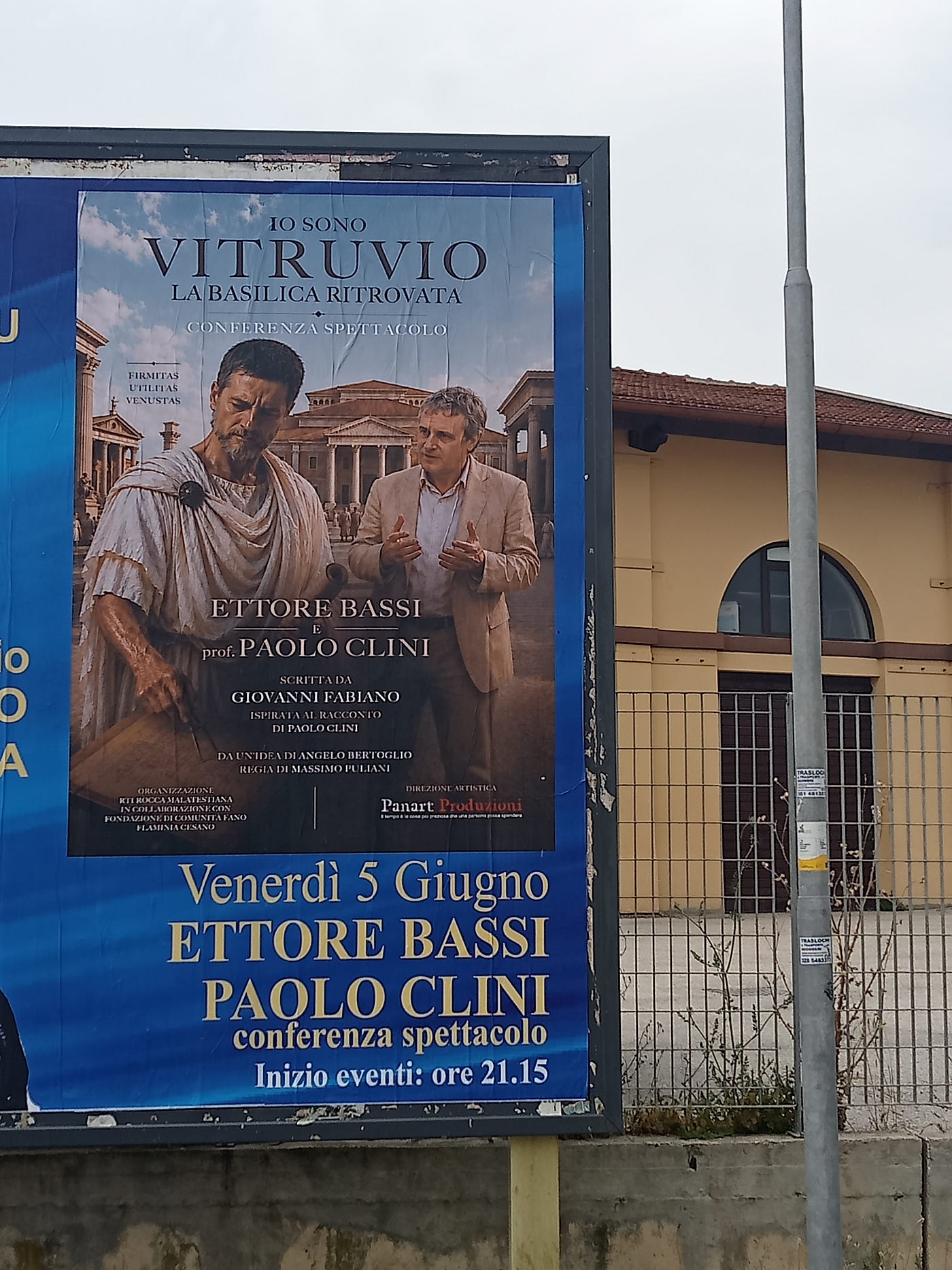
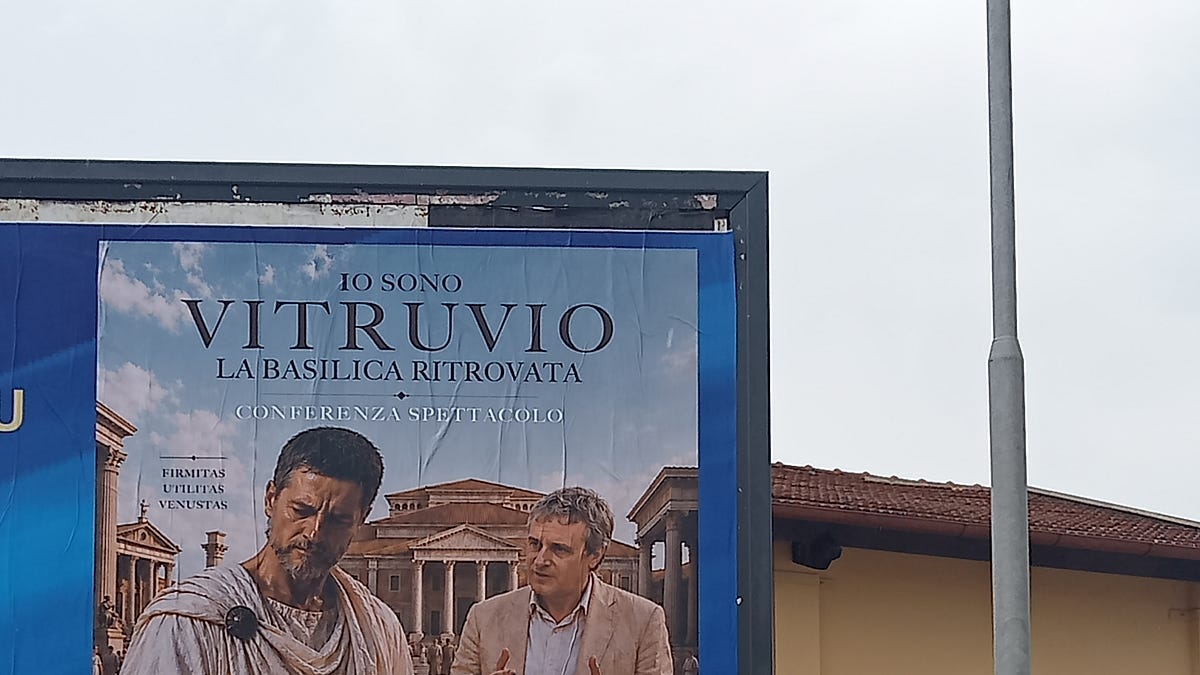
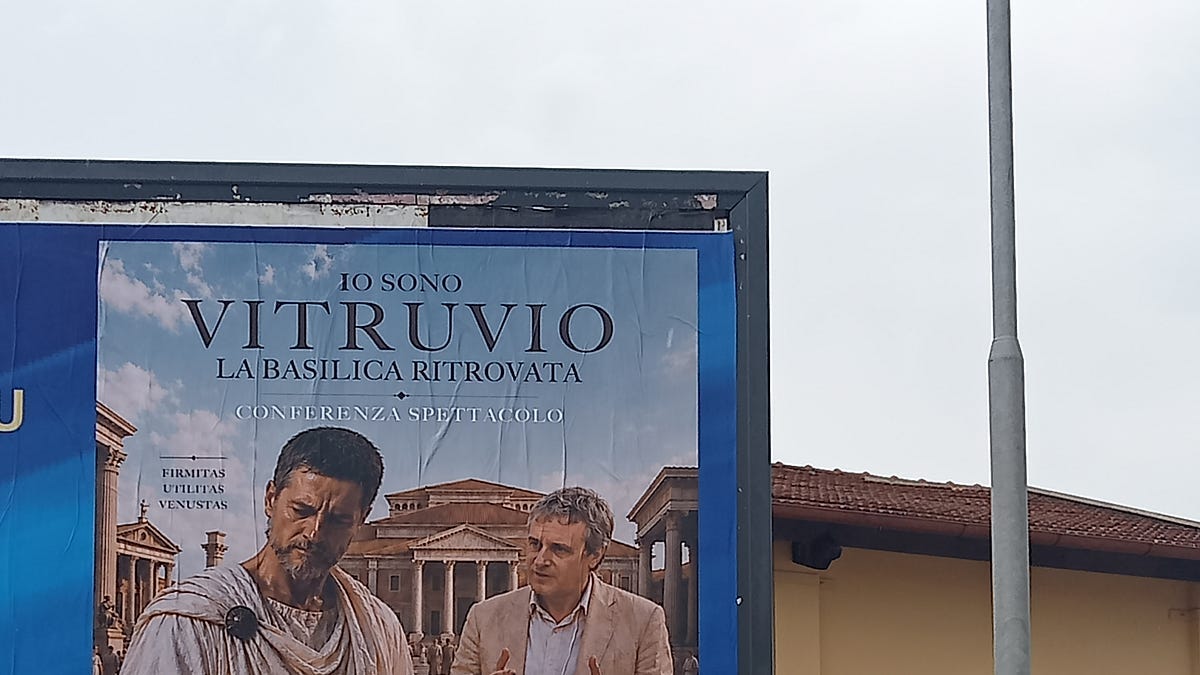
Poster at Fano’s main bus station announcing the debut of a theatrical production featuring professor Paolo Clini (right) in hypothetical dialogue with Vitruvius (played by actor Ettore Bassi).
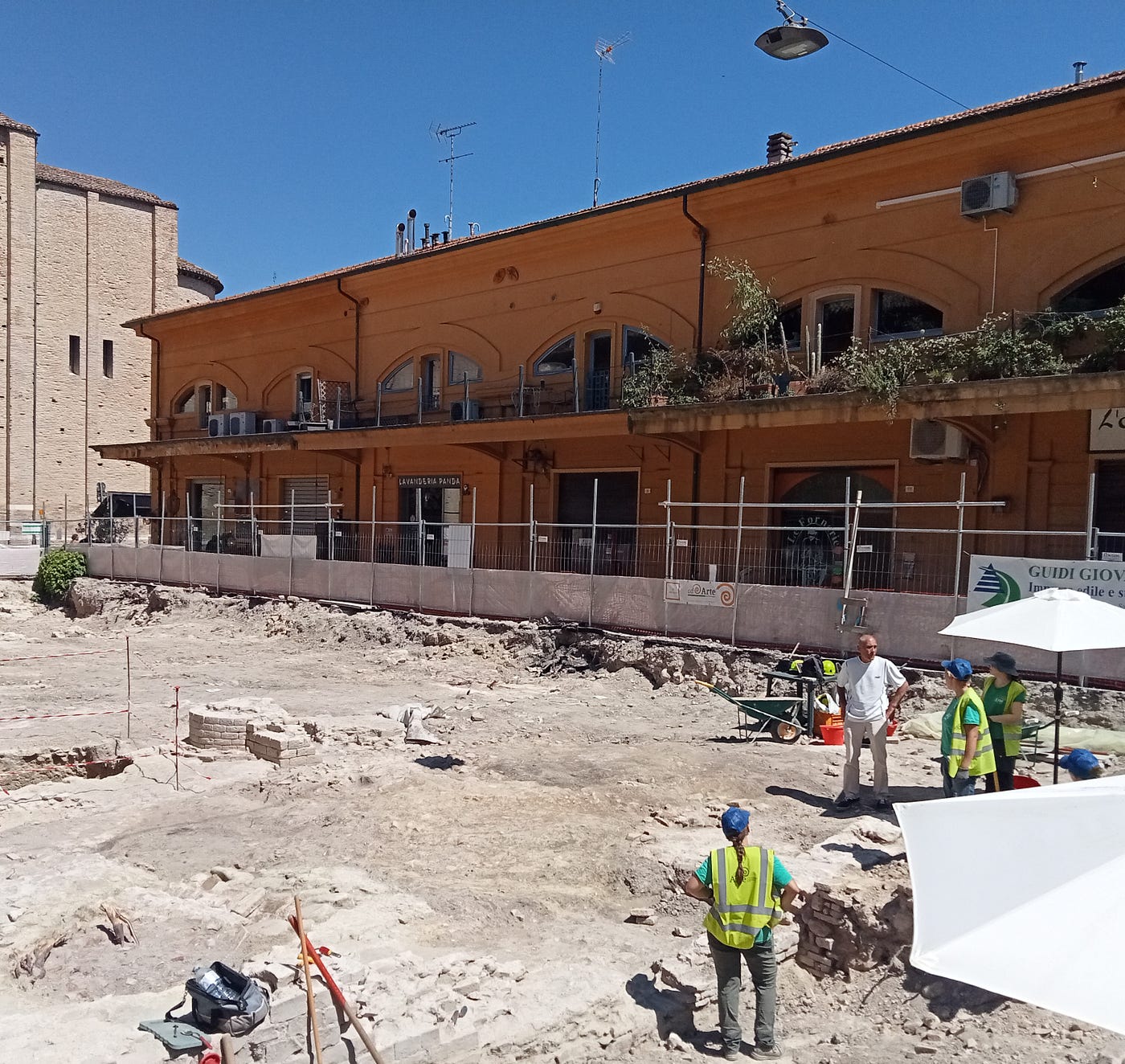
Archaeologists continue the work of uncovering the remains of the Basilica of Vitruvius in Fano’s centro storico. The stump of one of the iconic building’s massive columns and its pilaster can be seen on the left.
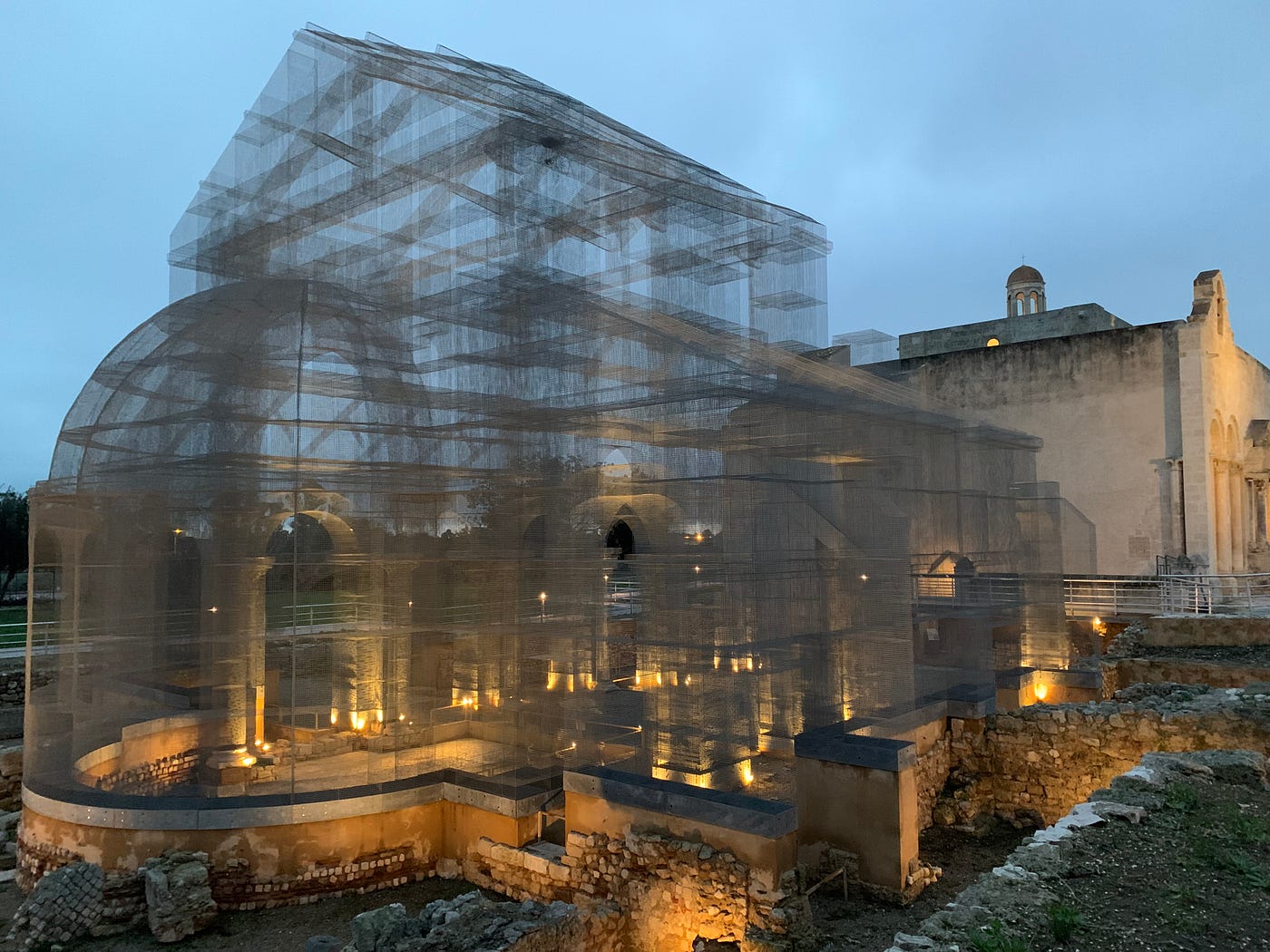
Eduardo Tresoldi’s reconstruction in wire mesh of the Basilica di Siponto in Apulia.
Originally published at https://douglasgrantmine.substack.com.
메타데이터
- post_id
- 94dfe689b5b7
- slug
- fanos-vitruvian-man-94dfe689b5b7
- url
- https://medium.com/@dgmine/fanos-vitruvian-man-94dfe689b5b7
- canonical_url
- https://medium.com/@dgmine/fanos-vitruvian-man-94dfe689b5b7
- author_url
- https://medium.com/@dgmine
- status
- ok
- fetched_at
- 2026-06-24 11:06:28