The History of Esperanto: Origins and Growth
From a teenager’s burned notebook to a language with its own poets, novels, and Wikipedia
#EO 3 #Esperanto
The History of Esperanto: Origins and Growth
From a teenager’s burned notebook to a language with its own poets, novels, and Wikipedia
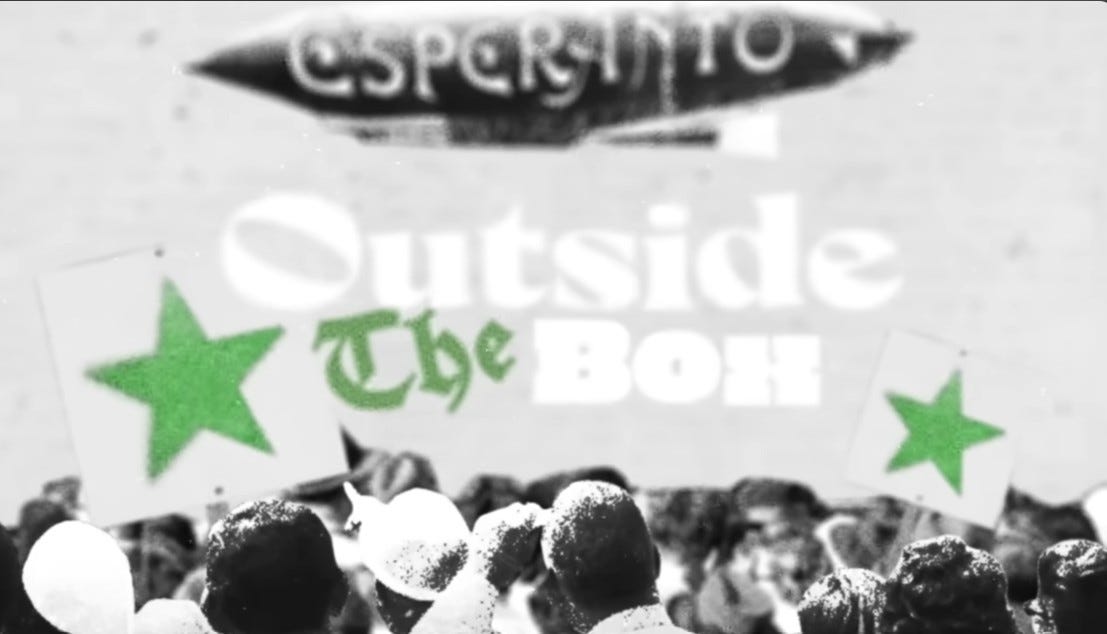
The vision for world peace ignited the wish for an international language that could bring mutual understanding with little effort of learning — a dream pursued by many. Only Esperanto survived strong for 139 years and almost became the world language in 1920. Pic taken from the YouTube video How Esperanto Almost Took Over the World.
On July 26, 1887, a broke young eye doctor in Warsaw published a slim booklet under the name “Doktoro Esperanto"—"the one who hopes." (He was broke because he treated people for free. I mention it because it says something about his character.)
Zamenhof later described this inner conflict in a letter to Nikolai Borovko:
“I was taught that all people were brothers, and this was always a great torment to my infant mind, because around me I saw only hatred, division, and distrust.”
It is one of the clearest windows into the psychological origin of Esperanto: a child who saw four peoples in one town, yet no bridge between them.
He called it Unua Libro, the First Book. It laid out sixteen grammar rules, a small starter dictionary, and a plan that sounded almost naive: a neutral second language, belonging to no country, that anyone could learn in months instead of years.
[embed]A short 3‑minute video on Esperanto’s history
That doctor was Ludwik Lejzer Zamenhof, and the language was Esperanto. Today, one hundred and thirty-nine years later to the day, it’s still here. Most of the languages built to compete with it are not.
A Childhood Spent Between Four Languages
Watching People Not Understand Each Other
Zamenhof grew up in Bialystok, a city that had been Polish, then Prussian, then Russian, and is Polish again today. Poles, Russians, Germans, and Yiddish-speaking Jews all lived on top of each other there, each group speaking its own language, each eyeing the others with suspicion. Zamenhof, watching this as a boy, came to believe the hostility wasn’t really about religion or blood. It was about not understanding what the person next to you was saying.
He was, by all accounts, cornered between four languages growing up and went on to learn more than ten in his lifetime.
He built his first version of a universal language as a teenager, celebrated it with friends, then went off to Moscow to study medicine. His father burnt the notebook while he was away, afraid the project would ruin his son’s future. Zamenhof rebuilt it from memory, tested it quietly for years, then rebuilt it again from scratch once he realized the vocabulary was still too heavy to learn fast.
That third version, reduced and condensed, built on reusable roots and fixed grammar to only 16 simple rules with zero exceptions, was the one his father‑in‑law finally paid to have printed.
The Movement Zamenhof Never Fully Controlled
Esperanto spread faster than Zamenhof could manage alone, which turned out to be exactly the point. The first World Esperanto Congress met in Boulogne-sur-Mer, France, in 1905, drawing speakers from twenty countries who had learned the language from books without ever hearing it spoken aloud and somehow understood each other anyway.
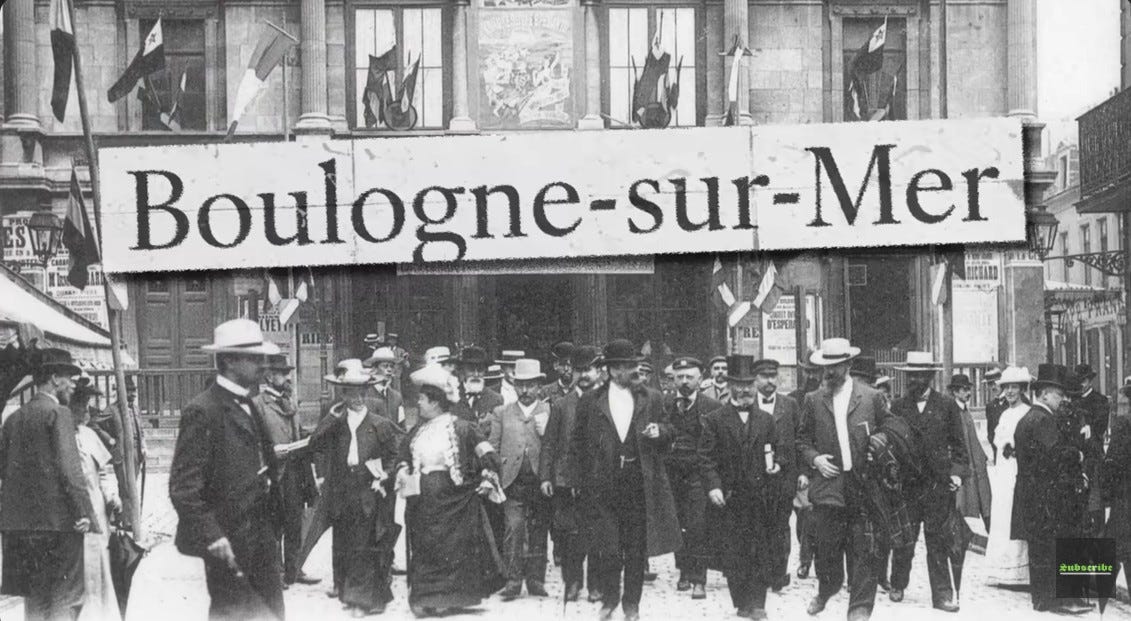
Black‑and‑white photograph of delegates at the first Esperanto Congress in Boulogne‑sur‑Mer, France, 1905. Men and women in formal attire walk past a building decorated with flags, marking the birth of Esperanto’s international movement. Photo from Wikipedia, licensed under CC BY‑SA 4.0.
At Boulogne‑sur‑Mer in 1905, Zamenhof expressed the ethical core of the movement in one sentence:
“We stand one beside the other,
not like strangers, but like brothers and sisters.”
The first World Congress was not just a linguistic milestone — it was the first time people from twenty countries experienced a neutral space without national barriers.
In 1908, a nineteen-year-old Swiss Esperantist named Hector Hodler founded the Universal Esperanto Association in Geneva, still the movement’s main international body today.
The language picked up strange, small footholds nobody plans for: an Esperantist bank in London, an association of Esperanto-speaking railway workers in Barcelona, and
Members of the British and French parliaments nominating Zamenhof for the Nobel Peace Prize.
The Reform Attempts That Never Won
Esperanto was challenged around a hundred times,
even by its own creator.
In 1894, seven years after publishing the language, **Zamenhof himself proposed a reform: drop the accented letters, simplify the plural, and cut the adjective-agreement rule.***
Under pressure from critics, he put it to a vote. The Esperanto community rejected it by a large majority. Zamenhof later called 1894 “a wasted year” and dropped the idea entirely.
- *In 1894 people wrote by hand, so the issue didn’t arise as a big problem back then, unlike today’s keyboards. I, the author of this article, think it would still be a good idea since it makes the writing a bit harder to get the accents on the 6 letters*. When I researched the subject, I found a trick that works on every typewriter, mobile, or laptop without accents. — I may get to this later in a separate article. Let me know if you want to know in the comments. Stay tuned, (Follow me!)
Zamenhof also experimented with a social‑momentum idea he called the “Promise System”: people signed a declaration stating they would learn Esperanto as soon as ten million others did the same.
Only a few thousand signed at first, but the concept shows how early Zamenhof was thinking about collective adoption, not just grammar.
IDO, a Serious Offshoot
The bigger challenge came in 1907. 13 years after Zamenhof's reform attempt, a committee had been assembled specifically to choose one international language once and for all, and most people assumed Esperanto would simply win.
Instead, an anonymous last-minute proposal, against the committee’s own rules, pushed for a reformed version instead.
French philosopher Louis Couturat ran with it and launched Ido, “offspring” in Esperanto. Ido dropped the accented letters, dropped the accusative case, and pulled the vocabulary closer to French, English, and Italian, an attempt to fix exactly the stumbling block people still raise about Esperanto today: **the accents on ĉ, ĝ, ĥ, ĵ, ŝ, and ŭ.
For a few years it worked; roughly a fifth of Esperanto’s leading promoters switched over. Then Couturat died suddenly in 1914, and momentum collapsed with him. Today, real counts put active Ido speakers at a few hundred to maybe a couple of thousand worldwide, against Esperanto’s low millions.
The accents, it turned out, were never the actual problem. A universal second language lives or dies on how many people already speak it, not on how clean its alphabet looks on paper, and Ido never solved that part.
Creating an Esperanto-land was discussed
Around the same time, a curious geopolitical footnote appeared: Neutral Moresnet, a tiny territory between Germany and Belgium, briefly became an Esperantist utopian proposal. People discussed whether it could become the first neutral state with Esperanto as its official language.
The idea never materialized, but it reveals how early Esperantists imagined a transnational community beyond national borders.
Two smaller reform languages followed:
Esperanto II in 1937, built by René de Saussure, brother of the linguist Ferdinand de Saussure, and Romániço in 1991, which kept Esperanto’s grammar engine but swapped in vocabulary drawn only from Romance languages. Neither built a living community. Esperanto, accents and all, is still the one still standing.
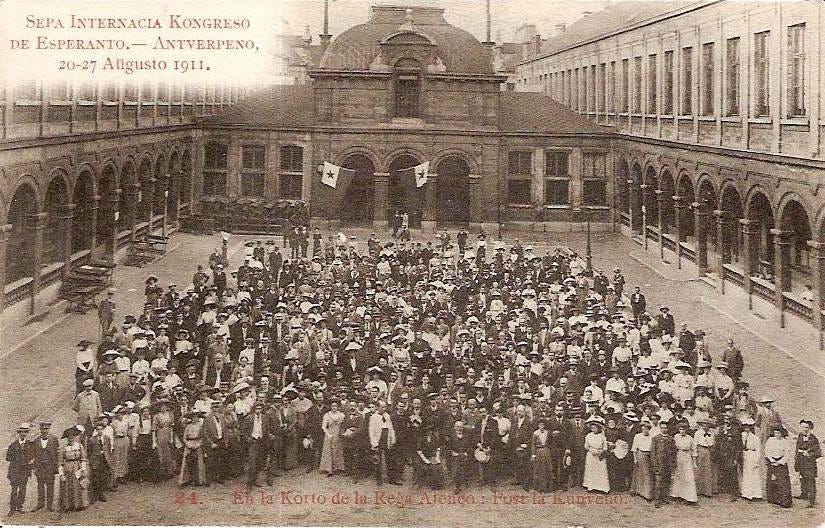
The Esperanto movement kept growing and growing — some estimate around two million speakers today. Shown here is a photo of the World Esperanto Congress held 20–29 August 1911 in Antwerpeno (Antwerp). Source: Wikipedia.
Esperanto, dedicated to world peace
… was haunted during the nationalist regimes and wars.
More in the next article, which sounds like a crime tale. Stay tuned!
Switzerland’s neutrality carried the movement through the First World War.
With most of Europe cut off from itself, the Universal Esperanto Association’s Geneva office became one of the few channels still open, helping trace and support Esperantists trapped or interned on opposing sides of the front.
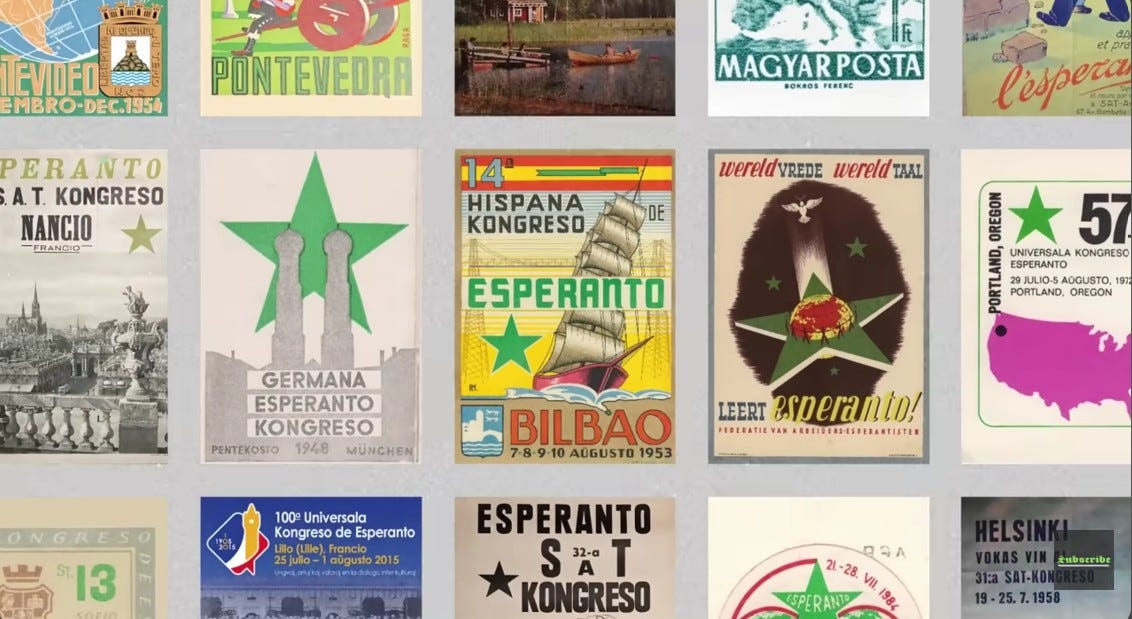
Collage of historical posters and stamps from Esperanto congresses worldwide, showing colorful designs from different countries and decades from Bilbao 1953 bis Lille 2015. Each piece features the green star symbol of Esperanto, reflecting its long international tradition. Source: Wikipedia.
A Language With Its Own Culture
Clubs, journals, and local meetups sprang up across Europe, the Americas, Asia, and beyond.
What grew out of it wasn’t just a communication tool;
Esperanto has its own genuine culture:
original poetry and novels written directly in Esperanto, translations of classics ranging from the Bible to Shakespeare, music, radio programmes, and eventually an entire Esperanto-language Wikipedia running past hundreds of thousands of articles.
Literature came first.
Zamenhof himself translated poetry and prose into Esperanto as he was developing it, partly just to stress-test whether the language could actually carry real writing.
Others followed fast: Antoni Grabowski is generally called the father of Esperanto poetry, and by the interwar years a real literary scene had formed around poets and novelists like Julio Baghy, Kálmán Kalocsay, and Jean Forge.
The best-known name is the Scottish poet William Auld, whose epic poem La infana raso (The Infant Race) got him nominated for the Nobel Prize in Literature in 1999, 2004, and 2006, the only person ever nominated for work written in Esperanto.
Altogether, more than 25,000 books have been published in Esperanto, over a hundred of them original novels, on top of translated classics running from the Bible to Shakespeare.
Esperanto attracted famous people:
The movement also attracted unexpected supporters:
Stalin, the Russian dictator, actually learned Esperanto in his youth and was briefly sympathetic to the idea of a neutral language before later persecuting its speakers.
J.R.R. Tolkien, the Oxford professor and creator of the world‑famous Hobbit and The Lord of the Rings, served in 1930 as an advisor to the British Esperanto Association.
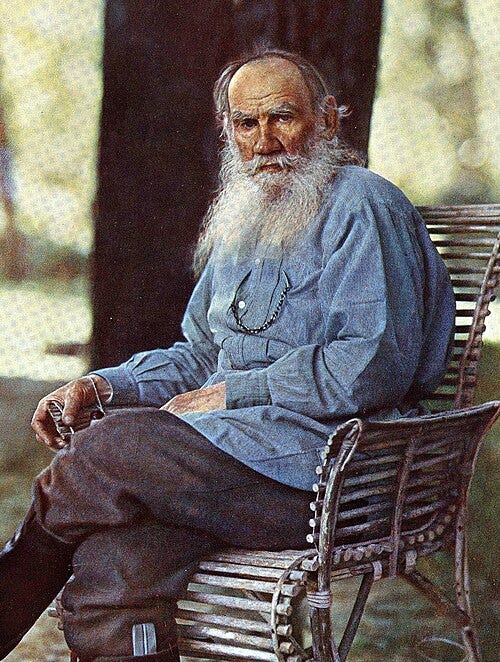
Leo_Tolstoy_1908_Portrait_Photo: public domain, via Wikipedia His active years were 1847–1910
Leo Tolstoy, the Russian writer and pacifist philosopher behind the world‑renowned War and Peace, praised Esperanto as a tool for peace.
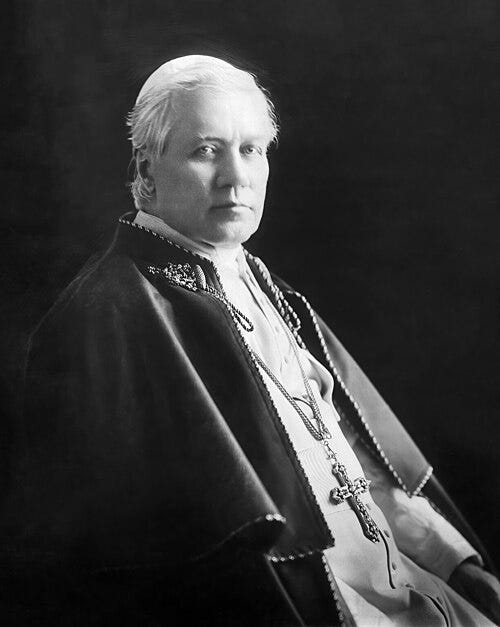
And even a Pope 1903–1914, Pius the X received Esperantists in a private audience, offering sympathy for a project meant to bridge nations. Photo: Ernest Walter Histed, via Wikipedia, public domain.
This public and open support shows how strongly
Esperanto appealed to many thinkers, writers, and spiritual leaders.
Esperanto on Radio
Esperanto programming on shortwave radio goes back to the 1930s; Radio Polonia in Warsaw alone has aired more than 25,000 Esperanto broadcasts over the decades.
China Radio International still broadcasts in
Esperanto daily.
In 2011, a volunteer team built Muzaiko, a
24-hour internet radio station in Esperanto, with
music, interviews, and news,
running around the clock to this day.
Vikipedio, an entire Esperanto-language Wikipedia.
In 2001, volunteers launched Vikipedio, an entire Esperanto-language Wikipedia.
It’s grown past hundreds of thousands of articles since, and it’s one of the clearest proof points that this is a working language, not a museum piece; people are still writing new things in it every day.
More about the World Congresses and how they reached Africa in the next article.
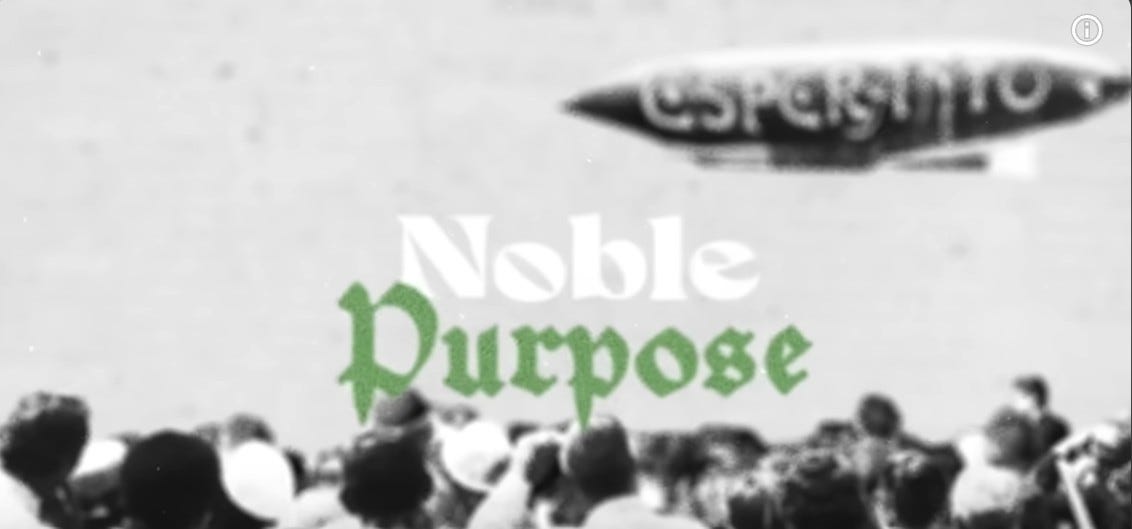
Esperanto always aimed to be the answer to misunderstanding, quarrel, and war — and it was exactly this noble purpose that finally stopped it, through suppression by nationalist regimes and competing interests. Pic taken from the YouTube video How Esperanto Almost Took Over the World.
Esperanto Is Carried by a Vision and Mission of World Peace…
…up to this day
For many speakers, Esperanto was never an abstract ideal sitting in a textbook. It became
a living second language, used
for friendship, love, work, and travel,
the same way any other language gets used once enough people actually speak it.
This history is to be continued in reality and in the following article. It reads like a crime story.
More about how Esperanto survived the wars despite persecution and the world congresses and how it reached Africa in the next article.
Stay tuned; if you do not want to miss it, follow me.
Sources drawn from Wikipedia, Smithsonian Magazine, Grokipedia’s History of Esperanto entry, and the Universal Esperanto Association.
메타데이터
- post_id
- 9581a805dcb7
- slug
- the-history-of-esperanto-origins-and-growth-9581a805dcb7
- url
- https://medium.com/language-lab/the-history-of-esperanto-origins-and-growth-9581a805dcb7
- canonical_url
- https://medium.com/language-lab/the-history-of-esperanto-origins-and-growth-9581a805dcb7
- author_url
- https://medium.com/@louisa-light
- status
- ok
- fetched_at
- 2026-07-31 07:58:30