Causal inference and the importance of cross-disciplinary communication
Recently I attended a workshop and conference focussed on the foundations of causal inference at the Isaac Newton Institute in Cambridge…
Causal inference and the importance of cross-disciplinary communication
Recently I attended a workshop and conference focussed on the foundations of causal inference at the Isaac Newton Institute in Cambridge. It was an exciting opportunity to broaden my knowledge of this set of statistical methods which have been gaining increasing popularity in healthcare, as well as to learn about recent developments in the field. It also prompted me to think about the different ways that cross-disciplinary communication can be used to improve our work in practice.
Causal inference is a term used in statistics and data science for the task of trying to gain causal knowledge — for example, that some treatment causes a particular health outcome. Traditionally, this would be done with an experiment: for example, in a randomised controlled trial (RCT), you could randomly assign patients to different treatments, and then use the difference in outcome rates between groups to estimate the causal effect of that treatment on the outcome. While historically RCTs have been regarded as the gold standard for gaining causal knowledge, there has been an exciting field of development in statistics aimed at gaining causal knowledge from observational, rather than experimental data. There are lots of practical challenges to running RCTs, so this is a compelling goal. The challenge, however, is that because treatments aren’t randomly assigned, we can’t just assume that differences in outcome are due to the causal effect of treatment. For example, if older patients are more likely to be prescribed a certain drug, then if we observe a higher rate of hospital readmission in the group receiving that drug, this could be due to the drug or the age of the patients typically receiving it. There are lots of methods being developed to try and tackle this challenge, which were the focus of this conference.
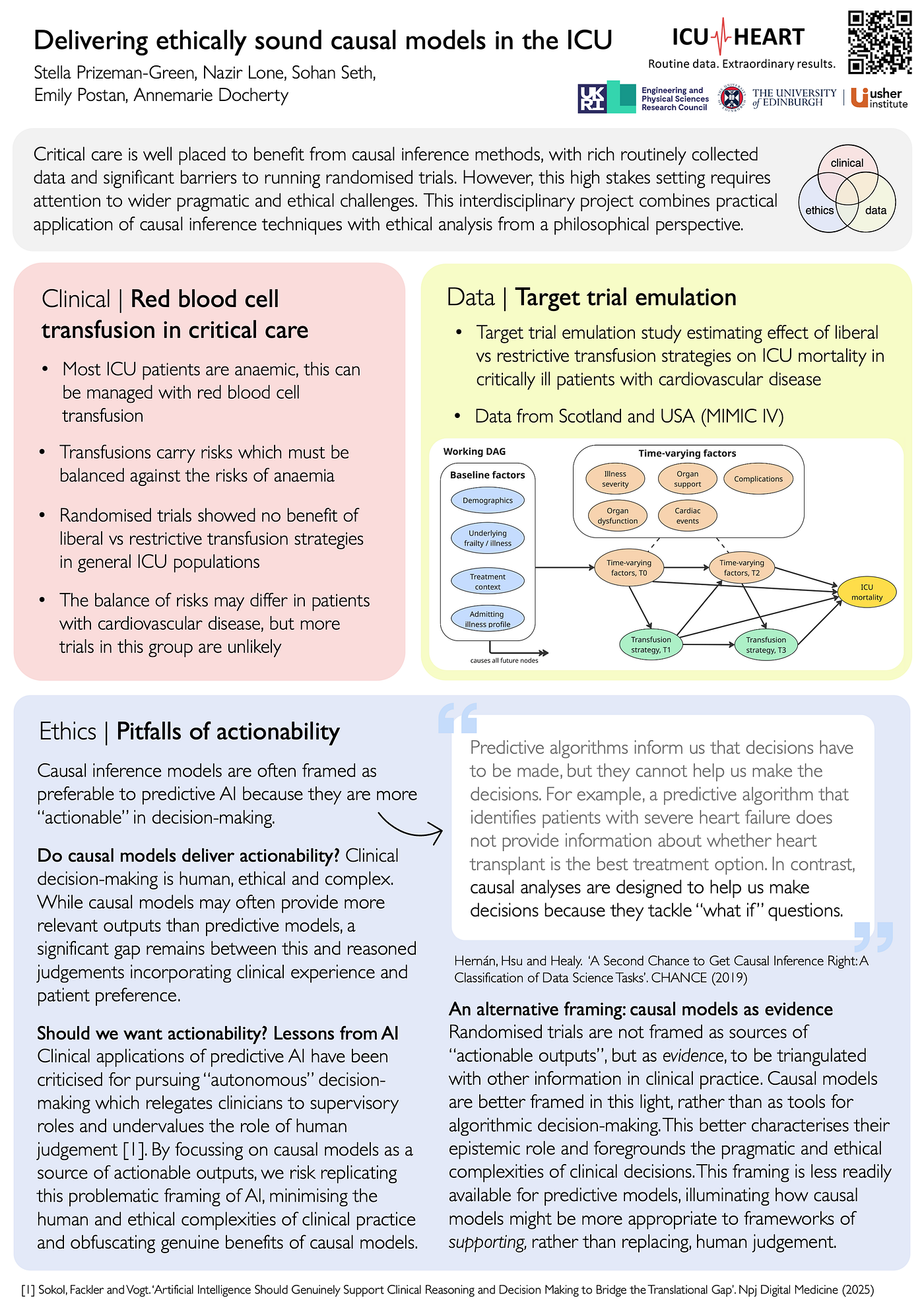
One of the key topics of conversation was different approaches to exploiting “natural” sources of randomisation out in the world, to mimic the kind of randomisation we might artificially create within a trial. For example, mendelian randomisation uses the random process of genetic variation as a basis for this kind of “natural experiment”. Hearing about these methodologies was interesting for me, as the major focus of my PhD so far has been on a completely different approach to causal inference — target trial emulation. Here, rather than focussing on actual randomisation in the world, randomisation is emulated by adjusting for the variables we think might make our groups look systematically different, to end up with evenly balanced patient characteristics across treatment groups, like in a trial. In the toy example I just gave, we could adjust for age in our statistical model, to counteract the skew it introduced to our treatment groups. You can read more about how I plan to apply these methods in the poster I presented at the conference, at the end of this blog. Target trial emulation, and other “confounder control” methods for causal inference, tend to be more commonly applied in the healthcare context, while “quasi-experimental” methods like mendelian randomisation are often more popular in the world of economics and social science. Since many of the conferences I’ve previously attended have been healthcare focussed, it was great to hear about how different methodologies are applied across disciplines.
In fact, this diversity of approach is the crux of another key idea gaining traction in the field: triangulation. The idea here is that all study designs — even randomised trials — are at risk of bias. So, rather than trying to replicate the results of prior studies, which risks replicating the unavoidable biases associated with the study design, we would be better off trying to approach the same question using diverse methodologies, datasets and researchers. That way, even though biases are not eliminated, they overlap different ways, meaning that we can hope to converge on a more stable answer to the research question at hand. For me, attending conferences like this with a very different methodological stance to the clinical conferences I’ve been to before is a great opportunity to learn about alternative methodologies and approaches that can hopefully lead to a more robust conclusion.
Another session which prompted me to think about how we could benefit from interdisciplinarity was a panel discussion on the challenges of translating methodological advances into the applied setting. There are a huge number of researchers exploring causal inference methodology in their work, whether that be developing entirely new methods or exploring the limitations and possibilities of those that already exist. However, there is still a barrier to translating these developments into practice. Some of this may be put down to an inevitable delay in the transmission of ideas, but there is still debate over how this interface between methodological advances and practical implementation might be improved. I know from experience that there is often a tension between seeking methodological rigour and the real-world practical challenges faced by any data science project.
One of the success stories in this area is the work of Miguel Hernán, whose work on target trial emulation has been more widely adopted by applied researchers, however the panel participants noted that getting to that point involved a huge amount of work in making these methods more accessible to a broader audience. The question then becomes: if there is a problematic gap between theory and practice, whose job is it to address that? Do applied researchers need to get better at seeking out the advice of methodologists, or should methodologists be more focussed on engagement and findings dissemination? The likely answer is that work is required from both sides — as someone who sits somewhere in the middle of this divide, I hope to work on this myself during my PhD. It seems that an essential part of that work is being exposed to a diversity of methodologies across different research areas, which is why it’s such a great opportunity to attend conferences and workshops that bridge these disciplinary divides.
메타데이터
- post_id
- 959c2cedbbed
- slug
- causal-inference-and-the-importance-of-cross-disciplinary-communication-959c2cedbbed
- url
- https://medium.com/icu-heart/causal-inference-and-the-importance-of-cross-disciplinary-communication-959c2cedbbed
- canonical_url
- https://medium.com/icu-heart/causal-inference-and-the-importance-of-cross-disciplinary-communication-959c2cedbbed
- author_url
- https://medium.com/@sprizegreen
- status
- ok
- fetched_at
- 2026-06-09 15:37:30