Apple’s Price Hike Is Really an AI Warning Shot
For the last two years, the AI story has been about GPUs, model size, and who can build the most capable intelligence. But the next phase…
Apple’s Price Hike Is Really an AI Warning Shot
For the last two years, the AI story has been about GPUs, model size, and who can build the most capable intelligence. But the next phase of the AI boom may be defined by something less glamorous and more important: memory.
Apple’s recent price increases tied to higher memory and storage costs are an early warning signal. This is not just an Apple story. It is a sign that AI infrastructure inflation is beginning to move from the data center into consumer hardware.
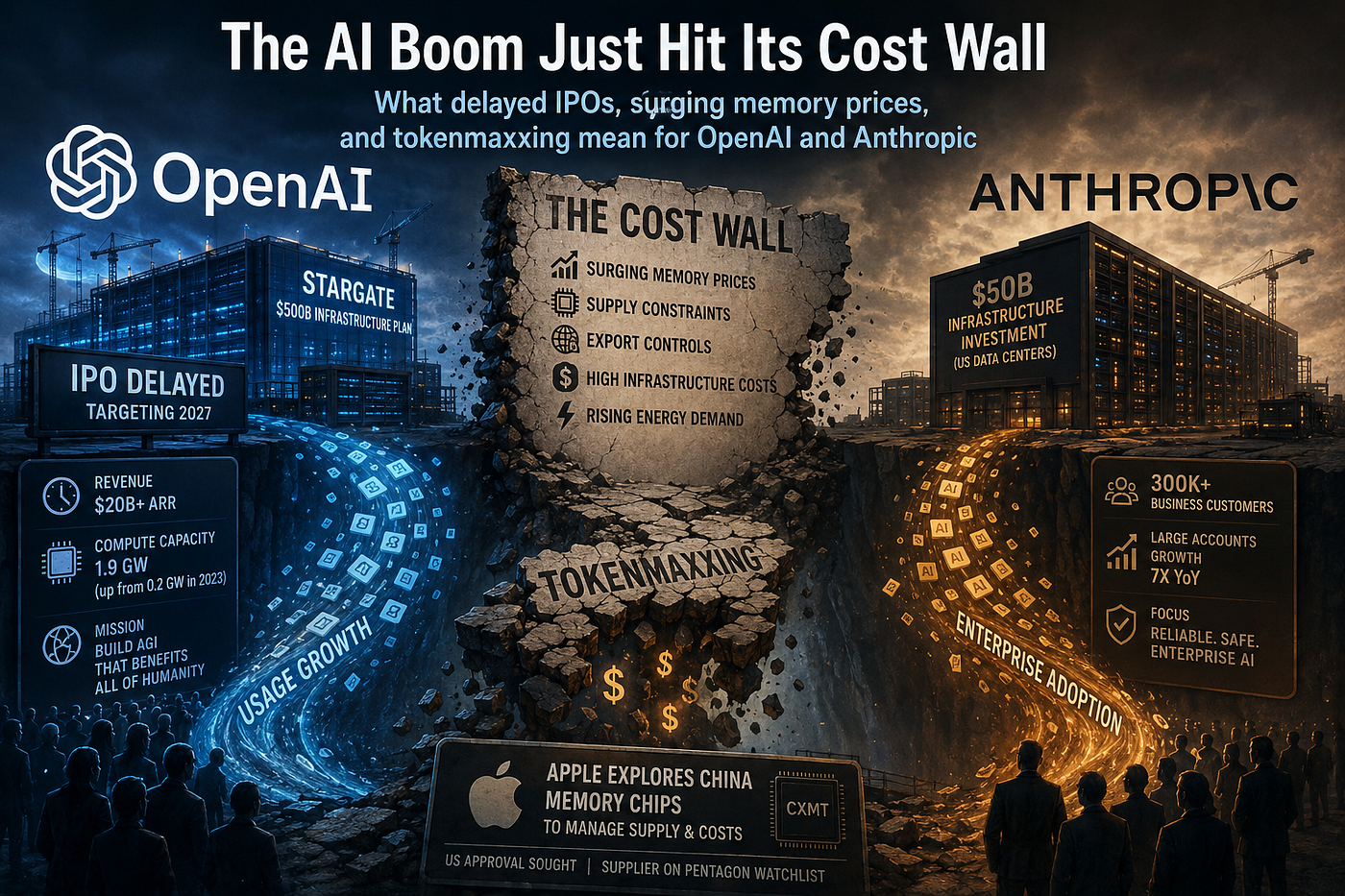
The AI economy is no longer competing only for GPUs. It is competing for high-bandwidth memory, DRAM, NAND, enterprise SSDs, advanced packaging, and the supply chain capacity needed to build all of it. The same memory ecosystem that powers AI data centers also powers phones, tablets, laptops, cars, consoles, and PCs.
That matters because AI demand is changing the economics of memory.
For years, memory was viewed as a cyclical commodity. Prices rose, suppliers added capacity, prices fell, and the cycle repeated. AI does not eliminate that cycle, but it changes the nature of demand. High-bandwidth memory is now strategic. Server DRAM is strategic. Enterprise storage is strategic. The companies that can secure supply have an advantage. The companies that cannot may face higher costs, lower margins, or higher prices for customers.

Memory: AI’s new bottleneck
Apple’s price hike is important because Apple is usually one of the best companies in the world at managing component costs. It has scale, cash, supplier leverage, and long-term procurement discipline. If Apple is passing memory pressure through to consumers, the pressure is real.
This is how AI inflation spreads.
First, hyperscalers buy GPUs. Those GPUs require high-bandwidth memory. Memory suppliers then prioritize HBM, server DRAM, and AI-related products because those are the highest-value markets. That tightens supply for conventional memory and storage. Eventually, consumer devices get more expensive.
Consumers may not see a frontier AI model running locally on every device they buy, but they may still pay for the AI boom through higher device prices.
This creates a new concern for the AI industry: token cost and optimization.
A token may look like a software unit, but its cost is physical. Every token generated by an AI system consumes compute, memory bandwidth, power, cooling, networking, and infrastructure capacity. As AI shifts from training to inference, that matters even more. Training is expensive, but episodic. Inference is recurring. Every prompt, chatbot response, document summary, code generation task, and agentic workflow creates an ongoing cost.
The industry often talks about “cost per token.” The hidden driver inside that metric is memory.
Large models need memory to store weights. Long-context models need memory to manage the context window. Inference systems need memory for the KV cache, which stores information from prior tokens so the model can generate efficiently. The longer the context and the more users served simultaneously, the larger that memory burden becomes.
This is why the next AI optimization race is not just about faster chips. It is about fewer bytes per token.
There are several ways the industry can respond.
The first is using smaller models where possible. Not every task needs a frontier model. Many enterprise workflows can be handled by smaller, specialized, fine-tuned, or distilled models. The likely future is model routing: simple tasks go to cheaper models, complex reasoning goes to more powerful ones.
The second is quantization. Lower precision formats can reduce memory footprint and improve throughput. Moving from FP16 to FP8, FP4, or other lower-precision formats allows systems to do more work with less memory. The tradeoff is accuracy and stability, but the economics are pushing the industry toward lower precision wherever quality allows.
The third is KV cache optimization. This may become one of the most important infrastructure battlegrounds in AI. Long-context AI is powerful, but it is memory-hungry. Techniques such as paged attention, cache compression, cache quantization, and smarter cache eviction can make inference more efficient.
The fourth is disaggregated inference. AI serving has different phases. The prefill phase processes the input prompt. The decode phase generates the output token by token. These phases have different compute and memory needs. Separating them across different infrastructure can improve utilization and reduce waste.
The fifth is tiered memory. HBM is fast but expensive. DRAM is cheaper but slower. SSDs are cheaper still. Future AI systems will likely use layered memory architectures, with the hottest data closest to the accelerator and colder context, embeddings, and retrieval data stored in lower-cost tiers.
The sixth is custom silicon. As inference workloads become more predictable, hyperscalers can design chips around specific models, latency targets, memory access patterns, and cost goals. That is why custom ASICs are gaining momentum.
This has major implications for the key AI players.
For Nvidia, the memory shock is both an opportunity and a risk. Nvidia remains the center of the AI infrastructure market because it offers the strongest combination of GPUs, networking, software, and developer ecosystem. But customers are no longer only asking, “How fast is the chip?” They are asking, “What is the cost per token?”
That pushes Nvidia to prove that its platforms can make scarce memory more productive. Blackwell, Rubin, NVLink, CUDA, TensorRT, and inference software all matter because Nvidia’s real value is no longer just the GPU. It is the full system.
The risk is that high memory costs make customers more open to alternatives. If AMD, Broadcom, Marvell, or in-house hyperscaler chips can deliver acceptable inference at lower cost, some workloads will move. Nvidia will still win a large share of the market, but memory inflation makes buyers more pragmatic.
For Micron, the story is more directly bullish. Micron benefits from AI-driven demand for DRAM, NAND, and high-value memory products. The old Micron was viewed mainly as a cyclical memory company. The new Micron may be increasingly viewed as a strategic AI infrastructure supplier. If customers sign long-term agreements to secure memory supply, Micron gains better visibility and pricing power.
The risk is that memory remains cyclical. If too much capacity eventually comes online, pricing can still weaken. But AI gives Micron a stronger structural demand story than in prior cycles.
For Apple, the issue is more complicated. Apple needs more memory in devices to support on-device AI, privacy, and richer local experiences. But the same AI boom is increasing memory costs. That creates a margin dilemma. Apple can absorb costs, raise prices, reduce base configurations, or push users toward more expensive tiers.
The key question is whether consumers will see enough value from AI features to justify higher device prices. If AI remains invisible or underwhelming, price increases become harder to defend.
For AMD, this is an opening. AMD can compete by emphasizing memory capacity, openness, and cost. But hardware alone will not be enough. The company needs software maturity, developer confidence, and reliable production performance. If it can deliver those, memory pressure could help AMD gain share.
For Broadcom and Marvell, the custom silicon opportunity becomes stronger. As AI inference scales, hyperscalers will want chips optimized for their own workloads. The goal is not just cheaper compute. It is better control over memory movement, power, networking, and utilization.
The broader lesson is simple: AI is becoming industrial. The constraints are no longer just algorithms and benchmarks. They are memory, power, packaging, cooling, and supply chains.
The next winners in AI will not simply be the companies with the biggest models or the most GPUs. They will be the companies that produce the most useful intelligence per dollar of memory.
Apple’s price hike is the first consumer-facing sign of a deeper shift. AI costs are no longer contained inside cloud capital spending budgets. They are starting to ripple through the entire technology economy.
The new AI question is not just whether intelligence gets cheaper.
It is whether intelligence can get cheaper while memory gets more expensive.
메타데이터
- post_id
- 95a3a94cfa7c
- slug
- apples-price-hike-is-really-an-ai-warning-shot-95a3a94cfa7c
- url
- https://medium.com/@ilanpoonjolai/apples-price-hike-is-really-an-ai-warning-shot-95a3a94cfa7c
- canonical_url
- https://medium.com/@ilanpoonjolai/apples-price-hike-is-really-an-ai-warning-shot-95a3a94cfa7c
- author_url
- https://medium.com/@ilanpoonjolai
- status
- ok
- fetched_at
- 2026-07-11 20:50:18