What’s the deal with the jumps? An analysis and study on Castlevania
The conversation around old Castlevania games has always been fascinating. From the meticulous analysis of its level design, the music, the…
What’s the deal with the jumps? An analysis and study on Castlevania
The conversation around old Castlevania games has always been fascinating. From the meticulous analysis of its level design, the music, the gameplay…..it’s a very fondly cherished series, and one that receives loads of praise and appreciation. Yet, one criticism of the old games has consistently been in the public discourse, and it’s one I’ve always found a sort of half-truth in: the controls are poor. But, what does “poor” mean in this context? In most conversations, this is in reference to two things, climbing stairs, and jumping. So what is it about these that brings these criticisms to front, and more importantly, are these criticisms made in the understanding of the rules of these games, or are they made in a lack of understanding? Let’s take a deep dive into the controls and nuances of Castlevania. I’m going to focus broadly on Castlevania 1 and Castlevania 3, with references to later Castlevania platformers sporadically when needed.
First, defining what the criticism of poor control could mean, in my eyes it always refers to how the game both handles a button input, and how it responds to it as it pertains to the rules of the game. This is where things like input latency (the measurement in time in which the game takes to process a button input) and things like animation timings matter: these work in harmony to provide the feeling of responsive movement. In this regard, Castlevania 1 and 3 don’t fall into being unresponsive…..most of the time. I mentioned two control “issues” above, stairs and jumping. The stairs, in this case, are definitely unfortunately guilty of being somewhat problematic. Interacting with them is very static compared to every other sort of movement interaction in the game, as few and far between as those are, and actually doing anything on them that isn’t climbing is extremely difficult. Attempting to utilize a subweapon on stairs is, simply put, a nightmare. Consider: subweapon usage is performed by pressing Up and the B button, but pressing Up on the stairs makes you….climb them. To actually utilize a subweapon on a staircase, you need to press B first, and then continue to hold it down, and then press Up. This works because, likely as a result of developer foresight, holding the B button on stairs causes the Belmont to attack automatically when he has control. This is awkward, and it also means the rules arbitrarily change on staircases in a way that isn’t particularly intuitive. Most people don’t even know about this method! I won’t dote on this too long, as later Castlevania platformers made the stairs a lot better, with more responsive subweapon usage while on them either through a button press input or just handling how stairs worked better, in addition to allowing the Belmonts to jump on and off the stairs at will. However, this criticism often comes up secondary to the primary criticism (and the focal point of this article): jumping!
In Castlevania, jumps are different than in most other platformers. When you press the A button, the Belmont jumps to a fixed height, and drops at the same speed. If you’re holding a direction, the Belmont will go in that direction, with the caveat being that you cannot reverse your momentum at all. If you are going forward during your jump, you’re simply going forward, end of discussion. Looking at this from a perspective of rules and input leniency, well, it passes on all fronts! Jumps are consistent, they always work when you have control while not on the stairs (in the case of the NES games) and the input is always responsive, the feedback is consistent and concise, so what’s the big deal?
As a result of this genre’s principle influence being Super Mario Bros., air control is an assumed property of jumping in these games. It’s considered EXTREMELY important, and when it’s absent, people notice. Suddenly basic platforming becomes much more difficult and meticulous, and jumping feels like a large commitment in it of itself, which leads to the question “Why is it like this? This doesn’t feel right by design!”, but when someone examines the level layouts in Castlevania, it makes perfect sense why the jumping is like this. Take a look here:
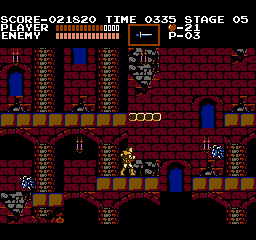
A sample room, from the 2nd stage of the game
In a Mario game, this room would be an absolute joke. In Castlevania, however? While it’s still not a particularly tricky room, the constantly respawning Medusa Heads and the movement of the hovering platforms coupled with how jumping and movement is make this area require a bit of precision and accuracy, much greater than that of what you’d need if you were simply playing as Mario, who could nimbly steer and correct his course in the air. This has led to criticisms of the jumping as “clunky”, “poorly designed”, and has even led to people seeking to amend this by modifying the games to allow the player to steer the Belmonts within the air. Even Konami has done this with some games (Castlevania 1’s remake on the Sharp X68000 and Super Castlevania 4), although in the case of these titles the games were specifically crafted around this ability being granted to the Belmont, not around its absence. This is usually where the argument ends, this is where the line in the sand is drawn. It’s designed around it, end of story. If it didn’t have this intentionality in its movement, it would cease to be Castlevania. This is absolutely a truth, but I want to dig deeper. It’s so much more fascinating and easy to appreciate when you dive into the layers of what Castlevania did with its approach to jumping and air movement.
I’d like to tap into what my time in the competitive fighting game scene has taught me, and zero in on a term that I think will really help this analysis hit home: “Mental Stack.” What is a “Mental Stack”? It’s essentially the amount of focus someone can put into what’s happening in a game before it starts to become unfeasible. You can think of it as a sort of task limit. The human brain is truly amazing, but we can only calculate so many variables at any given time before we overload, and the idea of the Mental Stack is incredible because it doesn’t just apply to fighting games, but to almost any game period, in this case platformers. Let’s observe another screenshot, this time of Super Mario Bros. 3, as I break down all of the variables involved in what making a jump here would entail:

A fairly basic timing puzzle in World 3
So, the jump controls in Mario have a lot of variability, let’s look at all of the considerations that go into a simple jump to a different destination:
- Mario’s current movement speed
- The direction the player is holding while initiating the jump
- Whether Mario has attained Maximum Running Speed, indicated by the P-Meter (these jumps carry much greater momentum)
- The amount of time in which the A button is held after jumping
- The directions the player inputs after jumping while in midair
That’s five variables, and now let’s add in the enemy interactions and other hazards:
- How long the A button is held after bouncing on an enemy
- Is the enemy spiked, or can they attack upwards towards where Mario is?
- Is there a pit below where Mario is about to land?
Oh. Make that eight, and this is of course excluding the variety of power-ups that all influence how Mario jumps as well. So, how do Mario games achieve their control scheme and game flow without overwhelmingly causing decision paralysis? Beyond how the games train the players into familiarity with these types of scenarios and how to think in patterned solutions to them, Mario games also design jumping to be relatively light and stress free. Consider: when jumping in Mario, you are safer than when you are grounded. Your entire lower body is effectively your attack, so anything below you or even roughly parallel to you cannot harm you unless it is an enemy specifically designed to combat this, and those are few and far between. This makes the focus of jumping less on an exceedingly high number of problem factors, and shifts it to “where is my next foothold going to be so I can jump again?” This intrinsically allows for a more streamlined thought process, and offloads a lot of the potential stress. Now, let’s take a look at Castlevania. Jumping in Castlevania is, as stated, a far more binary exercise, but how much more? Well, let’s list the influences on jumping in Castlevania, and it should very clearly demonstrate what I mean. So, what affects your jump in Castlevania? The following:
- The direction held before jumping
That’s it. While the considerations of things such as enemy positions and how to attack are still in play just like in Mario, jumping in Castlevania is a very binary exercise in movement. There’s no variable height, you don’t steer yourself, and your entire lower body isn’t your primary means of attack. So what does this achieve? Surprisingly, a lot. As someone adapts to this, they begin to simply make jumps and then immediately shift their focus to other events going on in the game space. You don’t have to worry about how long you pressed A, or how long you’re holding it. You know where the Belmont is about to land, it’s a fixed angle with a fixed timing and a fixed height. It’s a consistency that is much more difficult to achieve in a Mario game, let alone most platformers with less specific jump controls, but the benefits become far more apparent as soon as you figure out where you want to jump and when. This consistency is important not only because Castlevania is very challenging, but also because the games focus more on the types of enemies and combat situations you’ll be in rather than making a large amount of precarious leaps, and as such the jump controls are the way they are to give players the most accuracy possible in utilizing the Vampire Killer.

Imagine fighting Dracula in this state with variable jump heights. This boss fight demonstrates just how carefully crafted the jumps are in this game: at the apex of the height, the Belmont’s whip attack directly strikes Dracula’s weak point while simultaneously avoiding his triple fireball attack if timed correctly. This wouldn’t be achievable without the jump controls being the way they are, or at the very least, close to what they are. Castlevania’s jump controls are tuned for accuracy of movement as it pertains to the whip and where it’s needed, not for making a rapid sequence of immensely precise jumps, and that’s where I struggle with the identification of this decision as “clunky” or “poor.” Every pore of these games in their design is made in consideration to the way the jump (and the other controls, for the most part) work, and that’s why I’ll always struggle to call them bad. They are, simply put, part of the game’s rules, and if you adapt to its rules and let them guide you, you’ll find that it grants more flexibility in ways that are unique to it that you can’t find in a Mario game or other assorted platformers. It’s worth noting that even as the Castlevania games prior to Symphony of the Night made adjustments to the jump controls and how much air movement was allowed, the static jump height and fixed amount of air time has always been a staple.
In writing this, I want to make something very clear: my goal isn’t to persuade people to LIKE how the jumps control in these games. They’re very specific in their design and function, and as such if someone feels either creatively stifled by them or even frustrated, I completely get it. I don’t want people to feel bad for not liking them, but I do feel the need to make something clear: they’re the way they are for a reason. Additionally, no matter how binary Castlevania jumps are, the games still have a number of highly variable situations and aren’t merely simple to solve, but the jump controls are not directly responsible for these. If all this article does is inspire upon people a finer appreciation of these concepts even in their dislike of them, I consider that a success. Old Castlevania’s approach to movement may be inflexible and unwavering, but it’s a crucial piece in what I consider to be a wonderfully hand-crafted series of platformers, and it wouldn’t feel “right” if they weren’t the way they are in these games.
If you liked what you read here, feel free to check out my other work at my WordPress, where I put more long-form thoughts or reviews.
*You can also follow me on Twitter, where I commonly post fun little anecdotes and all of my work across both of these sites! I appreciate your time in reading this, and I hope it gave you something to think about.*
메타데이터
- post_id
- 95aff6b160d
- slug
- whats-the-deal-with-the-jumps-an-analysis-and-study-on-castlevania-95aff6b160d
- url
- https://medium.com/@TTTTTsd/whats-the-deal-with-the-jumps-an-analysis-and-study-on-castlevania-95aff6b160d
- canonical_url
- https://medium.com/@TTTTTsd/whats-the-deal-with-the-jumps-an-analysis-and-study-on-castlevania-95aff6b160d
- author_url
- https://medium.com/@TTTTTsd
- status
- ok
- fetched_at
- 2026-07-27 21:01:28