People Don’t Change Because We Tell Them To
I used to leave hard conversations feeling like I’d done everything right. I’d prepared. I’d researched. I’d chosen my words carefully…
People Don’t Change Because We Tell Them To

Just like a butterfly, behavior change is a process.
I used to leave hard conversations feeling like I’d done everything right. I’d prepared. I’d researched. I’d chosen my words carefully, anticipated the objections, and laid out the evidence in the clearest way I knew how. And then I’d sit across from someone, a student, a client, a colleague, and watch them nod politely while their eyes told me something entirely different. Nothing changed. Again.
For a long time, I told myself it was them. They weren’t ready. They weren’t motivated. They weren’t committed to the work. And I’d move on, carrying a quiet frustration I didn’t fully examine, already preparing for the next conversation I was sure I’d get right. I’ll be the first to admit, it took me an embarrassingly long time to ask the harder question: What if the problem was me?
Not my information. Not my frameworks. Not my delivery. Something more fundamental than any of that. I had been showing up to conversations about change as if I were the solution, as if the right combination of words, research, and structure would finally unlock something in another person. I was, without realizing it, treating human beings like problems I hadn’t solved yet. Which is a realization that didn’t feel good. It still doesn’t, entirely. Yet, I need it because it changed everything about how I work.
We’ve Been Treating Change Like an Information Problem
Here’s the assumption most of us carry into conversations about change, whether we’re aware of it or not: if people knew better, they would do better.
It’s a seductive idea. It’s clean. It makes change into a knowledge gap, something we can fill with the right words, the right data, the right explanation. It also lets us feel like we’ve done our job when we’ve delivered the information clearly and accurately. However, the evidence keeps telling us otherwise. Smoking. Exercise. Preventive care. Medication adherence. We’ve been giving people accurate, well-intentioned information about all of these things for decades. It almost never produces lasting change on its own. We know this in public health.
We also see it in organizational change efforts that launch with fanfare and die six months later. We see it in the conversations we have with people we love, where we say all the right things and nothing shifts. So if information isn’t the engine of change, what is?
What the Research Gets Right
In 1983, James Prochaska and Carlo DiClemente published something that changed how behavioral scientists thought about change. Working initially with smokers, they developed what became known as the Transtheoretical Model, which introduced a deceptively simple insight: change happens in stages.
People don’t move from “not changing” to “changed” in a single moment. They move through a process, from Precontemplation (I don’t think this is a problem), through Contemplation (maybe I should do something about this), into Preparation (I’m getting ready to try), then Action (I’m trying), and finally Maintenance (I’m sustaining it).
Each stage has its own logic, its own emotional texture, its own needs. And this matters enormously in practice: the same conversation lands completely differently depending on where someone actually is. Giving action-oriented advice to someone in Precontemplation doesn’t just miss the mark — it often deepens resistance. You’re not speaking to where they are. You’re speaking to where you want them to be.
I did this constantly in my early years. I’m embarrassed by how long it took me to see it. The TTM gave us something enormously valuable: a map of readiness. But it left an unanswered question that I kept running into in real rooms with real people. What creates movement between stages? And what’s my role in that?
The Question the Model Doesn’t Fully Answer
Understanding that someone is in contemplation tells you something important. It tells you they’re beginning to acknowledge a problem and weigh the costs. They’re not ready to act, but they’re not dismissing the issue either.
What it doesn’t tell you is what you can do, in how you communicate, in how you show up, in the conditions you create, to help them move forward. Or backward. Because both happen. I’ve learned, slowly and sometimes painfully, that what happens in the relational space between people has everything to do with which direction the movement goes.
I’ve sat in mediation sessions where the right question at the right moment cracked something open that years of conflict had calcified. I’ve also sat in sessions where I pushed too hard, too soon, where I was so certain I could see what someone needed that I stopped actually listening to them. And I watched them shut down. Not dramatically. Just quietly, like a door clicking shut. That’s the kind of failure that doesn’t announce itself. It just leaves you wondering later what you missed.
What I’ve come to believe and what the research increasingly supports is that communication doesn’t force change. Communication creates the conditions where change becomes possible. That’s the core of what I call the BRIDGE Feedback Model: not a replacement for the stages of change, but a map for how we travel through them with another person.
The BRIDGE Change Pathway
B: Build Psychological Safety
Everything starts here. Not with the agenda. Not with the information you’re carrying. With safety. Amy Edmondson’s research on psychological safety, the belief that you won’t be punished or humiliated for speaking up, asking questions, or admitting uncertainty, established something that practitioners knew intuitively but couldn’t always articulate: safety isn’t a cultural nice-to-have. It’s a neurological precondition.
When people feel judged, blamed, or at risk, the parts of the brain needed for genuine reflection go offline. We get defended. We get strategic. We get small. And we perform agreement rather than actually engaging. I know this from the inside. Some of the least honest conversations I’ve had in my life were with people who clearly needed me to say certain things. And I said them, not because they were true, but because the space didn’t feel safe enough for anything else. I nodded. I agreed. I left and did exactly what I’d always done. Building safety before anything else creates the conditions for a different kind of conversation. One where someone might actually tell you what they’re really thinking.
R: Recognize Cognitive Load
I used to think it was the frameworks, the context, and research that I needed to be thorough. I thought I was being helpful. What I was actually doing, I’ve come to understand, was overwhelming people before the conversation even had a chance to start.
John Sweller’s cognitive load theory tells us that working memory has hard limits. When those limits are exceeded, learning shuts down, not because the person isn’t trying, but because the brain literally cannot hold it all at once. The signal we often read as resistance is frequently just overwhelm. The harder discipline, one I still have to practice, is restraint. Bringing less. Creating space. Trusting that one clear thing, genuinely understood, does more than ten accurate things half-heard. What looks like a simpler conversation is often the braver one.
I: Invite Collaboration
In the world of mediation, people support what they help create. When we arrive with a plan fully formed and present it for adoption, we’re asking for compliance. When we arrive with a question and build something together, we’re inviting ownership. Those are fundamentally different asks, and they produce fundamentally different levels of commitment.
This connects to Edward Deci and Richard Ryan’s Self-Determination Theory, which identifies autonomy as a core human need. When people feel genuine agency in a process, their motivation is qualitatively different. It doesn’t require external pressure to sustain. The hard part, for those of us who came up as experts, is learning to be genuinely uncertain in the room. Not performed uncertainty, actual openness to where the person wants to go. That means sometimes following a direction you wouldn’t have chosen. It means trusting that ownership matters more than optimization.
D: Distinguish Impact from Intent
This step is where some of the most stuck conversations live. Fritz Heider’s work on attribution, and Bernard Weiner’s extensions of it, describe a pattern most of us recognize immediately once it’s named: we tend to judge ourselves by our intentions and others by their behavior. When something goes wrong, we know the complexity behind our own choices. We assume others acted for simpler, often less generous reasons. So when someone says you made me feel dismissed, and the listener hears you are a bad person, the conversation is over. Defensiveness floods in. The original concern gets buried.
I’ve been on both sides of this. I’ve been the person whose impact was named and felt my whole body brace against it, certain that my intention was good and therefore the impact couldn’t be what they said it was. That’s not logic. That’s self-protection. Learning to separate what happened from why it happened, and to hold both as real, is one of the most difficult and most necessary moves in any difficult conversation. It doesn’t assign blame. It creates space to actually look at what occurred. And that’s the only place change can begin.
G: Generate Forward Focus
Albert Bandura’s research on self-efficacy showed something that seems obvious in retrospect: people don’t just need to want to change. They need to believe that change is actually possible for them. Not for people in general. For them, specifically, in their specific circumstances. And this is where so many conversations about change go wrong. We present the full scope of the problem. We lay out the distance between here and where things need to be. We’re being honest, we tell ourselves. We’re being thorough. But what we often do is make the distance feel impassable.
People don’t change because they can see the entire mountain. They change because they can take the next step. One that feels real. One that feels possible right now, this week, with the energy and resources they actually have.
Generating forward focus isn’t optimism for its own sake. It’s the practical work of rebuilding belief that movement is possible, which is what makes the next movement more likely.
E: Establish Ongoing Dialogue
We must all remember that change is not linear. The Transtheoretical Model accounts for this; relapse isn’t treated as failure but as a normal part of the process. Most people cycle through the stages more than once before a change holds. What sustains change over time isn’t a single conversation, no matter how good it was. It’s a relationship. It’s the ongoing presence of someone who holds you in the process without holding the outcome over you.
There’s a meaningful difference between accountability and surveillance. One asks how you are doing with this, genuinely, with curiosity. The other watches for failure. People navigate the hard stretches very differently depending on which one they’re experiencing. This final element of BRIDGE isn’t a conclusion. It’s a recognition that the work doesn’t conclude. It continues, and it requires tending.
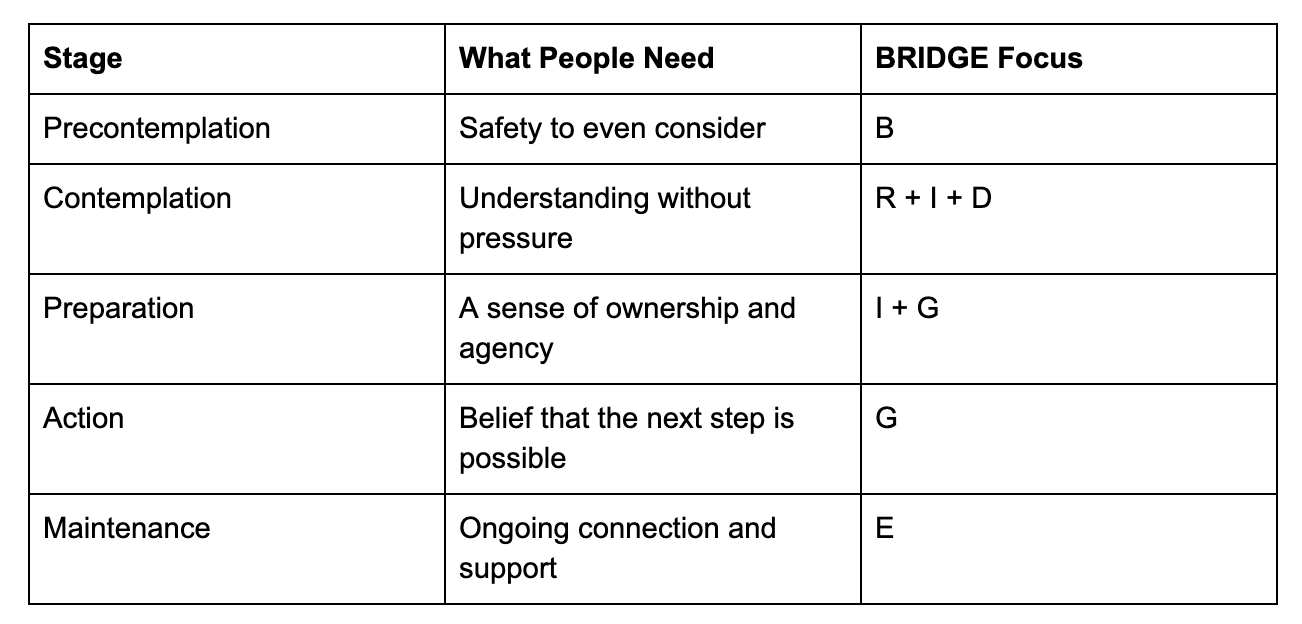
Mapping BRIDGE onto the Stages of Change
The way these elements come together shifts depending on where someone is in their process:
The Risk of Any Framework, Including This One
Frameworks are useful because they give structure to complexity. When you’re anxious, when the conversation is hard, when you don’t know what to do next, having something to hold is genuinely valuable. But frameworks can also become a way of managing distance. Of processing a person rather than being present with them. I’ve watched people, myself included , retreat into a model when the conversation got uncomfortable. Going through the letters. Checking the boxes. Staying in our heads because it felt safer than staying in the room.
BRIDGE is a scaffold for developing attunement. It is not a substitute for it. The goal, eventually, is to not need the letters, to have internalized something about how human beings move toward change, and to be able to meet people there without a framework guiding every step. That takes time. And it takes a willingness to sit with not knowing, which is genuinely hard for anyone trained to be an expert.
A Different Question
For years, when conversations about change weren’t working, I asked: " How do I get them to change? It’s the wrong question. Not because change isn’t the goal, it is, but because it positions the other person as a problem to be solved. And people feel that. They feel it in how we listen, in what we’re actually tracking, in whether we’re genuinely curious about them or just trying to move them somewhere.
The better question is: what condition might be missing? Safety? Capacity? Ownership? Understanding? Direction? Support? Each missing condition calls for something different, and naming the right one is often the most important move you can make.
For a long time, I believed communication was primarily about exchanging information. I was good at information. I knew how to research, synthesize, and explain. I thought that was the work. What I’ve come to understand, through the research, but more through the rooms I’ve sat in and the conversations I’ve been part of, including the ones I got wrong, is that communication serves something deeper. Communication creates the conditions where people feel safe enough to think, capable enough to act, and supported enough to persist.
Change rarely happens because we push harder. More often, it happens because we build a bridge strong enough for someone to cross, and then we get out of the way and let them walk.
About the Author
Malynnda Stewart, PhD, BCPA, is a leading expert on regulated difficult conversations, integrating trauma-informed mediation, neuroscience-based feedback, and health communication. As a board-certified patient advocate, certified conflict mediator, and grief advocate, and as the CEO of Compassionate Navigation, LLC, she helps professionals navigate high-stakes dialogue by working with, rather than against, human biology. Creator of the Regulated Conversation Framework and BRIDGE Method, host of the Communication Compass podcast. Her work is grounded in courage, curiosity, and compassion.
References
Bandura, A. (1977). Self-efficacy: Toward a unifying theory of behavioral change. Psychological Review, 84(2), 191–215.
Deci, E. L., & Ryan, R. M. (1985). Intrinsic motivation and self-determination in human behavior. Plenum.
Edmondson, A. C. (1999). Psychological safety and learning behavior in work teams. Administrative Science Quarterly, 44(2), 350–383.
Heider, F. (1958). The psychology of interpersonal relations. Wiley.
Miller, W. R., & Rollnick, S. (2013). Motivational interviewing: Helping people change (3rd ed.). Guilford Press.
Prochaska, J. O., & DiClemente, C. C. (1983). Stages and processes of self-change of smoking: Toward an integrative model of change. Journal of Consulting and Clinical Psychology, 51(3), 390–395.
Prochaska, J. O., Norcross, J. C., & DiClemente, C. C. (1994). Changing for good. William Morrow.
Sweller, J. (1988). Cognitive load during problem solving: Effects on learning. Cognitive Science, 12(2), 257–285.
Weiner, B. (1985). An attributional theory of achievement motivation and emotion. Psychological Review, 92(4), 548–573.
메타데이터
- post_id
- 95bf56d9c7f7
- slug
- people-dont-change-because-we-tell-them-to-95bf56d9c7f7
- url
- https://medium.com/@malynnda.stewart/people-dont-change-because-we-tell-them-to-95bf56d9c7f7
- canonical_url
- https://medium.com/@malynnda.stewart/people-dont-change-because-we-tell-them-to-95bf56d9c7f7
- author_url
- https://medium.com/@malynnda.stewart
- status
- ok
- fetched_at
- 2026-06-16 20:05:23