Domain Penalties: Complete Guide to Google Manual Actions
A domain penalty is Google’s way of saying your site broke the rules. When Google detects violations of its Search Essentials guidelines…
Domain Penalties: Complete Guide to Google Manual Actions
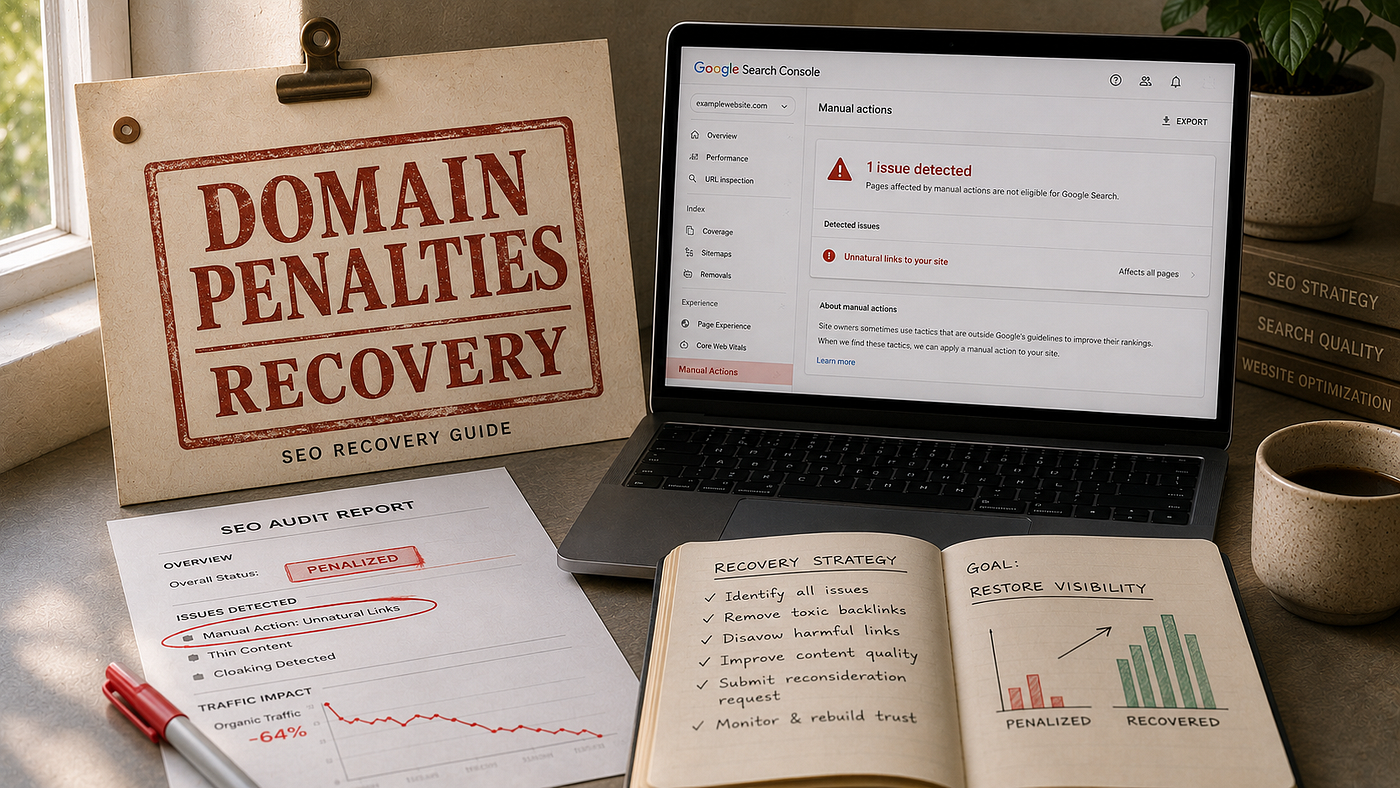
A domain penalty is Google’s way of saying your site broke the rules. When Google detects violations of its Search Essentials guidelines, it either automatically lowers your rankings or manually removes you from results entirely. The impact is immediate and brutal.
When a domain is penalised, visibility in search engines drops significantly. Your clicks vanish. Your organic traffic plummets. Your reach shrinks to almost nothing. We’re talking about 50% traffic drops or worse in a single week.
40% of businesses shut down within six months after receiving a Google penalty.
This isn’t hyperbole. A penalty can end your business. That’s why understanding what causes them and how to avoid them matters more than almost any other SEO topic you’ll encounter.
Signals That Impress Buyers and SEO Teams
Clean domain history is currency. When you’re buying a domain or inheriting one, the first thing smart operators check is whether it’s been penalised before. A domain with a clean bill of health commands higher acquisition prices and attracts serious buyers.
Here’s what signals trust:
- Zero manual actions from Google
- Natural backlink profile (no spam patterns)
- Consistent ranking history over years
- No spikes or crashes in organic traffic
- Original, high-quality content that hasn’t been mass-deleted
A domain’s past is written into Google’s memory. You can’t erase it — you can only rebuild trust.
Buyers want domains that are ready to perform immediately. If you’re selling, proving clean health accelerates deals. If you’re buying, verifying cleanliness protects your investment.
How to Check if a Domain Is Penalised
Start by asking Google directly. Use Google Search Console to check for manual actions. If Google has flagged your domain for violations, you’ll see a notification in the “Manual actions” section. This is the clearest signal possible.
Here’s your testing sequence:
- Log into Google Search Console for the domain
- Navigate to “Manual actions” in the left sidebar
- Check for any violation notices
- Review the “Security & Manual Actions” section for alerts
- Look at the Search Performance report for sudden traffic drops
Next, run a site-level search. Type site:domain.com into Google. If you see almost zero results or nothing at all you may be dealing with a site-wide penalty or deindexing.
Near-zero site:domain.com search results may suggest deindexing or site-wide penalty.
Check your backlink profile using tools like Ahrefs or SEMrush. Look for spikes in low-quality links or sudden link velocity changes. Spammy backlinks are a common penalty trigger.
Finally, examine your traffic history in Google Analytics. Dramatic, unexplained drops signal trouble. Stable growth? That’s a good sign.
Core Penalty Types Explained

Penalties come in two flavors: manual and algorithmic. Understanding the difference changes how you respond.
Manual Actions
Human reviewers at Google manually review your site and issue penalties for clear violations:
- Unnatural links (buying links, link schemes, private blog networks)
- Spam and deceptive practices (cloaking, hidden text, doorway pages)
- Hacked content (your site was compromised and malware was injected)
- Structured data abuse (using schema markup to mislead)
Manual actions appear in Search Console. Google tells you exactly what’s wrong and gives you a path to recovery.
Algorithmic Penalties
Google’s updates automatically detect patterns and demote sites without human review:
- Thin content (pages with very little original value)
- Spammy links (patterns that look unnatural to the algorithm)
- Content farms (mass-produced, low-quality pages)
- Core algorithm hits (your content doesn’t match what users actually want)
Websites impacted by algorithm updates may take 3–6 months or longer to recover, if they recover at all.
Algorithmic penalties are harder to diagnose because Google doesn’t tell you specifically what triggered them, much like the broader challenge of balancing credibility and innovation in **.ai versus .org digital identities.** You have to reverse-engineer it from your data.
Domain Health Checklist
Before you buy, inherit, or rely on any domain, run through this checklist. This is your protection plan.
- Check Google Search Console for manual actions
- Verify Search Console ownership (if possible)
- Search
site:domain.comand count results - Review backlink quality and link velocity in the past 2–3 years
- Pull organic traffic data from Wayback Machine or historical analytics
- Search for negative mentions or complaints about the domain
- Check if the domain was ever used for spam or malware
- Verify all pages return proper HTTP status codes (no soft 404s)
- Scan for malware using tools like Sucuri or MalwareFox
- Review the robots.txt and meta robots tags for blocks
A clean domain passes all ten. One failure doesn’t doom you — but it’s a warning flag.
Use Timestamped Pages to Track Recovery
If you’re recovering from a penalty, you need proof of change. Google wants to see sustained improvement over time, not overnight fixes.
Create or update pages with clear dates:
- Add publication dates to blog posts (schema markup helps here)
- Update your homepage with today’s date when you make major improvements
- Publish a “What We Fixed” post documenting your recovery efforts
- Add timestamps to policy pages showing when they were last updated
Google’s algorithm understands freshness. When it sees you actively improving your domain, it signals that the old problems are gone.
Add Schema to Reinforce Clean Signals

Schema markup won’t save a penalised domain, but it strengthens legitimacy. Think of it as an amplifier, not a cure.
Adding schema for Organization, Article, or LocalBusiness tells Google:
- Who you are (Organization schema)
- What your content covers (Article schema)
- When it was published and updated (datePublished, dateModified)
- How authoritative you are (author, publisher information)
Schema implementation strengthens a domain’s clarity and legitimacy to search engines but is not a magic fix for penalties. You still need clean content and natural links.
Strategic Use Cases for Penalty Checks
Domain health checks matter in specific moments. These are when you absolutely cannot skip this step.
- Before acquisition — You’re buying a domain. Check its history before spending money.
- Before migration — You’re moving a site to a new domain. Verify the target domain is clean.
- Before investment — You’re building a business on a domain. Confirm it’s not haunted by penalties.
- After a traffic drop — Your traffic tanked overnight. A penalty check diagnoses the problem.
- Before monetisation — You’re launching ads or sponsorships. Buyers want domain confidence.
SEO Protection Tips for 2026
Build your domain’s immune system. Prevention beats recovery every single time.
Here’s what works:
- Create original content that serves real readers, not search engines
- Earn links naturally by making things worth linking to
- Monitor your backlink profile monthly for suspicious patterns
- Keep your content updated and remove pages that aren’t useful
- Use SSL/HTTPS on every page
- Fix broken links regularly
- Respond quickly to hacking attempts and malware
- Diversify your traffic (don’t depend entirely on organic search)
The pattern is clear: domains that follow Google’s rules and focus on user value survive. Domains that cut corners don’t.
Future-Proofing Against Penalties
The algorithm changes constantly, but the core principle never does: serve readers first, search engines second. Domains that stay healthy in 2026 and beyond will be the ones that build for humans, not bots.
Google is moving toward rewarding experience and usefulness. Websites that prioritize user satisfaction, site speed, and genuine expertise will outrank those that don’t. Penalties will hit harder against AI-generated content, link schemes, and deceptive practices.
Your domain’s future depends on what you do today.
How VisionVix Builds AI Platforms from Premium Domains

VisionVix turns keyword-rich domains into scalable AI, SaaS, and developer-focused businesses. Instead of holding domains as static assets, each one is developed into a functional platform using modern technologies like Next.js, Supabase, and Stripe.
Every domain is chosen for its search value, branding strength, and commercial potential. Many are paired with deployable AI systems, automation tools, SaaS products, and developer infrastructure ready for launch.
Portfolio Highlights

- financeautomation.app — AI-powered finance automation solution
- hrautomation.app — HR and recruitment workflow platform
- contentautomation.app — Automated content publishing system
- autonomousagents.app — Autonomous AI agent deployment platform
- agenticorchestration.app — Multi-agent AI workflow infrastructure
메타데이터
- post_id
- 95c33293a2e2
- slug
- domain-penalties-complete-guide-to-google-manual-actions-95c33293a2e2
- url
- https://medium.com/@julianneagu/domain-penalties-complete-guide-to-google-manual-actions-95c33293a2e2
- canonical_url
- https://medium.com/@julianneagu/domain-penalties-complete-guide-to-google-manual-actions-95c33293a2e2
- author_url
- https://medium.com/@julianneagu
- status
- ok
- fetched_at
- 2026-06-09 15:37:30


