What Makes East of Eden One of Korea’s Most Memorable Family Dramas?
Some K-dramas you merely watch, others you experience. K-dramas live on. East of Eden definitely fits in the latter. Even today, the show…
What Makes East of Eden One of Korea’s Most Memorable Family Dramas?
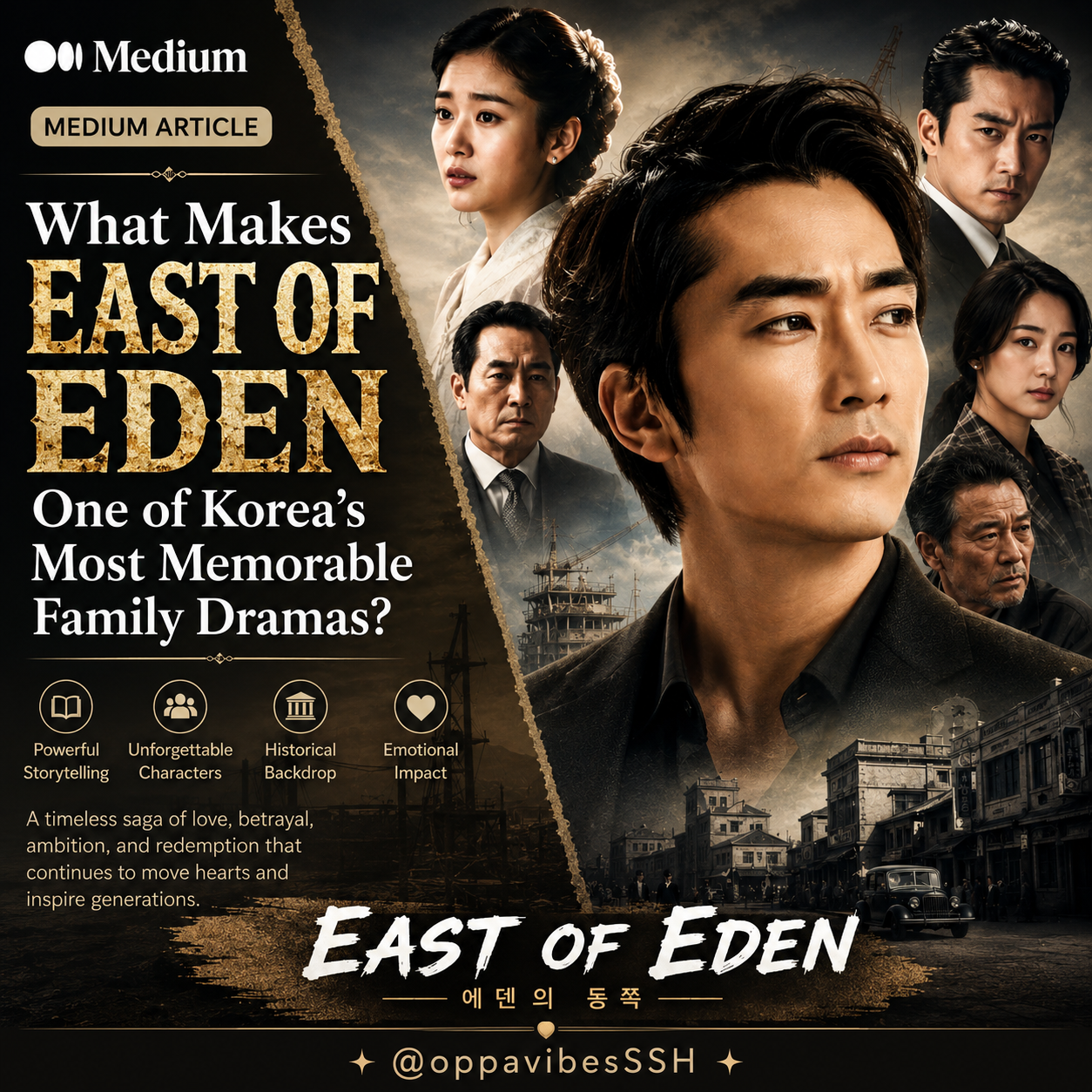
Some K-dramas you merely watch, others you experience. K-dramas live on. East of Eden definitely fits in the latter. Even today, the show is talked about like a physical ailment that leaves a pleasant ache.
Produced by MBC as a lavish 47th-anniversary special project, this 2008–2009 series is widely celebrated by fans as the epic masterpiece that earned Song Seung-heon his prestigious MBC Grand Prize (Daesang). With a massive 25 billion won budget and sweeping location shoots stretching across Hong Kong, Macau, and Japan, it serves as the ultimate showcase for "Mr Song” in his most rugged, fiercely protective, and iconic role. Spanning four decades (from the 1960s to the 2000s), the drama follows two boys swapped at birth by a vengeful nurse, one raised in a tycoon’s luxury, and the other, played with unforgettable intensity by Song Seung Heon, growing up to navigate the dangerous criminal underworld out of pure devotion to his family. For dedicated fans of Mr Song, this series stands as an ambitious, larger-than-life saga of destiny, sacrifice, and a timeless, heartbreaking romance.
At its heart, East of Eden follows Lee Dong Chul and Lee Dong-Wook, two men whose fates diverge dramatically, one drawn into the criminal underworld, the other rising through the ranks of law and privilege. Their paths cross and collide again and again over the decades, set against real backdrops of Korea’s rapid industrialisation, the Taebaek coal miners’ strikes, and the student democracy movements of the era.
It’s loosely inspired by John Steinbeck’s classic novel of the same name, borrowing its Cain-and-Abel skeleton of rival brothers bound by blood and rivalry, but the drama carves its own, distinctly Korean path. Where Steinbeck’s ending leans quietly tragic, this version goes for something far more explosive, a finale that still divides fans between “devastating” and "unforgettable".
The cast reads like a who’s-who of Korean melodrama royalty: Song Seung-Heon and Yeon Jung-Hoon as the two central men whose bond is equal parts brotherhood and battlefield, alongside Lee Da-Hae, Han Ji-Hye, Park Hae Jin, and Lee Yeon Hee rounding out a tangled web of loyalty and heartbreak. Song and Yeon reportedly had their own history together from an earlier production, and many long-time viewers feel that shared history bleeds into the raw intensity of their scenes together, as if the tension between the characters was always going to be electric.
Why Fans Still Talk About It
Ask anyone who has finished all 56 episodes of East of Eden what stayed with them, and you’ll rarely hear “the plot twists". You’ll hear about the characters.
Fans consistently point to the emotional honesty of the performances, the way grief, ambition, and quiet resentment are allowed to sit on screen without being rushed. Park Hae Jin’s portrayal of a good-hearted son raised under a villain’s shadow is often singled out as one of the drama’s most affecting arcs: a character forced again and again to choose between conscience and loyalty and who pays for it emotionally every time.
Then there’s the music. Long-time viewers often mention how each major character seems to carry their own musical theme, turning certain scenes into gut punches the moment a familiar melody creeps back in. It’s the kind of scoring choice that rewards long-term viewers; you don’t just recognise the song, you recognise the feeling it’s about to bring back.
And there’s something else fans return to again and again: the drama doesn’t hand out easy endings. Life in East of Eden is unfair in the way real life is sometimes unfair: ambition doesn’t always get punished, love doesn’t always get rewarded, and family doesn’t always mean safety. For viewers exhausted by tidy, feel-good resolutions, that rawness feels honest rather than cruel.
What It Teaches Us About Each Other
Strip away the coal mines, the corporate boardrooms, and the sprawling timeline, and East of Eden is really asking one question: how much of who we become is shaped by the people who raised us, and how much is a choice we make in spite of them?
The two brothers at the centre of the story are proof that identical starting points can lead to wildly different lives, not because of fate alone, but because of the small, human decisions made along the way: who to trust, who to protect, what to sacrifice, and what to become numb to in order to survive.
But that’s a piece of the reason why the drama itself offers such a rich frame for thinking about people, people we know. The show makes you realise that
- Circumstance shapes people, but it doesn’t excuse everything. Even characters raised under the same roof, facing the same hardships, choose different paths, a reminder that empathy for someone’s past doesn’t mean ignoring the choices they make in the present.
- Loyalty is rarely simple. The drama is full of characters torn between the family that raised them and the truth of where they came from, which mirrors something a lot of us quietly understand: love and obligation don’t always point in the same direction.
- Ambition has a cost, and it’s usually paid by someone else first. Watching how power and greed ripple outward through generations is a sharp reminder to notice who bears the weight of our own choices.
- Reconciliation isn’t guaranteed; sometimes the work matters even without a happy ending. Not every wound in this story closes neatly, and that’s arguably its most mature, most human lesson.
It’s a drama that rewards patience with perspective. The kind that makes you a little more forgiving of the messy, contradictory people around you, because you’ve just spent 56 episodes watching how messy and contradictory a person can become under pressure.
The Verdict
It goes without saying that East of Eden isn’t exactly light fare. It is indeed long, sometimes campy, and unapologetically dramatic in that grand-scale, operatic, "big-budget Korean epic” kind of way. However, hidden amongst the crimes and business intrigue lies an honest, profound story of brotherhood, class and the price of ambition, led by performances that have aged so well they are still some of the most moving to ever appear on Korean television.
If you’ve never seen it, go in with patience and tissues. If you’ve already lived through it once, you already know why it still lingers.
Loved this deep dive? Follow me here on Medium for more honest, heartfelt takes on the K-dramas that stay with us long after the credits roll – and come hang out with me on Instagram @oppavibesSSH for daily drama recs, character breakdowns, and behind-the-scenes trivia you won’t want to miss.
메타데이터
- post_id
- 95cccdb171ff
- slug
- what-makes-east-of-eden-one-of-koreas-most-memorable-family-dramas-95cccdb171ff
- url
- https://medium.com/@oppavibessh/what-makes-east-of-eden-one-of-koreas-most-memorable-family-dramas-95cccdb171ff
- canonical_url
- https://medium.com/@oppavibessh/what-makes-east-of-eden-one-of-koreas-most-memorable-family-dramas-95cccdb171ff
- author_url
- https://medium.com/@oppavibessh
- status
- ok
- fetched_at
- 2026-08-04 19:52:59