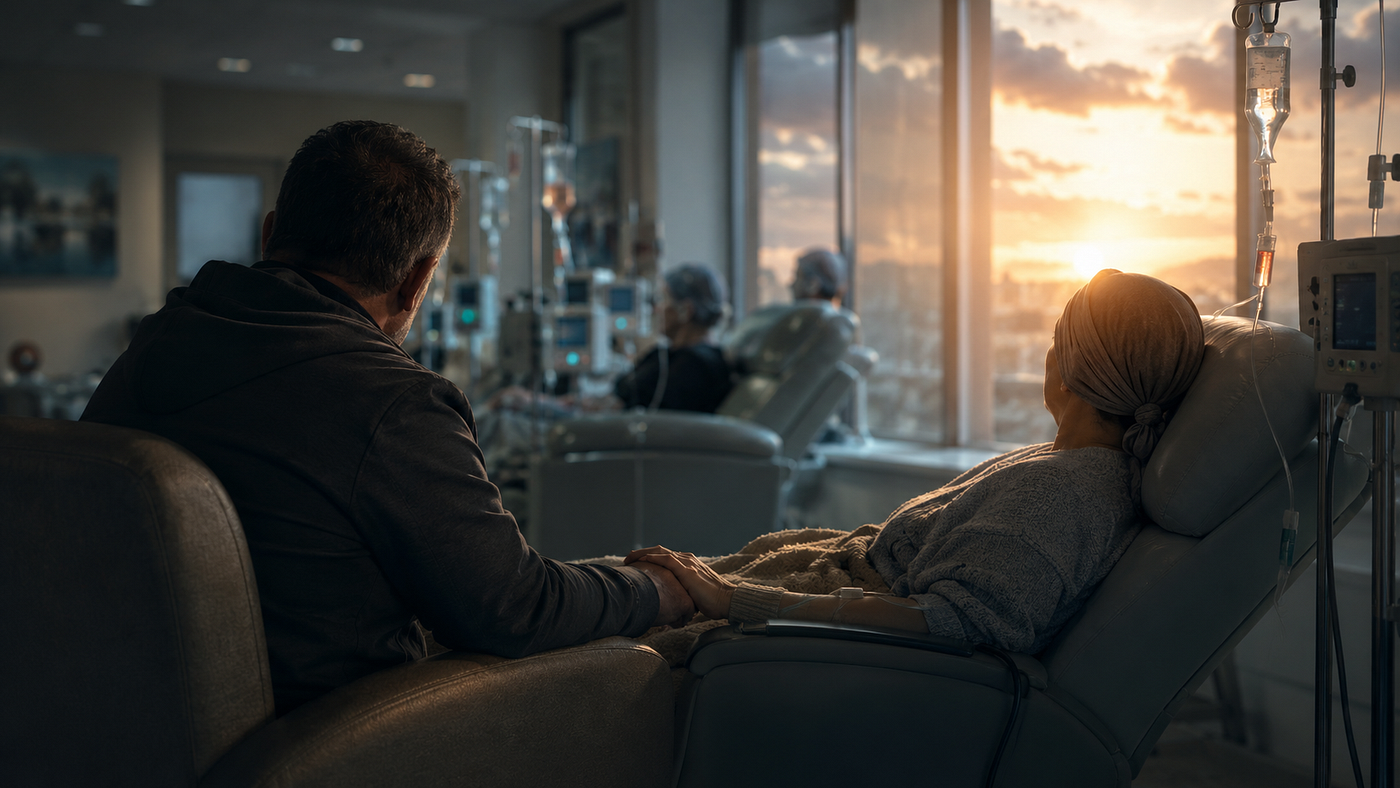
Cancer Warrior Dale 2025 Stage IV Oesophageal Cancer — How I Took Control of My Cancer
Posted by Ian Doherty
Cancer Warrior Dale 2025 Stage IV Oesophageal Cancer — How I Took Control of My Cancer
Posted by Ian Doherty
Author Dale
As part of our Awareness blog we have now commenced having writers that have and/or undergone various treatments for Cancer. The first writer from outside our team is Dale and his Stage 4 battle against Oesophageal Cancer. Dale has developed an incredible regime of combined medication that assists chemotherapy to defeat his cancer.
My Backstory
In a quaint little village called Burghfield Common, on the outskirts of Reading, UK — October 2024 — It was supposed to be the month everything changed — just not like this.
For years, I’d been building my business from scratch. The long nights. The weekends sacrificed. The stress that never switched off. All of it was finally about to pay off — I was two days away from signing a life-changing multimillion-pound contract with a UK high street bank.
We were preparing for a new life too. We’d accepted an offer on our house. Spain — Almuñécar — was calling. A slower life. A better life. The boys would grow up barefoot on the beach, speaking Spanish (Ana, my partner’s, native language), soaking up a childhood filled with sunshine and freedom.
We were clearing out, downsizing, dreaming big.
Add in two toddlers and a Great Dane puppy — my big silly Dukey-dog — all paws, love and chaos — and life was full to the brim. Hard. Beautiful. Messy. Perfect.
But under the surface, there were signs I ignored for too long.
I’d battled heartburn and acid reflux for years. Just part of the job, I thought. Price of ambition. But by July and August 2024, things started shifting. The reflux got worse. Then came the back pain — a dull, heavy ache that wouldn’t let up. And swallowing became harder, like something was blocking the way down.
I went to see a chiropractor. Thought maybe it was posture. Stress. Anything but what it actually was.
Meanwhile, Ana — my partner, my anchor — got blindsided by her own diagnosis. Lung cancer. No history. No warnings. Just one day, the world flipped upside down.
She went through surgery. A lobectomy. Her parents flew over from the US to help, because she couldn’t drive, couldn’t lift the boys, could barely lift herself some days. We became a one-parent, one-patient household overnight.
And my symptoms kept worsening.
The pain wasn’t leaving. The swallowing got worse. Something deep inside me knew — this wasn’t stress. This wasn’t a trapped nerve. It was something bigger.
My doctor finally managed to get me an endoscopy. Ana, still recovering, stayed home. I drove myself. Refused anaesthesia — I needed to get myself home afterward — I’ll never forget the rancid banana taste of the numbing agent — ergh…
It was supposed to be simple — quick, routine.
Instead, halfway through, the consultant paused. Looked at the monitor. Looked at me. And said words that punch harder than any fist:
“It’s cancer.”
An agonising week later and I met with the oncologist. It was a Stage IV oesophageal adenocarcinoma.
Spread to multiple lymph nodes.
A secondary tumour wrapped around my aorta.
Incurable. Inoperable.
Palliative care only.
An 11.5m prognosis on the clock, which was already counting down far too quickly.
And, to top it off, it was my youngest son’s first birthday.
Everything collapsed. The dreams. The plans. The future we’d been building.
We pulled out of the house sale. The kindest buyers you could imagine sent us a get well card and a Christmas card anyway. People like that still exist.
Ana, somehow still healing from her own cancer battle, stepped up even further. A few months later, she even trained as a phlebotomist and cannulation expert so she could cannulate me at home. Ran IVs. Tracked meds. Held everything together when I could barely hold myself up.
Then came another blow.
My mum — my boy’s “Granny Naughty” (a nickname she game herself fyi) — died. The day before Axel’s third birthday. We found out on the morning of his party. We put up balloons. Sang songs. Took pictures. Smiled through shattered hearts.
And then there was Duke.
Our beautiful, clumsy, loving Great Dane. I was in hospital more than I was home. Ana was drowning under the weight of it all, still recovering from her own surgery and cancer journey. Duke needed more than we could give. So, with broken hearts, we rehomed him. Gave him the life he deserved — even as it destroyed a piece of us to do it.
Grief piled on grief. Loss piled on loss. And life — cruelly — didn’t pause.
We still had toddlers who needed cuddles, bedtime stories, and constant attention.
We still had bills to pay.
We still had dreams flickering in the dark.
Lie down and accept it. Or fight like hell. I chose to fight.
And in the middle of all of it, I had a choice.
Not just for me.
Strategically. Intelligently. Unapologetically.
For Ana.
For our boys.
For the life we hadn’t finished living yet.
And that’s where this story really begins.
How I Took Control
Let’s be honest — I wasn’t supposed to be writing this.
Back in October, the message was brutally simple:
Incurable. Inoperable. Palliative care only.
11.5 months to live. Start looking for a good Hopsice.
That was the NHS’s best guess. A cold number. A quiet verdict.
But I didn’t want to guess what happened next.
I wanted a strategy. A plan. A way to tip the odds back into my favour.
At this point I want to note that the below isn’t quite in order of how I actually did them, it would be too hard to tell the story in the messy order it really happened — thus, I’m taking some artistic licence and applying a heavy dose of “in hindsight” as to make it more readable and understandable.
So I stopped waiting for someone to save me — and started learning how to save myself.
Step One: Know Your Enemy
The first thing I did was go beyond what the hospital offered.
I ordered a test Datar Cancer Genetics test, via a company called Astron Health — essentially, they did a full molecular and genomic profile of my tumour.
Not just ‘you have cancer.’
But what kind.
What drives it.
What feeds it.
What mutations it’s carrying.
Which pathways it hijacks.
What it might respond to — and what it might resist.
Suddenly, I wasn’t fighting blind anymore.
I had a map. A tactical advantage.
And most importantly — a starting point.
Step Two: Chemotherapy and Immunotherapy — Surviving the Necessary Evil
Let’s be clear: chemotherapy is not a gentle therapy.
It’s chemical warfare — designed to destroy anything that divides quickly, whether that’s cancer cells, hair follicles, gut lining, or immune cells.
I was prescribed CAPOX — a combination of Capecitabine, an oral chemotherapy, and Oxaliplatin, a platinum-based IV drug.
The treatment plan:
-
Oxaliplatin infusion every three weeks
-
Capecitabine tablets twice daily for three full weeks after each infusion
-
No breaks — except when neutropenia forced our hand.
The decision to proceed with chemo wasn’t one I made lightly.
Originally, I was prepared to decline chemotherapy altogether and pursue a purely alternative route.
But my Datar Genetics molecular profiling showed that CAPOX had a high predicted efficacy against my specific tumour mutations.
That, combined with my team’s input, made me rethink.
I wasn’t going to throw away a tool that might give me extra time — time to get everything else working.
Still, knowing and enduring are two different things.
The fatigue after each round was devastating — full weeks spent mostly in bed, body and brain battered into silence.
Neuropathy kicked in early — numbness, burning, tingling in my hands and feet, making even basic tasks painful or impossible.
And then came the bigger problem: neutropenia.
Neutropenia is when your neutrophils — a crucial type of white blood cell responsible for fighting infections — crash to dangerously low levels.
Without neutrophils, even a toddler’s sneeze could turn into life-threatening sepsis.
We had to adapt fast:
-
We pulled the boys out of nursery to avoid exposure to everyday bugs.
-
We isolated at home — no visitors, no playdates, no unnecessary outings.
-
Even the workmen renovating our bathroom were asked to wear masks and sanitise — anything to minimise infection risks.
The whole house became a sterile bubble to give me a fighting chance.
With my first bout of neutropenia getting worse as the weeks went on, I knew I needed more than conventional neutrophil boosters.
So I built my own additional support system:
-
Vitamin B3 (Niacinamide) to stimulate white cell production
-
Super dark chocolate (montezumas absolute black to be exact) for its immune-modulating flavonoids
-
Walnuts for their antioxidants and omega-3s
-
natural yoghurt and protein, to help give my body the much needed building blocks
It wasn’t a miracle — but it helped.
It gave my body just enough extra fuel to keep going and start making blood cells again.
Now, with chemo coming to an end in another month or so, I’m transitioning onto maintenance immunotherapy.
While chemotherapy bludgeons everything, immunotherapy trains the immune system to spot and destroy lingering cancer cells — like sharpening a blade.
There are still risks — immune storms, autoimmune reactions, liver inflammation — but right now, it feels like the next right move.
Chemo bought me the window.
Immunotherapy — along with everything else I’m doing — aims to slam the door shut.
Step Three: Build the Protocol
Armed with that information, I found an integrative oncologist who wasn’t trapped inside protocol-only thinking.
Someone who understood the emerging science around drug repurposing, immune modulation, metabolic therapy, and terrain theory.
Together, we built a protocol.
Not based on Facebook groups or Instagram science or Tik Tok miracle cures.
Not based on hope alone.
But grounded in real science, clinical insight, and a brutal honesty about what made sense for me — and only me.
My Off-Label Drug Protocol
In partnership with my (external to the NHS) integrative oncologist, and guided by my Datar Genetics report, here’s the complete off-label protocol I’m running:
Metabolic Modifiers & Tumour Starvation
-
Metformin — Lowers glucose and insulin availability; disrupts tumour energy supply
-
Pantoprazole — Alters tumour pH; may help make chemotherapy more effective
-
Ivermectin — Interrupts cancer cell metabolism; suppresses WNT signalling
-
Fenbendazole — Disrupts microtubules and glucose metabolism
-
Mebendazole — Similar to fenbendazole; also blocks angiogenesis
-
Sulfasalazine — Inhibits xCT transporter; impacts glutamate signalling and detox mechanisms
Beta Blockade & Stress Response
- Propranolol — Blunts stress hormones that fuel tumour growth and vascularisation
Inflammation Control & Immune Modulation
-
Aspirin — Anti-inflammatory, anti-platelet; may reduce metastasis
-
Celecoxib — COX-2 inhibitor; targets inflammatory pathways
-
Cimetidine — H2 receptor blocker; may reduce immune evasion and cancer cell adhesion
Mitochondrial Disruption & Cancer Stem Cell Targeting
-
Doxycycline — Targets cancer stem cells; disrupts mitochondrial function
-
Itraconazole — Blocks angiogenesis and Hedgehog signalling
-
Hydroxychloroquine — Inhibits autophagy; starves stressed cancer cells
Now, to be crystal clear: I’m not suggesting anyone runs off to cobble together their own DIY cancer protocol. That’s not bravery, that’s biochemistry roulette — and really not advised!
These drugs are powerful. They have side effects. They interact with standard treatments. And they should never be used without the guidance of an oncologist (preferably one who’s open to exploring beyond the textbook).
But for those of us who’ve exhausted the standard script — or who simply want to understand all the tools possibly available — awareness matters. And asking the right questions can open the right doors.
What I Didn’t Include
Some other well-known repurposed drugs were considered — Atorvastatin, Dipyridamole, Loratadine, Niclosamide, Low-dose Naltrexone, and Aprepitant — but after reviewing my profile, we left them out (for the time being anyway).
Because this isn’t about throwing the kitchen sink at it.
It’s about precision.
Layering smartly.
Building strategically.
Before I go any further: None of these therapies should ever be started without talking to a qualified practitioner.
The Therapies (With a Very Important Caveat)
Many interact with conventional treatments. Some can seriously backfire if used incorrectly.
And especially:
High-dose IV Vitamin C must never be given without first testing for G6PD deficiency.
In G6PD-deficient patients, it can cause a life-threatening reaction.
IVC must be administered by trained hands who know what they’re doing — especially if you’re undergoing chemo, immunotherapy, or radiation.
This isn’t guesswork.
This is clinical warfare.
Supportive & Complementary Therapies
Here’s what else I added to support my body, reduce side effects, and create a terrain where cancer struggles to survive:
-
Hyperbaric Oxygen Therapy (HBOT)
-
High-dose IV Vitamin C (after G6PD testing and under clinical oversight)
-
Mistletoe Therapy
-
Red Light Therapy
-
pEMF Therapy
-
Full-body Infrared Sauna
-
Medicinal Cannabis (under prescription)
-
Targeted Supplements — Enzymes, adaptogens, mitochondrial and liver support, immune modulators, antioxidants
Every choice, every therapy, was layered carefully.
Nothing random.
Nothing reckless.
The Diet (Built for Me)
Nutrition mattered too.
I built a therapeutic diet that is:
-
Vegetarian
-
Organic
-
Wholefood
-
Keto-inspired (very low-carb, moderate protein, high fat)
-
Low in Glutamate
No sugar.
No refined carbs.
No starch.
Why?
Because tumours like mine love glucose. And I wasn’t about to feed the enemy.
Some people go full carnivore. Some go strict keto.
I chose a path that worked for my biology and my ethics.
And the difference was immediate:
-
Energy back
-
Inflammation down
-
Blood markers improving
-
Brain clearer than it had been in years
Execution (This Isn’t a Hobby)
None of this happens by accident.
It takes planning. Research. Spreadsheets. An army of checklists. A willingness to stay the course even when you’re tired, scared, or overwhelmed.
But most importantly — it takes a team.
And that team starts with Ana.
She didn’t just support me.
She enabled this.
She trained as a phlebotomist.
Cannulated me at home.
Mixed my infusions in our kitchen.
Managed supplements. Appointments. Hospital correspondence.
All while raising two toddlers.
All while still healing from her own cancer surgery.
Ana isn’t just part of my survival.
She is the infrastructure underneath it.
Self-Advocacy in the Oncology Office — Watching My Own Back
When I first met my oncologist, I was optimistic.
She seemed open-minded — told me she was supportive of “alternative therapies” alongside conventional treatment.
I thought I had an ally.
But it quickly became clear that when she said “alternative therapies,” she really just meant yoga, and maybe a bit of breath work…
The moment I mentioned off-label drugs, metabolic therapies, mistletoe, hyperbaric oxygen, or anything that didn’t come straight from an NHS standard of care, her tone changed.
I was told it was “dangerous.” That it would “interfere.” That I should stick to what was prescribed and stop overcomplicating things.
It didn’t end there.
- Steroids in chemo: Without informing me, she tried to increase the dexamethasone (a particularly strong corticosteroid — used to help dampen the side effects of chemo) dose during my IV chemo infusion from the standard 8mg to 20mg.
Thankfully, I caught it when the nurse was setting up the drip.
I questioned it — pushed back heavily — and eventually got them to reduce it back to the standard 8mg.
Steroids aren’t harmless — they have profound immune-suppressing and metabolic effects, especially at such high doses.
Had I not been paying close attention, that change could have seriously undermined other parts of my strategy.
- Medications changed without discussion:
There have been multiple occasions where agreed parts of my treatment were either altered or quietly dropped without consulting me — including additional G-CSF injections I had specifically requested and had been agreed, to help boost my neutrophils.
Surgery push:
Each time, it’s been down to me to spot it, challenge it, and correct it.
More recently, my oncologist has pivoted to advocating for surgery — despite the fact that surgery was initially ruled out as an option due to my staging and overall prognosis.
The Power of Saying “No” — and Why It Might Just Save Your Life…
When my cancer started to respond to treatment — shrinking by 30–50%, with all signs of metastasis disappearing — a new door opened: Surgery
An oesophagectomy. The “curative” option.
It’s what the textbook says to do. It’s what many people assumed I would do. It’s what a doctor friend spent half an hour over Easter lunch trying to convince me to do. It’s what, not that long ago, I probably would have done without question.
But after everything we’ve been through — Ana’s diagnosis, my own fight, the endless research — I knew I couldn’t just say yes out of fear.
Because surgery isn’t just surgery. An oesophagectomy is life-changing. It comes with risks, serious side effects, and for many, a major loss in quality of life.
And the truth is: I am already surviving. I am already healing. And I believe — deeply — that the team, the protocol, and the momentum I’ve built can take me further without cutting my body apart.
So, I took a leaf out of Phil Richards MBE book, and I said “No”.
Not out of denial. Not out of arrogance.
But out of understanding. Self-advocacy. Trust.
Saying no was one of the hardest — and most empowering — decisions I’ve made since diagnosis.
Because here’s the thing nobody tells you:
- Saying yes to everything doesn’t make you brave.
- Sometimes, courage looks like saying no — even when others don’t understand.
If you’re facing your own decision point, here’s what I learned: You are allowed to ask why. You don’t have to accept every recommendation without question. You are allowed to wait. To assess. To watch. To give yourself time to make the decision that’s right for you. You are allowed to say no. Even if it goes against the standard. Even if it makes people uncomfortable.
Because this is your body. Your life. Your rules.
Surgery might still be part of my journey one day. By no means am I ruling it out forever.
But today, I choose trust. Trust in my body. Trust in the momentum we’ve built. Trust in the science and strategy that’s got me this far.
If you’re navigating your own hard choices right now — I see you
And,I want you to know: whatever path you choose, it should be yours.
What all this has taught me is simple:
You must be your own advocate.
No one — no matter how qualified, how experienced, or how well-intentioned — will care about your survival, your body, or your future more than you do.
You have to question everything.
You have to know your facts.
And you have to be ready to say no — loudly, clearly, and unapologetically — when something doesn’t sit right.
It’s your life.
Protect it fiercely.
Precision Matters: The Bloodwork & Supplement Protocol
Building a protocol isn’t a one-off decision.
It’s a living, breathing system that evolves with me — because cancer evolves too.
Every month, I sit down with my nutritionist and naturopath — one of the sharpest minds and kindest soul’s I’ve come across.
Together, we pull apart my bloodwork like detectives at a crime scene.
I run full panels every month:
-
Inflammatory markers
-
Liver function
-
Kidney function
-
Nutrient levels
-
Hormone profiles
-
Immune activity
-
Blood glucose and insulin
-
Vitamin D, magnesium, zinc, selenium, and more
Everything you can imagine.
Everything the body needs to heal, recover, and fight.
We don’t guess.
We measure.
We track.
We tweak.
Supplements aren’t thrown at me randomly either.
I take close to 50 targeted supplements and/or vitamins a day — each one chosen for a reason, mapped to my exact bloodwork and cancer profile.
It’s like walking a biochemical tightrope:
Giving my body the exact building blocks it needs, without tipping into excess, toxicity, or imbalance.
Think of it like Brian Johnson’s “Blueprint” — the Silicon Valley billionaire trying to reverse his age -
but this isn’t about vanity.
This is life and death.
A race to stay ahead of a disease that rewrites the rules constantly.
My team and I adjust dosages monthly.
Dial things up. Dial things down.
React to trends early, before problems explode.
Because in this game, the small margins matter.
The 1% changes stack up.
And when your body is the battlefield, you leave nothing to chance.
Where I Am Now
Six months into a terminal diagnosis:
-
My metastases are gone
-
My primary tumour has shrunk by between 30–50%
-
Chemo is nearly finished
-
I’m transitioning to maintenance immunotherapy + my protocol
Is it remission?
Not yet.
But it’s progress.
Real, measurable, meaningful progress.
And it’s proof that when you learn, plan, and fight smart — you can shift the odds.
Even when they tell you the odds are zero.
The Setbacks & Staying Human
If you’ve made it this far, you might be thinking,
“Wow, this guy has it together.”
Because this journey hasn’t been neat.
Let me stop you right there.
It hasn’t been clean or courageous every day.
It’s been more snakes than ladders.
For every scan that showed hope, there’s been a blood test that broke me.
For every moment of feeling empowered, there’s been a night lying awake, wondering if I would see my boys grow up.
This wasn’t just a physical battle.
It became a battle for our whole lives.
Neutropenia: The Great Unraveller
Chemo did what chemo does.
It battered my immune system into submission.
Neutropenia hit hard, more than once.
When your neutrophils — the white blood cells that fight infection — crash to near zero, even a toddler’s cold can be fatal.
We lived like fugitives in our own home.
Thermometers in every room.
Hospital bag packed by the door.
Antiseptic wipes within reach at all times.
A slight chill, a cough, a flushed cheek — and it was a full system panic.
We had to lock the world out to survive.
The Kids: Innocence Interrupted
The boys had to leave nursery.
Their innocent, runny noses and sticky hands became a threat I couldn’t afford.
No playdates.
No birthday parties.
No crowded parks.
Their world shrank down to four walls, an exhausted dad, and a recovering mum.
And still — still — they smiled.
They climbed into bed with us, bringing toy cars and superhero figures.
They handed me my meds like they were handing me treasure.
They sat by my chemo chair, acting out scenes where they were “fighting the bad guys, and saving daddy.”
Tiny nurses. Big hearts.
More resilient than I could ever put into words.
Ana: Patient, Partner, Powerhouse
Ana didn’t just survive her own cancer — she became my army.
While still recovering from her lobectomy, she trained as a phlebotomist so she could cannulate me at home (under the watchful supervision of our amazing nurse friend Jo, who has also been beyond amazing with her support on this journey of mine too).
She mixed IV bags in our kitchen, read research papers and articles I sent her (between toddler tantrums), kept notes and calendar entries with meds and appointments and supplements on.
She didn’t ask for this.
She didn’t get time to heal first.
She just stood up, wiped her eyes, and got to work.
Ana didn’t just support me -
She enabled me.
She was the hands I didn’t have when mine shook too much.
The strength I borrowed when mine ran dry.
The Losses: My Mum and Duke
Grief became a second skin.
My mum — our beloved Granny Naughty — died the day before Axel’s third birthday.
The morning of his party, we got the call.
And then somehow, we still sang happy birthday. Still lit candles. Still smiled for photos with broken hearts.
That week was a haze of cake and tears.
Then Duke.
Our beautiful, clumsy, amazing, loveable Great Dane.
He needed walks. Play. Company.
We could give him none of it anymore.
Ana was overwhelmed. I was in hospital more often than not.
Leaving Duke locked up, lonely, wasn’t fair.
We made the heartbreaking decision to return him to the breeder — who promised to find him a sofa to sprawl on, somewhere he could be truly loved again.
Saying goodbye to Duke broke me in a way words can’t touch.
The Abandoned Dream
Spain faded like a dream at dawn.
We had accepted an offer on the house.
Packed boxes.
Planned it all out.
Then cancer.
Then more cancer.
We pulled out. Apologised.
The buyers — who had every reason to hate us — sent us a get well card instead.
Kindness in the wreckage.
The life we were supposed to be living was gone.
Lynch Syndrome — Another Layer to the Story
As part of the deeper genetic investigations into my cancer, I’m currently being tested for something called Lynch Syndrome.
For those unfamiliar, Lynch Syndrome is a hereditary condition caused by mutations in DNA mismatch repair genes.
It significantly increases the risk of developing various cancers — particularly colorectal, endometrial, stomach, and yes, oesophageal cancers — often at a younger age than typical.
Being diagnosed with Lynch would mean:
-
My cancer likely had a genetic driver alongside environmental or lifestyle factors
-
My family (including my children) could have a higher inherited risk
-
My surveillance protocols going forward would need to be even tighter and more proactive
It’s not a diagnosis I wanted on the table.
But knowledge is power.
If I do have Lynch Syndrome, it gives me a new map — a new strategy — not just for myself, but for protecting my family as well.
And that’s the key to all of this:
Not surrendering to the unknown. Learning it. Naming it. Tackling it head-on.
Staying Human
Through it all — the hospital admissions, the grief, the financial strain, the fear that came in waves — we fought to stay human.
We built cushion forts in the living room.
We turned the house into one big play area — we put in climbing frame and crash mats, we made it somewhere they wanted to be.
We turned IV days into superhero missions.
We watched movies curled up together, tangled in blankets and hope.
Ana and I still whispered about dreams at night — the IV clinic we hope to open one day, the new life we would carve out of the ashes.
Because this fight was never just about staying alive.
It was about staying me.
Tired. Frustrated. Scarred. Determined. Joyful.
Still standing.
Still dreaming.
Still human.
Final Thoughts
A little over six months ago, I was told my time was running out.
Stage IV. Incurable. Inoperable.
“Palliative care only.”
“Focus on comfort.”
11.5 months to live.
That was supposed to be my future.
But here I am.
A slow fading out.
Not just existing.
Not just enduring.
But living — on my own terms, with my own team, and my own plan.
Where I Am Today
My metastases are gone
-
My primary tumour has shrunk by up to 50%
-
I’m finishing chemo
-
I’m moving onto maintenance immunotherapy
-
And most importantly — I’m not giving up
This isn’t a miracle.
This isn’t luck.
This is the result of relentless research, brutal honesty, strategic action, massive sacrifice — and an unshakable belief that just because the system says “there’s nothing more we can do” doesn’t mean there isn’t more you can do.
If you take anything from this, let it be this:
- Learn about your cancer
Don’t outsource your life.
You don’t need a PhD to understand your diagnosis.
You just need the willingness to care enough to ask better questions, to dig deeper, to stay curious even when it hurts.
Learn what drives your cancer.
Understand what fuels it.
Ask what your options really are.
Push when you’re told to sit quietly.
Because your oncologist may know protocols -
but you know your life.
You are the constant in the room.
And that makes you more powerful than you think.
- The standard of care is not the limit
I’m not anti-NHS.
I’m alive partly because of it.
But it’s built for the majority — not the individual.
It’s built for budgets, time limits, and protocols written for the average patient, not for you.
If I had stuck to the standard playbook, I wouldn’t be here writing this.
If I hadn’t read studies at 2 a.m., reached out to unconventional experts, chased better options — I wouldn’t have a tumour that’s shrinking.
I didn’t “go rogue.”
I became informed.
Strategic. Relentless. Personalised. Prepared.
And you can too.

- Positivity is not naive — it’s essential
I don’t mean the kind of positivity that glosses over reality.
I mean mental weaponry.
Because some days, the war happening inside your body is easier than the war happening inside your mind.
Positivity doesn’t mean pretending everything’s fine.
It means standing in the middle of the wreckage and saying, “You don’t get to win today.”
It means imagining a future that’s still worth fighting for — and doing the bloody work to make it real.
It means refusing to surrender your spirit, even when everything else feels like it’s falling apart.
- Give Back, However You Can
Ana and I didn’t just want to survive.
We wanted to make sure others could survive too.
Along with the wonderful Louise Williamson (who lives with MS), we co-founded the Pure Serenity Foundation because we know exactly what it feels like to fall through the cracks.
To be told there’s nothing more.
To feel alone and lost in a system that wasn’t built for you.
Through our Foundation — and through our JustGiving campaign — we’ve been able to fund access to HBOT for those who otherwise wouldn’t have it, and have given spaces for others to work with an extraordinary nutritionist and naturopath.
People who see the whole person, not just the diagnosis.
Because sometimes the most powerful thing you can do with your pain
People who understand biology, emotions, resilience.
is build a path for someone else as they walk through their darkness.
This isn’t charity.
It’s rebellion.
Love. Legacy. Purpose.
It says:
“We survived. Now we’re coming back for the others.”
Building Something Bigger: The Pure Serenity Foundation
When Ana and I set out to fight this battle, it quickly became clear that while knowledge and strategy are critical — access is everything.
We were lucky.
Lucky enough to find the right people.
Lucky enough to afford consultations with experts who could see beyond the standard script.
Lucky enough to build a plan when so many others are simply handed a death sentence and left to navigate it alone.
But not everyone is so lucky.
And that reality didn’t sit right with me — or with Louise Williamson, the incredible woman who helped run the Hyperbaric Oxygen Therapy (HBOT) clinic I was using.
Louise lives with MS herself, and she knows firsthand what it means to fight for access to therapies that aren’t easily available through traditional systems.
Together, we founded the Pure Serenity Foundation ( www.pureserenityfoundation.co.uk) — a growing initiative with a stubborn mission:
To give others the same fighting chance we’ve fought so hard for.
Through the Foundation — and the funds we’re actively raising via our justgiving page — we’re working to:
-
Fund access to life-changing therapies like HBOT for people who otherwise couldn’t afford it.
-
Sponsor places for individuals to work with an exceptional naturopath and nutritionist — the kind of clinical support that rebuilds the body’s terrain and gives people real tools to fight back.
-
Provide practical hope and a strategic path forward for those who’ve been told there’s “nothing more to be done.”
Because it’s not enough for us just to survive.
We want to make sure others don’t have to fight blind or alone.
Every pound we raise goes directly into helping someone else access real, evidence-based support — when the system has either given up or left them behind.
This isn’t charity.
It’s rebellion.
It’s resilience.
It’s legacy.
https://www.justgiving.com/crowdfunding/fighting-dave
It’s saying, “We didn’t just survive for ourselves. We’re coming back for the others.”
What Comes Next
The honest answer?
I don’t know.
There are no guarantees.
No promises.
No straight lines forward.
* I’m not done.* I’m not defined by my diagnosis.** * I’m not here to sit quietly.
But I do know this:
I want to build something.
Whether it’s the IV clinic Ana and I are dreaming of — a space for healing, recovery, and resilience — where we can put all we now know into helping others -
or whether it’s through Non-Executive Director roles, using my grit, strategic brain, and hard-won resilience to help businesses thrive.
Personally, I’m thinking it’s a mixture of them all…
Because I’m more than a patient.
I’m a builder.
A strategist.
A father.
A partner.
A problem-solver.
Cancer may have changed the script -
but it didn’t take the pen out of my hand.
One Final Thing
* You are not a statistic.* You are not powerless.** * You are not alone.
If you’re reading this because you or someone you love is facing cancer — I need you to hear this:
Don’t believe anyone who tells you there’s nothing more to try.
Don’t listen to people selling silver bullets or magic cures.
Research.
Ask.
Push.
Connect.
Then fight like hell — on your own terms, in your own way.
Because this story?
Yours. Mine. All of ours.
It’s still being written.
And we are just getting started.
HLAI wish to express their gratitude to Dale for writing and sharing this life changing article and approach to battling cancer. We have commenced opening our site to people who wish to discuss their own experience and battles. Open Talk is vital to help other victims of Cancer and this platform will help so many people understand what to expect throughout their own battle. Below are links to Our cancer Warriors articles that we have just commenced publishing. We would also like to invite other authors to share their approach and their journeys battling any form of cancer, please feel free to contact me to discuss ian@hlai.ie Lets all talk about cancer and help beat this life changing disease.
For our index page please click “here”
For our Cancer Warriors page please click “here”
Each page will open into a seperate tab
Originally published at http://hlai.blog on April 22, 2025.
메타데이터
- post_id
- 95ceaef6fece
- slug
- cancer-warrior-dale-2025-stage-iv-oesophageal-cancer-how-i-took-control-of-my-cancer-95ceaef6fece
- url
- https://medium.com/@ian1962/cancer-warrior-dale-2025-stage-iv-oesophageal-cancer-how-i-took-control-of-my-cancer-95ceaef6fece
- canonical_url
- https://medium.com/@ian1962/cancer-warrior-dale-2025-stage-iv-oesophageal-cancer-how-i-took-control-of-my-cancer-95ceaef6fece
- author_url
- https://medium.com/@ian1962
- status
- ok
- fetched_at
- 2026-06-20 20:29:01