USDT TRC20 AML Check: How to Screen TRON Wallets for Sanctions, Mixers & Fraud in 2025
Learn how to run instant AML checks on TRX wallets and USDT TRC20 addresses—sanctions screening, mixer detection, risk scores from 0.1 USDT.
USDT TRC20 AML Check: The Complete Guide to TRON Wallet Compliance in 2025
It started with a single $180,000 USDT TRC20 transfer.
A mid-sized P2P crypto exchange in Eastern Europe had processed the payment without running an AML check. The sender’s TRX wallet, it turned out, was three hops away from an OFAC-sanctioned entity — an address tied to a North Korean cybercrime group flagged in FinCEN’s 2024 advisory on virtual asset laundering. The exchange’s compliance officer found out six weeks later, during a regulatory audit. The fine was $2.3 million. The reputational damage was worse.
That story is not unique. In 2024 alone, Chainalysis reported that illicit actors moved over $40 billion through crypto — and TRON, home to the world’s largest circulating supply of USDT, was among the most heavily abused networks. USDT TRC20 accounts for more than 50% of all global stablecoin transactions by volume, making it the single most critical asset for AML compliance teams worldwide.
If your business touches TRON — whether you run a P2P platform, an exchange, a DeFi protocol, or simply send large USDT TRC20 payments — this guide is for you. We’ll walk through how TRON AML screening works, what a proper risk score means, and how platforms like TRX AML Check have made enterprise-grade compliance accessible to everyone from solo traders to institutional desks.
Why TRON Is the Highest-Priority Blockchain for AML Compliance
TRON’s architecture was designed for speed and low fees. A USDT TRC20 transfer costs fractions of a cent and settles in seconds — properties that made TRON the dominant stablecoin rail for global remittances, OTC desks, and cross-border payments.
Those same properties made it attractive for money launderers.
According to Elliptic’s 2024 TRON report, TRON-based wallets were involved in a disproportionately high share of sanctions-related crypto activity compared to the network’s market cap. The combination of USDT TRC20 liquidity, cheap transactions, and a large number of pseudonymous TRC20 addresses creates a near-ideal environment for layering — the second stage of the classic money laundering process.
The FATF has taken note. In its 2023 updated guidance on virtual assets, the Financial Action Task Force explicitly called out stablecoin transfers on high-throughput blockchains as a specific AML risk vector, requiring VASPs to implement enhanced transaction monitoring.
For compliance officers, this translates to one practical requirement: every TRX wallet and every USDT TRC20 address involved in a business transaction must be screened before funds are settled.
What TRON AML Screening Actually Does
Most people outside the compliance world assume “AML check” means checking a wallet address against a sanctions list. In 2020, that might have been sufficient. In 2025, it is dangerously incomplete.
Modern TRON AML screening involves five distinct analytical layers:
1. Direct Sanctions Screening
The first layer checks whether the TRX address itself appears on any active sanctions list. The major lists include OFAC’s SDN and Consolidated Non-SDN lists, the EU Consolidated Sanctions list, the UN Security Council Consolidated List, and the UK HM Treasury Financial Sanctions Register. A direct sanctions match is an automatic block — no further analysis required.
2. Multi-Hop Indirect Exposure Tracing
Here’s where basic block explorers like Tronscan fall short. Sophisticated money launderers rarely send funds directly from a sanctioned wallet to an exchange. Instead, they use intermediary wallets — sometimes dozens of them — to create distance between the dirty funds and the final destination. A proper AML engine traces the TRON transaction graph across multiple hops (typically up to 10), calculating the proportion of funds at each address that originated from a sanctioned or high-risk source.
3. TRON Mixer and Obfuscation Detection
TRON-native mixing services, token swap chains, and cross-chain bridge hops are used to break the on-chain trail. An AML platform trained specifically on TRON’s ecosystem can detect these patterns — something that generic multi-chain tools frequently miss because they lack the TRON-specific training data.
4. Dark Market and Ransomware Exposure
This layer cross-references wallet counterparties against known TRON-linked dark market wallets, ransomware payment addresses, and confirmed hack recovery wallets (for example, wallets associated with major TRON exchange hacks or bridge exploits).
5. TRON-Specific Behavioral Signals
This is the most sophisticated layer, and it’s unique to TRON. Metrics like energy rental abuse, TRC20 drainer contract interactions, unusual staking-unstaking cycles, and JustLend protocol laundering patterns are TRON-native risk signals that don’t exist on Ethereum or Bitcoin. Platforms that only apply generic AML logic to TRON miss an entire category of risk.
How to Run a TRX AML Check: Step-by-Step
For compliance teams new to TRON screening, here is the practical workflow using TRX AML Check.
Step 1: Gather the TRX address or TXID
Before any USDT TRC20 settlement — deposit acceptance, withdrawal release, OTC trade confirmation — obtain the counterparty’s TRX wallet address. You can also submit a TRON transaction hash (TXID) directly if you want to assess a specific transfer rather than a wallet.
Step 2: Select the token type
TRX AML Check supports TRX native, USDT TRC20, USDC TRC20, BTT, SUN, JST, WIN, and all TRC10/TRC20 tokens. Select the appropriate token to ensure the correct AML model is applied — USDT TRC20 and TRX have different transaction pattern profiles.
Step 3: Run the deep scan
The engine executes a 10-hop on-chain graph trace, cross-references 400+ TRON-specific risk indicators, and screens against 15+ global sanctions lists in real time. For most wallets, the full result returns in under 2 seconds.
Step 4: Interpret the risk score
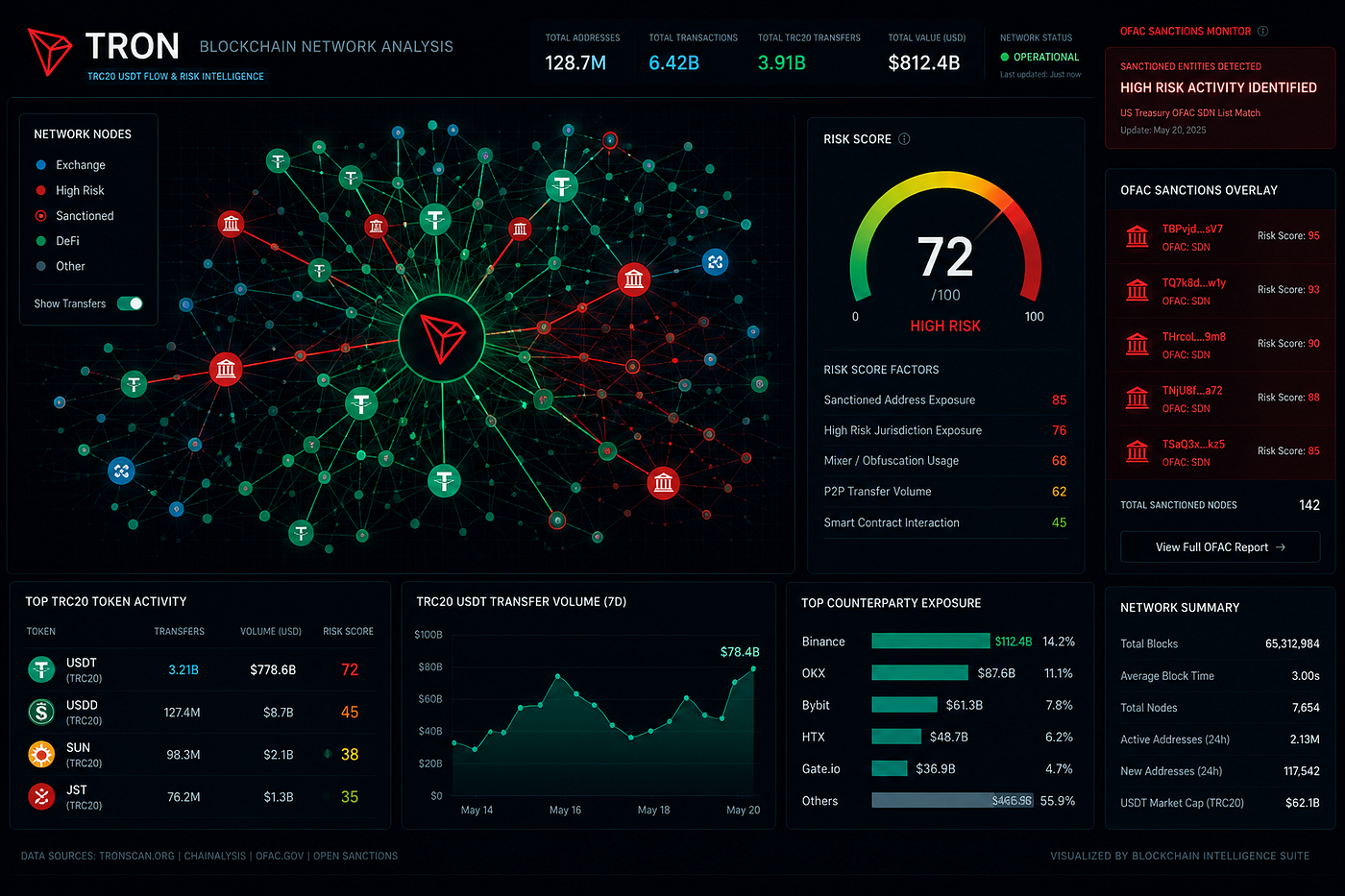
The 0–100 risk score breaks down as follows:
- 0–25: Clean — proceed normally
- 26–50: Moderate risk — consider enhanced due diligence
- 51–75: High risk — compliance action required
- 76–100: Critical — block transaction, consider SAR filing
Step 5: Download and archive the PDF report
Every TRX AML scan generates a signed PDF compliance certificate that includes the risk score, sanctions status, mixer detection result, fund flow graph, and a timestamped compliance statement. This document is your regulatory audit trail.
The USDT TRC20 Compliance Problem Nobody Talks About
The dirty secret of crypto compliance is that most AML failures don’t come from ignoring obviously flagged addresses. They come from indirect exposure that nobody checked.
Consider this scenario: a legitimate OTC desk receives a $500,000 USDT TRC20 payment from a client. The client’s wallet shows zero direct sanctions matches — it has never appeared on an OFAC list. But three hops back in the transaction graph, 22% of the funds in that wallet originated from a mixer linked to a 2023 TRON exchange hack. Without multi-hop tracing, the compliance team sees nothing. With it, they see a medium-to-high risk signal that warrants EDD before the trade clears.
This scenario plays out thousands of times per day across TRON. The OFAC FAQ on virtual currency makes clear that U.S. persons (and foreign persons under certain contexts) can face sanctions liability for indirect exposure — even when they didn’t know the funds had touched a sanctioned address. “I didn’t check” is not a defense.
Multi-hop tracing is not a nice-to-have. It’s a compliance requirement.
API Integration for TRON Exchanges and Payment Platforms
For engineering teams building TRON-native products, the compliance requirement translates into a technical integration task. Here’s what that looks like at the architecture level.
The TRX AML Check REST API accepts a POST request with a TRON wallet address and API key, returning a full JSON AML response in under 2 seconds. A typical integration for a USDT TRC20 payment processor looks like this:
Pre-deposit check: Before crediting a deposit, fire a TRX AML scan on the sending address. If the risk score exceeds your configured threshold (commonly 50–60 for retail platforms, 25–30 for high-risk verticals), hold the deposit for manual review.
Pre-withdrawal check: Before releasing a USDT TRC20 withdrawal, screen the destination address. Sending funds to a sanctioned or high-risk TRX wallet exposes your platform to the same liability as receiving from one.
Continuous monitoring: For high-value accounts, subscribe the wallet to the real-time monitoring service. Receive a webhook alert within 60 seconds of any TRON block confirmation if the wallet interacts with a newly flagged entity — including fresh OFAC designations.
Batch processing via CSV or the bulk API endpoint allows compliance teams to retroactively screen historical counterparty wallets — a common requirement during regulatory audits.
TRON AML in the Real World: Three Scenarios
Scenario 1 — The P2P Platform A USDT TRC20 P2P exchange processes 3,000 trades per day. At $0.02 per API call on a volume plan, their daily AML screening cost is $60 — roughly $1,800 per month. The alternative is a single regulatory fine, which for AML violations in the EU under MiCA starts at €5 million for the first offense. The ROI math is trivial.
Scenario 2 — The Individual OTC Trader A high-net-worth individual trading $50,000+ USDT TRC20 blocks on a P2P basis runs a single TRX AML scan at $0.10 before each trade. Over a month with 20 trades, total AML cost is $2.00. The protection is the same that institutional compliance teams rely on.
Scenario 3 — The DeFi Protocol A TRON-native DeFi protocol integrates TRX AML Check’s smart contract analysis to flag TRC20 deposits from high-risk wallets. Liquidity providers are protected from co-mingling their assets with illicit funds — reducing protocol-level sanctions risk under the OFAC action against Tornado Cash precedent.
Choosing the Right TRON AML Tool: What to Look For
Not all TRON AML tools are equal. Here are the criteria that matter for a 2025 compliance stack:
TRON-specific training data — Generic multi-chain platforms apply one-size-fits-all models to TRON. They miss TRON-specific laundering patterns like energy rental abuse, TRC20 drainers, and TRON DeFi layering schemes.
Real-time sanctions list sync — OFAC can add new designations without advance notice. Your AML tool must sync sanctions lists in real time, not on a weekly batch update.
Multi-hop tracing depth — The minimum acceptable hop depth for TRON compliance is 5. Ten hops is the professional standard.
Report format for regulatory purposes — PDF compliance certificates with timestamps, methodology disclosure, and signed attestation are required by most AML programs. JSON-only outputs are insufficient for audit documentation.
Pricing transparency — Pay-per-scan models ($0.10 per check) are suitable for lower-volume use cases. API and bulk plans with per-call rates down to $0.01–$0.02 are necessary for high-volume integrations.
FAQ
Q: Is TRON AML screening legally required? A: For regulated entities (exchanges, VASPs, payment processors), yes — under FATF recommendations, EU MiCA, and national AML laws in most major jurisdictions. For individuals, screening is not legally mandated but protects against inadvertent sanctions violations.
Q: Can I check a USDT TRC20 address instead of a TRX wallet? A: Yes. USDT TRC20 addresses are TRX addresses at the protocol level. Any USDT TRC20 address can be submitted directly for a full AML scan.
Q: What does a TRX AML report include? A: Risk score (0–100), sanctions check across 15+ lists, mixer detection, dark market exposure, fund flow graph, TRON energy/bandwidth analysis, and a signed PDF compliance certificate.
Q: How is TRX AML Check different from Tronscan? A: Tronscan is a block explorer showing raw transaction data. TRX AML Check performs automated AML analysis, multi-hop fund flow tracing, sanctions screening, and generates structured compliance reports — it is a compliance tool, not a data viewer.
Q: Can I use TRX AML Check for free? A: New accounts receive 3 complimentary scan credits on registration with no credit card required. A sample PDF report is also available for download without registration.
Q: What happens if a scan returns a critical risk score? A: The report details the specific risk factors found. The compliance decision — blocking the transaction, requesting EDD, or filing a SAR — remains with the user. TRX AML Check provides the data; your compliance program determines the response.
Q: Does the platform support bulk screening? A: Yes. CSV bulk upload (up to 10,000 addresses) and batch API requests (up to 1,000 addresses per call) are available on bulk and API plans.
Q: Are reports accepted by regulators? A: TRX AML Check reports are structured to meet CDD/EDD documentation standards in most major regulatory frameworks. Regulatory acceptance varies by jurisdiction; consult a qualified AML professional for jurisdiction-specific requirements.
Conclusion: AML Is No Longer Optional on TRON
The TRON blockchain processes hundreds of millions of dollars in USDT TRC20 transfers every day. Regulators, from the FATF to the EU’s MiCA framework to OFAC, have made their position unambiguous: VASPs and businesses handling crypto assets must screen counterparties before transactions settle.
The cost of non-compliance — measured in fines, license revocations, and reputational damage — dwarfs the cost of screening. At $0.10 per scan, there is no longer a price barrier to TRON AML compliance. There is only the decision of whether to act before a problem surfaces or after.
Whether you process five USDT TRC20 transfers a month or five million, the standard is the same: know who you are transacting with.
Start your first TRX AML scan today — TRX AML Check offers 3 free scans on registration, no credit card required. Enterprise API access, bulk plans, and white-label reports are available for businesses at any scale.
메타데이터
- post_id
- 95d5f5d7a85a
- slug
- usdt-trc20-aml-check-how-to-screen-tron-wallets-for-sanctions-mixers-fraud-in-2025-95d5f5d7a85a
- url
- https://medium.com/@ituvuci563/usdt-trc20-aml-check-how-to-screen-tron-wallets-for-sanctions-mixers-fraud-in-2025-95d5f5d7a85a
- canonical_url
- https://medium.com/@ituvuci563/usdt-trc20-aml-check-how-to-screen-tron-wallets-for-sanctions-mixers-fraud-in-2025-95d5f5d7a85a
- author_url
- https://medium.com/@ituvuci563
- status
- ok
- fetched_at
- 2026-06-26 08:21:59