NOOSA: A BIOSPHERE OF RELATIONSHIPS
So few biospheres guard so much Earth. One hidden surfer in mine.
NOOSA: A BIOSPHERE OF RELATIONSHIPS
So few biospheres guard so much Earth. One hidden surfer in mine.
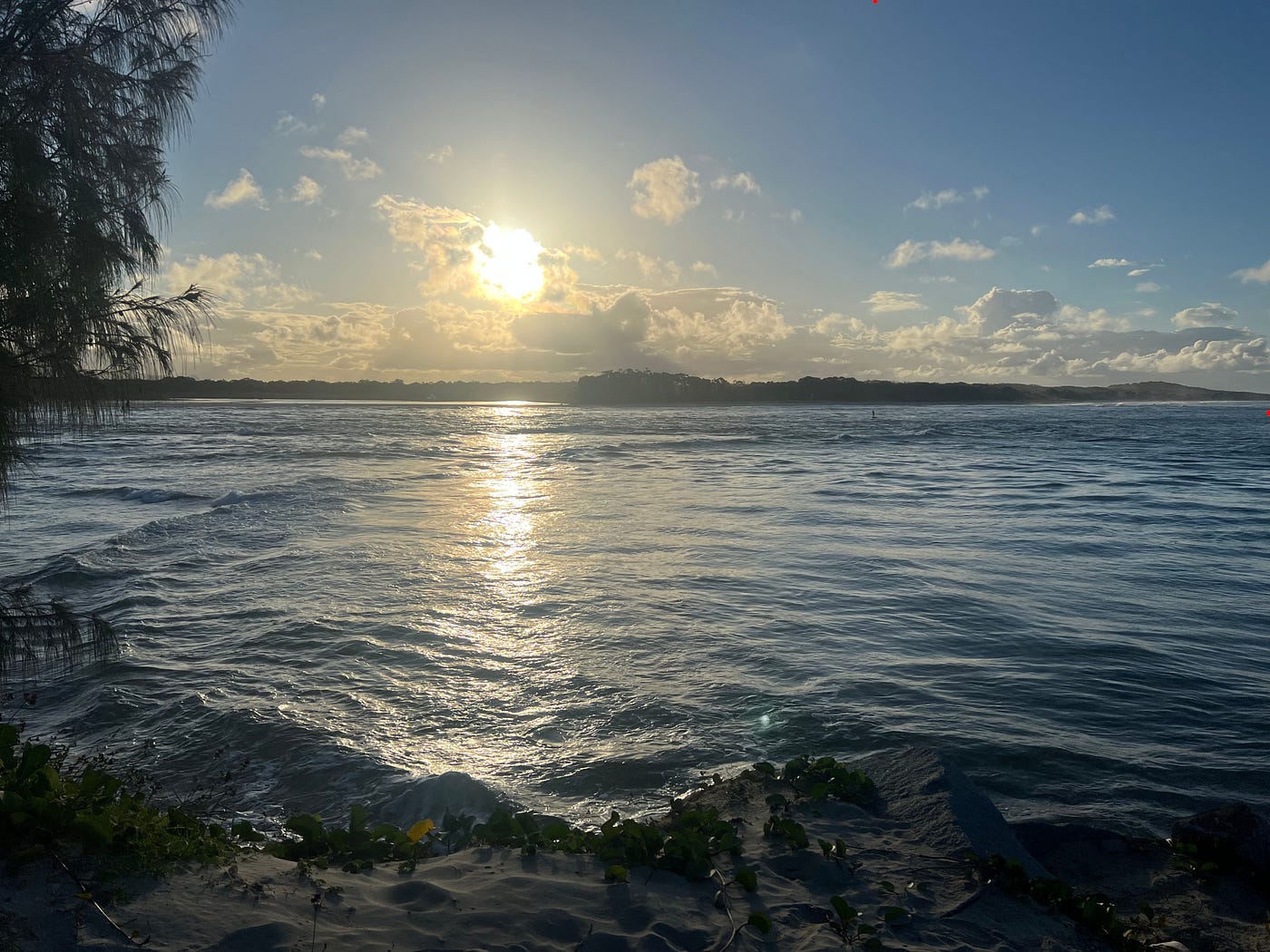
The mouth of the Noosa River where fresh water meets salt water. Sun breaking through afternoon clouds creates a golden pathway across the confluence. Taken with iPhone 13 Pro of the Author
The United Nations has designated only a few places on Earth as Biospheres — locations where oceans, rivers, lakes, mountains, plains, and forests coexist within a compressed geography. Noosa, on Queensland’s Sunshine Coast, holds this rare status. But the designation isn’t about preservation in amber, about protecting some pristine Eden behind velvet ropes. A Biosphere isn’t a museum. It’s a negotiation.
These photographs, captured over the course of a year with an iPhone 13 Pro, document not the place itself but the relationships that make the place possible. Each image is a case study in coexistence — where two systems meet and either conflict, adapt, or achieve equilibrium. From the smallest household symbiosis to the largest geological poetry, Noosa exists only in these interfaces.
THE HOUSEHOLD COMPACT

A gecko demonstrates perfect adhesion on weathered timber rafters. These household residents consume mosquitoes and insects while defying gravity with specialized toe pads. Photo by Author
Consider the gecko. Suspended upside-down from weathered rafters, all four feet splayed in perfect adhesion, this small lizard has negotiated a relationship with human habitation that benefits both parties. The gecko consumes mosquitoes and unwanted insects with methodical efficiency. The human provides shelter and warmth. Those suction-cap toes — adhesive pads so effective they could theoretically wash dishes without dropping one — allow the gecko to patrol ceilings where humans can’t reach, and insects congregate.
This particular individual demonstrated professional modeling skills when informed its portrait was needed. No camera shyness. Just the classic gecko cruciform, perfect form, appropriate gravity-defiance. Like all successful relationships, it’s built on clear mutual benefit and respect for boundaries.
EVOLUTIONARY MISCALCULATION

Electric turquoise leafhopper attempts camouflage against weathered timber — a strategy that works brilliantly on flowers but fails spectacularly on gray-blue wood. Photo by Author
Not all negotiations succeed. This brilliantly colored leafhopper, displaying electric turquoise stripes alternating with jet-black stripes, has attempted to blend in with a weathered timber handrail. The strategy represents a catastrophic failure in context-matching. These insects evolved their spectacular coloring to camouflage against equally spectacular flowers — tropical blooms where electric blue makes evolutionary sense. Against gray-blue timber, it’s wearing a high-visibility vest on a stealth mission.
The iPhone 13 Pro’s aging sensor captures what it can, though the colors are likely even more intense in person. The insect remains unaware that its relationship with this particular substrate is fundamentally incompatible. We haven’t informed it. Evolution will handle the feedback in its own time.
PHILOSOPHICAL WARFARE

Australian Brush Turkey crossing sun-dappled pavement. Protected by $18,000 fines, these anarchists systematically enforce their belief that French formal gardens belong in Versailles, not Queensland. Photo by Author
The Australian Brush Turkey operates under no such illusions about compatibility. These prehistoric creatures — black plumage, crimson head, brilliant yellow wattle — approach landscaping with philosophical conviction. French formal gardens belong in Versailles, they believe. Here in Noosa, everything should look like wild bush. They enforce this belief by systematically destroying any manicured garden that does not align with their aesthetic vision.
Protected by an $18,000 fine, they operate with complete impunity. Despite their reputation as ground-dwellers, they can fly when needed and roost on roofs and in high branches. They build massive compost-heap nests where they deposit up to twenty eggs that hatch at summer’s peak. Only a handful of chicks survive the gauntlet of pythons and domestic cats — nature’s harsh editorial process. Like any effective anarchist, the brush turkey can outrun a Ferrari on short stretches and has successfully resisted every attempt at domestication or compromise.
DEMOCRATIC CHAOS, CONTAINED

Kayak storage at Noosa Surf Club. Individual expression achieves maximum volume within utilitarian constraints — democratic color theory that Michelangelo never conceived. Photo by Author
The kayak storage rack at the Noosa Surf Club presents a different model of coexistence. Here, individual expression achieves maximum volume within utilitarian constraints. Pink, yellow, turquoise, orange, lime green, red, blue — every craft asserts its personality through color choice. Some feature bold racing stripes, others graphic patterns. The metal rack system with its padded supports creates geometric order, but the visual effect is pure chromatic rebellion.
This is a color theory that Michelangelo never conceived. The Sistine Chapel worked within Renaissance aesthetic constraints and religious symbolism. This rack operates under no such limitations. It’s democratic — everyone gets to pick their own shade of loud, and somehow, stacked together, it works. Not harmoniously, exactly, but honestly. The relationship between individual expression and collective function remains contentious but functional.
BOTANICAL PERSISTENCE

Noosa coastline featuring Pandanus palms, whose roots thrive in salt water conditions that would kill conventional vegetation. iPhone panoramic mode. Photo by Author
The Pandanus palms that punctuate Noosa’s coastline have negotiated a more patient relationship with their environment. Those spiky, architectural trees with spray-like leaves create dramatic silhouettes against sky and ocean. Their evolutionary marvel isn’t visible in the photograph — it’s underground, where their roots sit in salt water, enduring conditions that would kill conventional vegetation.
The panoramic format (iPhone’s computational stitching working across multiple frames) emphasizes the breadth and openness of the Queensland coast. But the real story belongs to those Pandanus trees — survivors that thrive where most would surrender. They’re botanical proof that adaptation beats complaint, that success in harsh conditions is simply a matter of evolving the right relationship with your environment. They ask nothing from the salt water except that it remain predictably lethal. In return, they define the visual signature of this coastline.
VOLUNTEER GUARDIANSHIP

Surf lifesavers at Noosa patrol station in iconic yellow-and-red uniforms. These volunteers maintain the interface between recreational optimism and the ocean’s capacity for sudden violence. Photo by Author
Five surf lifesavers relax outside their patrol station, wearing the iconic Australian yellow-and-red uniform that signals safety across the country. Bright yellow rashguards emblazoned with “SURF RESCUE” in bold red, distinctive broad-brimmed hats, sunglasses, and easy camaraderie. These are volunteers — they do this because they choose to, because when things go wrong in the water, someone has to know what they’re doing.
This ought to be the best unpaid job in the world. Sun, beach, friendship, and those colors that make every child laugh with recognition and relief. The Australian surf lifesaving movement is legendary — a cultural institution where fitness, community service, and beach culture intersect. The relationship these volunteers maintain isn’t with the beach but with the ocean’s capacity for sudden violence. They’re the interface between recreational optimism and hydrodynamic reality.
SHARED RESOURCES

Australian pelicans near timber jetty on the Noosa River, just hundreds of meters from ocean beaches. Fishing is practiced here by both species on shared communal grounds. Photo by Author
Just a few hundred meters from those ocean beaches, the Noosa River presents a different character entirely. Seven Australian pelicans float in formation near a weathered timber jetty, their distinctive massive bills and black-and-white plumage creating natural composition in golden-hour light. Behind them, moored boats and river infrastructure suggest an active community. Across the river, dense vegetation. Above, Queensland afternoon clouds building.
Fishing is the sport here, practiced by both species. The pelicans understand this jetty as a communal fishing ground, not human territory. They float with the patient confidence of locals who know the rhythms, who’ve seen tourists come and go, who’ll still be here when visitors return home. It’s an unspoken understanding: there’s enough fish for everyone. The best spot is wherever you can cast or dive from. Geographic compression creates this democracy — ocean and river separated by hundreds of meters, forcing all fishing interests into negotiated coexistence.
GEOLOGICAL POETRY

Looking north along Noosa headland where volcanic rock, Pacific surf, and coastal vegetation have negotiated equilibrium over millennia. During migration season, whales pass along this exact route to Antarctica. Photo by Author
Looking north along the Noosa headland, where land meets sea, natural geometry emerges from millennia of negotiation. Dark volcanic rock formations jut into the Pacific, creating multiple small coves that fragment incoming waves into white foam patterns. The ocean shows that distinctive turquoise-green in the shallows, transitioning to deeper blue-grey farther out. Heavily vegetated headland — dense native scrub, pandanus, coastal forest — descends almost to the waterline.
This is poetry, showing how nature blends water, surf, rock, and vegetation so perfectly. Everything exists in balance here: the violent energy of Pacific swells against ancient volcanic stone, resilient vegetation thriving in salt spray and wind, the interface between earth and ocean that neither element can claim exclusively. At the right time of year, whales pass by on their migration to Antarctica, traveling along this exact coastline. The composition captures that harmony, the way competing forces have negotiated a long-term arrangement.
GEOGRAPHY AS DESTINY

South of the promontory near Devils Playground, sheltered from direct Pacific swells. Geography creates destiny — different wave exposure produces entirely different beach character. Photo by Author
Around the Devils Playground, the coastline reveals a completely different character. Where the northern beaches show rocks and Pandanus sentinels, this southern stretch offers pure sand — smooth, golden, gently curving. The panoramic format again emphasizes horizontal expanse: vegetation framing the foreground, a pristine beach extending through the middle ground, gentle waves, and an expansive sky.
Geography tells the story. Being positioned south of the promontory creates natural shelter from crushing Pacific swells. Without that direct wave assault, sand accumulates rather than being stripped to reveal rock. The result is this softer landscape — the kind of beach where you walk barefoot without a navigation strategy, where you lay a towel without consulting tide charts. It’s another face of Noosa’s character, created entirely by the relationship between promontory position and wave dynamics. Same coastline, same ocean, different negotiation, completely different result.
TECHNICAL NOTE FOR AFICIONADOS
These images were captured with an iPhone 13 Pro(circa 2021), working within mobile photography’s inherent constraints. No telephoto capability forces compositional discipline — you compose with your feet, not your lens. The panoramic beach shots use iPhone’s computational stitching, seamlessly joining multiple frames. The hero image represents classic contre-jour technique — shooting directly into the sun, letting computational HDR handle extreme dynamic range between the brilliant sky and the dark foreground. Mobile photography’s limitations become creative advantages when understood as parameters rather than problems.
REVELATION
We opened with an image of the Noosa River mouth where fresh water meets salt water — sun breaking through dramatic clouds, golden pathway across textured water, needle-like Casuarina branches silhouetting on the left. A beautiful photograph of a liminal space, an interface between two different worlds, mixing in a turbulent confluence.
But please return to that image now. Zoom toward the right side, close to where water meets land. Find the two red markers at the top and right edges — where their imaginary lines cross.
There.
A solitary figure on an electric board. No other surfers. No boats. Away from the lifeguards. One person alone in this transitional space where fresh meets salt, where river becomes ocean, where boundaries dissolve.
Madness? Courage? Zen attitude? Perhaps all three, or perhaps something else entirely — the need some people have to find themselves in nature’s most liminal spaces, riding the edge between systems, comfortable in uncertainty. In a Biosphere, every relationship is tested daily. Some are ancient, negotiated over geological time. Some are recent, still working out terms. Some are chosen moment by moment by individuals seeking their own interface with the impossible.
The figure was always there.
*You just needed to learn how to see it.*
ADDENDUM
Eight hundred biosphere reserves protect Earth’s most vital ecosystems. The number sounds substantial until you realize it represents only 5% of the planet — and that percentage is not guaranteed.
Over 60% of these reserves already face extreme weather events: heat waves, droughts, and rising sea levels. Climate change doesn’t respect UNESCO designations. Countries withdraw sites for political reasons; 45 have already been removed from the network. The United States — which maintains 47 biosphere reserves — has announced it will withdraw from UNESCO entirely by year’s end. The fragility is actual, not metaphorical.
As species counts, these numbers represent what’s left, not what’s abundant. Eight hundred sanctuaries for an entire planet is not security — it’s a reminder of how much we’ve already lost, and how little remains to guard what’s irreplaceable.
The hidden surfer riding these waves doesn’t know how few places like this still exist. Neither do most people walking these beaches. But the number tells the truth: we live in one of the last sanctuaries. What we do with that knowledge matters.
For kasey sparks , who encouraged this work and helped select these images. Thank you, Kasey.
All photographs © Edwardo King. taken with iPhone 13 Pro.
메타데이터
- post_id
- 95f90f3e1d84
- slug
- noosa-a-biosphere-of-relationships-95f90f3e1d84
- url
- https://medium.com/@edwardo.king/noosa-a-biosphere-of-relationships-95f90f3e1d84
- canonical_url
- https://medium.com/@edwardo.king/noosa-a-biosphere-of-relationships-95f90f3e1d84
- author_url
- https://medium.com/@edwardo.king
- status
- ok
- fetched_at
- 2026-07-13 06:23:13