Continuous Threat Exposure Management (CTEM): The Framework Replacing Traditional Vulnerability…
Organizations can no longer rely on quarterly scans and endless vulnerability lists. Continuous Threat Exposure Management (CTEM) is…
Continuous Threat Exposure Management (CTEM): The Framework Replacing Traditional Vulnerability Management
Organizations can no longer rely on quarterly scans and endless vulnerability lists. Continuous Threat Exposure Management (CTEM) is changing how security teams identify, prioritize, and reduce cyber risk.
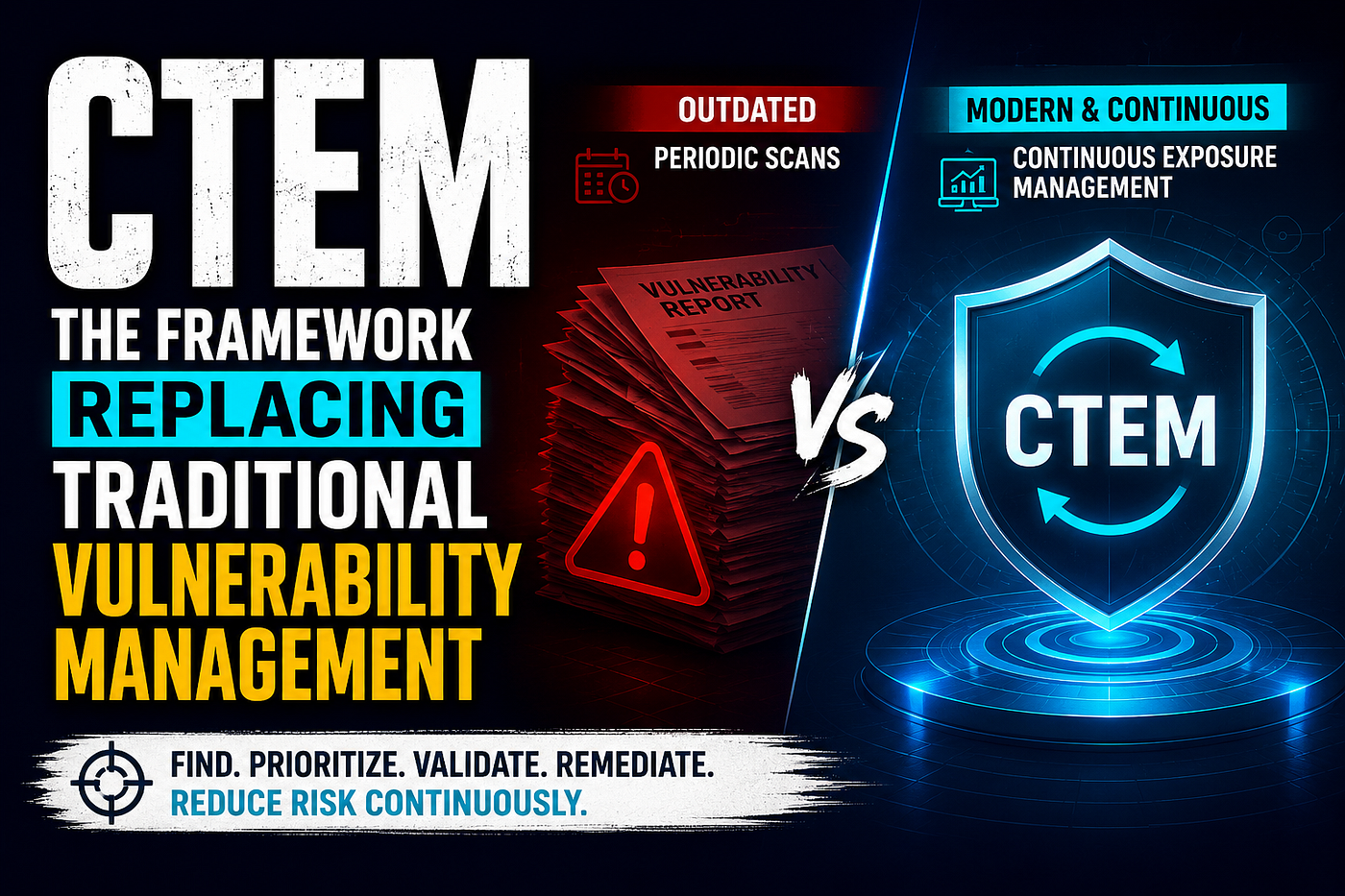
The Problem With Traditional Vulnerability Management
For years, organizations have followed the same security routine.
Run a vulnerability scan.
Generate a report.
Assign findings.
Schedule remediation.
Repeat next month or next quarter.
On paper, the process looks effective. In reality, many organizations still experience security incidents despite scanning thousands of assets and patching hundreds of vulnerabilities every month.
The issue is not a lack of security tools.
The issue is visibility.
Modern enterprises operate across cloud environments, SaaS platforms, remote work infrastructure, third-party integrations, APIs, and internet-facing applications. New assets appear every day. Security teams often discover exposed systems only after attackers find them first.
At the same time, vulnerability scanners generate thousands of findings. Most organizations do not have the resources to address every issue immediately. Security teams must decide which risks matter most and which can wait.
This challenge has led many enterprises to adopt Continuous Threat Exposure Management (CTEM) as a more practical and risk-focused security framework.
What Is Continuous Threat Exposure Management (CTEM)?
Continuous Threat Exposure Management, often called CTEM, is an ongoing process for identifying, validating, prioritizing, and reducing security exposures across an organization’s environment.
Unlike traditional vulnerability management, CTEM focuses on actual exposure and business risk rather than producing long lists of vulnerabilities.
The goal is simple:
Understand what attackers can see, determine how those exposures could be exploited, and reduce the risks that matter most.
Instead of asking:
“How many vulnerabilities do we have?”
CTEM asks:
“Which vulnerabilities create a realistic path for attackers to compromise critical systems?”
This shift helps security teams focus their resources where they create the greatest impact.
Why Organizations Are Moving Toward CTEM
The cybersecurity landscape has changed significantly.
A decade ago, organizations managed a limited number of servers, applications, and endpoints.
Today, enterprises manage:
- Public cloud infrastructure
- Hybrid cloud environments
- Internet-facing applications
- APIs
- Remote workforce devices
- SaaS platforms
- Third-party integrations
- Shadow IT assets
Many organizations no longer know exactly what assets are exposed to the internet.
As attack surfaces expand, periodic scanning becomes less effective.
A vulnerability discovered today may be exploited tomorrow.
Waiting weeks or months for the next assessment creates unnecessary risk.
Continuous Threat Exposure Management addresses this challenge through continuous monitoring and ongoing exposure analysis.
The Difference Between Vulnerability Management and CTEM
Traditional Vulnerability Management
Traditional programs focus on:
- Running vulnerability scans
- Identifying known weaknesses
- Assigning severity scores
- Tracking remediation progress
While valuable, this approach often produces overwhelming volumes of data.
Security teams may receive thousands of findings without clear guidance on which exposures present the highest business risk.
Continuous Threat Exposure Management
CTEM expands the process by focusing on:
- Asset discovery
- External attack surface visibility
- Exposure validation
- Threat context
- Attack path analysis
- Risk prioritization
- Continuous monitoring
Instead of treating every vulnerability equally, CTEM identifies the exposures most likely to be exploited and prioritizes remediation efforts accordingly.
This approach allows organizations to reduce meaningful risk faster.
Why External Visibility Matters More Than Ever
Many breaches begin with assets organizations did not know were exposed.
Examples include:
- Forgotten cloud instances
- Development environments
- Unused subdomains
- Misconfigured storage buckets
- Public-facing applications
- Unmanaged internet-facing services
Attackers continuously scan the internet searching for these opportunities.
Organizations need the same visibility.
This is why External Continuous Threat Exposure Management has become a key component of modern security programs.
Continuous monitoring of internet-facing assets helps security teams identify new exposures before they become security incidents.
Rather than discovering risks during annual assessments, organizations gain ongoing visibility into their external attack surface.

The Five Core Stages of CTEM
Successful CTEM programs typically follow a structured process.
1. Asset Discovery
The first step is understanding what exists.
Organizations must identify:
- Domains
- Subdomains
- Applications
- Cloud assets
- APIs
- Network services
- Internet-facing infrastructure
Without complete visibility, risk cannot be managed effectively.
2. Exposure Identification
Once assets are identified, organizations evaluate potential security weaknesses.
Examples include:
- Vulnerabilities
- Misconfigurations
- Exposed services
- Weak authentication controls
- Insecure cloud settings
- Excessive permissions
The objective is to understand every potential attack entry point.
3. Validation
Not every finding represents a meaningful threat.
Validation helps determine:
- Whether an exposure is exploitable
- Potential attack paths
- Likelihood of compromise
- Business impact
This step prevents security teams from wasting resources on low-priority issues.
4. Prioritization
Risk prioritization is where CTEM creates significant value.
Rather than focusing solely on severity scores, organizations evaluate:
- Business criticality
- Exploitability
- Threat intelligence
- Asset importance
- Potential operational impact
This allows teams to focus on exposures that matter most.
5. Remediation and Monitoring
Risk reduction is an ongoing process.
Organizations continuously:
- Fix vulnerabilities
- Remove unnecessary exposures
- Strengthen configurations
- Validate remediation efforts
- Monitor for new threats
The cycle repeats continuously.
How Attack Surface Management Supports CTEM
Attack Surface Management has become one of the most important components of modern CTEM programs.
The reason is straightforward.
Organizations cannot secure assets they do not know exist.
A mature **Attack Surface Management Vulnerability Process** continuously discovers and evaluates internet-facing assets, helping security teams maintain accurate visibility across dynamic environments.
This process enables organizations to:
- Discover unknown assets
- Identify exposed services
- Detect misconfigurations
- Track security posture changes
- Prioritize remediation activities
As environments evolve, attack surface visibility becomes a continuous requirement rather than a one-time project.
Threat Mitigation Must Be Continuous
Identifying risk is only part of the equation.
Organizations also need a structured Attack Surface Management Threat Mitigation Process to reduce exposure quickly and effectively.
This includes:
- Eliminating unnecessary services
- Fixing critical vulnerabilities
- Correcting misconfigurations
- Strengthening access controls
- Improving cloud security posture
- Monitoring newly discovered assets
When mitigation becomes continuous, organizations significantly reduce their attack opportunities.
The Role of Continuous Penetration Testing
Traditional penetration testing provides valuable insight at a specific point in time.
However, environments change constantly.
New applications are deployed.
Infrastructure evolves.
Configurations change.
Threat actors develop new techniques.
As a result, many organizations are adopting **Continuous Penetration Testing Solutions** to complement CTEM initiatives.
Continuous testing helps organizations:
- Validate exposures
- Simulate real attack scenarios
- Identify emerging weaknesses
- Confirm remediation effectiveness
- Improve overall security resilience
Instead of waiting for annual assessments, organizations gain ongoing assurance that security controls remain effective.
Cloud Security and Exposure Management
Cloud adoption has transformed business operations.
It has also expanded attack surfaces significantly.
Misconfigured cloud resources remain one of the most common causes of security incidents.
Cloud environments require continuous monitoring because:
- New resources are created frequently
- Permissions change regularly
- Configurations evolve rapidly
- Development teams deploy continuously
Integrating Cloud Application Protection Solutions into a CTEM strategy helps organizations identify cloud-specific exposures before attackers can exploit them.
Continuous visibility across cloud environments strengthens both security posture and operational confidence.
Protecting Sensitive Data Requires More Than Perimeter Security
Modern attacks often target sensitive information rather than infrastructure itself.
Customer records.
Financial information.
Intellectual property.
Operational data.
A strong CTEM program should also consider data exposure risks.
Organizations increasingly integrate **Information Protection and Data Leakage Prevention Solutions** to monitor sensitive information, prevent unauthorized access, and reduce the risk of accidental or malicious data loss.
By combining exposure management with data protection, organizations create a more comprehensive security strategy.
Business Benefits of CTEM
Organizations that adopt Continuous Threat Exposure Management often experience measurable improvements.
Better Visibility
Security teams gain a clearer understanding of assets, exposures, and risks.
Faster Risk Reduction
Resources focus on high-impact exposures rather than low-priority findings.
Improved Security Efficiency
Teams spend less time reviewing noise and more time addressing meaningful threats.
Reduced Attack Surface
Continuous monitoring identifies and removes unnecessary exposure.
Stronger Security Posture
Organizations proactively reduce risk before incidents occur.
Better Executive Reporting
Risk discussions become easier when based on validated exposures and business impact rather than vulnerability counts.
The Future of Cybersecurity Is Continuous
The cybersecurity industry is moving away from periodic assessments and toward continuous visibility.
Threats evolve daily.
Infrastructure changes constantly.
Attack surfaces expand without warning.
Traditional vulnerability management remains important, but by itself it is no longer enough.
Continuous Threat Exposure Management provides a practical framework for understanding real-world risk, validating exposures, prioritizing remediation, and maintaining ongoing visibility across complex environments.
Organizations that embrace CTEM gain more than improved security metrics.
They gain a clearer understanding of where risk exists, how attackers could exploit it, and which actions will create the greatest reduction in exposure.
In a world where cyber threats never stop evolving, continuous visibility and continuous risk reduction have become essential components of modern cybersecurity strategy.
메타데이터
- post_id
- 95fa239e0a3b
- slug
- continuous-threat-exposure-management-ctem-the-framework-replacing-traditional-vulnerability-95fa239e0a3b
- url
- https://medium.com/@glesec/continuous-threat-exposure-management-ctem-the-framework-replacing-traditional-vulnerability-95fa239e0a3b
- canonical_url
- https://medium.com/@glesec/continuous-threat-exposure-management-ctem-the-framework-replacing-traditional-vulnerability-95fa239e0a3b
- author_url
- https://medium.com/@glesec
- status
- ok
- fetched_at
- 2026-06-15 22:55:51