Anaximander and The Dawn of Philosophy and Science
The Milesian School — The First Scientists and Philosophers
Anaximander - The Dawn of Philosophy and Science
The Milesian School — The First Scientists and Philosophers
Throughout the ages, many have contributed to building Western philosophy and science, from Pythagoras, Plato and Aristotle, through Hume, Descartes and Newton, all the way to Einstein, Popper and Kuhn. But before them, there are the first greats — Thales, Anaximander, and Anaximenes, all of whom belong to the Milesian school of thought (6th Century BCE). Miletus is the birthplace of what we’ve come to know as philosophy and science. A vibrant city where different cultures would thrive and exchange ideas. What did it feel like to live there and how did it help usher in a new era of thinking? Let’s investigate.
History and Culture of Miletus
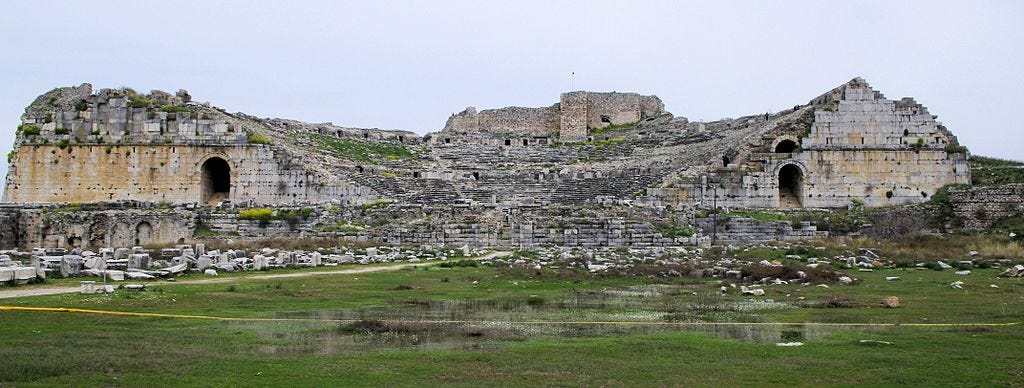
Original image by Kenneth Fairfax
Miletus is an ancient Greek city that to this day carries the memory of cultural diversity and free thinking. Located in modern day Turkey, on the western coast of Anatolia, Miletus is the perfect state to cross-pollinate ideas. Being on the trade-crossroads between multiple cultures, including Persian and Lydian, the Greek state had started to develop an identity of its own as an intellectual center. As Herodotus states — “Miletus was a significant power in maritime commerce and established over 80 colonies, primarily along the shores of the Black Sea. Its traders and sailors not only brought wealth but also ideas from diverse cultures.” [1]. It is in Miletus that Thales, Anaximander, and Anaximenes would develop the first steps in philosophy and science.
From Mythology to Philosophical and Scientific Thought
For the ancient man, be it of Greek, Egyptian, Persian or any origin, the world is a mythical place, driven by mystical forces. The cosmos and the sky are the domains of all-powerful Gods using the elements as their tools. Mighty beings of divine origins play chess with the world and bend all of reality to their will. That was all people knew — myths and mythology, handed down from one person to the other. And while poets like Homer give the Gods of Olympus more human-like traits, questioning the all-powerful beings that rule over the world was not something a one could do. That is, until the Milesian school starts to put these fundamental beliefs into doubt, developing the concepts of a natural world instead of a mythological one.
Starting with Thales but also true for the entirety of Milesian thought, they define the archē — one natural substance which is the ontological origin of the world. In a sense, they are the first monists, claiming that all of reality is derived from a single substrate or a concept. For each of the big three thinkers, the substance is different. For Thales it is water, for Anaximander it is the apeiron, which we’ll investigate further in an upcoming chapter and for Anaximenes — air. They derive their ontology through rational inquiry and not through belief or mythology. They think rationally and make speculations based on what they observe in the world. They see patterns and patterns of patterns, all of which help them to build a conviction of a natural world. As the great German idealist G.W.F. Hegel states :
“The Milesians were the first to elevate thought from the sensuous into the universal. Thales, Anaximander, and Anaximenes sought to explain the cosmos through principles derived from nature itself, thus breaking away from the mythological interpretations of earlier traditions.”[2][3]
Another reaffirming quote can be found in “History of Western Philosophy” by the great Bertrand Russell :
“Thales is considered by many as the first philosopher and the founder of Western science because he sought to explain natural occurrences by natural means. His bold hypothesis that ‘everything is water’ reflects an early form of material monism, which would become a central theme in Greek philosophy.” [4][5]
This is precisely the spirit of philosophy and science — questioning dogmas, investigating everything, putting established facts into doubt when they don’t seem convincing.
Thales, Anaximander and Anaximenes

Thales of Miletus (c. 620 — c. 546 BCE)
Thales of Miletus (c. 620 — c. 546 BCE) [6] is the first of this revolutionary way of thinking and the one to make the major step forward from the old ways of mythology. He is the first one to define his archē, his ontological primitive/principal as something naturalistic, namely — water, where everything originates from it. His way of viewing the Earth is quite interesting as he proposes that it is floating in water. He also makes a significant push in geometry by not only introducing principles adopted in Egypt but developing his own theorems, the first stating that “The diameter of a circle always subtends a right angle to any point on the circle” [7] and the second being known as the Intercept theorem, providing “the ratios between the line segments created when two parallel lines are intercepted by two intersecting lines.” [8] Known for his travels across the many lands and cultures Miletus has access to, one can see how Thales’ world view is shaped. And that world view, along with his own travels, shapes the ideas of another.
Anaximander of Miletus (c. 610 — c.546 BCE) [9] will be the subject of the entire second chapter of this essay but it would only make sense to include him here as well. For Anaximander, the ontological primitive of reality, his archē, is the apeiron. He defines it as boundless and unlimited, something that cannot be experienced. This is a step beyond Thales, as Anaximander states that at their core, even the elements have their genesis through the apeiron.
Anaximander has many other ideas that could rightfully give him the title as one of the first scientists — from his view on Earth floating freely in space, through his proto-evolutionary biology, all the way to his cosmology and many parts in between. All of that and more will be discussed in the next chapter. But now let us shift focus to the last of the three Milesian greats.
Anaximenes (? — c.528 BCE) [10] is without a doubt one of the greatest thinkers of his time. Much like Thales and Anaximander, he is interested in the origin of reality and his archē, much like Thales’ is one of the elements, but instead of water, he proposes air. Anaximenes sees air as the building block that through change gives us all the other elements, such as fire and water. It is in that same thought pattern that we can look at as the cornerstone of Anaximenes’ philosophy — that of eternal change.
The pattern of the shift from mythology to philosophy and science is clear in all three but one of them embodies it in ways that can astound even modern day thinkers.
Anaximander and Scientific Thinking

Anaximander as imagined by Pietro Bellotti around 1700, found in this publication — https://snl.no/Anaximander
As discussed earlier, Anaximander is a true paragon of the ideas of the Miletus school of thought. His work arguably gives start to the study of metaphysics, proto-evolutionary biology, complex cosmology and ingenuity through empirical discoveries. To better understand this, we must start with Anaximander’s archē, his ontological primitive — the apeiron.
The Apeiron — The Boundless, The Unlimited, The Infinite

At the heart of Anaximander’s philosophical and scientific thinking is the apeiron, that of which all comes to be. The one that gives birth to all, the substance through which everything else comes into existence. According to Anaximander, The Apeiron is infinite and boundless, it is eternal and cyclical. It has no origin and no end. It is in eternal motion while itself remains unchanged. A boundless unyielding concept at the heart of cycles of creation and destruction. It is both at the root of and governs all of existence. [9][12][13] One of the most interesting aspects of how it works is in the origin of the balance of opposites, which is at the root of The Apeiron but is also a big part of Anaximander’s entire system of natural laws. The boundless balances opposites, and it is through that balance that worlds and phenomena are created and then destroyed in the infinite cycle that is perpetuated through The Apeiron.
An interesting thing to note here is that this cyclical opposition also encompasses the elements and their properties and while they are a strong foundation for the Milesian school (Thales’ archē is water, Anaximenes’ is air), Anaximander sees something that pushes the boundary of his scientific thinking. The elements are composites and finite. They are made of other things; they interplay with each other. As Aristotle himself notes in his Physics :
“Anaximander observed that the elements are in opposition to one another, and if one were infinite, it would destroy the others.” [11][12][13]
Anaximander lays out a view in which The Apeiron is something that cannot be experienced directly by the senses but is seen through the way its laws mold the world. To quote Aristotle further:
“Some make the infinite the underlying substance, such as Anaximander and his followers, and they hold that the source of existing things is that which embraces all things and steers all.” [11][12][13]
This is a radical departure from his contemporaries in more ways than one. As the great physicist and thinker Carlo Rovelli points out in his book on Anaximander, he was one of the first to not only challenge the mythological origins of the cosmos but also challenge thinkers who were pivotal for his own way of thinking, in this case — Thales. [14] And while Anaximander does not attack his views, this was one of the first times where scholarly critique and critical thinking were pushed to the forefront oh the emerging scenes of philosophy and science. It is with all of this in mind that we must look at another revolutionary trail of though that he had — Anaximander’s cosmology.
Cosmology and Astronomy — A New Look

Before Anaximander, in the days of mythology, the Earth was always seen as something that is supported in space. Even Thales proposes that it is supported by the water it floats on. However, Anaximander makes a big leap with his way of thinking and brings to light one of the most important points to come out of the Milesian school. Namely, that the earth is not supported by something, nor is it surrounded by water — it is floating freely in space with nothing to aid it. It is his brilliant cosmological picture that provides the logic for why this is happening. In it, the Earth has a cylindrical form and is surrounded by the celestial bodies, which orbit around it. Their orbits are concentric circles all of which have fixed (although considered by many to be arbitrary) radial offsets with Earth being the center. Days shifting into nights, seasons shifting into other seasons, all of these are the motions that circulate through these offsets. [9] And here is probably the most interesting part — this cosmological picture told Anaximander the important truth, namely that Earth is floating free in space. He would say that due to these concentric circular offsets of the celestial bodies, the planet is in perfect equilibrium so there is no reason for it to be a part of any cosmic motion. It is in a position of indifference. To quote Aristotle:
“Anaximander says that the Earth stays where it is because of its indifference; there is no reason for it to move in one direction rather than another, since it is equally related to all points.” [11][12]
Carlo Rovelli points to the significance of Anaximander’s findings, stating that even though his reasoning or empirical evidence are not what we’ve come to know since, this was truly the most difficult leap into cosmology to be made, especially at that time. [14] One must question everything they know about reality and put it under the most intense scrutiny to get to where Anaximander got.
Now, to look at another one of his achievements — developing a conceptual idea of what we could consider proto-evolutionary biology.
Proto-Evolutionary Biology

To understand the significance of Anaximander’s thoughts, we need to once again take a step back. In the days of old, the creation of life and more specifically humans, was something attributed to the Gods or at the very least to godly processes. The fish was created a fish, the dog was created a dog, and a human was created a human. This has been so ingrained into the world view at the time that questioning it was unthinkable. This is where Anaximander’s proto-evolutionary theory comes in.
He describes life as something that originated in a moist environment at an earlier stage of the lifecycle of the Earth. As water and earth started to mix and dry under the influence of the sun, life is born. From there, life evolves into more complex forms. Initially he describes the first living beings as being enclosed in thorny barks and as they move away from moist to dry, they break away from the bark, they survive for a short while. [15][16] From there he posits the existence of fish and fish-like creatures. It is from them that humans evolved. To quote Censorinus:
“He declares that humans were originally born from animals of different kinds because other animals quickly manage on their own, but humans alone require lengthy nursing. For this reason, they would not have survived if they had been like this in the beginning.” [15][16]
The process of birth of life as well as any evolutionary conditions are an entirely natural process, completely independent of the activity of a deity. As Hippolytus would clarify :
“He says that originally, when the Earth was moist, the warm elements acted upon the moist, and living creatures were generated.” [17][18]
It is truly astounding to see the depth of thought that Anaximander puts into his work and even though we’ve investigated a lot of the bigger concepts, he is known for contributing to other scientific and philosophical discoveries.
Further Innovations

A world map as imagined by Anaximander, Hecateos and Aristagoras. Credit: National Museum of Krakow
Anaximander is credited by Strabo for creating one of the earliest maps of what was then perceived as the world — “He was the first to draw the outline of land and sea, and he made a map of the entire world that was known to him.” [19][20] With that he would lay the groundwork for future generations of cartographers that would make even more precise and accurate representations of the world. Another great achievement of Anaximander is the introduction of the gnomon with which time could be measured, solstices and equinoxes determined as well as celestial events. [16] Through his overall philosophical and scientific world view, he also offered natural explanations to thunder, lightning, the formation of rain a basic model of the atmosphere and earthquakes. [11][12]
From Ancient to Modern Times
After looking at the Milesian school of thought and focusing on Anaximander, we can see a clear pattern of building the base of what we would come to consider philosophy and science. Although in its infancy at the time, the steps Thales, Anaximander, and Anaximenes take are huge and groundbreaking. Their influence is felt throughout the ages — from other early thinkers like Plato, and Aristotle, through historical figures like Isaac Newton and Immanuel Kant, leading into modern day philosophers and scientists like Albert Einstein and Thomas Kuhn. Bertrand Russel acknowledges :
“Anaximander, a pupil of Thales, was a bold and speculative thinker who introduced the conception of the indefinite or infinite as the origin of all things.” [4][5]
Karl Popper would state:
“With Anaximander, the critical tradition begins; he was perhaps the earliest philosopher to criticize his teacher.” [21][22]
With all of this it becomes apparent — the Milesian school has shaped the world as it is today and will be forever remembered for their bold steps into laying out the future that is our present.
Bibliography
-
Herodotus, The Histories, Penguin Classics 1996
-
G.W.F., Hegel, Lectures on the History of Philosophy, University of Nebraska Press, 1995, vol. 1
-
Г.В.Ф., Хегел, История на Философията, Издателство Българска Комунистическа Партия, 1961, Том 1
-
Bertrand, Russell, History of Western Philosophy, Routledge, 1945
-
Бертранд, Ръсел, История на Западната Философия, Издателска къща „Христо Ботев“, 1994, Том 1
-
Internet Encyclopedia of Philosophy, Thales of Miletus, https://iep.utm.edu/thales/
-
Math Open Reference, Thales’ Theorem, https://www.mathopenref.com/thalestheorem.html
-
Geometry Help, Intercept Theorem, https://geometryhelp.net/intercept-theorem/
-
Internet Encyclopedia of Philosophy, Anaximander, https://iep.utm.edu/anaximander/
-
Internet Encyclopedia of Philosophy, Anaximenes, https://iep.utm.edu/anaximenes/
-
Aristotle, The Complete Works of Aristotle, Princeton University Press, 1984
-
Аристотел, Съчинения в Шест Тома, Издателство „Захарий Стоянов“, 2012, Том II, Част I, Физика
-
Аристотел, Метафизика, Университетско Издателство „Св. Климент Охридски“, 2023
-
Carlo Rovelli, Marion Lignana Rosenberg, Anaximander and The Nature of Science, Penguin, Penguin Audio, 2023, Read by Roy McMillan
-
K. Freeman, Ancilla to the Pre-Socratic Philosophers, MA: Harvard University Press, 1983
-
Диоген Лареций, Животът на Философите, Народна Култура София, 1985, Допълнение от Тодор Томов
-
H. Diels, W. Kranz, Die Fragmente der Vorsokratiker 6th Edition, Berlin: Weidmann; 1951.
-
H. Diels, W. Kranz, Die Fragmente der Vorsokratiker 6th Edition, Berlin: Weidmann; 1951, Refutation of All Heresies, Translation by several hands, Internet Archive, archive.org
-
Strabo, Geographica, The Geography of Strabo, Harvard University Press, 1917
-
Страбон, География, Поредица Антични Автори Към Изворите за Тракия и Траките, Книги I-V, Книги IX — XI, Рал-Колобър, 2006, Допълнение Валерий Русинов
-
Karl Popper, Conjectures and Refutations: The Growth of Scientific Knowledge, Routledge, 2002
-
Карл Попър, Целия Живот е Решаване на Проблеми, Калъс & Космополит София, 2005
-
Страбон, География, Поредица Антични Автори Към Изворите за Тракия и Траките, Книги I-V, Книги IX — XI, Рал-Колобър, 2006, Допълнение Валерий Русинов
-
Страбон, География, Поредица Антични Автори Към Изворите за Тракия и Траките, Книги I-V, Книги IX — XI, Рал-Колобър, 2006, Допълнение Валерий Русинов
메타데이터
- post_id
- 960341d92e5f
- slug
- anaximander-and-the-dawn-of-philosophy-and-science-960341d92e5f
- url
- https://medium.com/@ivan.ognqnov/anaximander-and-the-dawn-of-philosophy-and-science-960341d92e5f
- canonical_url
- https://medium.com/@ivan.ognqnov/anaximander-and-the-dawn-of-philosophy-and-science-960341d92e5f
- author_url
- https://medium.com/@ivan.ognqnov
- status
- ok
- fetched_at
- 2026-07-27 21:01:28


