The Quantum Fourier Transform: Why Shor Works
How changing perspective reveals hidden patterns
The Quantum Fourier Transform: Why Shor Works
How changing perspective reveals hidden patterns
The Step That Felt Like a Leap
If Shor’s algorithm felt convincing but not fully satisfying, you’re not alone.
Up to that point in the series, everything followed a clear pattern:
- Define a state,
- Apply transformations,
- Measure an outcome.
Then suddenly, one step seemed to do something extraordinary: a quantum state was transformed, and a hidden period appeared almost effortlessly.
That step was the Quantum Fourier Transform (QFT).
It’s often introduced as a dense mathematical object, which makes it feel like something you’re supposed to accept rather than understand. This episode takes a different approach.
We’ll slow down and answer a simpler question first:
What does any Fourier transform actually do?
By starting with a familiar, classical example and then translating that intuition into the quantum setting, we’ll see that the QFT isn’t mysterious at all. It’s a carefully chosen change of perspective — one that turns repetition into something measurable.
By the end of this episode, the “magic” in Shor’s algorithm should disappear. What remains is a clear, structural reason for why it works.
← Previous: *Episode 12 — Shor’s Algorithm: The Day Cryptography Broke*
Why Shor Still Feels Like Magic
After reading about Shor’s algorithm, many readers walk away with the same feeling:
“I understand the steps… but I don’t understand why the middle part works.”
That “middle part” is the Quantum Fourier Transform (QFT).
It often gets introduced with intimidating formulas and little intuition, which makes it feel like a black box that somehow extracts periods out of thin air.
This episode exists to remove that feeling.
We’ll do that by:
- Starting with a simple classical Fourier example
- Understanding what Fourier transforms really do
- Translating that idea into quantum terms
- Walking through a small, concrete QFT example
- Connecting it back to Shor’s algorithm
No physics. No signal-processing background required. Just pattern recognition and linear algebra.
Part 1: A Gentle Classical Fourier Example
Imagine a Simple Repeating Signal
Suppose you record a sequence of numbers:
1, 0, 1, 0, 1, 0, 1, 0This sequence clearly repeats every 2 steps.
But imagine you didn’t know that.
All you have is the raw data.
The key question is:
Is there a systematic way to detect repetition without manually comparing values?
This is exactly what the Fourier transform is designed to do.
What the Classical Fourier Transform Does (Intuitively)
Instead of asking:
“What value do I see at each position?”
Fourier asks:
“How strongly does this data match different repeating patterns?”
It tests your data against patterns like:
- Repeating every 1 step
- Repeating every 2 steps
- Repeating every 4 steps
- Repeating every 8 steps
And tells you which repetition dominates.
For our example:
1, 0, 1, 0, 1, 0, 1, 0The Fourier transform would show a strong spike at frequency = 1/2, indicating a period of 2.
You didn’t search for the period. You changed perspective, and the period revealed itself.
That’s the core idea.
The Key Insight (Classical)
The Fourier transform does not create new information. It rearranges existing information so patterns become obvious.
This idea transfers directly to quantum computing.
Part 2: Why Periods Are Hard to See Directly
Now let’s connect this to Shor.
In Shor’s algorithm, we construct a function like:

If you list its values, they look chaotic:
1, 2, 4, 8, 1, 2, 4, 8, ...Yes, there’s a period — but it’s buried inside modular arithmetic.
Looking at values one by one doesn’t help.
This is exactly like trying to spot repetition by staring at raw signal samples.
What we need is a Fourier-style perspective shift.
Part 3: What Changes in Quantum Computing
Quantum States Are Vectors
A quantum state is written as:
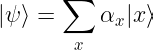
This means:
- The system exists in many states at once
- Each state has a complex weight (amplitude)
Crucially:
These amplitudes can interfere.
That interference is what allows quantum Fourier transforms to work in one step.
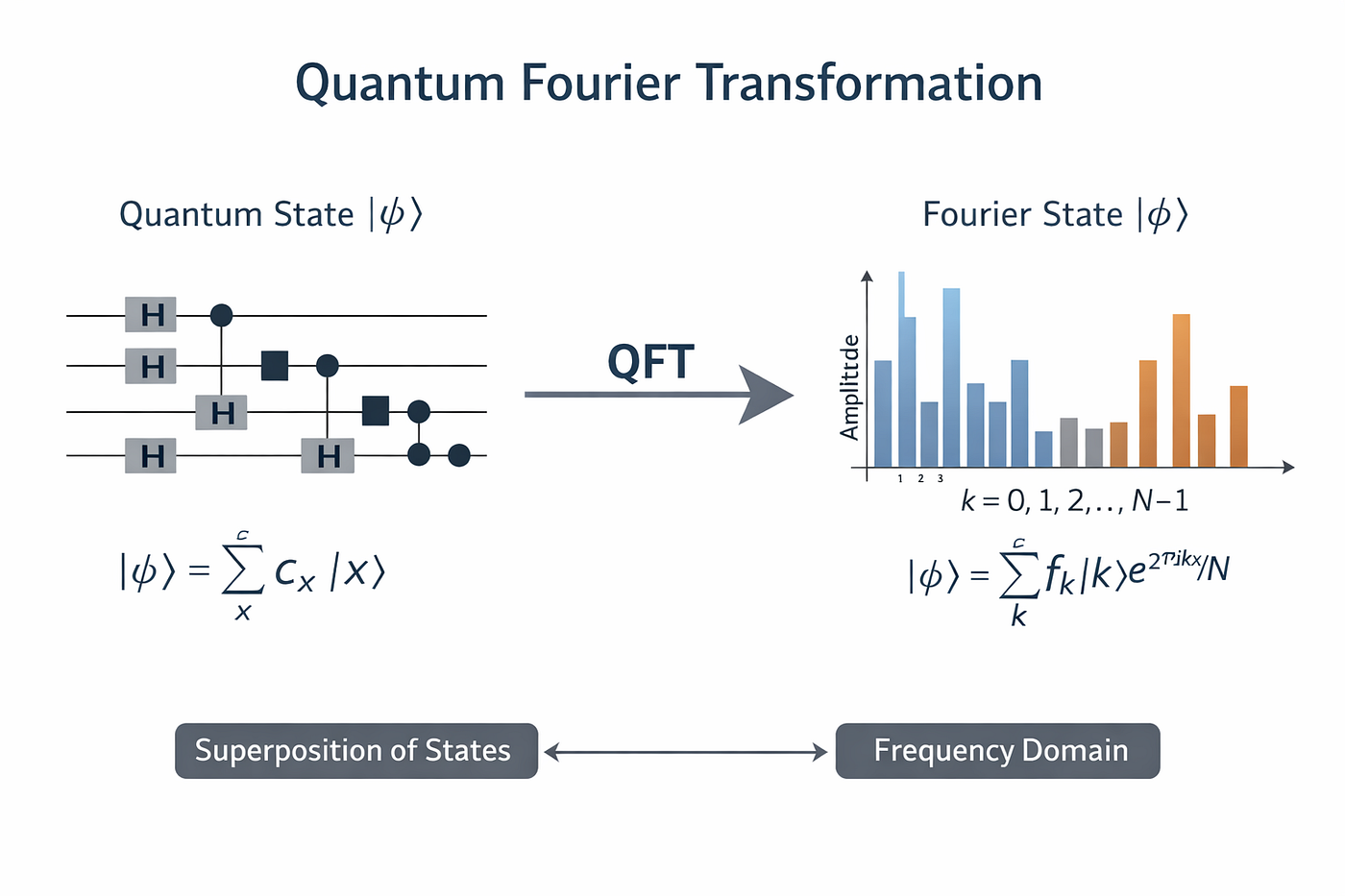
Part 4: The Quantum Fourier Transform (Conceptually)
The Quantum Fourier Transform does the same thing as the classical Fourier transform:
It changes how we describe the system so that periodic structure becomes visible.
But instead of operating on explicit data values, it operates on amplitudes.
That’s the difference.
What the QFT Does to a Single Basis State
If you start with a state like:

The QFT transforms it into:
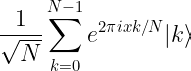
Ignore the formula for a moment.
Conceptually:
- One state becomes a weighted combination of all states
- The weights encode how “aligned” the original state is with each frequency
This is just a change of basis.
Part 5: A Small, Concrete QFT Example
Let’s keep things tiny.
Suppose We Have 3 Qubits
That gives us 8 basis states:

Now suppose, after some earlier steps (like in Shor), the system is in this state:

Notice something?
These values differ by 2.
That means the state has a hidden period of 2.
But in the computational basis, it just looks like four random states.
Apply the QFT
When we apply the QFT:
- Amplitudes corresponding to frequencies compatible with period 2 reinforce
- Others cancel out
After the QFT, the probability distribution is no longer spread out.
Instead, it spikes at states corresponding to: k=0 and k=4
These values encode the period.
Measurement now gives us information about repetition — something that was invisible before.
Part 6: Why Measurement Suddenly Works
Before QFT:
- Measuring gives random-looking values
- Period is hidden
After QFT:
- Measurement is biased toward frequency-aligned states
- Period information becomes readable
This is the crucial moment.
The QFT does not compute the period explicitly. It reshapes the state space so the period affects probabilities.
Part 7: Connecting This Back to Shor
In Shor’s algorithm:
- We build a superposition over many inputs
- We entangle inputs with a periodic function
- Measurement isolates a periodic pattern
- QFT converts that pattern into spikes
- Classical math extracts the period
The QFT is the bridge between:
- “the system contains a period”
- “we can read the period”
Without it, Shor collapses.
Part 8: Why This Can’t Be Done Classically
You might ask:
“Couldn’t we just run a Fourier transform on classical data?”
The problem is data availability.
Classically:
- You must explicitly compute and store values
- That takes exponential time
Quantumly:
- Superposition gives you all values at once
- Interference does the comparison in parallel
The speedup is not because of faster math. It’s because the math acts on possibility itself.
The Real Lesson of the QFT
The Quantum Fourier Transform teaches a deeper lesson about quantum computing:
Quantum algorithms succeed by choosing the right representation.
Not more computation. Not clever branching. But better alignment between problem structure and measurement.
This is why:
- Simon works
- Shor works
- Phase estimation works
- Many future algorithms will work
Closing: Why Shor Works (At Last)
Shor’s algorithm doesn’t break cryptography by brute force.
It breaks it by asking:
“What hidden repetition does this problem contain?”
And then using the Quantum Fourier Transform to make that repetition visible.
Once you see QFT this way, it stops being intimidating.
It becomes something familiar:
A perspective shift that turns confusion into clarity.
What You Should Take Away From the QFT
The most important thing to remember about the Quantum Fourier Transform is this:
The QFT does not compute new information. It re-expresses existing information so that the structure you care about becomes visible.
Periods that are hidden in one representation become obvious in another. Measurement only works after that realignment happens.
This is why Shor’s algorithm works. And it’s why many quantum algorithms follow the same pattern:
- Encode structure into a state,
- Rotate the state space,
- Let interference do the filtering.
Once you see the QFT this way, it stops being a special trick and starts looking like a general tool.
In the next episode, we’ll take the final step in this progression and study Quantum Phase Estimation — the algorithm that generalizes everything you’ve learned here.
Phase estimation is the bridge between: Fourier transforms, eigenvalues, and many real-world quantum applications.
It’s the algorithm beneath the algorithms.
**→ Next: ***Quantum Phase Estimation: The Algorithm Beneath the Algorithms*
메타데이터
- post_id
- 96336aedd79c
- slug
- the-quantum-fourier-transform-why-shor-works-96336aedd79c
- url
- https://medium.com/the-quantum-ladder/the-quantum-fourier-transform-why-shor-works-96336aedd79c
- canonical_url
- https://medium.com/the-quantum-ladder/the-quantum-fourier-transform-why-shor-works-96336aedd79c
- author_url
- https://medium.com/@nagendra-gupta
- status
- ok
- fetched_at
- 2026-07-14 00:59:35