POLITICS THIS WEEK ISSUE 4: Contenders and Pretenders: Assessing the 2027 Presidential Field
This week marked the conclusion of party primaries and the ratification of candidates by political parties. With just seven months to the…
POLITICS THIS WEEK ISSUE 4: Contenders and Pretenders: Assessing the 2027 Presidential Field

This week marked the conclusion of party primaries and the ratification of candidates by political parties. With just seven months to the 2027 presidential election and the INEC deadline for the submission of candidates’ names now passed, the contours of the contest are beginning to take shape.
At least 15 political parties are expected to field presidential candidates. Some smaller parties, such as APGA, have adopted the APC candidate, while the NNPP has indicated its openness to alliances. Yet, it remains unclear who among the field are genuine contenders and who are merely pretenders.
By a contender, I mean a candidate who possesses both the capacity and the intention to win the election. A pretender, on the other hand, may lack either or both. Such a candidate may simply be interested in splitting the votes of a major contender, enhancing another candidate’s chances, or enjoying the publicity and name recognition that come with a presidential bid. Ultimately, the difference between a contender and a pretender lies in capacity and intent. The campaign season and, eventually, the election results usually expose the pretenders and confirm the contenders.
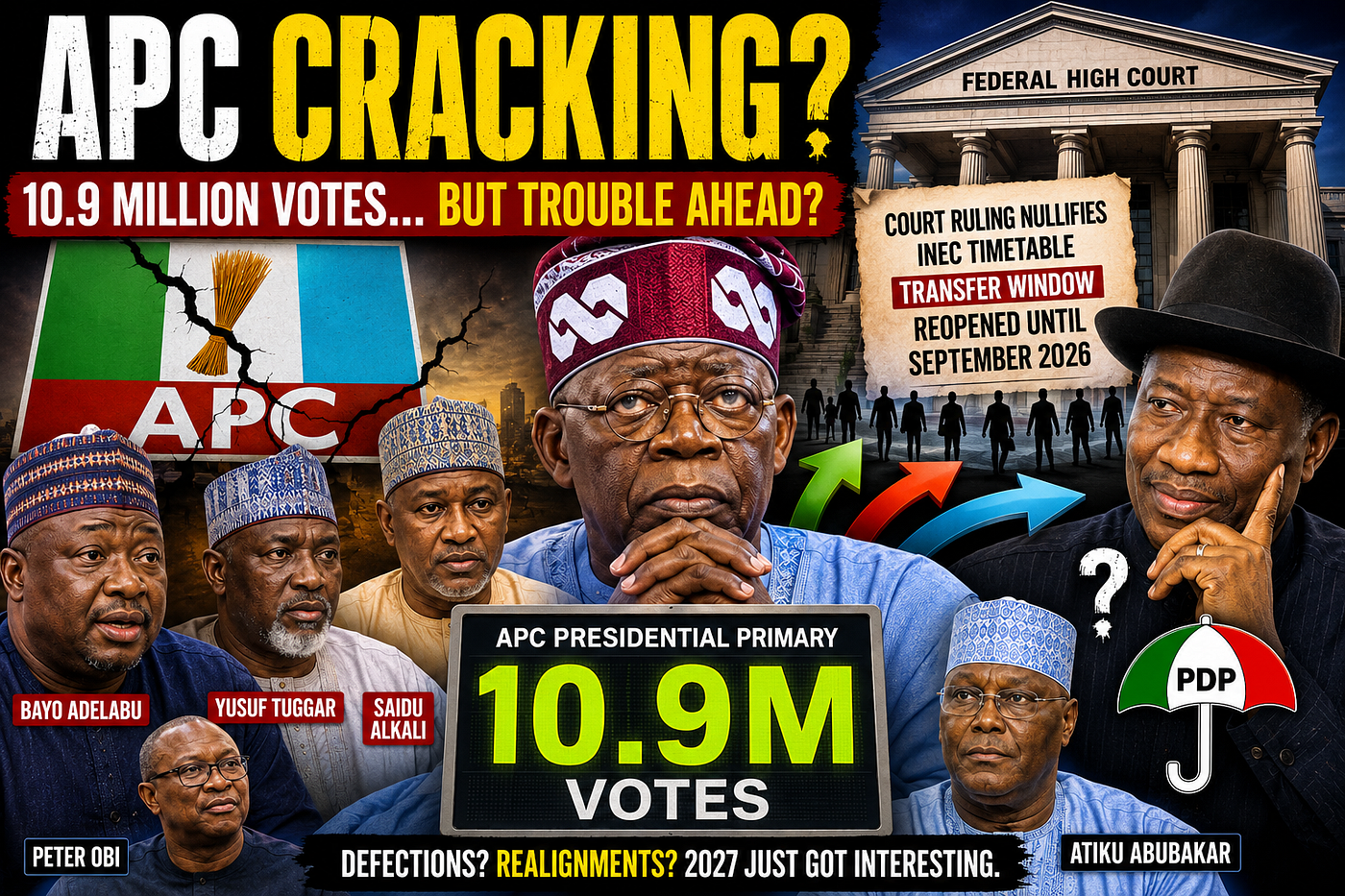
As things stand today, there is only one undisputed contender: the APC presidential candidate and incumbent President of Nigeria, Bola Ahmed Tinubu (BAT). His capacity to win is beyond question, and his determination to secure re-election appears equally clear. Backed by the full machinery of the state, the support of 33 state governors, and the APC’s political structures across the 36 states and the FCT, he may be the most formidable incumbent Nigeria has seen in recent history.
The fragmented nature of the opposition further raises questions about whether he will face a serious challenge in his bid for a second term. However, while incumbency provides significant advantages, it also comes with notable liabilities. The most important of these is public perception of governance.
Although the government points to several achievements, many Nigerians do not feel those achievements have translated into meaningful improvements in their daily lives. The administration continues to grapple with insecurity and has yet to fully overcome the economic consequences of its twin policies of fuel subsidy removal and the floating of the naira.
For example, PMS currently sells at around ₦1,400 per litre, while the dollar remains above ₦1,300. Meanwhile, the minimum wage stands at approximately ₦70,000. Many Nigerians will inevitably compare these realities with conditions in 2023, when BAT assumed office, when PMS sold for less than ₦200 per litre and the dollar exchanged for under ₦900.
Unsurprisingly, the government has offered extensive explanations and justifications for these outcomes, chief among them being the substantial increase in FAAC allocations to states. Whether Nigerians find these arguments persuasive, and whether they are satisfied with the overall state of the country, will ultimately be determined at the ballot box. In my view, this remains the APC’s most significant vulnerability.
Among the remaining candidates are two figures who possess both the capacity and intention to win the election: Atiku Abubakar of the ADC and Peter Obi of the NDC.
Atiku Abubakar emerged victorious in the fiercely contested ADC presidential primaries, defeating Rotimi Amaechi and Mohammed Hayatudeen. The party adopted the Option A4 method, and as I accurately predicted in the last issue, both opponents boycotted the official declaration of Atiku’s victory, citing irregularities and electoral manipulation. However, Atiku has since met with his fellow contestants, and efforts at reconciliation are reportedly underway.
Most observers believe his victory was never seriously in doubt. Atiku remains one of Nigeria’s political heavyweights, a figure whose stature is matched only by a handful of politicians, most notably Bola Ahmed Tinubu. Together, they tower above much of the political class and have remained dominant actors in the country’s politics for decades.
A seven-time presidential aspirant, Atiku is now making his fourth appearance as a presidential candidate. No other politician in the race possesses a comparable level of presidential campaign experience. That experience, combined with his vast political network and national recognition, makes him a formidable candidate.
The political arithmetic also appears favourable to him. Assuming the current field remains unchanged, Atiku would be the most prominent northern candidate on the ballot. Given Nigeria’s enduring ethnic and regional voting patterns, this could provide him with a significant advantage, especially with several southern candidates competing for votes in the South.
Yet the central question remains: will experience and regional advantage be enough?
His greatest challenge may be convincing Nigerians who believe that power should remain in the South following the eight-year presidency of the late Muhammadu Buhari. This remains an emotionally charged issue, and one for which Atiku has struggled to provide a convincing counterargument. The zoning debate significantly affected his prospects in 2023 and may prove equally consequential in 2027.
This time, however, he faces an additional complication: the platform on which he is running.
Although Atiku spearheaded the now-collapsed opposition coalition, the ADC itself is deeply divided. The party is fractured into multiple factions and entangled in a web of legal disputes that could ultimately threaten its electoral viability. While Atiku is the candidate of the INEC-recognised David Mark-led faction, Dumebi Kachikwu and Chris Uba have also emerged as presidential candidates under the Kachikwu-led and Nafiu Gombe-led factions respectively.
For a party hoping to mount a serious challenge to an incumbent president, this level of internal instability is alarming. In many ways, it presents a more complicated problem than the G5 crisis that hampered Atiku’s PDP campaign in 2023. Indeed, it is beginning to appear that the choice of the ADC may prove to be the most consequential miscalculation of his 2027 bid, although the possibility of reconciliation cannot yet be ruled out.
For now, however, his most urgent political decision may be the choice of a running mate.
Peter Obi has been ratified as the presidential candidate of the NDC and is the first among the major contenders to announce a running mate, selecting Rabiu Kwankwaso. This marks a sharp contrast with his 2023 campaign, when he was unable to meet the INEC deadline for the submission of a substantive vice-presidential candidate. This time, he enters the race with greater clarity and political potency.
Obi and Kwankwaso finished third and fourth respectively in the 2023 presidential election, securing 6,101,533 and 1,496,687 votes. While their combined total still fell short of BAT’s tally, their alliance represents one of the most strategically significant developments of the election cycle. Together, they have assembled a coalition with the potential to seriously challenge the incumbent president.
The strength of the ticket lies not only in electoral arithmetic but also in the passionate support bases both men command. The Obidient Movement and the Kwankwasiyya movement are among the most organised and enthusiastic political constituencies in the country. If effectively mobilised, their combined force could create a political movement unlike any seen in recent Nigerian elections.
If the recently concluded primaries are any indication, the NDC also possesses something many opposition parties currently lack: organisational coherence. Under the leadership of Senator Seriake Dickson, the party has maintained a disciplined and unified structure. Critics may describe his leadership style as overly centralised, but such an approach may prove politically advantageous at a time when opposition parties are routinely destabilised by internal factions, litigation, and competing power centres.
The NDC has also been deliberate in building its political structure from the ground up. Unlike in 2023, when many of the party’s candidates benefited from Obi’s popularity, the party now appears focused on fielding stronger down-ballot candidates who can, in turn, strengthen the presidential campaign.
Aside from BAT, Obi may be the only major candidate who has clearly improved his position since the last election. Yet significant challenges remain. While the Kwankwaso alliance may help address his longstanding weakness in the North, the NDC remains largely uncompetitive in the South-West, a region that continues to be one of the APC’s strongest bases.
Obi may also have lost the element of surprise that defined his 2023 campaign. Four years ago, many political actors underestimated the scale and speed of his rise. This time, his opponents are fully aware of the threat he poses and will be far better prepared to counter it. Whether the NDC can overcome that reality may ultimately determine whether Obi remains merely competitive or becomes a genuine favourite for the presidency.
Figures such as Seyi Makinde and Goodluck Jonathan possess enough political weight to significantly influence the outcome of the election. However, when it comes to either their capacity or intention to actually win the presidency, serious doubts remain.
Makinde has both the influence and financial resources that come with governing Oyo State. He can likely deliver substantial support within his home state and may even prove competitive across parts of the South-West, potentially eating into BAT’s traditional stronghold. However, his national appeal remains largely untested. Winning a state and winning a country are two very different propositions.
Goodluck Jonathan presents the opposite problem. Unlike Makinde, he already possesses national name recognition and appeal, having previously occupied the nation’s highest office. Yet the circumstances surrounding his emergence only revive criticisms that dogged his presidency in its final years — namely indecisiveness and an apparent reluctance to take firm political positions.
To date, Jonathan has made no clear declaration regarding his presidential ambitions. Meanwhile, the PDP remains divided into rival factions and has suffered severe political setbacks across the country. The Turaki-led faction that issued him a certificate of return did so in his absence and through representatives. If Jonathan were genuinely committed to another presidential run, one would expect him to be actively rebuilding and unifying the PDP, much in the way Senator Seriake Dickson has done within the NDC.
Should his candidacy solidify, Jonathan could rewrite the electoral map in the South-South and South-East, directly cannibalizing Obi’s core base. For now, however, his campaign exists in the realm of political theory. A great deal can change in seven months, but as the board stands today, Makinde and Jonathan remain the two most consequential wildcards — or pretenders — in the 2027 race.
At the heart of this analysis lies a simple reality: nothing is guaranteed.
The eventual winner may not necessarily be the most popular candidate, but rather the one who runs the most disciplined, organised, and strategic campaign. Elections are not won merely by possessing strengths; they are won by maximising those strengths, minimising weaknesses, and building the right alliances at the right time.
Whichever contender best accomplishes those tasks — and whichever pretenders they are able to attract to their side — may well produce Nigeria’s next president.
메타데이터
- post_id
- 96471f4414ce
- slug
- politics-this-week-issue-4-contenders-and-pretenders-assessing-the-2027-presidential-field-96471f4414ce
- url
- https://medium.com/@itslatid/politics-this-week-issue-4-contenders-and-pretenders-assessing-the-2027-presidential-field-96471f4414ce
- canonical_url
- https://medium.com/@itslatid/politics-this-week-issue-4-contenders-and-pretenders-assessing-the-2027-presidential-field-96471f4414ce
- author_url
- https://medium.com/@itslatid
- status
- ok
- fetched_at
- 2026-06-21 15:33:18