Justice After Atrocity: Why Nuremberg Still Matters
MoviesToHistory.com — August 2026 Monthly Newsletter
Justice After Atrocity: Why Nuremberg Still Matters
MoviesToHistory.com — August 2026 Monthly Newsletter
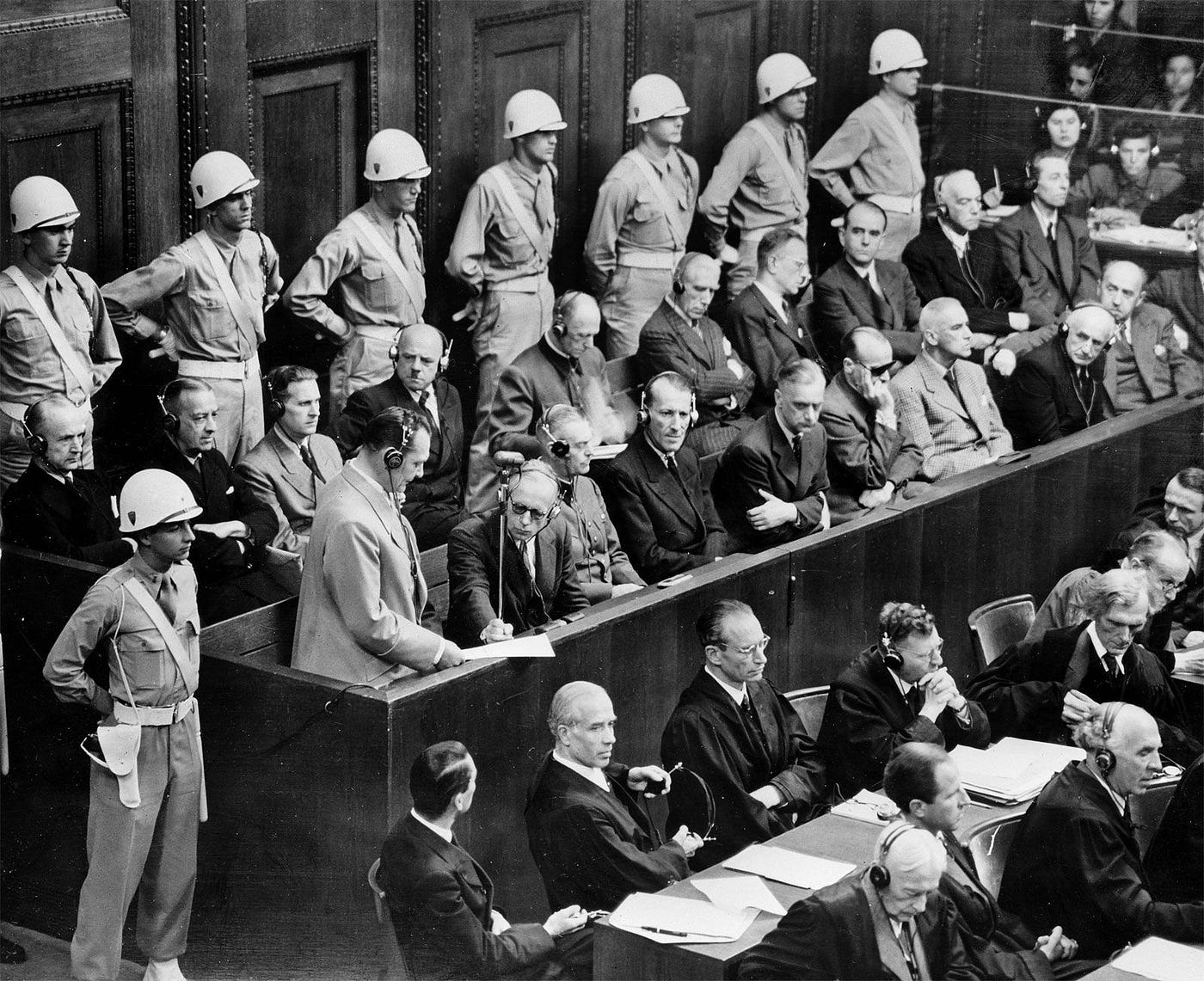
There are moments in history when justice is asked to do something almost impossible: impose law upon acts so vast that existing legal language seems inadequate.
The Nuremberg Trials were one of those moments.
In the aftermath of World War II and the Holocaust, the surviving leaders of Nazi Germany were not simply defeated enemies. They were defendants brought before an international tribunal and confronted with documentary evidence, witnesses, prosecutors, judges, and a developing legal framework designed to establish individual responsibility for crimes committed through the machinery of the state.
More than eighty years later, Nuremberg remains central to debates about war crimes, crimes against humanity, international law, individual responsibility, obedience, propaganda, and the limits of justice after mass atrocity.
But there was another question unfolding behind the courtroom proceedings.
Who were the men sitting in the defendants’ dock?

Were they psychologically abnormal monsters? Opportunists? Fanatics? Bureaucrats? Or could seemingly ordinary human beings become participants in extraordinary evil?
That question sits at the center of James Vanderbilt’s Nuremberg and makes the film an especially compelling subject for MoviesToHistory.

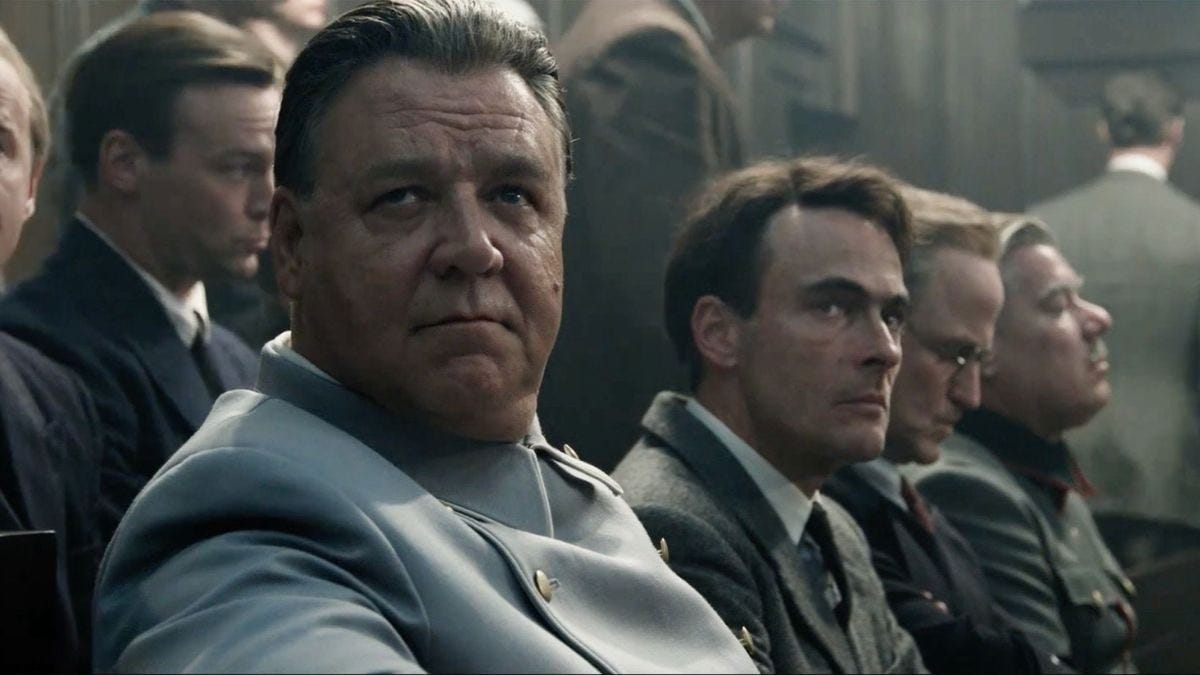
Based on Jack El-Hai’s The Nazi and the Psychiatrist, the film follows U.S. Army psychiatrist Douglas Kelley, played by Rami Malek, as he evaluates Hermann Göring, played by Russell Crowe, and other imprisoned Nazi leaders before and during the Nuremberg proceedings.


Rather than approaching Nuremberg exclusively as courtroom history, the film enters the prison cells and psychological examinations surrounding the trials.
The result raises a question that has guided our coverage throughout August:
How do we understand perpetrators without allowing understanding to become exoneration?

🎬 This Month’s Featured Film: Nuremberg
Nuremberg occupies unusual territory for a historical drama.

It is simultaneously a courtroom story, psychological character study, war-crimes drama, and examination of the human capacity for authoritarianism and mass violence.
The Nuremberg Trials have been dramatized many times, but Vanderbilt’s film shifts much of the emphasis toward the psychological confrontation between Kelley and Göring.

That choice changes the historical question.
Instead of simply asking whether the defendants were guilty, the film asks something much more unsettling:
What kind of person becomes capable of participating in a regime responsible for systematic mass murder?
Douglas Kelley hoped psychology might help answer that question.
What he discovered was considerably more disturbing.

📖 Cornerstone Article of the Month
Nuremberg vs. History: How Accurate Is the Film?
This month’s cornerstone MoviesToHistory feature examines where Nuremberg follows the historical record, where it condenses or dramatizes events, and how those choices affect our understanding of the trials.

At the center of the analysis is the relationship between Douglas Kelley and Hermann Göring.
Kelley was assigned to evaluate the mental condition of Nazi prisoners awaiting trial. His work included interviews, psychological examinations, intelligence testing, and personality assessments.

The assignment initially appeared to offer an extraordinary opportunity.
If Nazi leaders represented some distinct psychological pathology, perhaps psychiatry could identify it.
Perhaps evil could be diagnosed.
Perhaps future societies could recognize the warning signs.
But Kelley increasingly encountered a much more complicated reality.
The defendants did not conveniently conform to the image of obviously deranged monsters.

That realization became one of the most disturbing implications of his work.
The danger was not necessarily that the Nazi leadership represented a psychologically alien category of humanity.
The danger was that people capable of participating in enormous crimes could possess many recognizable human characteristics.

Our cornerstone review therefore evaluates Nuremberg across several MoviesToHistory categories:

Historical Context — How effectively does the film reconstruct the political, legal, and moral circumstances surrounding the trials?
Character Portrayal — How closely do Rami Malek’s Douglas Kelley and Russell Crowe’s Hermann Göring correspond with the historical figures?
Psychological History — Does the film accurately represent the psychiatric examinations and theories surrounding the defendants?
International Justice — How clearly does the film communicate what was unprecedented about prosecuting Nazi leaders before an international tribunal?
Dramatic License — Where does Vanderbilt compress chronology, construct dialogue, heighten confrontation, or reshape historical relationships for narrative effect?
Together, these categories form this month’s MoviesToHistory Accuracy Meter.
But historical accuracy is only the beginning.
Because the deeper question surrounding Nuremberg is not simply whether a scene happened exactly as depicted.
It is whether the film communicates what Nuremberg meant.

⚖️ Nuremberg Was About More Than Punishment
It would be easy to remember the Nuremberg Trials simply as the moment Nazi leaders were prosecuted after Germany’s defeat.
Their historical significance is much larger.
The International Military Tribunal confronted a fundamental problem: what responsibility does an individual bear when crimes are committed under the authority of a government?

The defendants could point toward the state.
They could point toward military hierarchy.
They could point toward orders.
They could point toward Adolf Hitler.
Nuremberg helped establish a different principle:
State authority does not automatically erase individual responsibility.
That principle profoundly influenced the subsequent development of international criminal law.
The proceedings also demonstrated something else that historical films sometimes struggle to convey.

Justice is a process.
It requires evidence.
It requires documentation.
It requires argument.
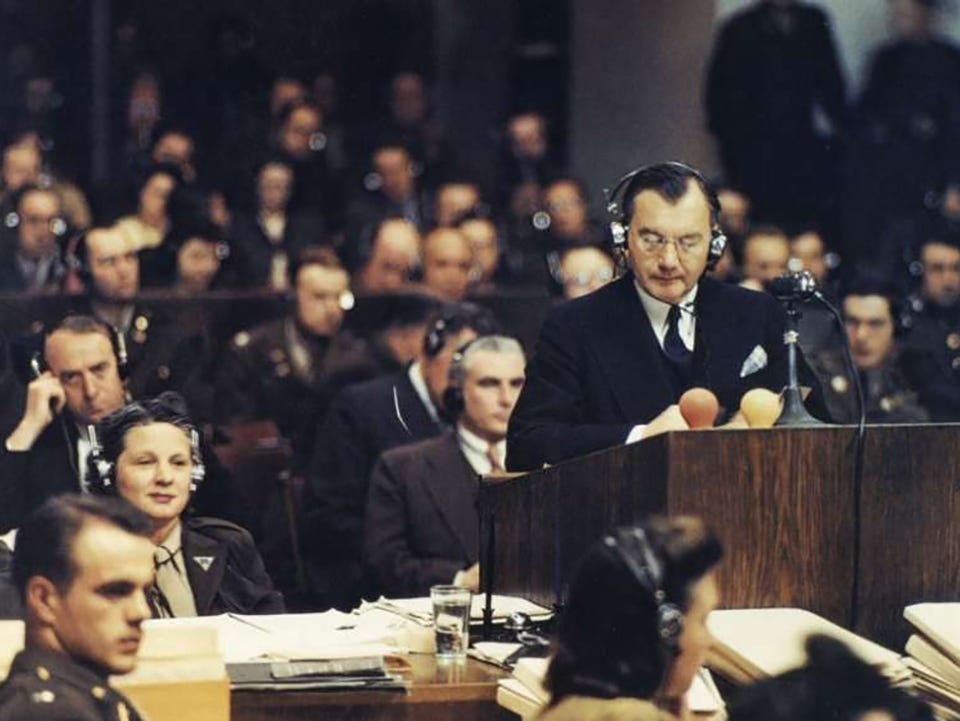
And it requires confronting the possibility that even people accused of monstrous crimes remain defendants entitled to legal proceedings rather than objects of vengeance.
That tension is part of what makes Nuremberg historically extraordinary.
After one of history’s most catastrophic wars, the Allies chose not merely to punish leading Nazis.
They chose to put them on trial.
🧠 Douglas Kelley and the Psychology of Evil
The most fascinating historical figure behind Nuremberg may also be the one least familiar to many viewers.

Douglas Kelley arrived at Nuremberg with a question that seemed both scientific and moral:
Was there something psychologically distinctive about the Nazi leadership?

The implications were enormous.
If Nazism could be traced to a particular pathology, psychology might provide society with a diagnostic warning system.
But what if there was no single Nazi personality?
What if authoritarianism, ambition, conformity, resentment, ideological commitment, opportunism, and the desire for power could emerge among people who were not clinically insane?
That possibility was considerably harder to accept.
Kelley’s encounters with Göring became particularly important.

Göring had been one of the most powerful figures in Nazi Germany. At Nuremberg, he remained intelligent, manipulative, theatrical, politically calculating, and determined to defend both himself and the regime he had served.
The relationship between psychiatrist and prisoner consequently becomes more than an unusual historical encounter.

It becomes a struggle over interpretation.
Kelley wants to understand Göring.
Göring wants to control how he is understood.
And history sits between them.

📚 Continue Reading: Beyond the Film
For readers who want to move beyond the dramatization, this month’s recommended reading begins with Jack El-Hai’s The Nazi and the Psychiatrist.
The book provides the historical foundation for Vanderbilt’s film and explores Kelley’s extraordinary assignment evaluating Nazi prisoners.
But the story should not end there.
Readers interested in the broader Nuremberg proceedings can also explore works examining the International Military Tribunal, the prosecution teams, documentary evidence presented during the proceedings, and the legal precedents that emerged from the trials.

Kelley’s own work deserves particular attention.
His writings about the defendants force readers to confront an uncomfortable proposition: the perpetrators of political atrocity cannot always be safely separated from the rest of humanity by labeling them insane.
That conclusion makes his work relevant far beyond 1945 and 1946.

It shifts the conversation from:
“What was wrong with them?”
to:
“What circumstances allow human beings to become capable of this?”
That is a far more difficult historical question.
It may also be the more important one.

🔍 Coming to MoviesToHistory
Our August coverage continues by moving progressively deeper into the history and ethics behind Nuremberg.

The Psychiatrist and the Reichsmarschall: Douglas Kelley, Hermann Göring, and the Search for the Nazi Mind
We will move beyond the film to examine the real encounters between Kelley and Göring.
Who was Douglas Kelley before Nuremberg?
What did the U.S. military expect him to discover?
How did Göring attempt to dominate prison life and influence the other defendants?
And what conclusions did Kelley ultimately reach about the psychology of Nazi leadership?
This feature examines the unsettling search for a psychological explanation for political evil.

Can Evil Be Diagnosed? Psychology, Nazism, and the Dangerous Search for a “Nazi Personality”
Our next analysis expands beyond Kelley himself.
If perpetrators of atrocities are automatically characterized as monsters or madmen, we may inadvertently make history easier to understand than it actually was.
The article will explore how psychiatry and psychology approached the Nazi defendants while asking what is gained — and what is lost — when political and moral responsibility is transformed into psychological diagnosis.

Justice on Screen: The Ethics of Turning Nuremberg Into Entertainment
Finally, we will confront the ethical responsibilities involved in dramatizing crimes against humanity.
Historical filmmaking depends upon narrative construction.
Characters are consolidated. Conversations are recreated. Timelines are compressed. Conflicts are intensified.
Those techniques may be ordinary components of filmmaking.
But should the rules change when the subject is genocide?
When filmmakers dramatize Nuremberg, they are not merely adapting history.
They are participating in historical memory.
That creates responsibilities extending beyond conventional questions of cinematic entertainment.

🎞️ Real vs. Reel: Follow the History Beyond the Blog
Throughout the month, our Real vs. Reel series will continue breaking Nuremberg into accessible historical questions across social media.
We will examine the real Douglas Kelley, separate the historical Hermann Göring from Russell Crowe’s interpretation, explore what psychological testing could — and could not — tell investigators about Nazi leadership, identify moments where the film compresses history, and explain the international legal legacy of the trials.

We’ll also continue using the MoviesToHistory Accuracy Meter to distinguish several ideas that are too often treated as interchangeable:
A scene can be invented while expressing a documented historical reality.
A scene can be technically accurate while creating a misleading historical impression.
And sometimes dramatic license can illuminate history rather than simply distort it.
Understanding that difference is at the heart of MoviesToHistory.
💭 The Question of the Month
Historical films can introduce millions of viewers to people, events, and ideas they might otherwise never encounter.

But Nuremberg asks us to consider whether cinema can accomplish something beyond teaching historical facts.
Can it teach principles?
Can a film explain why due process matters even when the defendants are accused of horrific crimes?
Can drama demonstrate why individual accountability matters?
Can cinema help audiences understand why international justice developed?
And can watching justice dramatized on screen influence how we understand justice in the present?
So this month’s discussion question is:
Can historical films teach justice as effectively as they teach history?
There is no simple answer.
A film can reconstruct a courtroom without explaining the law.
It can reproduce testimony without communicating its significance.
It can turn perpetrators into compelling characters while pushing victims toward the edges of the narrative.
But cinema can also make abstract principles tangible.
It can transform legal history into human choices.
It can show audiences that justice is not inevitable.
It must be constructed, defended, documented, and remembered.
Join the conversation: What historical film has most influenced the way you think about justice, accountability, or human rights?
Reply to this newsletter or join the discussion across MoviesToHistory social channels.

Why Nuremberg Still Matters
Nuremberg belongs to history.
The questions raised there do not.
Who is responsible when governments commit crimes?
Can obedience excuse participation?
How should democracies respond to defeated enemies who committed atrocities?

What separates justice from revenge?
Can psychology explain evil without excusing it?
And what responsibility does one generation have to preserve evidence for the next?
These questions explain why filmmakers continue returning to Nuremberg.

They also explain why we should continue examining those films critically.
Historical cinema is powerful precisely because, for many viewers, the screen becomes their first encounter with the past.
That makes accuracy important.
But accuracy alone is not enough.
We also have to ask what a film teaches us to remember, whose experiences it centers, what it simplifies, and what moral conclusions audiences may carry away when the credits roll.
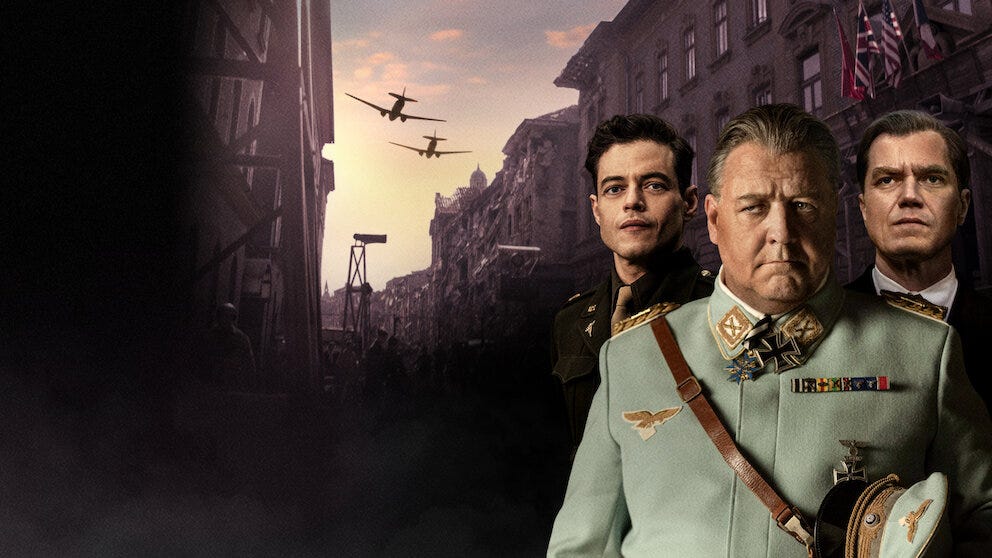
Nuremberg gives us an opportunity to examine all of those questions at once.
Because the enduring legacy of the trials is not simply that justice was pursued after atrocity.
It is the principle that even after civilization experiences catastrophic violence, law, evidence, accountability, and historical memory still matter.
And perhaps that is the most important history a film about Nuremberg can teach.
MoviesToHistory.com
Where cinema meets the historical record.
🎬 Read the full August coverage at MoviesToHistory.com
📚 Follow the Real vs. Reel series throughout the month
⚖️ Join the discussion: Can historical films teach justice as effectively as they teach history?
메타데이터
- post_id
- 965ec637f18d
- slug
- justice-after-atrocity-why-nuremberg-still-matters-965ec637f18d
- url
- https://medium.com/@siobsbhndy/justice-after-atrocity-why-nuremberg-still-matters-965ec637f18d
- canonical_url
- https://medium.com/@siobsbhndy/justice-after-atrocity-why-nuremberg-still-matters-965ec637f18d
- author_url
- https://medium.com/@siobsbhndy
- status
- ok
- fetched_at
- 2026-08-21 11:58:18