Ethics, Moral Rhetoric, and Ludonarrative Dissonance in Pokémon Black and White
Introduction
Ethics, Moral Rhetoric, and Ludonarrative Dissonance in Pokémon Black and White
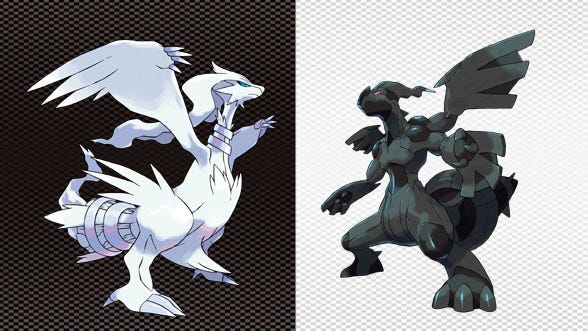
Pokémon Black and White (Pokémon, 2011)
Introduction
Pokémon Black and White explores the complex ethics of Pokémon ownership, causing an ethical tension between the narrative’s moral ideals versus player actions. By exploring the ethics of Pokémon ownership, political rhetoric and moral authority, and ludonarrative dissonance between the story and Pokémon’s standard game progression, Pokémon Black and White demonstrates a complex and persistent tension between narrative ideals and required actions.
From the narrative, the character N embodies a philosophical critique of Pokémon in training and battling, constantly questioning if it constitutes exploitation or companionship. Through his constant moral dilemmas and unique ability to communicate with Pokémon, N acts as the game’s method of raising the question: is it morally justifiable to treat Pokémon as companions, or does their relationship with humans only constitute instrumentalization?

N’s Castle (Serebii, 2011)
The ethical narrative of Pokémon ownership is further analyzed through the actions of Team Plasma’s political rhetoric. By advertising themselves as a movement for Pokémon liberation, Team Plasma attempts to separate Pokémon and trainers. Their entire ideology is questioned when members start using Pokémon as a labor force to impose their moral authority over Pokémon trainers. By involving themself in capturing and battling Pokémon, they reveal a dark hypocrisy, highlighting their true intentions. This section highlights how moral rhetoric can be used as a facade to mask Pokémon exploitation, contradicting ethical claims and practices.

Team Plasma (Serebii, 2011)
Finally, ethical narratives and player actions collide with Pokémon Black and White’s game mechanics. Game progression requires having a strong team of Pokémon to advance past difficult areas of the story. This effectively incentivizes Pokémon instrumentalization and efficiency over companionship. The concept of ludonarrative dissonance is explored through conflict between narrative themes and gameplay requirements.
Ethics of Pokémon Ownership
Pokémon Black and White constructs a main ethical tension between viewing Pokémon as companions and treating them as instrumental resources, a contradiction that is most clearly explored through the character of N. While the game shows the thematic opposition of truth and ideals through its legendary dragon Pokémon, these themes ultimately serve to create a more crucial moral question: whether Pokémon training is a mutual partnership, or a system of animal exploitation.
Throughout the game, N repeatedly challenges the player as a Pokémon trainer, questioning why the player justifies capturing and battling Pokémon. N is special, because possesses a supernatural ability to communicate with Pokémon, allowing him to truly understand their emotions. This power is what reinforces his belief that Pokémon are subjected to human systems, and not voluntarily participating. As Stina Attebery argues, Pokémon function within game systems as both controllable entities, forming what is described as a “biological labor force” that the player strategically manages and deploys (Attebery, 2015). N’s philosophy stems from this concept of Pokémon as a labor force as immoral and exploitative.
N’s critique of catching, training and battling Pokémon directly conflicts with the player’s primary goal to become the strongest Pokémon trainer. For years, core Pokémon gameplay requires collecting Pokémon to complete the Pokedex, and to assemble a strong team of six Pokémon capable of defeating difficult key opponents. Players are incentivized and rewarded to capture and create the most optimal team for use in battle, further reinforcing the system of Pokémon usage as human tools (Attebery, 2015). Even if the player chooses a Pokémon based on appealing appearance or personal reasons, this still subjects them to the system which rewards Pokémon performance and utility.

N Questioning Pokémon Ownership (Psypokes, 2011)
From a broader point of view, the human-Pokémon relationship has complex ethics. To the average trainer, capturing Pokémon is the accepted norm and practiced around the world. However, Pokémon may see it as a forceful removal from their habitats to be locked into Pokeballs, to eventually be subjected to brutal battling events. As Miguel Sicart (2009) argues, the ethical dimensions of video games emerge through the interaction between rules and player actions; game systems shape not only what players do, but how they understand their role within those systems. Pokémon Black and White explores the human-Pokémon relationship, questioning the morality of Pokémon ownership, even when the game requires the player to participate in Pokémon battling.
N’s role is not just a rival, but also a philosophical questioner to the player. Throughout various player confrontations, N discusses topics on Pokémon welfare and freedom. At a crucial moment after N’s Pokémon battle loss to the player, N swears to become the Pokémon Champion, to persuade all trainers that Pokémon should be liberated. Despite the weight of N’s arguments, the player continues to advance the game in the very system N opposes. In this sense, Pokémon Black and White demonstrate a persistent moral ambiguity: that Pokémon are advertised as companions, despite the structural gameplay continually rewarding the player for using them as resources to be utilized.
Political Rhetoric and Moral Authority
Building on the ethical tensions from N, Team Plasma takes these concerns into a broader ideological movement that seeks to restructure the moral foundation of the Pokémon world. N presents a personal and philosophical critique of Pokémon ownership, but Team Plasma uses this as a growing propaganda, using political rhetoric to create a moral system where Pokémon liberation is an ethical necessity.
Throughout Pokémon Black and White, Team Plasma grunts appear in public towns across the Unova region, delivering speeches contradicting the legitimacy of Pokémon training. Their speeches position Pokémon as victims of a human-made system of exploitation, and argue trainers as participants to this system. Team Plasma encourages individuals to question the idea of Pokémon capturing and battling. Their goal is not to promote a radical idea of questioning Pokémon ownership, but to act as a moral authority. The morally correct course of action of Team Plasma is full liberation of Pokémon, by any means. This use of political rhetoric allows Team Plasma to establish themselves as moral authorities, forcefully becoming the equalizers between humans and Pokémon.

Team Plasma Pokémon Liberation Speech (Psypokes, 2011)
The moral system constructed by Team Plasma is contradicted by their actions. Despite advocating for Pokémon liberation, members of the group use forceful tactics and Pokémon as their tools, involving the capture and use of Pokémon in battles to impose their authority. This contradiction reveals the hypocrisy in their ideology, reproducing the very practices they wish to condemn. Team Plasma’s moral authority acts to only benefit themself, while stripping others of the right of faithful Pokémon ownership. As Miguel Sicart (2009) argues, ethical meaning in games emerges through the interaction between rules, systems, and player behavior. Team Plasma’s actions serve to act against the rules and systems of the Pokémon world, demonstrating that moral claims are not enough, and immediate action is required.
Towards the climax of Pokémon Black and White, it is revealed Team Plasma is under control by a manipulative mastermind, Ghetsis. By using political rhetoric, Ghetsis uses the ideology of Pokémon liberation as a way to consolidate power over the Unova region. The true goal of Ghetsis was to be the sole Pokémon user in the region, effectively giving him the only biological labor force of Pokémon. The player realizes N is the adopted son of Ghetsis, showing the mastermind’s long term goal of positioning N as a symbolic king and moral figurehead of Team Plasma (Boutin 2025). This manipulation highlights how political rhetoric can be mobilized to obtain power, even when it is built upon ethical foundations, such as N’s honest ideology. While N’s beliefs appear sincere, participating in Pokémon battles act as a complex element contradicting his moral position to pursue his goals.

Battle with N (Psypokes, 2011)
Ultimately, the ideology of Team Plasma exposes troubles with moral intentions and practices. The organization advertises themself as a Pokémon liberation movement, siding against Pokémon ownership, despite relying on the same tactics to act as moral authority. This ethical tension undermines Team Plasma’s credibility as a group for Pokémon liberation, further acting as a contradiction to the game itself, critiquing the use of Pokémon as instrumental resources to achieve major key objectives.
Narrative Ideals versus Gameplay Reality
While Pokémon Black and White explores ethical concerns about Pokémon ownership through its narrative with N and Team Plasma, its gameplay highly contradicts these themes. Following the generic formula of Pokémon games, the player must advance through dangerous routes, tricky gym leader fights and overcoming the Pokémon League to become the region champion. To complete these milestone tasks, the player must use Pokémon as strategic resources, valuing efficiency over basic companionship. Game progression cannot continue until these tasks are completed. Successful strategies include optimizing experience points, movesets and even choosing Pokémon with strong individual values — statistics which are genetically assigned. By requiring the player to construct their own optimized, powerful team of Pokémon, the player’s actions act against certain themes visited throughout the story. In this way, the gameplay incentivizes viewing Pokémon primarily as tools, rather than partners.

Rival Meetup (Psypokes, 2011)
This ethical tension is understood through the concept of ludonarrative dissonance, where the game’s narrative and gameplay mechanics are contradictory. Ludonarrative dissonance is a concept analogous to cognitive dissonance, where individuals experience contradicting beliefs. Pokémon Black and White explores this theme through both N and the player’s use of Pokémon as instruments. Similar moral challenges are explored through the character N, where he finds no other solution than becoming a strong Pokémon trainer himself. The player, similar to N, is offered no other viable alternative to the exploitative Pokémon system other than to participate. This creates a jarring difference between what themes the game is pushing, versus what the game is requiring the player to do.
Grabarczyk & Walther (2023) suggest players encountering ludonarrative dissonance may attempt to save the narrative by rationalizing their actions. Players may justify their treatment of Pokémon by labelling battles as a necessity for mutual benefits and companionship growth. Other justifications for Pokémon battles include saving the world, or a Pokémon’s willingness to participate. Regardless of the rationalization, Pokémon Black and White’s game mechanics objectively reward instrumentalization. The very need for player action rationalization shows the underlying inconsistency in the game, rather than resolving it, highlighting its internal contradictions with narrative and gameplay.
This tension should not be recognized as an unavoidable feature of all video games. As Liang (2024) argues, ludonarrative dissonance is better viewed as a challenge of game design, not an inherent truth about the medium. The dissonance in Pokémon Black and White arises from the franchise’s traditional progression systems such as leveling, battling, trading and breeding Pokémon. This progression system rewards the use of Pokémon as tools, despite the game’s narrative raising ethical concerns about Pokémon exploitation and companionship. To clarify, the conflict between the game’s narrative and gameplay is not intended, but a byproduct of contradiction, prioritizing the traditional progression systems over thematic consistency.
Overall, Pokémon Black and White demonstrates how gameplay mechanics can undermine intended narratives. Even though the story invites the player to question Pokémon ownership ethics, the forced game design ensures the player must continue to follow the system of Pokémon exploitation. This effectively reinforces Pokémon as instrumental resources, contradicting narrative themes due to its own game framework.

Mandatory Unova Gym Badges (Psypokes, 2011)
Conclusion
Pokémon Black and White ultimately exposes the tension between ethical narratives and actions. First, N’s philosophical critique invites the player to think about the morality of Pokémon ownership. Throughout the story, N serves as a reminder to the player to question whether Pokémon battling is out of trainer companionship, or a way to use Pokémon as an instrument for personal gain. N’s unique ability to perceive Pokémon emotions perfectly positions him as the moral opposition to the player, rivalling in both battles and morals. This section established the game’s story framework, encouraging the player to reflect on their human-Pokémon relationships.
Second, Team Plasma demonstrates ideological manipulation using political rhetoric and moral authority. Masked as advocates for Pokémon liberation, their main method of enforcing their beliefs relies on Pokémon battling and abduction, acting with hypocrisy. Team Plasma attempts to reconstruct the moral system of the Pokémon world. Unknowingly, Team Plasma is revealed to be manipulated by Ghetsis, the mastermind behind the organization with intentions of overtaking the region of Unova.
Finally, the traditional gameplay mechanics of the Pokémon franchise and the intended narrative of Pokémon Black and White act as a case of ludonarrative dissonance. Players may try to rationalize their gameplay actions, yet it is explored that the game objectively rewards instrumentalization of Pokémon. This section explores this dissonance as a design challenge, with gameplay incentivizing Pokémon tools, contradicting the narrative Pokémon liberation themes. Together, these three sections of Pokémon ownership ethics, political rhetoric and moral authority, and ludonarrative dissonance between narrative and gameplay demonstrate how Pokémon Black and White are games which create persistent moral ambiguities for which the player must reflect on their own ethics as they progress through the story.
References
Attebery, S. (2015). Coshaping digital and biological animals. Humanimalia, 6(2), 56–84. https://doi.org/10.52537/humanimalia.9912
Boutin, W. (2025, July 4). What does Team Plasma’s Ideals Represent in “Pokémon Black Version”? Scifi Dimensions. Retrieved March 20, 2026, from https://www.scifidimensions.com/what-does-team-plasmas-ideals-represent-in-pokemon-black-version/
Grabarczyk, P., & Walther, B. K. (2022). Game of twisted shouting. Eludamos Journal for Computer Game Culture, 13(1), 7–27. https://doi.org/10.7557/23.6506
Liang, J. (2024). Dynamical-meaning Focused Design: Overcoming Ludonarrative Dissonance. https://doi.org/10.26503/dl.v2024i2.2342
Plasma & N. (2011). Serebii. https://www.serebii.net/blackwhite/plasma.shtml
Pokémon Black and White. (2011). Pokémon. https://www.pokemon.com/us/pokemon-video-games/pokemon-black-version-and-pokemon-white-version
Sicart, M. (2009). The ethics of computer games. In The MIT Press eBooks (pp. 107–150). https://doi.org/10.7551/mitpress/9780262012652.001.0001
Walkthrough. (2011). Psypokes. https://www.psypokes.com/bw/walkthrough.php?part=9
메타데이터
- post_id
- 9660211e9bcb
- slug
- ethics-moral-rhetoric-and-ludonarrative-dissonance-in-pokémon-black-and-white-9660211e9bcb
- url
- https://medium.com/@johnpalanes/ethics-moral-rhetoric-and-ludonarrative-dissonance-in-pok%C3%A9mon-black-and-white-9660211e9bcb
- canonical_url
- https://medium.com/@johnpalanes/ethics-moral-rhetoric-and-ludonarrative-dissonance-in-pok%C3%A9mon-black-and-white-9660211e9bcb
- author_url
- https://medium.com/@johnpalanes
- status
- ok
- fetched_at
- 2026-06-26 21:52:29