The Engine of Trust: How The Transparent Web (Web 5.0) Actually Works
In my previous article, I introduced the concept of Web 5.0 — The Transparent Internet. I argued that the next evolution of the web isn’t…
The Engine of Trust: How The Transparent Web (Web 5.0) Actually Works
In my previous article, I introduced the concept of Web 5.0 — The Transparent Internet. I argued that the next evolution of the web isn’t about new tokens but about a new, verifiable “moral operating system” for humanity.
The core problem we face is “blindness.” We interact with systems we cannot see. The solution is transparency.
But what does that look like? How do we get a small business owner, already busy with payroll and inventory, to adopt such a revolutionary system?
The answer: We don’t start by demanding transparency. We start by offering utility.
We are building the first “Transparent Web Platform,” an AI-powered website generator that functions like an advanced WordPress for the Web 5.0 era. Here is the step-by-step-journey of how it works.
Step 1: The On-Ramp — The “AI Transparency Toolkit”
No business owner wakes up and thinks, “I want to build an immutable audit log today.” They do think, “I need a better ‘About Us’ page,” or “How do I build trust with new customers?”
This is our on-ramp.
When a new business, let’s say a local bakery, joins the platform, they are first greeted by our AI Transparency Toolkit.
Powered by the Gemini API, this tool asks the owner a simple question: “Describe your business and your values.”
The baker writes: “I run a local bakery. I’m proud that I source all my flour from a local, organic mill and use fair-trade coffee.”
The AI instantly generates a professional, public-facing Transparency Statement for their new website:
“At The Corner Bakery, we believe in community and quality. That’s why we’re committed to transparency in our sourcing. We proudly use 100% organic flour from the Green Valley Mill and exclusively serve fair-trade certified coffee. We believe you have a right to know what’s in your food, and we’re proud to share our process with you.”
To save this statement and build their site, the owner creates their account. In that instant, they have a Firebase-secured identity (userId) and have saved their first piece of verifiable data to their private profile.
They came for a tool; they stayed for the trust.
Step 2: The Control Panel — An “AI-WordPress” for Data
Now that the baker is on the platform, they get their “AI-powered WordPress” control panel. This is where the magic happens.
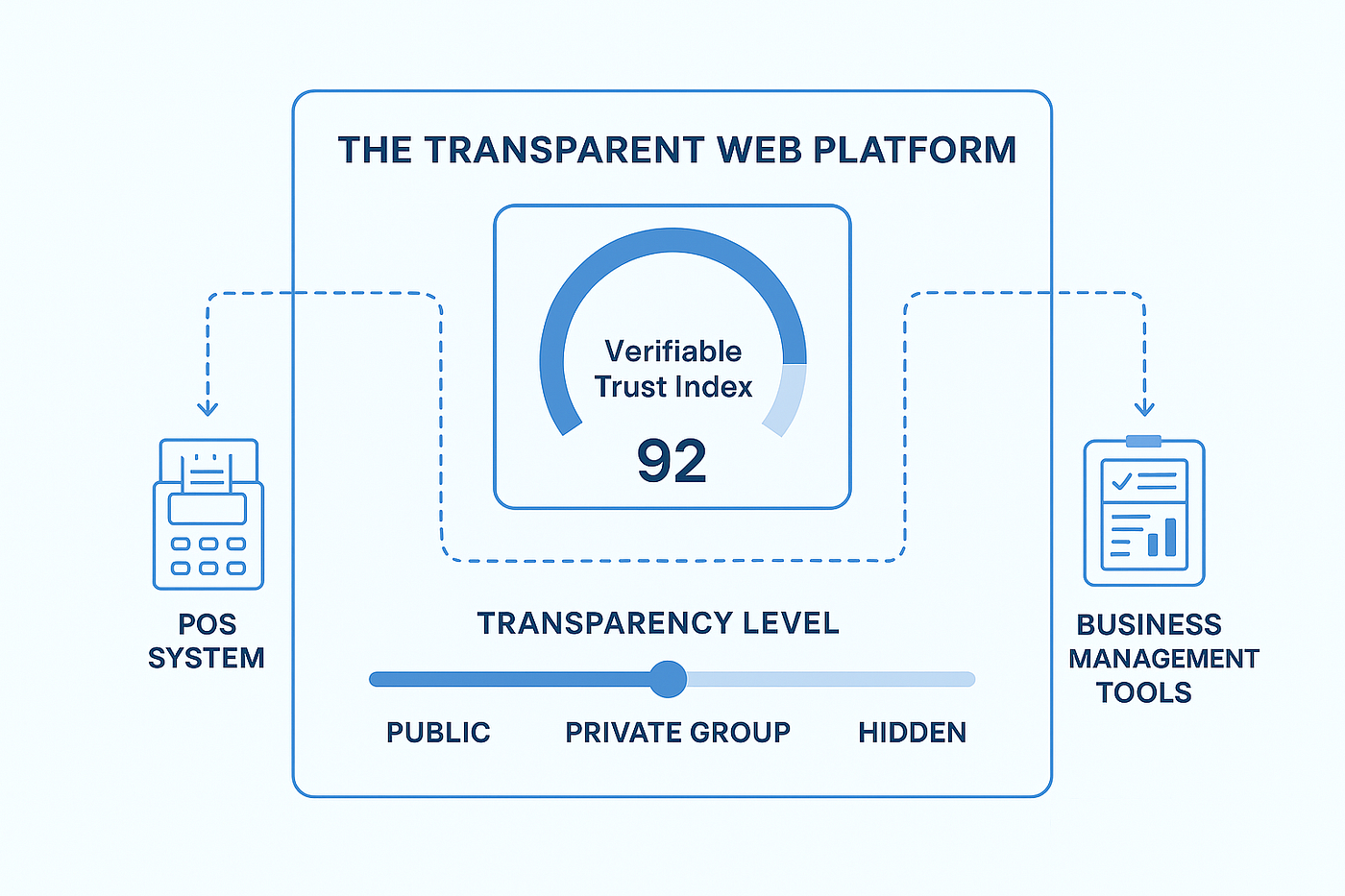
This dashboard allows them to link and manage their core business data. For each piece of data, they have three simple, powerful visibility toggles:
- Public: This data (like their “Sourcing” or “Transparency Statement”) is visible to everyone on their public website.
- Private Group: This data is hidden from the public but is shared with a specific, verified group. Think of this as the foundation for the Open Investment Protocol (OIP). The owner can share detailed “Monthly Costs” or “Profit Margins” only with potential investors or lenders on the platform.
- Hidden: This data is private to the owner (e.g., “Employee Salaries,” “Internal Memos”) and is for their records only.
Step 3: The Trust Index — Making Opacity a Liability
Here is the core mechanism that makes the system self-pushing.
Every choice the owner makes in their Control Panel instantly updates their public website’s “Verifiable Trust Index” — a simple score from 0 to 100.
- Making their “Sourcing” data public? +20 points.
- Making “Revenue” public? +30 points.
- Sharing “Costs” with a Private Group? +10 points.
- Hiding “Profit Margin”? 0 points.
Now, the social-forcing function kicks in.
The new, honest bakery has a Trust Index of 95%. Their website proudly displays it. Customers love it.
What about the “shady” competitor down the street? Their website doesn’t have a score. Or, if they join the platform and hide everything, their score is 10%. Suddenly, their lack of transparency is not an invisible secret; it’s a visible, public liability.
Trust becomes a measurable, competitive advantage. Shady businesses are forced to follow the open-source Web 5.0 standard, or they will be left behind.
Step 4: The Immutable Audit Log — The “Receipt” for Every Decision
This is what makes the Trust Index verifiable.
How do we know the baker didn’t just hide all their bad data right before an audit?
Because every single change is recorded in a public-facing, Immutable Audit Log backed by Firestore.
Nov 16, 2:30 PM: 'Revenue' visibility changed from 'Public' to 'Hidden' by Owner_ID: 8a...b7Nov 17, 9:05 AM: 'Sourcing' data updated by Owner_ID: 8a...b7
This logis the ultimate source of truth. It’s the “receipt” for every decision the business makes. This permanent, historical log is what allows for the future of Web 5.0.
A business can choose to share this log directly with the government (for the Autonomous Taxation System) or with verified investors (for the OIP), proving their trustworthiness over time.
This is how the system works. It’s not a fantasy. It’s a practical, tool-based platform that uses AI as an on-ramp to build a verifiable, self-regulating ecosystem of trust.
메타데이터
- post_id
- 9680dc51ea44
- slug
- the-engine-of-trust-how-the-transparent-web-web-5-0-actually-works-9680dc51ea44
- url
- https://medium.com/@orkunalabaz/the-engine-of-trust-how-the-transparent-web-web-5-0-actually-works-9680dc51ea44
- canonical_url
- https://medium.com/@orkunalabaz/the-engine-of-trust-how-the-transparent-web-web-5-0-actually-works-9680dc51ea44
- author_url
- https://medium.com/@orkunalabaz
- status
- ok
- fetched_at
- 2026-07-17 22:50:57
