Whispers of Cosmos
_________________________________________________________________
Whispers of Cosmos
Decoding the Deep Space Clouds
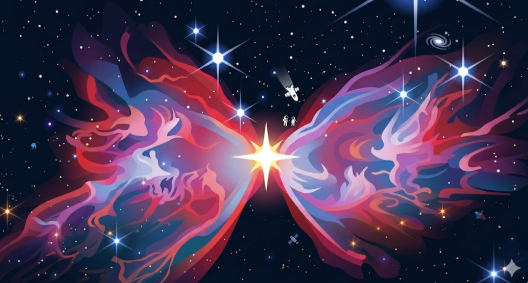
When we look at the night sky through the lens of modern space telescopes, we are met with breathtaking, vibrant structures stretching across light-years of void. These are nebulae — vast clouds of dust, hydrogen, helium, and other ionized gases. Far from being static cosmic decorations, these clouds are the dynamic stages where stars are born and where they meet their spectacular ends. Nebula comes from the Latin word which means ‘cloud’.
Understanding these celestial formations requires looking at how they interact with light and the unique stellar events that create them. Because nebulae emit and reflect light across the entire spectrum, astronomers need a variety of telescopes to uncover their secrets.
Optical Telescopes
Traditional visible-light telescopes are essential for capturing the striking colors of emission and reflection nebulae, revealing the glowing gases and dark dust lanes as they would appear to the human eye.
Infrared Telescopes
Space-based infrared observatories are crucial for peering directly through the dense, obscuring cocoons of cosmic dust. They allow astronomers to witness the hidden thermal glow of newborn stars forming deep inside stellar nurseries.
X-ray and Ultraviolet Telescopes
To observe the violent aftermath of a star’s death, or a supernova remnant, telescopes tuned to ultraviolet and X-ray wavelengths are required. These instruments detect the superheated, highly ionized gas blasting outward into space at millions of miles per hour.
Let’s dive in to learn more about these astonishing objects.
The Stellar Nurseries: Emission and Reflection Nebulae
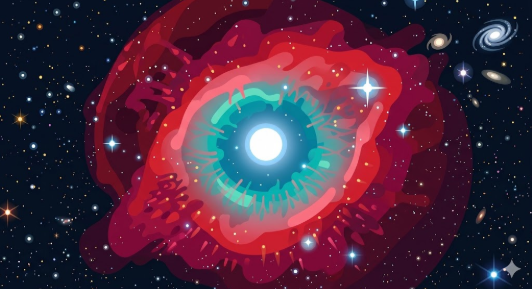
Most of the vibrant colors we associate with deep space come from Emission Nebulae. These are glowing clouds of ionized gas that emit their own light. Typically energized by hot, young stars embedded deep within them, the intense ultraviolet radiation from these newborn stars strips electrons from the surrounding hydrogen atoms. When those electrons recombine with the hydrogen ions, they emit a characteristic red glow.
In contrast, Reflection Nebulae do not emit their own visible light. Instead, they act as cosmic mirrors. These clouds consist of dense dust that scatters and reflects the light of nearby stars. Because interstellar dust scatters blue light more efficiently than red light (the same phenomenon that makes Earth’s sky blue), reflection nebulae frequently appear with a distinct, cool blue hue. Often, emission and reflection nebulae exist side-by-side in the same stellar complex, creating a brilliant contrast of cosmic red and blue.
The End of a Star: Supernova Remnants
Not all nebulae are places of birth; some are monuments to a star’s destruction. One of the most famous examples of this is the Crab Nebula, a spectacular Supernova Remnant.
When a massive star reaches the end of its life, it runs out of fuel and collapses under its own gravity, triggering a colossal explosion called a supernova. The violent blast ejects the star’s outer layers into space at thousands of kilometers per second.
The Crab Nebula is the remaining expanding cloud of that specific explosion, which was so bright it was actually observed and documented by astronomers on Earth in the year 1054 AD. Today, looking at the intricate, web-like filaments of the Crab Nebula reveals the raw power of stellar death, dispersing heavy elements back into the universe — elements that will eventually seed the next generation of planets and stars.
메타데이터
- post_id
- 96974db3bdac
- slug
- whispers-of-cosmos-96974db3bdac
- url
- https://medium.com/@koli.shital09/whispers-of-cosmos-96974db3bdac
- canonical_url
- https://medium.com/@koli.shital09/whispers-of-cosmos-96974db3bdac
- author_url
- https://medium.com/@koli.shital09
- status
- ok
- fetched_at
- 2026-07-13 06:23:13