The Boob Tube: “Being There” as Nescient Noetics
Do You Understand?
The Boob Tube: “Being There” as Nescient Noetics
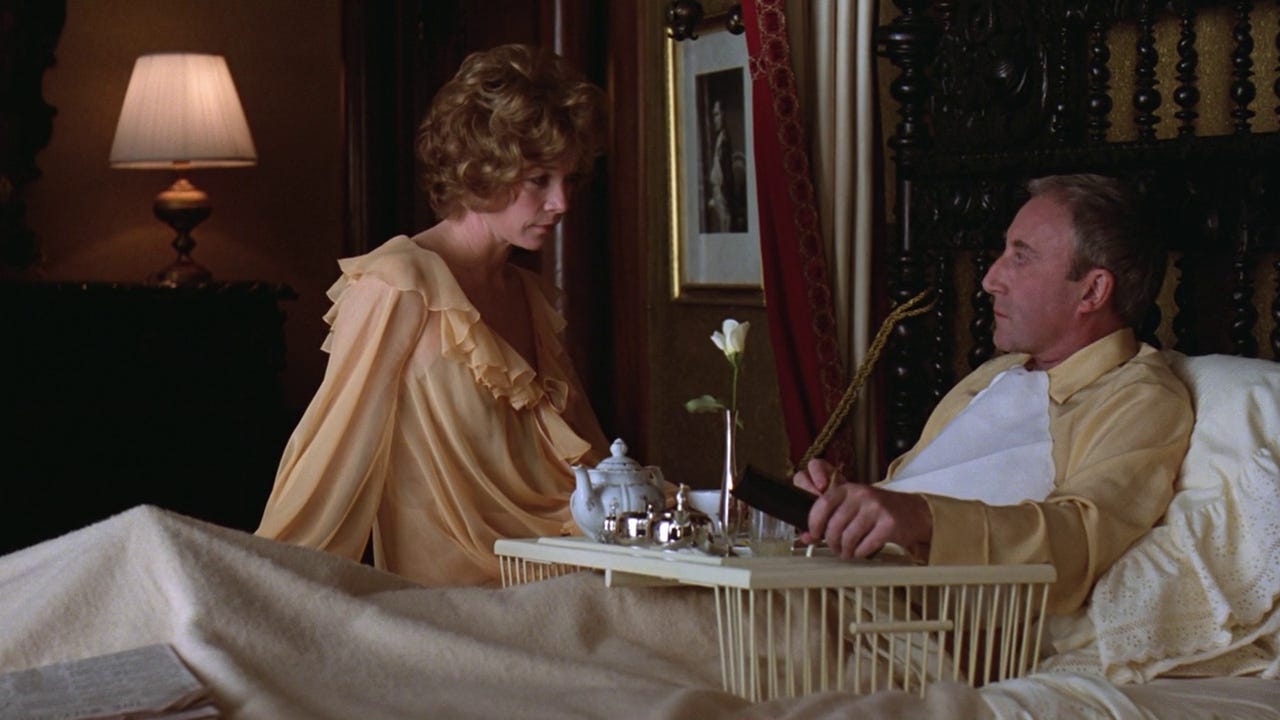
Shirley MacLaine and Peter Sellers in “Being There” (1979)
Hal Ashby’s Being There takes an interest in reality. A concern that can either be understood as formal, or recognized as fundamental. At the center, there lies a dedicated game of trickery, one entirely predicated on an almost divine goodness. Peter Sellers plays Chance. He’s a gardener. He has no history, no tangible connections to the real world, and in fact, no interaction with anything beyond his home. He was born and raised within the confines of a townhouse, sustained by the wealthy owner’s hospitality. Every day, he tends to the man’s garden. An almost Biblical contract of elementary silence. Take care of the garden, and you can eat, drink, and sleep in secluded paradise. A paradise that, luckily, introduced Chance to his love of television. Everything he knows is spoon-fed by his countless boob tubes. He’s so connected to them, there are moments where the programs seem to speak for him. Acting as a guide through all sorts of situations, dictating actions and influencing behavior. As a viewer, we’re supposed to perceive Chance as simple. But the world of Being There is a sociological farce. One big satirical strategy, woven into a mess of assumptive fabrications. A textured web held together only by the stitches of purer intentions. What is, after all, simplicity? Sartre and Occam’s Razor both had a similar idea of it. One that our protagonist seems to have an unintentional familiarity with. When Chance is evicted from his lifelong estate, he must finally enter the world. A middle aged man, taking the biggest leap of his life. Coming into contact with an outside reality he has no sound grasp on. A fact that doesn’t matter much to him, all things considered. He packs up his things and makes his way. Off goes a man who would hold no discernable regard between the shadows in Plato’s cave and the fire that made them. What would worry us is an adventure to him. What would frighten us is an amusing surprise. This strange man makes a fool of the entire stratum of civilized society, without ever having the intention to do so. Chance survives on being misunderstood. Through no fault of his own, he’s thrust into circumstances that elevate his existence. He gains a new name, a new home, new credentials, new friends, and a new wife. He’s a consultant to The President, a storied financial advisor, and proficient in eight languages. His faults are virtues. His mistakes are blueprints. His words are instantaneously poetic. All because he speaks politely, thinks slowly, and has no reservations about being himself. It’s that perfunctory sincerity, that cordial puerility, which gives Chance the edge. In a world so fixated on esoteric comprehension, a lowly gardener is able to transform the external into an internal canvas. Why can he do what he does? Is he brilliant? Is he slow? Is he a little bit of both? He’s the messiah for the secular age. The Biblical child-like mind taken to the extreme. A sort of oblivious omnipotence, content with living off fortunate transactions. To tend every garden he can, for food, drink, and TV. Too limited to know his own limits, but wholly confident nonetheless. A state of being that reality also finds itself in. One that is easily distorted, if we care at all about distortion. If we give more credence to our ‘being’ than it deserves. Or, in turn, give more credence to our credences than they deserve. Being There asks us to examine, in an ontological sense, what being somewhere means. Is there a right way to exist, per social standards? All the symbols and structures society has devised are almost imperceptible without delicate training, yet even the most basic understanding can, perceivably, give you an enormous advantage. So much of our traditions and customs are formed by rationalism. Our construction of the world, and shared perception, is built on a system of rules. But Chance is tabula rasa. He’s the ultimate empiricist. Almost a god-like figure. His immense power comes not from experience, but from the lack thereof. Ignorance is the final step of intellectualism. True epistemology ends with humility. To Chance, ‘being’ is a state of mind. He’s just as there as everyone else is, yet the audience is made to see a disconnect. Not one we can inherently demonize or condemn as innately incorrect, but one purposefully underscored. And it’s through that disconnect we’re able to observe what it truly means to watch. The world we inhabit is performative. Little scenes unfolding on our television. A television that Chance has the remote control for. He can’t change the world, but he can disrupt it. And the ultimate disruption comes from nescient noetics. A near blank slate is the most powerful thing in the world. You can be everything, be nothing, and then be both. Whatever you are, you don’t change a bit. Everyone else does the heavy lifting, trying to spin things their way. It’s no skin off your back. If you don’t like the show, you can always change the channel.
메타데이터
- post_id
- 969e603187f5
- slug
- the-boob-tube-being-there-as-nescient-noetics-969e603187f5
- url
- https://medium.com/@matthewsteinkefilm/the-boob-tube-being-there-as-nescient-noetics-969e603187f5
- canonical_url
- https://medium.com/@matthewsteinkefilm/the-boob-tube-being-there-as-nescient-noetics-969e603187f5
- author_url
- https://medium.com/@matthewsteinkefilm
- status
- ok
- fetched_at
- 2026-08-05 13:08:32