Java Series #2: The Chef’s Workspace — Deep Dive into Stack and Heap Memory
In Part 1, we took a grand tour of the Java Restaurant. We saw how the JDK Building houses the kitchen and how the Master Chef (JVM)…
Java Series #2: The Chef’s Workspace — Deep Dive into Stack and Heap Memory
In Part 1, we took a grand tour of the Java Restaurant. We saw how the JDK Building houses the kitchen and how the Master Chef (JVM) translates your universal recipe (Bytecode) into a five-star meal.
But even the world’s greatest chef can’t cook in a vacuum. To produce a meal, the chef needs a workspace. He needs a place for quick chopping, a place for long-term storage, and a system to clear out the trash so the kitchen doesn’t become a mess.
Today, we’re going behind the scenes of the JVM to look at the two most important zones in the kitchen: The Stack and The Heap.
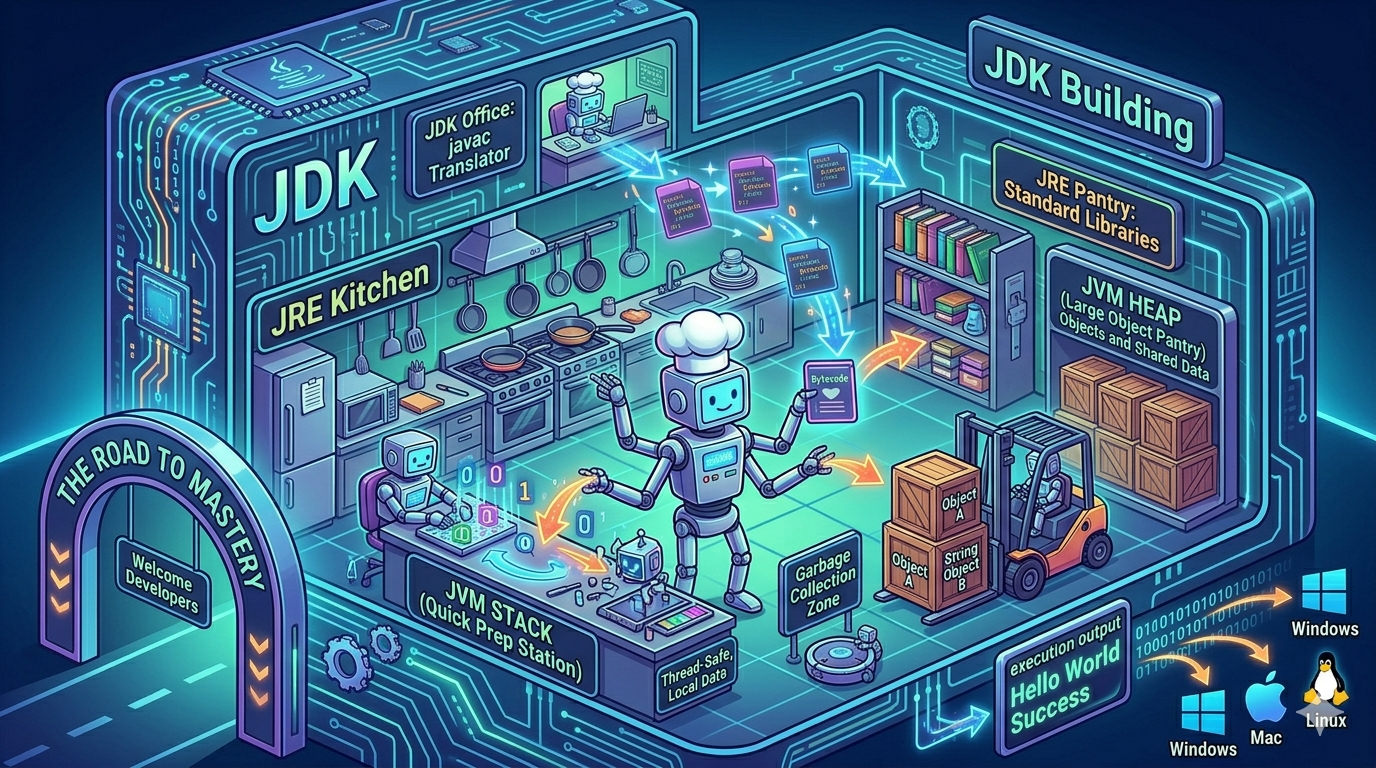
The JVM Master Chef actively managing data flow between the lightning-fast, ordered JVM Stack and the massive, long-term JVM Heap storage .
1. The Stack: The Chef’s Prep Counter 🔪
Imagine the Chef’s immediate workspace — the small, lightning-fast cutting board right in front of him. This is the Stack.
In Java, the Stack is where the “immediate” action happens. Every time a method is called, the Chef creates a small “block” on this counter to hold exactly what he needs for that specific task.
- What lives here? Primitive variables (like
int,double,boolean) and the "references" (the address tags) to larger objects. - The Rule: LIFO (Last-In, First-Out). Just like a stack of plates, the Chef only works with the plate on top. When a method finishes, that “plate” is instantly cleared off the counter.
- The Speed: It is incredibly fast. There’s no searching; the Chef knows exactly where the data is.
Behind the Scenes: If you call too many methods (like an infinite loop), you run out of space on the counter. This is the famous
**StackOverflowError**.
2. The Heap: The Massive Pantry 📦
Now, imagine a giant walk-in pantry at the back of the restaurant. This is the Heap.
The Heap is where the Chef stores the “big stuff” — the massive crates of ingredients that don’t fit on the cutting board. In Java, whenever you use the new keyword, you are placing something in the Heap.
- What lives here? All Objects. Whether it’s a
String, aList, or a customUserobject, it lives in the Heap. - The Rule: Items stay here as long as the Chef still has a “Label” (Reference) for them on his Stack counter.
- The Speed: Slower than the Stack. The Chef has to go into the pantry, find the right crate, and bring it back.
3. The Garbage Collector: The Cleaning Crew 🧹
In a busy restaurant, scraps of food and empty boxes pile up. If the Chef had to stop and clean every five minutes, the food would never get served.
In the JVM, we have a Cleaning Crew called the Garbage Collector (GC).
- The GC looks at the Heap (The Pantry).
- If it finds a crate that no longer has a “Label” on the Chef’s counter (no active reference), it throws it away to make room for new ingredients.
Expert Insight: Unlike the Stack, which cleans itself instantly, the Heap depends on the GC. If your Heap fills up faster than the crew can clean it, you get the dreaded
**OutOfMemoryError**.

A comparative diagram illustrating the ordered, fast, LIFO mechanics of the JVM Stack VS the unstructured, massive storage, and object focus of the JVM Heap, with the critical ‘Reference’ link bridging the two
4. A Real-World Example: “Ordering a Pizza”
Let’s see how this looks in code: int slices = 8;
Pizza myOrder = new Pizza();
- The number
8is a primitive. It sits directly on the Stack (The Prep Counter). new Pizza()creates a large object. This goes into the Heap (The Pantry).- The variable
myOrderis just a "label" sitting on the Stack that points to the actual pizza in the Heap.
Summary: Knowing Your Workspace 📋

Coming Up Next in Part 3 🚀
The kitchen is set up, the memory is managed, but how does the Chef handle multiple orders at once without burning the food?
In Part 3, we are diving into the world of Concurrency and Threads: The Multi-Chef Kitchen — How Java Handles Thousands of Tasks Simultaneously.
The Road to Mastery 🎓
This series is taking you from a Java beginner to a Java expert. Understanding memory isn’t just theory — it’s the secret to writing high-performance, professional-grade code.
- Follow me on Medium to ensure you don’t miss the Concurrency deep-dive.
- Clap if you now know the difference between your Stack and your Heap!
- Comment below: Have you ever crashed your system with a
StackOverflowError? Tell me your story!
메타데이터
- post_id
- 96b8aafe4ca9
- slug
- java-series-2-the-chefs-workspace-deep-dive-into-stack-and-heap-memory-96b8aafe4ca9
- url
- https://medium.com/@r-ragul/java-series-2-the-chefs-workspace-deep-dive-into-stack-and-heap-memory-96b8aafe4ca9
- canonical_url
- https://medium.com/@r-ragul/java-series-2-the-chefs-workspace-deep-dive-into-stack-and-heap-memory-96b8aafe4ca9
- author_url
- https://medium.com/@r-ragul
- status
- ok
- fetched_at
- 2026-06-15 20:49:13