High‑Frequency Data in Modern Data Warehouses
High-frequency data has quietly become one of the most valuable and challenging data assets in modern analytics. Whether it’s financial…
High‑Frequency Data in Modern Data Warehouses
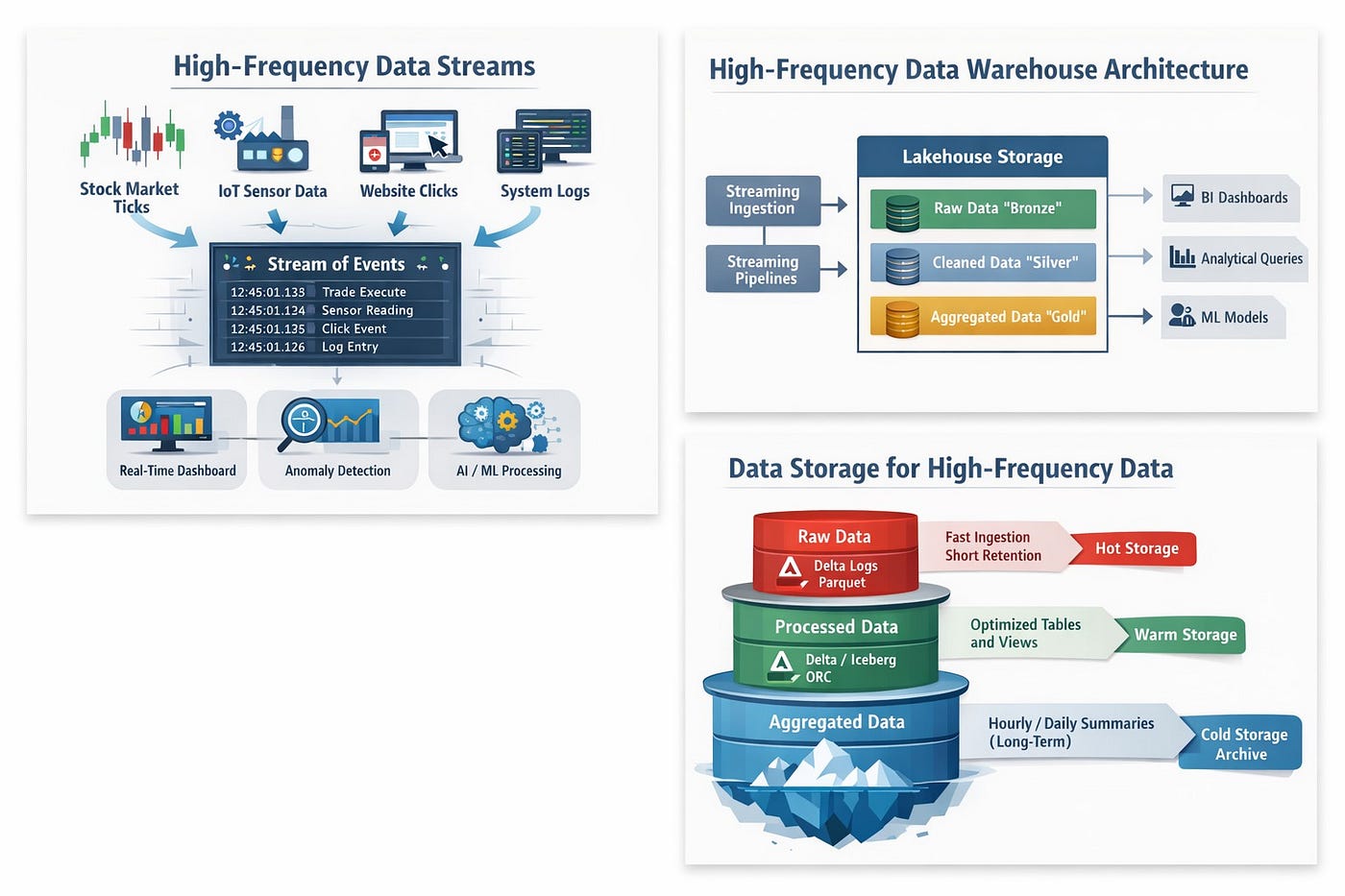
High-frequency data has quietly become one of the most valuable and challenging data assets in modern analytics. Whether it’s financial tick data, IoT sensor streams, click‑level behavioral logs, or telemetry from distributed systems, organizations are generating more granular data than ever before.
But here’s the twist: traditional data warehouses were never designed for this kind of firehose. And yet, today’s businesses expect real-time dashboards, instant anomaly detection, and machine-learning pipelines that thrive on dense time-series data.
So what exactly is high‑frequency data, and how do you store, model, and optimize it in a warehouse without drowning in volume, cost, or latency?
Let’s break it down.
What Is High‑Frequency Data?
"High‑frequency data" refers to data generated at extremely short intervals—often in milliseconds or microseconds. Each event is recorded as a separate observation, creating a huge, rapidly growing time‑series dataset.
Common examples include:
Financial markets: Trades, quotes, order book updates
IoT devices: Temperature, vibration, and pressure readings.
Web analytics: Clickstream events, scroll depth, interactions
System telemetry: CPU metrics, RAM, logs, traces
Manufacturing: Cycles in machines, sensor readings, PLC outputs
If you’re generating data every 5 milliseconds, that’s 200 events per second per device. Multiply that by thousands of devices or users, and it shows that you’re in a high-frequency data environment.
Why High‑Frequency Data Breaks Traditional Warehouses
Classic data warehouses were built for:
1️⃣ Batch ingestion
2️⃣ Daily or hourly updates
3️⃣ Aggregated data
4️⃣ Star schemas
5️⃣ High‑frequency data flips all of that on its head.
The challenges:
Challenge: Why It Matters
Due to high ingestion rates, millions of events per minute may overwhelm batch pipelines.
Storage explosion due to raw granular data growing exponentially.
Query performance from billions of rows that are scanned and could affect latency.
Real‑time expectations, from dashboards and ML models, that are dependent on fresh data.
This is why modern architectures preach streaming ingestion, columnar storage, and lakehouse patterns.
How to Store High‑Frequency Data in a Warehouse
There’s no one-size-fits-all approach, but the following patterns consistently work across platforms like Snowflake, BigQuery, Databricks, and Microsoft Fabric.
1️⃣ Use a Lakehouse or Hybrid Architecture
High‑frequency data is best handled in a lakehouse, where:
✔ Raw data lands in cheap object storage (low-cost storage)
✔ Incremental processing creates optimized tables (high-performance analytics)
✔ Warehouses query curated layers (evolution of schema, ACID transactions (Delta, Iceberg, Hudi))
2️⃣ Partitioning Strategies That Actually Work
Partitioning is recommended as it allows several groupings, such as
Date (e.g., event_date)
Hour for extremely high‑frequency streams
Device ID / Symbol / Region for distributed workloads
For example, /year=2026/month=03/day=10/hour=22/. This keeps partitions manageable and queries fast.
3️⃣ Use Micro‑Batch or Ingestion of data via streaming
Depending on your platform, it allows automatic handling of schema, low latency, and exactly‑once or at‑least‑once guarantees.
✔ Fabric → Eventstream + Data Warehouse
✔ Databricks → Auto Loader + Delta Live Tables
✔ Snowflake → Snowpipe Streaming
✔ BigQuery → Streaming inserts or Pub/Sub → Dataflow
4️⃣ Model Data Using a Time‑Series‑Optimized Schema

There are two common modelling patterns for tables.
Wide table
One row per timestamp, many columns
✔ Fast reads
✘ Hard to evolve schema
Narrow table
One row per metric
✔ Flexible
✔ Works well with streaming
✘ More rows
Most high‑frequency systems choose narrow tables
5️⃣ Optimize Query Performance

To keep queries fast:
✔ Use clustering deployed with Snowflake or Z‑ordering with Databricks
✔ Implement materialized views for aggregates
✔ Precompute hourly/daily rollups
✔ Use column pruning and predicate pushdown
✔ Avoid SELECT * on raw tables
A common pattern is:
Raw → Bronze
Cleaned → Silver
Aggregated → Gold
Dashboards should never hit raw, high‑frequency tables directly.
6️⃣ Control Storage Costs
High‑frequency data grows fast. The recommended approaches are as follows:
✔ Compression (Parquet, Delta, ORC)
✔ Retention policies (e.g., keep raw for 7 days)
✔ Downsampling (e.g., 1‑second or 1‑minute aggregates)
✔ Tiered storage (hot → warm → cold)
Real‑World Example: IoT Sensor Data
Imagine a factory with 2,000 machines, each sending data every 10 ms.
✔ 100 events per second per machine
✔ 200,000 events per second total
✔ 17.2 billion events per day
A modern warehouse can handle this, but only with:
Streaming ingestion, partitioned storage, lakehouse architecture and aggregated gold tables
This is the kind of workload that platforms like Fabric, Databricks, Snowflake, and BigQuery are optimized for!
메타데이터
- post_id
- 96d170de8cd1
- slug
- high-frequency-data-in-modern-data-warehouses-96d170de8cd1
- url
- https://medium.com/@jaycees10000/high-frequency-data-in-modern-data-warehouses-96d170de8cd1
- canonical_url
- https://medium.com/@jaycees10000/high-frequency-data-in-modern-data-warehouses-96d170de8cd1
- author_url
- https://medium.com/@jaycees10000
- status
- ok
- fetched_at
- 2026-08-09 04:21:30



