It’s not about creating a idealistic utopia.
Sanitized world is impossible, vitality is possible regardless.
It’s not about creating a idealistic utopia. It’s about answering actual needs. It’s about doing what humanity does since our beginning — evolving.

Sanitized world is impossible, vitality is possible regardless.
There are things which never change — hunger, pain, the need for survival.
But the old as time urge to thrive in vitality beyond surviving, is what shaped civilizations.
What made their imprints timeless? Sustainable value.
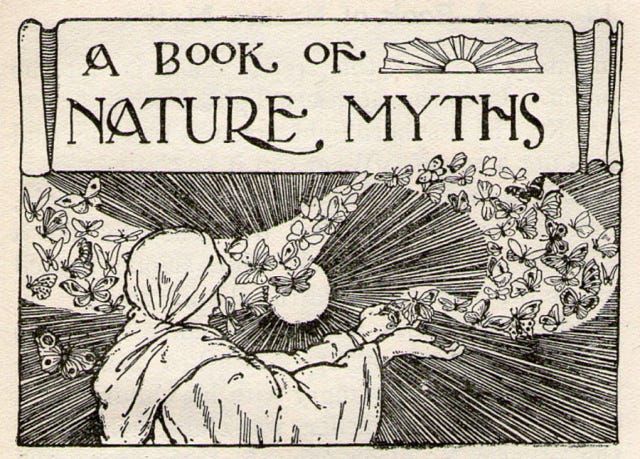
A book of Nature Myths by Florence Holbrook 1909
Naïveté: institutions mean what their slogans say; prestigious people are necessarily competent or honorable; markets are fair; humanitarian language means humanitarian motives; democracy eliminates manipulation; wealth proves merit; philanthropy proves benevolence; respectable branding proves respectable conduct.
Look at incentives.
And then — crucially — don’t become cynical simply because you’ve learned to see structure.
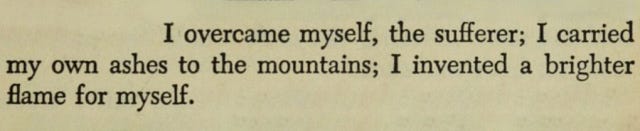
𝙵𝚛𝚒𝚎𝚍𝚛𝚒𝚌𝚑 𝙽𝚒𝚎𝚝𝚣𝚜𝚌𝚑𝚎, 𝚃𝚑𝚞𝚜 𝚂𝚙𝚘𝚔𝚎 𝚉𝚊𝚛𝚊𝚝𝚑𝚞𝚜𝚝𝚛𝚊

“The inner beauty of shells.” National Geographic. March 1955.
Humans inhabit worlds of constructed meaning.
Sometimes meaning is preserving heritage, building, embracing power and creating beauty.
Sometimes “meaning” looks like sitting in the sun and remembering that your life is also meant to be lived, not just optimized, monetized, and turned into proof that you’re worthy.
Sometimes it’s leaving what brutalizes you, and seeking people, environments and things, which answer the deeply-human need for vitality.

August 12, 1928
Virginia Woolf, “A Writer’s Diary” (1918 — 1941)
originally published: 1933
I’ll introduce my general approach in the second part of this article.
About my projects helping young people thrive in this and the future world.
Healthy criticism on many current educational systems is me pointing out their naivety. Grooming future young adults to be targets for exploitation.
Naivety: “Adults are sensible. Authorities protect you. People generally mean what they say. Be nice, work hard and everything will work out.”
versus
Paranoia: “Everyone wants something from you. Trust nobody. The world is dangerous.”
Neither prepares a child accurately.
The alternative is discernment.
Age does not confer moral authority. A title does not prove competence. Confidence does not prove knowledge. Niceness does not prove safety.
I think the most damaging thing a child or young person can be taught, is lack of critical thinking skills combined with low self esteem and no awareness of their individual value.
Anthropologist Jean Briggs documented Inuit communities where children were purposefully presented with emotionally complicated hypothetical situations and questions. Children weren’t simply taught rules like be cooperative. They were made to think through interpersonal situations involving anger, aggression, jealousy, possession, rejection and conflicting desires.
exploitation often works through outsourcing judgment:
“He knows better.”
“She’s the professional.”
“They’re older.”
“It’s a prestigious organization.”
“Everybody says this is normal.”
Someone who has spent childhood actually exercising judgment has a different psychological starting point.
A meta-ethnographic review found striking emphasis on children’s autonomy across San, Nayaka, Batek, Matsigenka, Yukaghir and other communities.
Adults frequently allowed children to observe, experiment and learn through firsthand experience with relatively little interference, rather than constantly explaining, directing and correcting.
This and powerful autonomy…
Research describes Hadza culture children as active foragers who acquire meaningful quantities of food themselves. One later study reports children regularly producing roughly 25 – 50% of their daily caloric requirements. Adults facilitate this by making appropriately sized functional bows and digging sticks and giving children opportunities to forage.
Today’s equivalent would be
creating something valuable → exchanging it → pricing it → keeping money → saving → purchasing → negotiating → making a bad deal → recognizing it → trying again.
A 15-year-old who has already sold something for €20, discovered it cost €12 to produce, dealt with an unreliable customer and negotiated €30 next time has acquired knowledge no motivational speech can reproduce.
I could go on and on about helping young people thrive in this world, and I do, in my projects through my NGO and other ventures.
In the eyes of children we see the future reflecting, and I am not a selfish loser thinking my future depends on exploiting younger oppressed people.
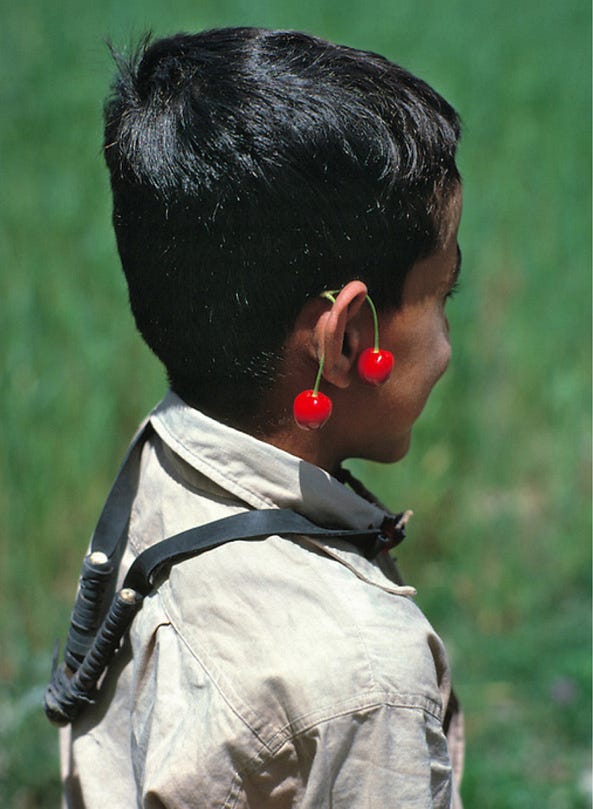
A young boy carries his slingshot around his neck and wears cherries like earrings in Gilgit, Khyber Pakhtunkhwa, Pakistan.
Mhm.. and now my unconventional entrepreneurship, social-impact business and the intersection between art and enterprise.
It’s impossible to give a finished article on these subjects, because they are ever evolving themselves.
I had to come to terms with the fact that working with these subjects is touching the infinite stream of humanity. Embracing it is the key.
If course effects are brought by very tangible actions, operations etc. But keeping the big picture in mind while focusing on the „here and now” is my nature, that’s what made me do this work.
I was always enthusiastic book reader and very early on I started to use this question as my perception lense:
Across human cultures, how have people combined power structures, commerce, beauty, social obligation, identity, ecological stewardship, status, craftsmanship and collective prosperity – and what did modern business separate that might be worth recombining?
I am fully aware this world will never become perfect. What even is perfection? Through time different people, rulers, creators, caregivers etc have had their visions of perfect world. Endless philosophies, religions, hierarchies… Imperfect, always imperfect. What is the need then to strive for excellence, for more?
Māori enterprise: business embedded in intergenerational responsibility
Contemporary Māori enterprise in Aotearoa/New Zealand is fascinating because many Māori organizations explicitly operate with objectives extending beyond maximizing distributions to today’s owners. Research and government work on the Māori economy discusses concepts including whanaungatanga (relationships), kaitiakitanga (guardianship/stewardship), collective benefit and long-term/intergenerational thinking.
That creates a different question from conventional shareholder capitalism:
What if the people to whom the enterprise is accountable include people who haven’t been born yet?
The big picture thinking again…
Or
Apprenticeship made businesses into knowledge-preservation machines
This appears across enormous numbers of cultures.
A master craftsperson wasn’t simply manufacturing an object.
They were simultaneously reproducing the capacity to manufacture that object in the next generation.
That’s an extraordinary business concept.
Production creates product.
Teaching creates future productive capacity.
So imagine measuring an enterprise not merely by:
What did we sell this year?
but:
What human capability exists now that didn’t exist because of us last year?
But it requires capacity to pass quality forward to younger generations, and it’s a fact, that today it’s not a common practice. I always have to remind myself of what is in my control and what is outside of it…
This article can be long for miles. And it can’t simultaneously.
We all have things to do.
Till next time, one way or another…!
메타데이터
- post_id
- 96e0fb2c84c2
- slug
- its-not-about-creating-an-idealistic-utopia-96e0fb2c84c2
- url
- https://medium.com/@missinfinity/its-not-about-creating-an-idealistic-utopia-96e0fb2c84c2
- canonical_url
- https://medium.com/@missinfinity/its-not-about-creating-an-idealistic-utopia-96e0fb2c84c2
- author_url
- https://medium.com/@missinfinity
- status
- ok
- fetched_at
- 2026-08-24 13:17:33